
Transcriptions from the Nova Organi Harmonia
-
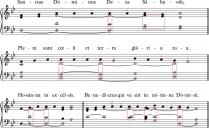
I've been transcribing some accompaniments from the NOH and adding rhythmic interpretation to the scores, since the original book didn't follow the common Solesmes interpretation of the time. As a sample, here are the Asperges me and Vidi aquam. I've been working on similar scores for some of the Mass ordinaries, and hope to do the same for all the ones we use. The scores are produced using Lilypond and LaTeX software.
(An improved version is below.) -
Is there anything you can do about these clashes?
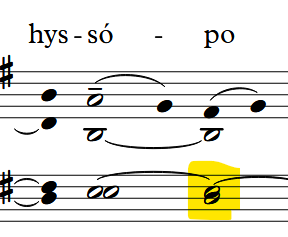
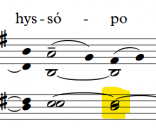 288 x 237 - 13K
 -
An excellent and worthy project on so many fronts, chonak - the addition of Solesmes rhythm is very useful, as is the fresh and clear typesetting.
Will the coding also allow for easy transposition? -
Yes, thanks for spotting that, GerardH. A corrected copy is here, and if you notice any more details to fix, please let me know.
And yes, Palestrina, I've been transposing some to keep the ranges manageable for our schola of men.
 367K
367K -
I would be interested to see your lilypond file. I do a lot of lilypond engraving.
-
Many of us are grateful to you and others who re-engrave NOH accomps. Thank you.Thanked by 1davido
-
For what it's worth, here's an adaptation from the NOH to go with the usual Gloria in the vernacular.
60K -
These are useful, but they don't exactly reinforce the Solesmes rhythm. In the Asperges, the chord should change on the ictus at the last note of et instead of mun-, likewise at per ni-. Counting nivem as 1-23 is a more serious departure from the Solesmes rhythm because it violates the third rule for ictus placement, which requires an ictus on the first note of the pes at -vem, since there is no other known ictus taking precedence over that placement. As a singer, I would find it unsettling to be counting 123 and hear a chord change on 2 that also doesn't align with the chironomy. You've done good work here, but if your objective is to Solesmesnify it, why not go all the way instead of something that's neither fish nor fowl?
Although I recognize that long-short-short is what many actually do at da- and ba-, it would be better to use a tenuto mark, likewise at the final alleluia of the Vidi aquam. The ictus in the mode VII psalm verse is on the upper note; it would be helpful to have a rest notated before Miserere and Gloria. There's some flexibility in the guidelines for ictus placement, but choosing the word finals at secundum magnam would be more standard. Dextro and dicent are disaggregate neumes, so the ictus and chord should be on the first note. Same suggestion as above about a rest before Confitemini and Gloria. The chord changes at ejus and amen highlight another interpretive difference between NOH and the Solesmes method.
For reference, I'm attaching these chants from the modern notation edition of the Liber Usualis, edited by the same monks who edited in the Gregorian notation editions. Note that later presentations of the Solesmes method (certainly by the 50s) treated rests before bar lines as quarter instead of eighth. At the end of the second line, you have a quarter bar line in the melody and a half in the accompaniment.Thanked by 1CHGiffen -
I don’t have it at hand, but for tests: Carroll’s chironomy book summarizes the change to rests made by Dom Gajard and how they should be made in function of the following composite pulse and whether it is a full 1-2 or if the first note is silent.
-
I appreciate the thoughtful comments. It might be worthwhile to incorporate insights from other books at some point, in order to make these more sensitive adaptations.
-
Here are Masses XVII and XVIII for Lent.
(Note: this is a draft.)
https://forum.musicasacra.com/forum/uploads/FileUpload/5c/118c47e446256c2ac845d96478a0ee.pdf
773KThanked by 1CHGiffen -
Some of the NOH scores do seem to place chord changes at the ictus often, and if there are differences on this point, it may be due to choices made by the seven composers involved in this Kyriale volume.
I'm not sure that marking the ictus in such a way which would give it stress really fits with Solesmes' principles. Dom Gajard, in his lectures on The Rhythm of Plainsong,
https://shop.musicasacra.com/product/the-rhythm-of-plainsong-joseph-gajard/
is clear on the point that the ictus is not generally coincident with stress. Rather, it's the beginning of a gesture, or perhaps the hinge that connects two gestures. The image he offers most often is that of a footfall that ends one step and leads to the next.
While we English speakers are used to hearing chord changes at the start of rhythmic groupings in metrical music, maybe that isn't something we ought to expect in accompanied plainchant. -
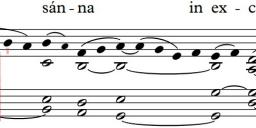
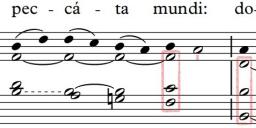
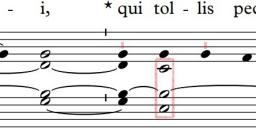
As you said, the original NOH didn't follow the common Solesmes interpretation of the time. There are differences between the Belgian, French, and German styles of interpretation and accompaniment, which Ostrowski has written about here, here, and here. I think a true Solesmes-style accompaniment, where the chord changes often don't coincide with word stress, is more jarring to English speakers than moving chords away from the ictus. It seems like some of these chord changes are trying to emphasize melodic peaks rather than text or Solesmes ictus placement. Would you say that's accurate?

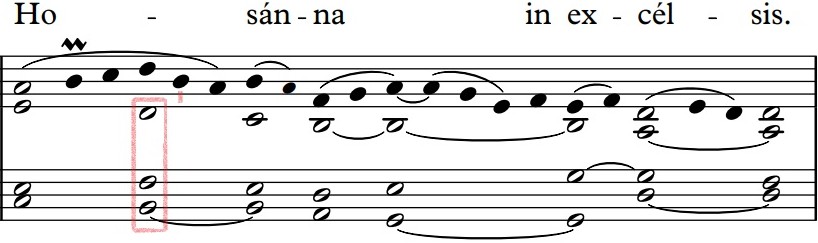

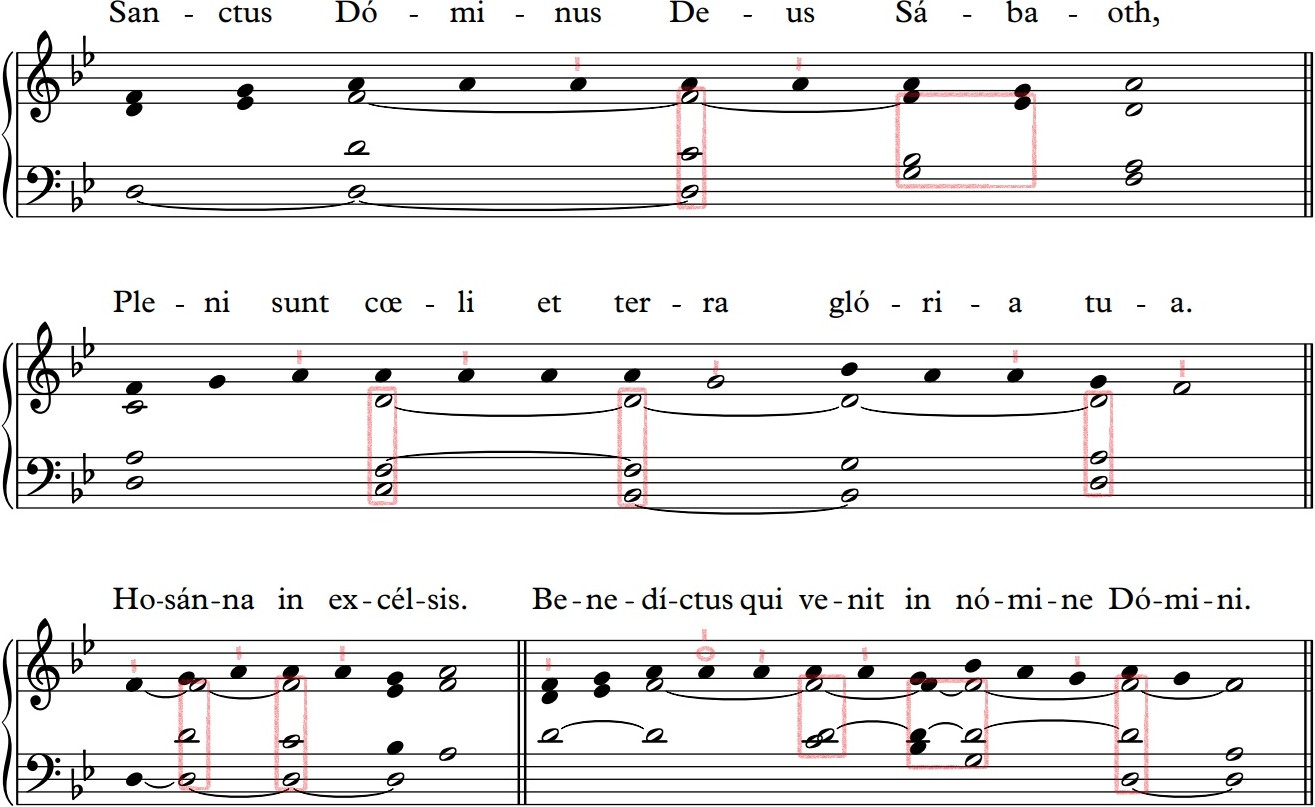

The chord change at the end of eleison is especially disconcerting. In the Sanctus, the box at in nomine should be only over the first note; but I can't easily correct the marking after the file has been saved and closed, sorry.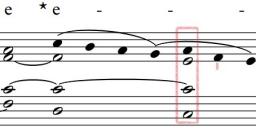 1200 x 227 - 62K
 818 x 243 - 49K
 1312 x 231 - 77K
 1201 x 222 - 65K
 1315 x 807 - 207K
 -
chonak,
Will there be more engravings forthcoming? Thank you for these!! -
Yes, it's very much a work-in-progress.
-
Here is a score for Mass I, for Paschaltide (transposed):
https://forum.musicasacra.com/forum/uploads/FileUpload/1f/13ceecd0b4c4dd363634e9d4f0c2e1.pdf
Also, here is an updated score for the Asperges and Vidi aquam:
https://forum.musicasacra.com/forum/uploads/FileUpload/00/c126c974cf73e45b57e2a085d13559.pdf 708K -
Credo III, "secundum" p. 12 first line - clashing noteheads in the bass clef.Thanked by 1chonak
-
Thanks for the comment about spacing, Francis.
I guess I understand the idea: if these pages are presented as loose sheets, you'd be able to set up three at once, so that number becomes a useful limit to work with. I've been thinking of this as a booklet, so that when a page turn is inevitable, there isn't much practical difference between three pages and four pages. I'll look for cases where the content can be kept to three pages.
And thanks for spotting the notehead clash, m_r_ taylor; I'll revise that and post it.
PS: Here's a revised version of the Credos:
https://forum.musicasacra.com/forum/uploads/FileUpload/7e/a10dd1194316cc295b3fad49e13cd2.pdf 667KThanked by 1CHGiffen -
Here it is:
https://forum.musicasacra.com/forum/uploads/FileUpload/67/96ad8a3201ed14c02a16595512b035.pdf 59KThanked by 1CHGiffen


Welcome to the MusicaSacra Forum!
To participate in the discussions on Catholic church music, sign in or register as a forum member, The forum is a project of the Church Music Association of America.
Categories
- All Discussions21,844
- General Music Discussion8,548
- Job Openings292
- Management of Music Programs862
- Choral Matters539
- Church Documents and Rubrics540
- CMAA Notes307
- Events760
- For Newcomers: Read First26
- Sacred Polyphony567
- Hymnody898
- Gregorian Chant: General2,749
- ↳ Graduale Romanum and Liber Usualis372
- ↳ Graduale Simplex61
- ↳ Semiology65
- Vernacular Plainsong704
- Anglican Use and Anglican Chant73
- Organ, Other Instruments and Repertoire452
- New Composition/Works in Progress1,342
- Recordings238
- Music for Hispanic Ministry163
- Music Education: Children217
- Music Education: General223
- News Items247
- Positions Wanted3
- General Discussion: Catholicism742
- Amusements185
- General Discussion1,048
- Opinions119