
Choir gallery
-
When I interviewed for my position, the Pastor took me up to an attic above the church nave and said that he wanted to make it a choir gallery. And also that we would put a pipe organ in place there as well. We have an organ builder but the architects are coming to think about the gallery itself.
So now the project is off and running. The question is: if you could put whatever you wanted in a choir gallery, what would it be? Terraced levels for the choir? Risers instead? Chairs?Floor surface? Your thoughts and/or experience.
Kevin
-
If I were to make one suggestion, it would be that the seating area/risers not be permanent. That's not to say you have to use a Wenger riser system or similar, but that maybe they be free-standing in a space that otherwise might be considered a blank slate. When we expanded the choir area seating in a past position, it was very difficult and complicated. I like modularity.
In my rehearsal room, I built 3'x8' riser segments in two heights so I had three levels of seating, and could move them around the room to accommodate any configuration need.
(Oh... and if they could squeeze in a small bathroom to the side—what a treat that would be.) -
If it were me I would seriously consider whether the organ console need be front and centre. This is conditioned by my personal experience (and its limitations) where the organist has never simultaneously been the director, always needs mirrors and screens to get a glimpse of the sanctuary, and has difficulty following the conductor's gestures due to the console positioning, which sometimes results in the organist deciding he or she is in charge of tempo and dynamics. Also, for instance if I want to wrap up a hymn on the 3rd of 5 verses, it would be nice not to have to turn away from the choir to signal to the organist. There are probably good counter-justifications though.
If space allows would have an open area apart from seats and kneelers where the singing actually takes place. It adds what I consider a touch of ceremony to gathering for music, and more importantly makes rearranging people according to the needs at hand much much easier. Edit: AND lets the schola easily form a nice semicircle or circle. Some downsides are more space needed, and more stomping sounds from certain people who never learned how to walk quietly.
I agree with modularity in the seating. In fact, if you could position the console in a place where it would work for both separate director and organist or organist-director, and combined that with moveable seating (allowing you to experiment), it could be very flexible.
Just a couple personal opinions, and I may add more later. -
Adjustable and relocatable choir desks such as Mark Edward Nelson makes. https://www.facebook.com/media/set/?vanity=markedwardnelson&set=a.1040693779637
It makes such a huge difference, particularly for children, to be able to set down their music at an appropriate height, and just focus their bodies on standing well and singing.
I agree with what others said about flexibility in the flooring. I’m attaching a picture of the choir seating by the nave altar in Ely Cathedral. They sing from movable and stackable wooden platforms which can be taken away for other events. Very flexible and better visually and acoustically than the Wenger platforms.
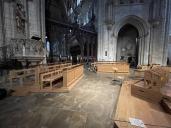 4032 x 3024 - 3M
 -
As an organist.... YES please put the console front and centre! I detest having to look in mirrors to see the director, the sanctuary, the world.... It makes me feel very isolate and cut off from the rest of the group, and makes playing for funerals etc solo extremely challenging.
And as someone who occasionally sings in a choir loft that has a mix of modular and permanent risers: permanent ones are more comfortable, but modular ones are eminently more flexible. If I were designing a loft from scratch, I agree with the others and would do 100% modular.(Oh... and if they could squeeze in a small bathroom to the side—what a treat that would be.)
I concur lol -
@Abbysmum To be clear I'm talking about when the organ console is both front and centre and the organist is facing away from the sanctuary and also lacks a good view of the directing, which seems to be a fairly common setup. I'm not sure what the upside of it except when you have an organist-director. Maybe there are some mechanical benefits to it for traditional organs, I don't know.
A "back and centre" setup where the organist is facing director and sanctuary would work, as would an "off to one side" setup where the organist is facing across the gallery at the choir and can check the sanctuary with a slight head turn. How exactly to make these work for an organist-director I'm not sure, but there's probably a way. -
How exactly to make these work for an organist-director I'm not sure, but there's probably a way.
Back and centre wouldn’t work (singers would have to turn around to see). Front and 90° to the sanctuary works. I think this arrangement is easier when the altar is on the organist’s left, and the choir on the right, so the RH can be clearly seen for cues.Thanked by 1Chant_Supremacist -
Moving up, down and across risers can be noisy and risers can be hostile to ppl who find navigating them challenging unless you wish to reduce your potential recruitment.Thanked by 1Chant_Supremacist
-
@Chant_Supremacist reminded me @kevinf that I forgot to mention on FB that our console can move basically anywhere and we can get more tubing to cover the electric stuff (cables?; it’s a giant hose basically) if it’s not long enough. In theory we can flip the console around so that it faces forward, but we have had it on the gospel side at an angle in cases where we don’t need mirrors When we first got in the loft it was facing the corner of the back and side wall to the gospel side, was a mistake; then it flipped to face the epistle side, its pre-storm configuration, and now it’s in the center facing backwards, but it would take the same amount of space as the platform is a rectangle, not a trapezoid (I could see someone cutting two corners off of the part under the console, not the part where the bench is).
Anyway I would prefer flipping it forward to avoid mirrors if possible but also because I like having the long side to put things on to set out for services and to rehearsals. (I don’t put so much that the organist would be annoyed).
At Saint Martin’s in Louisville, there were risers built in, and then chairs. The organist faced the back wall but had some space behind to move around and then up if conducting separately from the console (someone else played, it was a capella…).If space allows would have an open area apart from seats and kneelers where the singing actually takes place. It adds what I consider a touch of ceremony to gathering for music, and more importantly makes rearranging people according to the needs at hand much much easier. Edit: AND lets the schola easily form a nice semicircle or circle. Some downsides are more space needed, and more stomping sounds from certain people who never learned how to walk quietly.
Yes. A thousand times yes.Thanked by 1Chant_Supremacist -
A previous discussion with many good ideas:
https://forum.musicasacra.com/forum/discussion/21844/things-to-consider-for-loft-chancel-stalls-choir-room-music-classroom-etc./p1Thanked by 1Chant_Supremacist -
And another that touches on loft design more broadly:
https://forum.musicasacra.com/forum/discussion/19621/ideal-loft-layouts/p1 -
Back and centre wouldn’t work (singers would have to turn around to see). Front and 90° to the sanctuary works. I think this arrangement is easier when the altar is on the organist’s left, and the choir on the right, so the RH can be clearly seen for cues.
I give almost all my cues with my left; typically the right has much more important musical information than the left which is just fluff or inner voices. RH+Ped can easily cover for a moment while your left hand gives a cue.
It's a curious thing, but I'm essentially a "left handed conductor" now, even when I'm not at the organ for this very reason.Thanked by 1rvisser -
I was somehow not aware that moveable consoles exist. With moveable seats/pews, that combination of flexibility would enable one to experiment with and solve all the line-of-sight and positioning problems I feel plagued with. And then the next person can solve them in their own way.
If you need or desperately want risers (and I'm with Liam in not being a big fan, fwiw) just make sure they are spacious and rock solid. Any sense of precariousness or instability is distracting and tenses additional stabilizing muscles you don't necessarily want tense while singing. If it needs to be said, this goes for carpeted flooring as well (slight sense of instability varies with piling), though I assume that's not in the offing to begin with.
Agree with factoring in on-site storage. In addition to some general storage we actually have individual cubbies and as with many things that small sense of ownership or establishment seems to gratify people. As noted in one of the threats ServiamScores linked to this could include or allow for vestments. (Edit: I'm leaving the amusing typo.)
This is quite minor in the grand scheme, but how about some way to safely have elevated lit candles for possible candlelit liturgies? E.g. anchored candelabra (with an extinguisher nearby). -
Agree on the candle front. I always have to faff about to make tenebræ and the Easter Vigil work.
-
Yeah in the parishes where I’ve been in the music program, the console is moveable or is at least detached from the case and the façade pipes. Different story in some of the bigger churches that I’ve visited, and of course it’s not typical in France from what I have seen. As it happens, we get the most space with the console in the center facing the rear wall (since we need a longer hose: it comes from the right, as the pipes are right above the vestibule/baptistry so opposite the altar, and we need the hose to run to the left, the epistle side, if the console faces the apse). But we’d have exactly the same space if we flipped it around, and that’s great. We lose an entire wing if it’s at an angle on the gospel side, and you can’t see anyone conducting in the middle if you have the organ on the epistle side.
Now, we have singers who are behind the columns and can mostly see only the wall that leads to the organ or up the stairs to the bells, on the epistle side. There’s no great solution there. But there’s plenty of space, and there’s space for more singers if we wished to add more.
We don’t have space for all of the current singers plus instrumentalists. I wish that we had about fifteen to twenty extra feet and a bump-out wing on both sides like at St Joseph’s Shrine in Detroit to put musicians who probably won’t be running down the stairs away from stairs (we have one set, this isn’t ideal) and then the ones who do closest to the stairs, with everyone being able to see the Mass and the conductor(s) unimpeded.



Welcome to the MusicaSacra Forum!
To participate in the discussions on Catholic church music, sign in or register as a forum member, The forum is a project of the Church Music Association of America.
Categories
- All Discussions21,809
- General Music Discussion8,535
- Job Openings289
- Management of Music Programs862
- Choral Matters539
- Church Documents and Rubrics540
- CMAA Notes307
- Events758
- For Newcomers: Read First26
- Sacred Polyphony566
- Hymnody896
- Gregorian Chant: General2,745
- ↳ Graduale Romanum and Liber Usualis372
- ↳ Graduale Simplex60
- ↳ Semiology65
- Vernacular Plainsong704
- Anglican Use and Anglican Chant72
- Organ, Other Instruments and Repertoire450
- New Composition/Works in Progress1,338
- Recordings238
- Music for Hispanic Ministry163
- Music Education: Children217
- Music Education: General222
- News Items246
- Positions Wanted3
- General Discussion: Catholicism742
- Amusements185
- General Discussion1,047
- Opinions119