
A funny thing happened while I was reading the GIRM...
-
Ok, so over on @ServiamScores YouTube channel, he tells me I should read the GIRM. Good advice. I've been working through that initial 70 or so pages of instructions over my lunch break the past few days (I coincidently found a hard copy of that section on a shelf in my office a couple of days before he posted that short. One of the previous occupants left it there with copious notes in the margins. I work in the Faith Formation office as my "day job".)
I know this has been debated here and I've read lots about it on the CMAA website already, but it's really stark when reading it. The entire thing talks about chant, and only chant, except in ONE spot - having a post communion hymn. That seems to be the only place that word is used. I should qualify this by saying this is the Canadian version of the GIRM.
So here's my question - if the GIRM is pretty explicit about using chant (and prescribing when it should be used etc), why do we sing hymns in the OF? I know that's a $64,000 question, but I'm interested in the history of how we got to here when the roadmap points us there. So I'm looking for recommended reading.
Now, I will admit, I haven't read to the end yet. I have about 15 pages left, so maybe there's plot twist I haven't gotten to yet. But the cast of characters (Sacrosanctum concilium and its compatriots) seem pretty firmly entrenched in the story, so I'm not expecting any surprises. But I'm having a cognative dissonance moment where the CCCB instructions are to use chant, but on the CCCB website it lists nothing but hymns as recommended music suggestions for literally every Sunday and Feast Day of the calendar.
Please, oh wise ones, suggest more reading for me!
-
They decided to translate cantus as “chant”, but “song” wouldn't have been wrong. At any rate cantus doesn't mean Gregorian, in the IGMR / GIRM.
-
Chapter 48 of the GIRM tells the various sources from which the Entrance Chant may be taken: the Graduale Romanum or the Graduale Simplex, or from another chant that is appropriate for the occasion and which is approved by the bishops' conference. In Canada I expect that the current CBW is considered as fulfilling those last criteria.Thanked by 1Abbysmum
-
The trouble is, CBW3 is out of print, and the successor Music for Catholic Worship has been coming “soon” for the better part of a decade.Thanked by 1Abbysmum
-
They decided to translate cantus as “chant”, but “song” wouldn't have been wrong. At any rate cantus doesn't mean Gregorian, in the IGMR / GIRM.
I’m not entirely convinced of that. Sacrosanctum concilium says that simpler versions of the chants are to be created for churches with smaller resources, which suggests a prioritizing of Gregorian Chant.
After COVID, I was really hoping that the chant propers would make a comeback.The trouble is, CBW3 is out of print, and the successor Music for Catholic Worship has been coming “soon” for the better part of a decade.
CBW IV isn’t going to be what you think it is. I know Attende Domine was added, but it was a challenge to get it in. -
Regarding why we sing hymns in the OF... I (somewhat recently) learned that the roots of the vast majority of today's NO Masses were born out of the tradition of the low Mass with hymns. This is why the default seems to be a Missa lecta and a four-hymn sandwich - VERY few places actually observed Masses in the NO as being congruent with Sung High Masses, and have kept it up as such through the transition from the VO to the NO.
-
The USCCB staff clarified back some fifteen years ago that "cantus" being translated as "chant" does not mean "chant" in a restrictive English sense, but in terms of meaning is equivalent to "song". It was one of the examples where the translation relied on the crutch of friendly cognates without considering meaning. Anyway, if "chant" were to be interpreted in a restrictive sense, you couldn't do polyphonic propers either.
It's all water long under the bridge, and I would not recommend anyone in parish ministry trying to play clever with that choice of translation as if it were a silver bullet to support their goal. -
After COVID, I was really hoping that the chant propers would make a comeback.
The music director of our parish started singing (vernacular) propers for entrance and communion during COVID, and he continued doing so when congragational & choral singing was allowed again, without ever explaining why this was a good idea; pastor didn't either. People - as least who I spoke about it - started associating propers with living under pandemic restrictions. No wonder that they promptly disappeared when we got a new pastor in 2023 and entrance & communion hymn came back.[...] would not recommend anyone in parish ministry trying to play clever with that choice of translation as if it were a silver bullet to support their goal. -
PS: from page 2 of the January 2012 USCCB Divine Worship newsletter, in which the Secretariat for Divine Worship directly addressed the question:
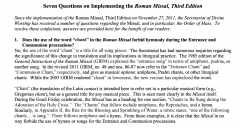 1494 x 794 - 351K
 -
I'm interested in the history of how we got to here when the roadmap points us there
What the periti of V2 might have thought they were getting was a mandate for a Missa Cantata. But since it was an unfunded mandate, it didn't happen, and the Low-Mass-with-hymns paradigm prevailed instead.
Ken Canedo's Keep the Fire Burning is a good history of 1960s-70s Catholic music through the eyes of the victors.
More here: https://forum.musicasacra.com/forum/discussion/comment/258540#Comment_258540 -
What the periti of V2 might have thought they were getting was a mandate for a Missa Cantata. But since it was an unfunded mandate, it didn't happen, and the Low-Mass-with-hymns paradigm prevailed instead.
The other big (probably even bigger) dog that didn't bark was that few bishops were willing make normatively typical on at least Sundays and days of precept (1) the chanting of the dialogues and orations by the members of their presbyterates, and (2) the singing of the Ordinary.
Cart vs horse placement issues.
Then again, by the time the new missal rolled out, bishops and pastors were fighting a rear-guard action to stanch the hemorrhaging of faithful from regular appearance in the pews after Humanae Vitae.Thanked by 1CHGiffen -
Years ago, in the early days of the PrayTell blog, they published the minutes of the meetings of the liturgical committee at St. John's Abbey from the mid 60s. It was very illuminating. They presumed that Sung Mass=Gregorian chant, and since there were not any vernacular versions of the traditional chant available they decided that in implementing the vernacular liturgy they would do what they called "Solemnized Low Mass," which they conceived of as introducing some elements of High Mass (e.g. the singing of the Sanctus) into Low Mass. They seem to have thought that once music was available they would shift to a vernacular High Mass, but that never seemed to happen. They seem to have come to prefer the "simplicity" of the Solemnized Low Mass. Reading this back then was a real revelation to me in coming to understand how we ended up where we did.What the periti of V2 might have thought they were getting was a mandate for a Missa Cantata. But since it was an unfunded mandate, it didn't happen, and the Low-Mass-with-hymns paradigm prevailed instead. -
I will accept that “chant” can be translated in a broader sense (“chanter” is “to sing” in French, for instance). That said, there’s only one way to interpret “chant” in the first three options. We don’t refer to the “songs” in the Graduale Romanum or simplex.
The whole “option four is a loophole so we can do whatever the heck we want” is a despicable interpretation of the rubrics.
For starters (and while I acknowledge this is debated) the options appear to read in a hierarchical sense, if properly contextualized.
Let’s think: SC specifically mandated that Gregorian Chant be retained in the new rite of Mass. MS then specified that the books of chant (yes, chant) were to be updated for the new rite of Mass. Then the rubrics specifically mention chanting first from the Graduale Romanum, and if not that, then the simplex, and if not that, then another collection of antiphons and psalms approved by the local ordinary, and then, if none of those conditions or met, another chant. This is clearly a reductive set of rubrics which stray further and further from the council’s stated ideal, and from liturgical precedence.
Think about it: the old rite entirely consisted of these chants, and then the council states, “we need to keep all this stuff” (and polyphony) and then the first rubric is to “keep doing the same stuff”. This is very straightforward. And if you don’t do the stuff, do the simpler version of the stuff. And if you don’t do that stuff, do other stuff that is derivative of it.
So to then read rubric 4 as wide as a barn door and to drive a tractor clear through it and then entirely ignore ALL of liturgical precedence and tradition is to completely rip the rubric out of context and tradition. (And this is to speak only of the Roman Rite, not of any of the other ancient and apostolic rites which also all incorporate chanted antiphons.)
The Simplex exists. The Graduale Romanum is recommended by name multiple times. It was even revised and recast as the Gregorian Missal (only in 2012!) to fulfill the mandate that things were to be revised to suit the new calendar and form…
And let’s look at polyphony which flowed from Gregorian chant. What does it set? The antiphons in s a special sacral idiom. This is also recommended. (Along with organ)
Now let’s look at the average, suburban NO Mass. No propers, no organ, no chant, no polyphony.
And people HONESTLY dare—based on the liberal reading of option 4 alone—that this is in any way fully compliant with the wishes of the council? (And even funnier: that it’s the ‘unique’ expression of the ‘Roman Rite’?!) (And I forgot to add, all the while also ignoring the propers right in the altar missal itself!)
I. Just. Don’t. Buy. It. -
It's a free country, but it doesn't mean "chant" in the GIRM was intended nor is required to be read restrictively, which was the much narrower starting point of this thread.
-
Years ago, in the early days of the PrayTell blog, they published the minutes of the meetings of the liturgical committee at St. John's Abbey from the mid 60s. It was very illuminating. They presumed that Sung Mass=Gregorian chant, and since there were not any vernacular versions of the traditional chant available they decided that in implementing the vernacular liturgy they would do what they called "Solemnized Low Mass," which they conceived of as introducing some elements of High Mass (e.g. the singing of the Sanctus) into Low Mass. They seem to have thought that once music was available they would shift to a vernacular High Mass, but that never seemed to happen. They seem to have come to prefer the "simplicity" of the Solemnized Low Mass. Reading this back then was a real revelation to me in coming to understand how we ended up where we did.
By far my favorite blog series. It’s A+ stuff.
I documented some of it here:
https://forum.musicasacra.com/forum/discussion/11338/the-most-interesting-blog-post-series-of-2014-from-pray-tell-blog-collegeville-archives-from-1960s -
ServiamScores writes:The Graduale Romanum is recommended by name multiple times. It was even revised and recast as the Gregorian Missal (only in 2012!) to fulfill the mandate that things were to be revised to suit the new calendar and form…
I'm a little puzzled at this last assertion: the 1974 Graduale Romanum was revised to suit the new calendar; it was constructed (with tiny exceptions) according to the rules in the first edition of the Ordo Cantus Missae, which tells how the 1961 GR chants were to be reordered for the new calendar.
Are you saying that the Gregorian Missal, in its various vernacular editions, changes some content or calendar assignments from those in the GR '74? I've never compared them to check, so I'll be surprised if this is the case. -
Thank you all for your replies. It's been an interesting discussion.
I *could* buy into the word "chant" being used in the non-restrictive sense except for two things:
1. What ServiamScores talks about in how the Graduale Romanum and the Simplex are referred to.
2. If we didn't have this random, solitary use of the word "hymn" when referring to post-communion music, which now I'm wondering is a translation problem or an intentional word choice. Why are they making that distinction? It would be a place where there is no prescribed text, so if that was an intention word choice it makes sense that hymn would be used there.Thanked by 1CHGiffen -
It doesn't appear to be a translation mistake. The Latin text of the GIRM (from the 2002 Missale Romanum) has this:88. Distributione Communionis expleta, pro opportunitate, sacerdos et fideles
per aliquod temporis spatium secreto orant. Si placet, etiam psalmus vel
aliud laudis canticum vel hymnus a tota congregatione persolvi potest.
which is:88. When the distribution of Communion has been completed, the priest and faithful should, if there is an opportunity, pray in silence for some time. If desired, a psalm or another song or hymn of praise can be sung by the whole congregation.
So the rubric explicitly allows for a variety of musical forms, psalm, song ("canticum"), or hymn ("hymnus").
In some places, musicians have moved the usual recessional hymn to the place which this GIRM paragraph proposes; then the departing procession is accompanied solely by the organ.
-
In addition to the question by @Abbysmum: I have noticed that the term "hymn" is used in this forum in a different meaning from how I would use this term. According to my music lexicon, a "hymn" is "solemn song of praise of cultic origin". This would mean that "hymn of praise" is a pleonasm. The lexicon further says that "later" (post-Graecan), the term "hymn" meant a song based on a non-biblical text. As examples, the lexicon gives the Gloria, the Sanctus, the Te Deum and Pange lingua.
It seems to me that "hymn" in this forum is used in a different meaning, namely as a synonym for sacred songs based on metric poetic non-bibical texts meant to be sung by the entire congregation and of post-medieval origin. Apparently it is often referred to with disdain ("four hymn sandwich"). Can someone please provide a definition of "hymn" how it is understood in this forum? -
but what's the different between a song and a hymn?
Easy songs are found in books with Hymn written on the cover and Hymns are found in Liturgical books including the Kyriale (Angelic Hymn), Graduale, Antiphonale, Processionale, and Hymnarium.
As @Xopheros notes above, the problem is that historically Hymn referred to a Liturgical piece of music, such as the Gloria (Angelic Hymn), Sequence Hymn, Prose Hymn, Processional Hymn, and the Divine Office Hymn.
Other religious but not Liturgical music was just a Song or a Carol (Carols are not just for Christmas).
Now most people refer to any metrical text with a religious theme as a Hymn, including former songs, carols and metrical translations of true Hymns.
So in short the meaning of hymn varies with the context both here and almost anywhere else.Thanked by 1CHGiffen -
As Xopheros rightly indicates, the word "hymn" has a broad meaning in the study of liturgy, and his lexicon sounds about right.
A handful of hymns are of prose texts such as the Gloria and the Te Deum, which have been adopted into the liturgy itself; but most hymns are of versified texts, structured in stanzas with a fixed meter. They range from the hymns of St. Ambrose to present-day compositions. Most but not all hymns of the Latin Office have some pattern of rhyme, and the same is the case for English hymns since the Renaissance.
Metrical hymns are generally of non-scriptural texts, and they were only slowly admitted to the liturgy: first in the monastic Office, as shown in the Rule of St. Benedict; and later (13th c.) in the Roman Office.
Hymns are a subcategory of songs, and the proviso Xopheros quotes, that hymns are "of cultic origin", is relevant.
I suppose many of the contemporary songs used in church from composers such as Haugen, Joncas, etc., could be called prose hymns, when they lack rhyme and meter. But the compositions of more irregular form might not resemble liturgical/cultic material enough to deserve the name of 'hymn', and we might fall back to calling them 'songs'.
-
"song"/"cantus-canticum" is simply the broadest category of vocalized music. Psalm, canticle, poem/carmen, and hymn are, as it were, lesser-included subcategories. There's simply no official basis for assuming a restrictive meaning in the context of the 2011 Missal. The text won't credibly bear the function of a silver bullet.
-
@Abbysmum, your instincts are right on target—the “plot twist” you’re sensing actually appears at the very beginning of the Mass instructions. Although paragraph 88 explicitly mentions a hymn after Communion, the General Instruction of the Roman Missal (GIRM) already provides broad flexibility earlier in the liturgy. In the Canadian version, Section 48 outlines four options for the Entrance chant, culminating in Option 4: “another liturgical song” (alius cantus) suited to the sacred action, feast, or season, and approved by ecclesial authority.
The U.S. edition of the GIRM follows essentially the same structure and wording, likewise permitting “another suitable song” approved by the bishops’ conference. This same provision is repeated for the Offertory (GIRM 74) and the Communion procession (GIRM 86) in both countries. As @Liam and @chonak noted, the Latin term cantus simply means “song,” even though it is translated as “chant” in English, which opens the door for hymns to be used in place of the prescribed antiphons.
At the same time, those hymns are not meant to function independently of the liturgical action or merely to parallel the readings; rather, they should support the ritual moment itself. The proper antiphons act like signposts or mile markers within the liturgy, orienting the faithful to what is happening, and any hymn chosen should echo and reinforce that role.
The CCCB’s recommendation of hymns—and the similar practice in the U.S.—fits squarely within the GIRM’s framework, provided those hymns truly serve the liturgical action as “another suitable liturgical song”.
This discussion actually touches on something I’ve been studying more deeply—how hymns are meant to support the liturgical action rather than simply mirror the readings. I’ve put together a short document on it and would genuinely appreciate any feedback if you’d be open to taking a look. What is a Catholic Hymn? -
Paraphrasing a post by Dr. Paul Ford from several years ago:
The hymn after Communion as found in the Graduale Simplex, 465–474, is one of these: the Te Deum, the Te Decet Laus, and the Te Laudamus Domine.
This is why, in this particular instance, the word "hymn" is used. There was a rubric in the 1967 revision of the missal regarding this "hymn," but it is not found in the New Order of the Mass. One wonders why. These would be some much superior to the syrupy "meditations" that disfigure the mass in some places. -
I'm a little puzzled at this last assertion: the 1974 Graduale Romanum was revised to suit the new calendar; it was constructed (with tiny exceptions) according to the rules in the first edition of the Ordo Cantus Missae, which tells how the 1961 GR chants were to be reordered for the new calendar.
Are you saying that the Gregorian Missal, in its various vernacular editions, changes some content or calendar assignments from those in the GR '74? I've never compared them to check, so I'll be surprised if this is the case.
I didn’t specify the ‘74 when I made my remark. I was just highlighting the fact that the GR had been recast as the Gregorian Missal which is (evidently) the 74 GR but with vernacular translations and rubrics thrown in for good measure. I had forgotten that the GR was revised in 74, but this merely bolsters my argument that the documents were revised and intended for use.
As I granted above. But even your own observation requires its own clarification, because there is no other way to interpret “chant” than… chant when referring to the music in the Graduale Romanum (/ Missal) and Simplex."song"/"cantus-canticum" is simply the broadest category of vocalized music. Psalm, canticle, poem/carmen, and hymn are, as it were, lesser-included subcategories. There's simply no official basis for assuming a restrictive meaning in the context of the 2011 Missal. The text won't credibly bear the function of a silver bullet.
Ironically, the fact that “hymn” is referred to explicitly later, as Abbysum points out, is closer to a silver bullet than even the broad interpretation of “chant” to mean any sung song. -
Behind ServiamScores's post is the idea that the four numbered options listed in GIRM 48 are arranged hierarchically. That is, the entrance antiphon is the first choice for that moment in the liturgy, and the other options are to be thought of as substitutions for it. This seems to dovetail well with the idea that Gregorian chant should have pride of place in our liturgical celebrations. It also just seems completely sensible given the history of the Latin rites.
If the list is indeed in order of preference, the history of how we got here since Vatican 2 is interesting but extraneous; the point stands that in the modern Pauline Rite songs ("chant" in the broadest possible sense as the GIRM has it) of any sort, including hymns, are allowed, but antiphons ("chant" in the sense of Gregorian melodies or something derived from them) should be considered the first choice. Is that a reasonable summary of the situation? -
So, a question for Gregorian chant practitioners on this board who started with little to nothing, as it were:
My impression is that the resources to direct, learn, train and supply scholas that wish to include Gregorian chant on a stable basis in their repertoire (but not necessarily at the level of always doing all the propers, as it were) are much more readily available than they were 30-40-50 years ago; does that impression have a firm root in reality on the ground?
-
I would say yes, but I would also say that it was primarily Summorum pontificum and the effect it had on parishes in the years following that allowed that to happen at the local level. That is, places where both the old Roman rite and the new rite coexisted in a single parish are much further along in the fluent use of Gregorian chant in the new Mass than parishes where that didn't happen, regardless of how widely available chant resources are online. That is just my impression based on my experiences of singing/playing in parishes in New York and New England (and travel elsewhere).
-
provided those hymns truly serve the liturgical action
This phrase comes up a lot, and while I thought I understood it at first, the more I think about it the more confused I am by what they mean here.
Do they simply mean that, for example, a eucharistic hymn (I use the word in the common English usage to mean any metered religious song, as in a 4-hymn sandwich) should accompany the Communion procession? Or is there a different meaning that I'm missing?Except that it's no such thing. That's just reading something into that's not intended.
There is very much the risk of that. Ambiguity foments speculation. It's extremely frustrating that the document, while somewhat vague from necessity (it is, after all, the "general instructions") doesn't adequately define it's terms.Ironically, the fact that “hymn” is referred to explicitly later, as Abbysum points out, is closer to a silver bullet than even the broad interpretation of “chant” to mean any sung song.
And that's why I got stuck here. Word choice in a document like that is so important, so I have to believe that they are trying to tell us something specific here; unfortunately, without them defining their language, it's impossible to know what that something is! -
it was primarily Summorum pontificum and the effect it had on parishes in the years following that allowed that to happen at the local level. That is, places where both the old Roman rite and the new rite coexisted in a single parish are much further along in the fluent use of Gregorian chant in the new Mass than parishes where that didn't happen, regardless of how widely available chant resources are online. That is just my impression based on my experiences of singing/playing in parishes in New York and New England (and travel elsewhere).
I can at least partially corroborate - not so much that Summorum itself moved the needle here in Vancouver, but more that the regular celebrations of the usus antiquior have served as incubators for chant scholars. I for one wouldn’t be able to do half of what I’m doing now without the years I spent singing at Holy Family.Thanked by 1CHGiffen -
Ambiguity foments speculation. It's extremely frustrating that the document, while somewhat vague from necessity (it is, after all, the "general instructions") doesn't adequately define it's terms.
It's not a bug, it's a feature.Word choice in a document like that is so important, so I have to believe that they are trying to tell us something specific here; unfortunately, without them defining their language, it's impossible to know what that something is!
Although the liturgy reform came quickly (in terms of church history) after VII, it was running far behind the facts. Active participation of the peolpe in the liturgy, including vernacular singing texts from outside the missal, had taken momentum for decades - if not centuries - and so in different directions in different countries, so mainstreaming this worldwide from a central authority might not have been feasable; especially in those times. -
@Abbysmum, you’re asking really good questions, and your frustration makes sense—these texts weren’t written like modern legal documents, so some ambiguity is intentional. When the GIRM says a hymn should “serve the liturgical action,” it just means the music should match what’s actually happening in that moment (like gathering at the Entrance or sharing in the Eucharist at Communion), not just fit a general theme.
And when paragraph 88 in the GIRM says “hymn,” it’s not making a sharp technical distinction—it’s simply reflecting the historical sources (like the Te Deum in the Graduale Simplex), where what’s suggested at that point really are hymns, so the term is being used in a straightforward, descriptive way. -
As I recently commented in another thread -Before Sixtus V created the SCR, such things were established by Customaries in a few major cathedrals & monasteries (eg Sarum/Salisbury) and adapted from these in other places to suit the available forces.
See wikipedia on "Customary (liturgy)". These things are created to ensure everybody is singing from the same hymn sheet. -
Like some of other commenters above, I prefer to think of hymns in the more restrictive sense of metered and (usually) rhymed poems set to tunes matching the meter of the text--if only to avoid the confusion that results when referring to any religious or liturgical song as a hymn. For what it's worth, many hymnologists consider hymns primarily as a literary form, and only secondarily as a musical one. Hence, the practice of mixing and matching of hymns and tunes, which (more often than not), are written by different people.
@chonak;I suppose many of the contemporary songs used in church from composers such as Haugen, Joncas, etc., could be called prose hymns, when they lack rhyme and meter. But the compositions of more irregular form might not resemble liturgical/cultic material enough to deserve the name of 'hymn', and we might fall back to calling them 'songs'.
With the more strict usage of the term "hymn" in mind, I agree that pieces lacking meter and rhyme are better described simply as songs. I think these represent a different kind of composition, in which the texts are mainly prose, and the writer(s) of the words and the composer(s) of the music are the same person(s). Moreover, the texts and melodies don't function as separate entities the same way hymns and hymn tunes do. -
My impression is that the resources to direct, learn, train and supply scholas that wish to include Gregorian chant on a stable basis in their repertoire (but not necessarily at the level of always doing all the propers, as it were) are much more readily available than they were 30-40-50 years ago; does that impression have a firm root in reality on the ground?
This is undoubtedly true if you're talking about the 1970s-1990s (30 to 50 years ago). But going back a little farther, the Pius X School of Liturgical Music, for example, was offering vigorous training in chant with leading lights in the field. Right around 1967 they had to cancel the whole program as nobody was signing up. So in this case at least it seems the problem was on the side of demand, not supply. (Fascinating though slightly different perspective here.)I'm interested in the history of how we got to here when the roadmap points us there
Some answers can be found in this very enlightening account by someone in the trenches in the years of the Council and following: Msgr. Richard J. Schuler, "A Chronicle of the Reform."
-
It's helpful to remember that as a whole the GIRM is descriptive rather than prescriptive - i.e. it lays out a something of a normative liturgy without mandating absolute rules. Or more precisely, certain sections are prescriptive, others merely descriptive, and the difference can often be determined by reference to other parts of the GIRM or to other authoritative documents as well as an understanding of the musical tradition of the Church.
For example, as discussed in this thread, the American version of GIRM 62 says that the alleluia is "sung by everybody." Looking past the translation issue of this particular section, this cannot be a "rule" since the Gregorian alleluia, sung by the schola alone, is clearly an option, as the document states in the previous section. -
There is a book of all his collected articles, and it is a FASCINATING read. Very eye opening.ome answers can be found in this very enlightening account by someone in the trenches in the years of the Council and following: Msgr. Richard J. Schuler, "A Chronicle of the Reform." -
It's helpful to remember that as a whole the GIRM is descriptive rather than prescriptive - i.e. it lays out a something of a normative liturgy without mandating absolute rules. Or more precisely, certain sections are prescriptive, others merely descriptive, and the difference can often be determined by reference to other parts of the GIRM or to other authoritative documents as well as an understanding of the musical tradition of the Church.
This is such a fascinating concept that I failed to consider. In my zeal, I often confound the two (my neurodivergent brain likes to make everything prescriptive whether it was intended to be or not). I find it hard to know what to do when things are "merely" descriptive - there is an implication there that things can change on the whim of us mere mortals. That's uncomfortable to me. But I guess that's how the evolution and progression of the Mass over millenia occurs.Some answers can be found in this very enlightening account by someone in the trenches in the years of the Council and following: Msgr. Richard J. Schuler, "A Chronicle of the Reform."
Thank you!! -
Here's another thought about hymns, this time using a broader definition that would include texts like the Gloria or the Te Deum. Most choral musical settings of the Te Deum I'm familiar with (excluding chant) are like short oratorios. The same is true of many concert settings of the Gloria (i.e., Vivaldi, Poulenc), Stabat Mater, Dies irae, etc. Presumably composers did this on account of the length of these texts, and to provide variety.
But, even settings of the Gloria for liturgical use may take any number of musical forms: ABA' (as in the Heritage Mass by Alstott or the Mass of Wisdom by Janco), entirely through-composed (People's Mass by Vermulst), or, more recently, with a verse and refrain structure. So, the term "hymn" in this broad sense is not confined to a specific literary or musical form. Which is why the narrower definition is easier to explain.
Any thoughts? -
there is an implication there that things can change on the whim of us mere mortals. That's uncomfortable to me.
That might be more of an inference, though I get the discomfort. The overall context in the GIRM is that it places a responsibility to make judgments to be made according to the circumstances - which can change in a variety of ways.
Could someone treat it as a whim for expediency? Sure. Then again, for example, speeding the recitation of the preconciliar Mass by reciting the sotto voce parts on the inhale as well as the exhale was in places a common whim for expediency. -
"Word choice in a document like that is so important, so I have to believe that they are trying to tell us something specific here; unfortunately, without them defining their language, it's impossible to know what that something is!"
Totally agree, abbysmum. I speak fluent Spanish and very often translate for non-Spanish speakers. One NEVER translates literally. You have to translate so that it makes sense to the non-Spanish speaker. Many, many words and idioms are not able to be translated literally. They make absolutely no sense in another language.
With that in mind, is the GIRM a literal translation from the Latin? Are there Latin words that should not have been translated literally, but should have been modified so that the meaning is fully understood in English?
-
With that in mind, is the GIRM a literal translation from the Latin? Are there Latin words that should not have been translated literally, but should have been modified so that the meaning is fully understood in English?
It was translated "literally" according to the prescriptions of Liturgicam Authenticam. That said, many translators argued at the time that the result in the Missal was somewhat ham-fisted in places. Perhaps for pertinent example, defaulting to the false-friendly cognate "chant" for "cantus"; that clarification of the intended meaning of the English word choice was believed needed is an example of why another choice might have been more "literal" in actuality.
Unrelated tangent example of cognate misdirection: "Crucifix" is an English noun, not a Latin noun (it might be called a back-formation from the Latin verb). Latin typically uses "crux": which can mean a cross - either that is or is not bearing an image of the crucified Lord. Normally, in a liturgical instruction context, it's assumed to mean "with", except in the case of the canonical wood crosses for the Stations of The Cross, because they are themselves customarily (but not always) accompanied by images of the scene of the relevant station. Nevertheless, too many people decades ago interpolated into the translation of "crux" as "cross" a deliberate intention to mean a cross without the image of the crucified Lord. So...be careful with overinterpreting words that appear to be cognates.
Translation in general is a treacherous terrain for anyone who works on an operating assumption that lock-step word + syntax correspondence is necessary and/or desirable. Because I started learning foreign language at the age of 9, my brain was plastic enough to absorb the integrity of the idiomatic genius of other languages compared to my mother tongue, even to be point where I felt the non-English language was more apt/elegant/capacious than English in a given situation (I was dreaming in the other language by my mid-teens). Some might call it ineffable. -
With that in mind, is the GIRM a literal translation from the Latin? Are there Latin words that should not have been translated literally, but should have been modified so that the meaning is fully understood in English?
Careful we don't follow this reasoning too far down the path and wind up with a Comme le prévoit "dynamic equivalence" situation -
I don't really think there is any problem with dynamic equivalence as a translation theory (or, no more problem than there is with any other translation theory). The problem with the old ICEL translations was not the translation theory behind them, but the presumption that modern English speakers are idiots who cannot handle complex or challenging ideas. They were simply bad examples of dynamic equivalence (just like a lot of what we have now are bad examples of formal equivalence).
-
Neither CLP nor LA ever placed a value on euphony according to the idiomatic nature of the receiving language, nor did they distinguish among texts that are frequently repeated - thus might more readily bear a complex rhetorical register because depth of meaning has more of an opportunity to percolate over time - and those that are rarely repeated. But at least LA established the precedent that translation guidelines can be changed.Thanked by 1novusgordo
-
When St. Jerome turned the Chronicle of Eusebius of Caesarea into Latin, he urged in his preface:" If I translate word-for-word, it sounds absurd”. He also added: "If any one doesn‟t think that translation alter the charm of a language, let him force Homer wordfor-word into Latin" (Venuti, 2000:24).Indeed, I not only admit, but freely proclaim that in translation from the Greek – except in the case of Sacred Scripture, where the very order of the words is a mystery – I render not word-for-word, but sense-for-sense (St.Jerome‟s letter to Pammachius, section V, line 85 in Venuti, 2000:23)
One could argue that liturgical texts should enjoy the same status as scripture in this context, but GIRM is not a liturgical text and sense for sense should have been be the reqirement. The elephant in the room is that, the European languages excepted, knowledge of Latin is so rare that de facto most translations of the liturgy are made from the (American)-English.St. Jerome put Scripture in a special category that required more literal translation principles than other literature. His Vulgate was, therefore, quite literal. For Schwarz (1955:34), St. Jerome asserted that a literary work must be translated according to sense, as the lack of equivalents in the two languages and the preservation of word order would make the word-for-word translation sounds incoherent and ridiculous and it destroys all literary qualities as well. In the case of Bible, the meaning of the sacred text cannot be exhausted in that it is like the ocean, inexhaustible and mysterious. This mystery must be preserved in the translation because changing the order of words would not only destroy this mystery, but it would also endanger the unfathomable profundity of the sacred text.




Welcome to the MusicaSacra Forum!
To participate in the discussions on Catholic church music, sign in or register as a forum member, The forum is a project of the Church Music Association of America.
Categories
- All Discussions21,844
- General Music Discussion8,548
- Job Openings292
- Management of Music Programs862
- Choral Matters539
- Church Documents and Rubrics540
- CMAA Notes307
- Events760
- For Newcomers: Read First26
- Sacred Polyphony567
- Hymnody898
- Gregorian Chant: General2,749
- ↳ Graduale Romanum and Liber Usualis372
- ↳ Graduale Simplex61
- ↳ Semiology65
- Vernacular Plainsong704
- Anglican Use and Anglican Chant73
- Organ, Other Instruments and Repertoire452
- New Composition/Works in Progress1,342
- Recordings238
- Music for Hispanic Ministry163
- Music Education: Children217
- Music Education: General223
- News Items247
- Positions Wanted3
- General Discussion: Catholicism742
- Amusements185
- General Discussion1,048
- Opinions119