
Music List Sharing
-
I've been thinking that it would be nice to have a thread where we can just share our rep lists for random liturgies or sacred concerts of any sort - it's always fun to discover obscure composers or hidden gems from colleagues!
Our Lady of Knock - Latin Novus Ordo at St. John Vianney Church, Colonia NJ
Propers: BVM Mediatrix of All Graces
Ordinary: Mass in F - Charles Wood (1866-1926)
Prelude: 6 Occasional Preludes, Op. 182: No. 6, At Even-tide - C.V. Stanford (1852-1924)
Processional: Glorious Things of Thee Are Spoken (ABBOT’S LEIGH)
Offertory: Magnificat in B-flat - Sir Charles Villiers Stanford
Communion: Ave Maria - Seán Tunney (b. 1996)
Communion: Ave Maria! O Maiden, O Mother - Laurence Ampleforth (1846-1929)
During the veneration of a relic of Our Lady's veil: Lady of Knock - Dana Rosemary Scallon (b. 1950), arr. Johnum Palado & Sonia Wang
Postlude: 4 Intermezzi, Op. 189: No. 4, Intermezzo Founded upon an Irish Air - C.V. Stanford
Stanford was born in Dublin, Wood was born in Armagh, and my friend Seán Tunney is the Assistant Director of Music at the Knock Shrine in County Mayo. Wood's Mass is really lovely (particularly the SAT trio in the Benedictus) and not very well-known, definitely worth checking out! SATB + organ, no divisi, accompaniment is interesting but not too difficult. -
We had a Choir Workshop Mass tonight, the culmination of an afternoon of rehearsals of a joint choir representing five area parishes. Peter Carter of the Sacred Music Project was the workshop guest conductor and the Mass featured some of his harmonizations of common chants.
Chanted readings and Intercessions
Entr.: Entrance chant from Source and Summit
Kyrie: Kyrie XVIII harm. Carter
Gloria: de Angelis
Psalm: Source and Summit
Alleluia: Mode VI arr. Carter
Creed: Credo I, Roman Missal
Offertory: Ave Maria, Elgar
Sanctus: Roman Missal, arr. Carter
We proclaim: Roman Missal arr. Carter
Agnus Dei: Roman Missal, arr. Carter
Comm.: Ave Verum, Mozart
Recess.: Faith of Our Fathers ST CATHERINE -
We're not in the league of the above posts, but here's our 2026-7 rehearsal schedule for a unison group that sings chant and congregational hymns.
-
I once shared a repertory list in another thread. One also can search for threads on specific feasts (All Souls, for example), or start one on say, OT 22 A.Thanked by 1Chant_Supremacist
-
Today we had I Vespers of St Bartholomew
Chant office, with the Victoria Domine ad adjuvandum, Asola falsobordone for the hymn and Magnificat, Salve, For all thy saints in warfare (AURELIA). -
I'll post my 2027 repertoire list once it's finished.
-
We do have somewhat regular threads about feast day programs, so I'm diverging a little from the OP and just posting our complete planned repertoire for 2027, excluding hymnal rep (CBW III and Traditional Roman Hymnal) and Gregorian propers. I'm hoping this might be useful to someone, and it is indeed something that would have been useful for me 3 years ago when I started.
Tuned it up a little since yesterday, not finalized, but I knew I would forget if I waited. There's no schedule here a la Probe, just a list.
-12 pieces will be removed from the 2026 rep; 19 pieces added; 49 keepers.
-About 40% of the polyphonic rep is 16th C. and that bothers me.
-Tenebrae rep not included.
-The difficulty is fairly dialed in to be attainable (bearing in mind how much is retained and repeated over years) for an amateur choir with at least 1 solid voice in each section and weekly practice (with occasional extra practice).
-The Schola Supplement (selected polyphonic propers, polyphonic antiphons for occasions like Ash Wednesday and Candlemas, and some prelude/postlude stuff) is a little aspirational and we aren't likely to sing all of it. -
Choir List of Sacred Heart Choir for the month of August.
-
About 40% of the polyphonic rep is 16th C. and that bothers me.
We’re basically only interested in that at the moment. (Renaissance in general I mean). We don’t have the resources to do classical. We also don’t like it as much. Baroque, especially early or very cantus firmus/chant like, yes (I just discovered a late baroque Ave Maris Stella where they sing the chant ornamented by instruments). But again, no resources, not at the moment.
I don’t have anything really against it; St Joseph’s in Detroit often does Rheinberger in summer. I know that Stimson likes Gounod. But the polyphonic repertoire is incredibly vast, and that’s where our interest really lies. -
I just don't like giving the impression that the VO's music is frozen in amber. Also, as much as I like the "16th Century sound," we sometimes need relief from it. 20th and 21st c. tonal music is really good for that and I want to keep expanding there.
Unfortunately, 14th-15th C. seems comparatively inaccessible: there are just not as many easily readable scores around, and then often the rhythms are a little tricky for my people, or the piece is simply too long. Dufay's Conditor is an example of something that's harder than it looks for a choir like mine to get right, due to some funky chords and rhythms.
If anything I would like to have more repertoire coming from Catholic folk sources like the Piae Cantiones or Montserrat manuscript, though it doesn't have to be that old. -
I mean, sure, but the vast majority of repertoire at the big NO programs is still Renaissance. Yes, Westminster even commissioned works that are now in standard repertoire both in TLM and NO contexts, but even so, a lot of that stuff is so hard too.
Different strokes for different folks and all, or de gustibus etc.
I agree that the score situation isn’t the best. One particular CPDL contributor has essentially ruined the possibility of using the Trent Codices.Thanked by 1Josaphat1934 -
One particular CPDL contributor has essentially ruined the possibility of using the Trent Codices.
LOL! Not true! Just because the free ice cream machine is broken down, it doesn't mean you can't eat ice cream. But it does make it more expensive. I'd LOVE to do more 15th century. But between the rhythms and the scoring, there's not much for us. We worked on Ockeghem Missa Au Travail Suis but it was bit much for us. We do the Dufay Conditor (in G Phrygian SAB), and really, it's about as easy as Dufay or 15th c. gets.
One of the advantages of doing 40% Renaissance is that you're repeating the same moves a lot, which makes reading easier. OTOH, particularly in the Missal of Pius V, there tends to be a fetishization of that style.
Right now we're a little short on women. My one alto is fine on her own. I have 2 sopranos, but one often has to work on her own church job, and the remaining one isn't as fine on her own. I have a solid tenor, and me on bass, and one of each who are new readers. So I'm looking at 3 and especially 2-part music. Here are some things we're working on:
Aichinger: Caro mea vere est cibus. It's TTB bc in the Donfrid anthology; we're doing it M/W (the B isn't in the original print, just in Donfrid; we may add it in at some point.
Haller: Missa Prima Op. 4 (SAB)
Agostino Donini (Perosi school): Tantum ergo a2
W.J. Marsh: Pie Pelicane a2. A little sentimental maybe
Everett Titcomb: Panis Angelicus. 4 parts, but pretty homophonic
Staf Nees: Tantum a 2. "In" Eb, but heads toward A minor in the middle, which provides the teaching moment of an enharmonic shift.
I should work up a spreadsheet. Our repertoire is pretty idiosyncratic (to the despair of some who say "I couldn't find this on Youtube.") -
I agree the Conditor is easy as that gets, but for some reason the choir couldn't get it down and actually had an easier time with Burchard's Creator, which on paper seems harder.Thanked by 1Josaphat1934
-
That’s one recent piece that I love. But that’s because he was at Bellarmine for years when I was in Louisville. Saint Martin’s commissioned at least one piece.
-
@Chant_Supremacist bless your capable choir! I see you've included Media Vita (1995) arr. Michael McGlynn - with drum like Anúna ;) ?
Thanked by 1Chant_Supremacist -
It's always interesting getting in the weeds with Early Music.
Had a couple of specialists along for a feast day Mass, historic instrumentalists. The kids and adults did what I thought was a ravishing rendition of the Jacquet Veni Creator for Communion, done at a deliberately relaxed pace to fill a long time, interspersed with chant verses. I was floating on the sound for the duration.
On his way out, one of the players said (with what I found at the time to be a bit more of a barb than I appreciated but I'm genuinely not sure): "You might consider a faster tempo on the 16th cent. music if your singers are up to it."
I honestly don't think he meant to be hypercritical, but for me it was just such an interesting moment to reflect on how deeply "correctness" can embed itself in our minds and close us to other beautiful interpretations / interactions with this repertoire that, in many ways, remains a blessed mystery in terms of its actual performance practice.
I feel this way in particular about Gregorian chant. -
For reference, this is the Jacquet Veni referenced in my post above!
Sorry for the noisy recording -- it was during Communion with all the foot traffic. -
"You might consider a faster tempo on the 16th cent. music if your singers are up to it."
I am hypersensitive and would have been annoyed in the moment, probably, but I think that it’s good advice. We wind up doing a lot in 4/4 or very slow cut time. I still haven’t figured out mensuration and proportions, but I am interested in doing more HIP with polyphony. And we don’t drag chant, but now I really am sensitive to rushing, like, feeling like a note was just skipped entirely in a descending passage, as the comical (except not) example of what Dom Gajard warns about.Thanked by 1rich_enough -
I am hypersensitive and would have been annoyed in the moment, probably, but I think that it’s good advice. We wind up doing a lot in 4/4 or very slow cut time. I still haven’t figured out mensuration and proportions, but I am interested in doing more HIP with polyphony. And we don’t drag chant, but now I really am sensitive to rushing, like, feeling like a note was just skipped entirely in a descending passage, as the comical (except not) example of what Dom Gajard warns about.
I mean the, “if your singers are up to it”, was entirely unnecessary in my opinion.
In our practice, tempo in this repertoire is something we most often arrive at as a choir by encountering the piece in itself and in its intended context during rehearsal. I show up with an idea of what I think I want them to do, but then tweak that after hearing it on the voices and feeling it as a choir. We certainly don’t show up and hack it out day-of. Fundamentally, we are an open ensemble capable of real expressive variety across a broad repertoire, and treat Renaissance polyphony with sensitivity, individuating the pieces, rather than adopting a one-size-fits-HIP approach. This is something I feel very strongly about.
And that was what was fundamentally so jarring to me about the experience. The performance deeply resonated with the choir, you could see it on every face. It did everything we asked it to do, the singers approached it competently and with technical skill. The effect was beautiful, serene, sensitive, and served at the liturgy very well. And yet, his mindset had been formed in such a way that the only thing to say was a critique on a “technicality” (itself speculative) with implicit shade thrown on the choir’s competence?
But it reminded me of nothing so much as what I see in the world of chant, where extremely speculative positions and then applications on performance practice seem to overwhelm musical and liturgical considerations. Fundamentally, the plainsong that comes down to us is an extraordinarily vast repertoire. It comprises many genres and the pieces are composed over a long timespan. I am certainly interested by discussions about possible historic performance practice of the chant, but some of these are based on the witness of particular monastic manuscripts and their unique notation systems, which are not available for the entire repertoire, or on the fairly sparse textual witness, and can become quite idiosyncratic.
The historic witness of the notation that we have certainly seems to be that the chant was a changing reality across the centuries, and, based on the information manuscripts appear to carry or don’t carry, we see that its performance practice varied significantly in time and place, and we even see a lot of melodic variety.
And yet, how we talk about it / think about it / insist upon it being done in such particular ways...! -
My view here is that someone who has spent enough time mastering the chant repertoire acquires a right to have his own style.
For instance, while I consider myself fundamentally influenced by Solesmes, we do typically use oblique organum (rarely parallel), even with two distinct organal voices, both also pronouncing the text. I used to write these all out in advance, but now my guys know what I'm looking for and 75% of the time I let them develop their lines in practice, with input like "more intensity here," "more stability for this part," "move here, not there." I've joked with them that we're reinventing polyphony from first principles. Strict unison is probably 10% of the time.
We also occasionally do rhythmic interpretations of the Alleluia jubilus in 3/4 time. I cant claim that this is historically accurate, but sometimes an Alleluia just strongly suggests a rhythmic interpretation to me (the last two Sundays, for instance), for the most part I feel it emerges from the score.
Or again, although I typically respect the Solesmes rhythmic markings, I don't feel bound by them (the ictus in particular) and have been known to remove a dot here or there, or add or remove episemas, to achieve different melodic emphases I find latent in the music. Then there are judiciously added ornaments of repercussions, shakes, tremolo, or slight glissandos.
I tend to think of these things as just what experienced musicians are supposed to do with a score: reverently enliven it with aspects of their own character and subjectivity, so as to "sing a new song unto the Lord." I don't think chant is being sung quite this way anywhere else in the world, and I'm pleased with that. -
I mean the, “if your singers are up to it”, was entirely unnecessary in my opinion.
I don’t really disagree, although I see the point behind it, and also that he seems to live in a vacuum (which gets to your other points) and lack some social skills.
In my case we just rehearsed something that, frankly, needs to be faster or be in two; otherwise, we won’t be able to do it again and will be asked to do the plainchant for the longest portion, which to me defeats the purpose of the repertoire selection.
As to chant: it’s why I’m quite happy with Mocquereau and Gajard in contrast to my more open-minded views of polyphonic music, although original pitch, or a conventional transposition like down a P4 often has a practical element: doing the chant alongside it as normal, keeping the solfège the same visually and in the mind: we did the Palestrina Missa Regina Caeli for four voices with one flat (in F, I suppose). That’s a goofy piece to do in another key given that the chant and therefore the motet on which the setting is modeled are also with just the one flat.
At the very least, a reasonably articulated, coherent view of rhythm is important, versus just vibes. (I can live with someone else doing something different: it’s their house!) Someone asked about the non-usage of the ictus and he asked for the short answer (he’s also been, FWIW, under ICRSP care for the last two years): 1) people knowingly don’t use it or move it around, which, OK, so long as it’s coherent and relatively consistent 2) people don’t read the materials designed to instruct those using the Solesmes editions, which is a problem that Dr. Weaver has addressed many times, for example. I’ve run into that in some wonderful exchanges with other musicians elsewhere, just as I have myself. -
Preparing my Schola for the 24th Sunday in OT, here's our list!
 59K
59K -
This whole "faster if you're up to it" thread amuses me, because slow is much harder, especially in a small group where not everyone breathes with maximum efficiency. Partly because my background has been HIP, partly because I'm kind of hyper, I tend toward fast tempi, and increasingly I'm trying to dial it down a notch, so the harmonies have time to breathe. But things that are obviously ornamental (cadential eighths/16ths) don't necessarily need to be distinct. Would I have been offended? Probably not; I don't hear it as much as a competence question as a flexibility question. But I'd rather be too fast than sing like Nicola Montani's choir.
-
Here are the lists for St. Gertrude Parish and Mount St. Mary's Seminary in Cincinnati.
-
@cholman Amazing! The rep for St. Gertrude's is much of what would be on my bucket list schedule. Also lovely to see Dominican Rite included!
-
Annual Mass & Candlelight Procession honoring St. Padre Pio
St. Josaphat Oratory, Bayside NY
Missa brevis in F - Andrea Gabrieli (1532-1585)
Justorum animae - Orlandus Lassus (1532-1594)
Give us the wings of faith - Ernest Bullock (1890-1979)
Holy is the true light - William H. Harris (1883-1973)
Decus morum dux minorum - Giovanni Battista Fasolo (1598-c.1680)
Inno a Padre Pio
T'adoriam, Ostia divina
Noi vogliam Dio/We stand for God -
Choir List of Sacred Heart Choir for the month of September.
Vespers of the Blessed Virgin resume after every Mass on September 13th, unless otherwise noted.
Bake sale on September 27th. Music of Hildegard of Bingen to be featured; baked goods of Hildegard of Bingen [thankfully] to be omitted.
833KThanked by 1Josaphat1934 -
@StimsonInRehab Her cookie recipe looks alright!
-
Madonna della Lavina/Our Lady of the Torrent
(Venerated in Cerami, Province of Enna, Sicily)
TLM at Saint Aloysius Church in Caldwell, NJ
Missa Sicut lilium inter spinas - Giovanni Pierluigi da Palestrina (1525-1594)
Salve Regina - Peeter Cornet (c. 1575-1633)
Mira il tuo popolo (trad. Italian)
Ave dulcissima Maria - Carlo Gesualdo (1566-1613)
O gloriosa Virginum - Palestrina
Sicut lilium inter spinas - Palestrina
O Sanctissima (SICILIAN MARINER'S HYMN) -
Vespers of the Holy Cross:
Domine ad adiuvandum for 4 vv, Lassus
Chant including the Magnificat (my bad: I ran out of time) except for the Vexilla Regis, Victoria (Roman version)
Salve Regina (simplex)
Lift high the cross (CRUCIFER)
Thanked by 1CHGiffen -
Holy Cross 2026
Full Proper
Mass II / Credo III
Salvator mundi, Tallis
Vexilla regis, Brumel
CRUCIFER
ROCKINGHAM, harm. Webbe
-
Patronal Solemnity of St. Wenceslaus 2026
NO Mass and Solemn Vespers II with the Bishop
-
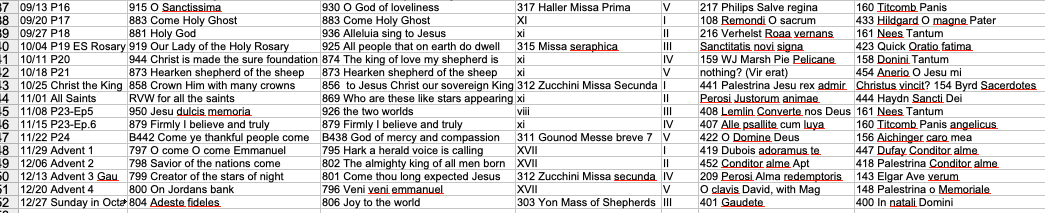
I had to fill in some holes, but here is our rep from last week through the end of the year. Hymn numbers are from Campion Missal 1st edition. Other numbers are from our repertoire binders.
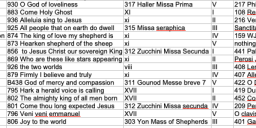 1045 x 213 - 103K
 -
Wow, Credos II & V, cool!
-
Big fan of V. I wish we could use it after Easter or on major feasts; we use I, but a new Credo is ambitious.
-
Three TLMs for Michaelmas - not sure quite why I'm doing this much music, but it'll be fun!
St. Michael's Church, Staten Island
Missa L'homme armé - Jacob Obrecht (1458-1505)
Christe sanctorum - Sixt Dieterich (c. 1493-1548)
Congregati sunt inimici nostri - Clément Janequin (c. 1485-1558)
O sacrum convivium - Jacquet de Mantua (1483-1559)
Michael Archangele - Jacotin (early 16th century)
Michael Archangele - Claudin de Sermisy (1495-1562)
Montfort Academy, Mount Vernon
Missa Aeterna Christi munera - Giovanni Pierluigi da Palestrina (1525-1594)
Princeps gloriosissime - Luca Marenzio (c.1553-1599)
Factum est silentium - Felice Anerio (c.1560-1614)
Tibi Christe, splendor Patris - Palestrina
Andante soavamente e dolce - Charles Macpherson (1870-1927)
Chaconne in E minor, BuxWV 160 - Dietrich Buxtehude (1637-1707)
O Jesus, Life-spring of the Soul (GONFALON ROYAL)
St. Josaphat's Oratory, Bayside
Missa L'homme armé a 4 - Giovanni Pierluigi da Palestrina (1525-1594)
Factum est silentium - Felice Anerio (c.1560-1614)
Tibi Christe splendor Patris - Orlando di Lasso (1532-1594) -
Feast of St. Wenceslaus
Shrine Chapel of the Blessed Sacrament, Raritan
Missa brevis in D major, K. 194 - W. A. Mozart (1756-1791)
O esca viatorum - Johann Michael Haydn (1737-1806)
Isti sunt sancti - Balthasar Resinarius (c. 1483-1544)
Ave verum corpus, K. 618 - Mozart
Primum quaerite - Heinrich Isaac (c. 1450-1517)
Svatováclavský chorál (12th century)
Toccata Pastorell - Josef Seger (1716-1782)
Toccata - Bohuslav Matej Cernohorsky (1684-1742) -
Vespers of Saint Matthew
Office of an Apostle, chant
Exsultet caelum laudibus, Victoria
Magnificat Primi Toni, López Capillas,
Salve Regina, simple tone
He sat to watch over customs paid (I went with TALLIS’ CANON) -
Classes begin for us this Wednesday, and we will have a Votive Mass of the Holy Spirit this Thursday in our Newman Center to mark the start of the year.
Davis Newman Center, Sept. 24, Mass of the Holy Spirit
Introit: The love of God has been poured into our hearts (Lumen Christi Simple Gradual, Bartlett), with verses
Kyrie: Kyrie XVI
Gloria: Congregational Mass (Lee), alternatim schola and assembly
Responsorial Psalm: Lord send out your spirit (Alstott)
Alleluia: Mode 1 from Graduale Simplex, psalm toned verse from lectionary
Offertory: Confirma hoc Deus (mode 8, graduale simplex)
Sanctus: ICEL
Agnus Dei: Agnus ad lib. II
Communion ant.: Spiritus qui a Patre procedit (Graduale Simplex), with verses
Communion hymn: Come down, O love divine
Closing: Come Holy Ghost
-
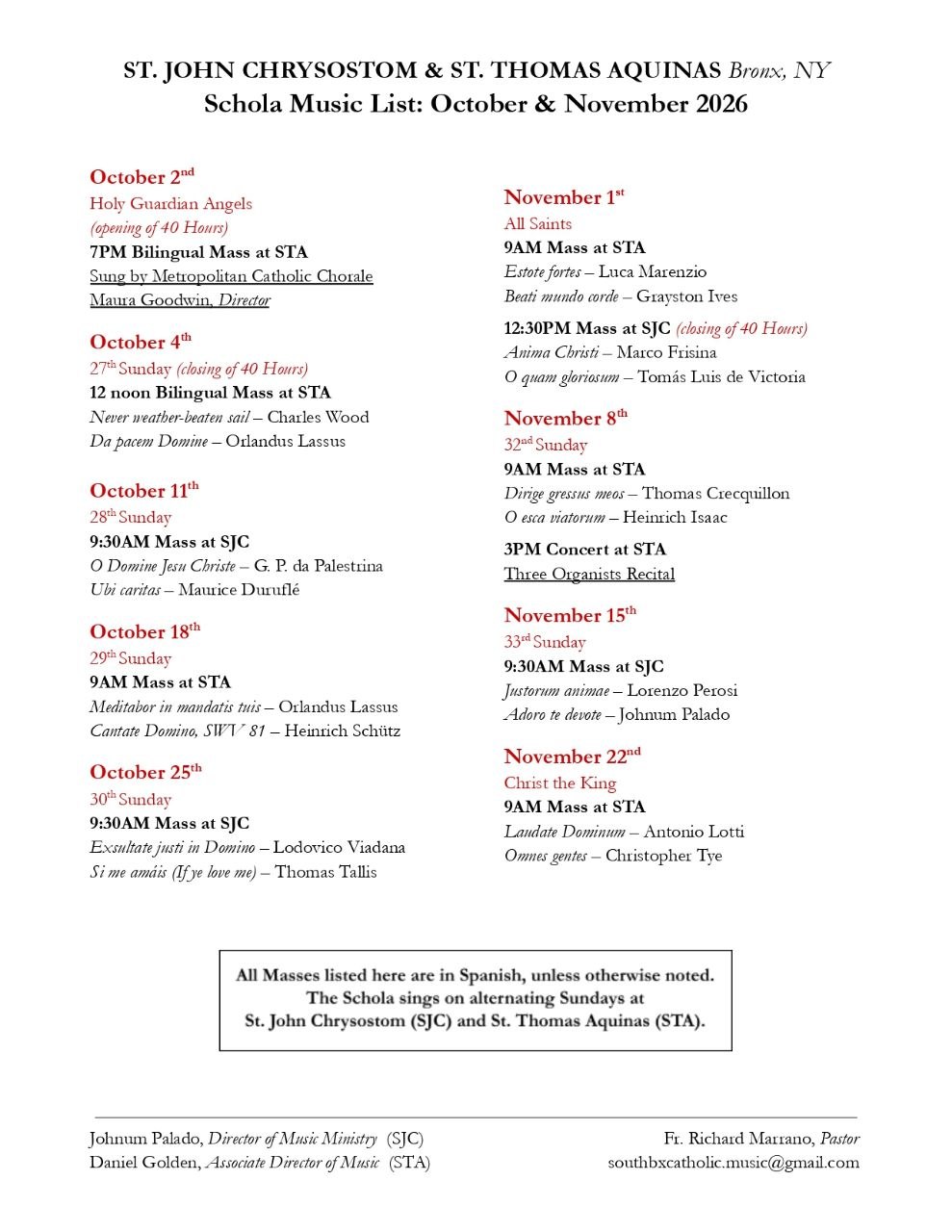
Guardian Angels/Opening of 40 Hours, English/Spanish Bilingual Mass
St. Thomas Aquinas, Bronx NY
Sung by Metropolitan Catholic Chorale: Maura Goodwin, Director
Let all mortal flesh keep silence
Missa de Angelis
O quam gloriosum - Tomás Luis de Victoria
Cherubic Hymn - Paul Jernberg
Bendito, bendito
O salutaris hostia - Pierre de la Rue
O celestial medicina - Francisco Guerrero -
Davis Newman Center
Feast of SS. Michael, Gabriel, and Raphael, archangels
Vespers:
- Hymn: Christ we implore you/Angelum pacis Michael Divine Office Hymnal, ICEL
- Antiphons from AR II, Psalms/Canticles in English
Mass:
- Entrance and Communion Antiphon from Fr. Weber's Propers, vol. 3
- Mass VIII (de Angelis, as requested by the schola)
- Responsorial Psalm: Alstott
- Alleluia: mode 3, Graduale Simplex
- Offertory Ant.: Graduale Simplex (w/o verses)
- Offertory Hymn: O bless the Lord, my soul (Montgomery)
- Communion Hymn: Soul of my savior (Maher)
- Salve Regina -
I'm very excited to have my parish schola starting tomorrow - this rep makes a nice contrast to Flor y Canto stuff!
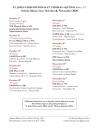 989 x 1280 - 140K
 -
Feast of St. Bartolo Longo
Shrine Chapel of the Blessed Sacrament, Raritan NJ
Messa del sesto tuono No. 2 - Antonio Lotti (1667-1740)
Almighty and everlasting God - Orlando Gibbons (1583-1625)
Salve, Regina (Dominican Tone) - Alvez Barkoskie IV (b. 1986)
O thou who camest from above (HEREFORD)
Komm, Heiliger Geist, Herre Gott - Heinrich Scheidemann (c. 1595-1663)
Voluntary in A for Double Organ - Christopher Gibbons (1615-1676) -
Music List for October. Additionally, a quartet of brass students from Vincennes University will be accompanying the procession on Christ the King, playing Susato's Danse du Roy and Kunc's Christus Vincit. 520K
-
Today’s Vespers:
Domine ad adjuvandum, Victoria,
Chant office of the Sunday
Lucis Creator Optime. Lassus,
Magnificat in falsobordone of the third tone for 4vv, Lassus
Salve Regina, simple tone
All creatures of our God and King (LASST UNS ERFREUEN)
-
St Gerard - Latin Novus Ordo at St. John Vianney Church, Colonia NJ
Missa a note negre - Cipriano de Rore (1516-1565)
O altitudo divitiarum - Rore
Pater noster a 5 - Francesco de Layolle (1492-c.1540)
Descendi in hortum meum - Josquin des Prez (c.1452-1521)
Beneath Thy Compassion - Paul Mealor (b. 1975)
Sursum Corda & Alla Marcia - John Ireland (1879-1962)
God of mercy and compassion (AU SANG QU'UN DIEU)


Welcome to the MusicaSacra Forum!
To participate in the discussions on Catholic church music, sign in or register as a forum member, The forum is a project of the Church Music Association of America.
Categories
- All Discussions21,853
- General Music Discussion8,552
- Job Openings293
- Management of Music Programs862
- Choral Matters539
- Church Documents and Rubrics540
- CMAA Notes307
- Events763
- For Newcomers: Read First26
- Sacred Polyphony567
- Hymnody898
- Gregorian Chant: General2,749
- ↳ Graduale Romanum and Liber Usualis372
- ↳ Graduale Simplex61
- ↳ Semiology65
- Vernacular Plainsong704
- Anglican Use and Anglican Chant73
- Organ, Other Instruments and Repertoire452
- New Composition/Works in Progress1,342
- Recordings238
- Music for Hispanic Ministry163
- Music Education: Children217
- Music Education: General223
- News Items247
- Positions Wanted3
- General Discussion: Catholicism742
- Amusements185
- General Discussion1,049
- Opinions119