
Universal Prayer Priest's Introduction and Prayer
-
The parish where I currently attend to our construction woes seemingly orders the prayers to complement the lectionary. I forgot about these. We had them in my home parish too. I don’t absolutely love these: nothing is objectively bad, and they go in hierarchical order, but they don’t always have explicit or even implicit prayers for the whole church on earth, for the pope and bishop, for the clergy etc. before moving to other intentions. I don’t think that this would merely repeat what is in the anaphora, since that doesn’t include the other faithful (the lower orders of clergy, virgins, religious, etc.) and can be tied each week to a specific intention.
The bishop’s office requires the missal prayers for confirmations. I believe that this solves the problem too. -
I noticed that for the time after Pentecost, one of the introductions (which is an invitation, actually) calls for a prayer to Christ, while both options for the concluding prayer address God. There should be a concluding prayer that is addressed to Christ.
For prayers that complement the lectionary, you could also use a collect from the 1998 ICEL Sacramentary, which as alternative collects that match the readings of Year A, B and C. -
As someone who had responsibility for composing these some decades ago, and then upon further recollection and contemplation realized gaps in my own daily prayers of general intercession, I would like to suggest for consideration adding a prayer between those for the sick and those for the faithful departed (the latter should be included but there is the more important prayer in the Eucharistic Prayer for them), something like this:Let us pray for your servants who are dying, who may have lost the will to live, or who may die today or in the coming days; Lord, grant them the mercies and grace of dying the happy death of the just according to your gracious will.
We neglect those categories (the may overlap, but they are also distinct) of people in our pubic prayers, and I believe we strain to retrain ourselves to be mindful every day of them. Where they go, we too shall follow: the most basic affirmation of common solidarity.
I have another general prayer of daily thanksgiving that can be adapted for a more general intercession:Let us pray: Lord, stir up within us the spirit of thanksgiving for all the blessings and prayers you have answered according to your gracious will, especially those of which we know not, that we do not understand, that we do not appreciate, or that we take for granted.
My personal private version of that adaptation is simpler:
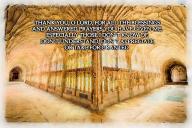 4096 x 2734 - 19MThanked by 1CHGiffen
 -
I always pray for the sick and the dying together, but yes.
There should be a concluding prayer that is addressed to Christ.
Is that so? The authentic ancient collects are addressed to God (rarely the Father but especially Lord, God, Lord God…) and AFAICT the missal formulates them in the same way.
Of course the model intentions are inelegant and don’t reflect what I said above: church, pope, bishops, clergy, other faithful in order, civil powers, those in need in a suitable order; the sick, the dying, and the departed towards the end. In fact, I learned recently that the sometimes required collect for the dead always was second to last. Something for the spirit of thanksgiving like Liam’s could go after that, and then the prayers end.
Anyway the introduction should definitely be directed to the Father as in the text on the left.Thanked by 1Liam -
Clear guidance on the appropriate content for the Universal Prayer/Intercessions/Bidding Prayers seems remarkably lacking. My initial (i.e. 1970s) understanding was that the objective was to reflect the particular needs of the time or location, e.g. those in the community currently sick (by name), lately dead, or whose anniversaries are about now, or for the current published intention of the pope. There is no need to duplicate the generic prayers in the Canon or the priest's selected orations. That is still what I hear in both Catholic Cathedrals in London, and indeed in Anglican Cathedrals. Unfortunately in many parishes it degenerated into an opportunity for a lay person (or a deacon) to usurp the role of the priest by offering their own prayers (quite often framed heretically).
-
The E&W Liturgy Office has quite good guidance for confirmations. I would move the prayers for the church and pope to be first, but this is a good start and mercifully short.
-
You may be interested in the following work:
https://archive.org/details/ConsiliumDeOratione1965/page/4/mode/2up
It was the first of the guidelines put out by the Consilium, and has IMHO very sensible (though largely ignored) suggestions for the composition of the prayer. It also has many sample for concluding prayers from ancient sacramentaries, etc..
There is a larger edition (couldn't find it online, but I have a scan if anyone is interested) put out a year later in 1966 with many more sample formularies [see below]. The samples in the appendix of the Missal are taken from some of these. It is in Latin with a (dynamic-equivalent) French translation
You may also be interested in taking a look at the books put out by various dioceses/Conferences in the period between 1965-19689 when the Prayer of the Faithful was more regulated. They often have large numbers of sample texts with sensibly worded Collects and petitions.
----
Sample formularies of the 1966 edition:
1. Formula generalis, I
2. Formula generalis, II
3. Tempore Adventus, 1
4. Tempore Adventus, II
5. Tempore Nativitatis Domini
6. In festo Epiphaniae
7. Tempore post Epiphaniam
8. Tempore Septuagesimae
9. Tempore Quadragesimae, I
10. Tempore Quadragesimae, II
11. Tempore Passionis
12. In Missa « In Cena Domini »
13. In nocte sancta Paschatis
14. In dominica Resurrectionis
15. Tempore paschali, I
16. Tempore paschali, II
17. In festo Ascensionis
18. In festo Pentecostes
19. In festo Sanctissimae Trinitatis
20. In festo Ss.mi Corporis Christi
21. In festo Sacratissimi Cordis Iesu
22. Tempore post Pentecosten, I
23. Tempore post Pentecosten, II
24. Tempore post Pentecosten, III
25. Tempore post Pentecosten, IV
26. Tempore post Pentecosten, V
27. In festo Immaculatae Conceptionis B. Mariae Virginis
28. In festo Sanctissimi Nominis Iesu
29. In festo Sanctae Familiae Iesu, Mariae, Ioseph
30. In festo Purificationis B. M. V.
31. In festo Annuntiationis B. M. V.
32. In festo Sancti Ioseph opificis
33. In festo Sancti Ioannis Baptistae
34. In festo SS. Petri et Pauli Apostolorum
35. In festo Pretiosissimi Sanguinis D. N. Iesu Christi
36. In festo Transfigurationis D. N. I. C.
37. In festo Assumptionis B. M. V.
37. In festo Nativitatis B. M. V.
39. In festo Sanctac Crucis
40. In festo Sancti Michaelis Archangeli
41. In festo D. N. Iesu Christi Regis
42. In festo Omnium Sanctorum
43. In Dedicatione ecclesiae
44. In festis B. M. V.
45. In festis SS. Apostolorum
46. In festis SS. Martyrum
47. In festis SS. Confessorum Pontificum
48. In festis SS. Doctorum
49. In festis SS. Confessorum non Pontificum
50. In festis SS. Virginum
51, In festis SS. non Virginum
52. In celebratione Matrimonii
53. In Exsequiis defunctorum, I
54. In Exsequiis defunctorum, II -
I am responsible for preparing the petitions for the universal prayer at the Cathedral here in Baltimore. Over the years I've accumulated a file of petitions organized around what is being prayed for: the Church, those in authority, peace and justice in the world, those in need, those who have died. Each week I select from these depending on what is in the readings and what is happening in the world. There is a fair amount of repetition of petitions over the course of the year, but I think of that as a feature, not a bug.
I often adapt a verse from the responsorial psalm for the priest's introduction (e.g. "The Lord is kind and merciful; therefore let us turn to him in prayer"). I also provide the concluding collect. I draw these from all over: I get a lot from weekday Mass formularies that a lot of people never hear; I even use some of Cranmer's collects from the BCP.Thanked by 1Liam -
I was responsible for these things in my previous parish. What I did during the privileged seasons is, for the intro, I might adapt an introit that wasn't used the previous week or isn't going to be used in the week to come; for the concluding prayer, I'd use a similar collect. For example, if I was in Advent and the Immaculate Conception fell on Tuesday of the coming week (most likely second week), I'd adapt the introit and collect, respectively, of the Tuesday of the Second Week of Advent for these moments. During green time, I'd usually just select something ad libitum from the Missal, including the examples found in the appendix. One exception would be in the weeks leading up to Lent: I would actually use a translation of the Collects for the Extraordinary Form -gesima Sundays (we had a TLM at our parish as well).
-
Unfortunately in many parishes it degenerated into an opportunity for a lay person (or a deacon) to usurp the role of the priest by offering their own prayers (quite often framed heretically).
I don’t know where they come from in my parish, but sometimes they irritate me with their unnecessary bias towards families. For example, praying for people who are looking for work, but they add on, “especially families”. Families have the greatest amount of government benefits where I live compared to single people. Even shacked up couples with no kids have better benefits than singles, yet they’re the ones who get all the prayer intentions, etc. Sometimes I wonder if anyone in the church has any concept of what it’s like being single trying to support yourself, work full time, manage your own home on your own, take care of yourself alone when you’re sick, etc and still remain faithful to church teaching by not getting into a relationship of convenience and use and shacking up.
*end rant*
-
Oh, well, SponsaX, the Catholic Church's brief for lay people who do not live in the context of religious community or family life is typically an afterthought.
One of the things I asked God as I was developing a more extensive practice of personal morning and evening prayer was to help me pay more attention to those who and that which are elided or overlooked - in literary terms, subtext MIA. Who and what are we not seeing, hearing, sensing? I believe the Universal Prayer can help stir up that attentiveness in us.
That thanksgiving prayer I shared above is all about that. But also the other prayer: praying for the dying as such does not *necessarily* include (1) the many people who have lost the will to live (and who are vulnerable to self-harm), perhaps with no perceptible physical or mental illness, and who may be incapable of prayer or have no one praying for them - they need our prayers, and (2) those who have no obvious awareness (or reason therefore) of the proximity of death, but who will nevertheless die suddenly or soon, with nor prayers to carry them through such a death. How did I learn attentiveness to these? Life experience.
These are disquieting realities, and we tend to elide them because of that. American popular culture is particularly gifted in grooming us to go around, beneath, and above anyone/anything disquieting who/that lacks the entertainment value of melodrama.
People who have pointed experience of being overlooked or being at the margins (in so many different ways albeit not usually in EVERY way) may have a special charism for this attentiveness. I've come to understand this as something that may be adjacent to the Jesuit idea of Incompletion: that our sensing of our distance from God and our unfulfilled yearning to reduce that distance is itself a form of the indwelling of the presence of God - when you're open-hearted to be willing to take an awareness and turn it upside-down and inside-out, you might receive the gift of coming closer to God's perspective.
I don't think the Universal Prayer needs to be all about that; but it can include it rather than doing the usual American Catholic thing of practically relegating it to personal spiritual direction. -
(sorry I wanted to delete this, but can't seem to find that option)
You can’t. People do the . when they want to delete something.Thanked by 1PLTT -
I would prefer that it be a bit more explicit. A period can be seen as passive-aggressive.
-
@MatthewRoth: You could always do something like:
--this comment has been withdrawn by the original poster-- -
yes, I agree; my trouble is that because there’s no edit history here (or even just an “edited” label) it appears that the . is the original comment which…I don’t encourage it, but I could understand wanting to leave only one period as a response.



Welcome to the MusicaSacra Forum!
To participate in the discussions on Catholic church music, sign in or register as a forum member, The forum is a project of the Church Music Association of America.
Categories
- All Discussions21,841
- General Music Discussion8,546
- Job Openings292
- Management of Music Programs862
- Choral Matters539
- Church Documents and Rubrics540
- CMAA Notes307
- Events760
- For Newcomers: Read First26
- Sacred Polyphony567
- Hymnody898
- Gregorian Chant: General2,749
- ↳ Graduale Romanum and Liber Usualis372
- ↳ Graduale Simplex61
- ↳ Semiology65
- Vernacular Plainsong704
- Anglican Use and Anglican Chant73
- Organ, Other Instruments and Repertoire451
- New Composition/Works in Progress1,342
- Recordings238
- Music for Hispanic Ministry163
- Music Education: Children217
- Music Education: General223
- News Items247
- Positions Wanted3
- General Discussion: Catholicism742
- Amusements185
- General Discussion1,048
- Opinions119