
beata viscera
-
does anyone have this version in gabc or already transcribed in gregorian notation?
-
There are nine listed in gregobase - are any of them useful to you?
-
No its a different melody. Thanks though.
-
It’s transcribed into modern notation here, perhaps that will help.
-
Thankyou so much. I'd be so grateful. Any time before August would work. God bless you.
-
That is nice, thanks @Andrew_Malton! And thanks to @monasteryliturgist for posting it. When I saw the original, it looked too difficult. But having downloaded the mxl and now listened to some YouTube recordings, it's lovely.
Singable intervals (steps, third, fifth), enough repetition to make it easy to pick up. The modern notation has sixteenth (semiquaver) decorations which are not in the picture posted where for example 'viscera' (16ths & 8ths) and 'marie'(8ths) use the same punctum inclinatum. So @tomjaw would you just not render anything less than an 8th? For my little group, I'd stick to the modern notation to keep the decorations. -
I have found another manuscript with it in with only 3 verses,
Analecta reference... https://archive.org/details/analectahymnicam1921drev/page/n433/mode/2up
I use a font based method to typeset chant, the default is a 4 line stave but could draw in an extra line. I don't know if it can be done in GABC as I have only set a few things that way.
I have no experience with using modern notation, and no programme to set it in that notation.
At the moment my plan is to set all 7 verses to each of the two variant melodies.Thanked by 1probe -
The CPDL mxl is in modern notation, readable in Musescore, attached as PDF with the text and translation. As a learning exercise I could do the CPDL piece in gabc if anyone could suggest how I would represent the semiquavers.
-
I did it as an exercise in transcription, so attached is my effort. gabc text and pdf.
I followed the manuscript as closely as I could. You might like to lengthen the final notes of each phrase. There are quite a few YouTube performances of this as examples.
I'd be tempted to change the A at 'beata' to A-B so the first and second phrase are the same, for ease of learning.
The version in modern notation that I posted before has an extra A to start 'post' on the last line. I left it as a doubled last note of 'integrita' as it looks to me.
I'm an amateur at this so when you get a professional version, take it!
Thanked by 1CHGiffen -
I have completed the first verse, with a slight change to make the two melisma in the Response written using identical neumes. I will set the other 6 verses shortly.
I will then set the variant melody in the Swiss manuscript.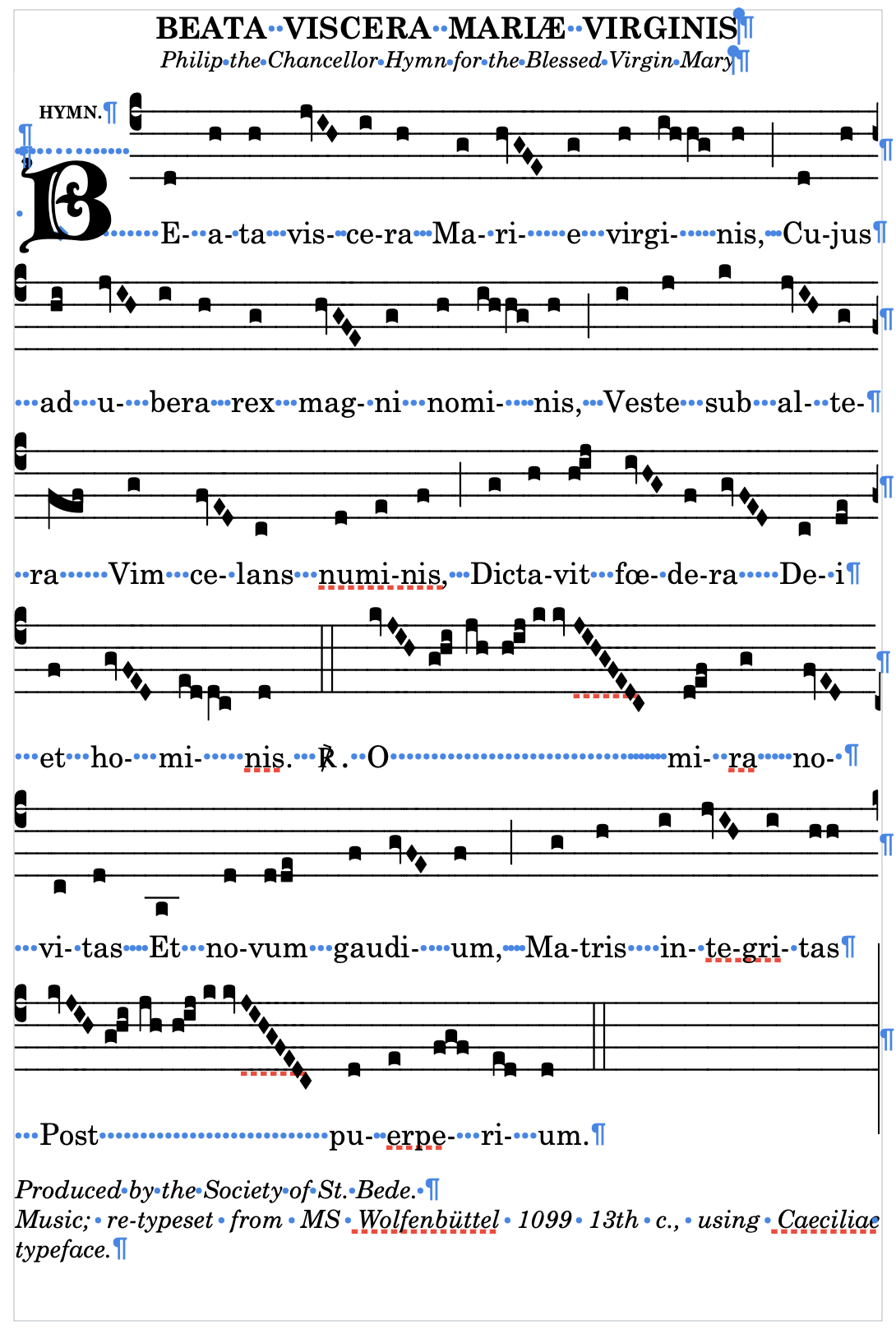
 1090 x 1622 - 406K
 -
Thank you @tomjaw ! I now see that neither gregorio nor Source&Summit automatically put in the tail at the top of the climacus. I'll add v to do that.
As a matter of interest, what Swiss manuscript are you referring to? I found one in Germany which had been posted back in 2014 by @continuousbass. -
Cod. Sang. 383 (St Gallen 383) pre A.D. 1250 possibly from the Cathedral of Lausanne
https://www.e-codices.unifr.ch/en/csg/0383/174/0/
Thanked by 1probe -
One consideration for both of you editors: I suspect the upward tail on the third note is a plica that represents another note (b). There is another one in the last line. That SG383 find is really interesting. It feels like such a different piece in that mode!
-
Thank you Charles! I hadn't realised the little tails could have that meaning - is that like a liquescent neume? So that could explain the editorial decision (Tristan Meares) in the modern notation from cpdl to add sixteenth note decorations. Someday (though not in a heatwave) I'd love to visit the Abbey of St. Gall in St. Gallen with a knowledgeable guide. I have the book of the Words on the Wave exhibition at our National Museum.
-
One more thing: I have now found the translation of all seven verses and I could not sing five of them with their mediaeval references to the Jews. I could do the first and last. Although even there the meaning of the "Solem quem librere" verse is not clear to me, maybe it's just the translation. "Let the wholly enclosed womb of the mother behold from the side as it is reflected"? And then there's the response associating childbirth with loss of purity that is not going to sit well with modern sensitivities. Maybe I should look for other 12-syllable Marian hymns to set it to.
-
I don't think St. Matthew lived until the Mediaeval period, but he as a Jew and tax collector wrote, "So when Pilate saw that he was gaining nothing, but rather that a riot was beginning, he took water and washed his hands before the crowd, saying, “I am innocent of this man’s blood; see to it yourselves.” And all the people answered, “His blood be on us and on our children!"
It is all very well trying to claim that this is incorrect, but that calls into question the entire Bible not just the Gospel of St Matthew.
In the past people knew the bible and took what was written seriously, if we choose to ignore sections because they do not fit with modern ideas, what does that say about us! -
Thanks for everyones hard work. I had been on our annual canonical retreat this past week, and this was a lovely gift to come back to.Thanked by 1tomjaw
-
Dear @monasteryliturgist
Have produced the full 7 verse version of this Hymn as found in the Wolfenbüttel 1099 manuscript as well as the 3 verse version found in the St Gallen manuscript. they can be found here,
https://societyofstbede.wordpress.com/2026/07/04/beata-viscera/
Thanks to @Charles_Weaver for the valuable input, I used the other manuscript to help compare. I suspect another manuscript is around as the recording on Youtube is slightly different. -
May I follow up with a translation question, please?
Vox Clamantis have for the last verse:
Solem, quem librere,
Dum purus otitur
In aura cernere
visus non patitur,
cernat a latere
dum repercutitur,
alvus puerpere,
qua totus clauditur.
The eye cannot bear to look freely on the sun
As it rises in the air in all its purity.
Then let it behold that sun from the side, as it is reflected:
In the womb of a pregnant woman, where it is enclosed entire.
To my literal eyes 'reflected' asks us to picture a shiny bump reflecting the sun. Is there a more allusive expression?
mirrored
echoed
represented
re-imagined
revealed
symbolized
pictured
...?
https://www.traditioninaction.org/religious/Music_P000_files/P160_Bea.htm has a translation sticking closer to the Latin word order:
The sun, unconcealed, shining,
At daylight one cannot suffer to see,
One sees it from in its reflection,
In the womb of childbirth, which is fully virginal.
-
The second translation is more literal, but missing the link between the Sun being Christ and the moon being a type of the Blessed Virgin, reflecting the light of Christ for us.
-
Thanks @tomjaw, the simile/metaphor/parallel escaped me - so 'reflection' here is an allusion to the moon reflecting sunlight, which we can look at, as Mary reflects Christ. I don't think that can be unpacked in a translation within the verse but rather a footnote. I'll look it up.
https://ancientinsights.wordpress.com/2021/09/11/mary-rachel-and-the-moon/
Thanked by 1tomjaw


Welcome to the MusicaSacra Forum!
To participate in the discussions on Catholic church music, sign in or register as a forum member, The forum is a project of the Church Music Association of America.
Categories
- All Discussions21,844
- General Music Discussion8,548
- Job Openings292
- Management of Music Programs862
- Choral Matters539
- Church Documents and Rubrics540
- CMAA Notes307
- Events760
- For Newcomers: Read First26
- Sacred Polyphony567
- Hymnody898
- Gregorian Chant: General2,749
- ↳ Graduale Romanum and Liber Usualis372
- ↳ Graduale Simplex61
- ↳ Semiology65
- Vernacular Plainsong704
- Anglican Use and Anglican Chant73
- Organ, Other Instruments and Repertoire452
- New Composition/Works in Progress1,342
- Recordings238
- Music for Hispanic Ministry163
- Music Education: Children217
- Music Education: General223
- News Items247
- Positions Wanted3
- General Discussion: Catholicism742
- Amusements185
- General Discussion1,048
- Opinions119