
GABC-like chant notation on modern staff?
-
Hello all,
I am wondering if there is an easy way to format chants (similar to GABC), but on a 5-line modern staff. In order to make English adaptations of chants more organ-friendly, I have to take the GABC code, transpose if necessary (which is of-itself time-consuming), and add a 5th line + staff signature + accidentals in microsoft paint. Does anyone have a better method?
Thank you,
CantorCole -
Are you looking for square notation in a five line staff with a modern clef, or for rendering gabc in modern notation all along?
-
I would transpose by hand in notation software if you must, then use the tools to transpose to your preferred key. (My assumption was perhaps wrong: I think I now understand, something like the special vesperal that Jeff O posts about sometimes)
-
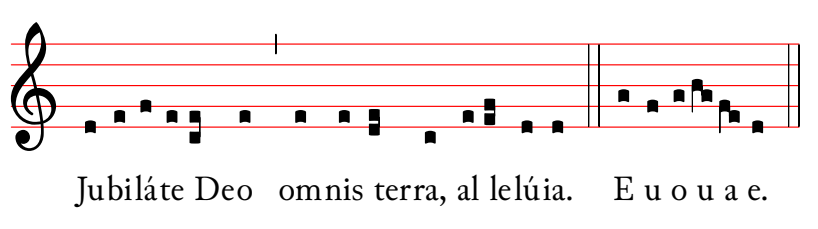
Here's what LilyPond can do. (And here's the source code.)
With https://github.com/igneus/lilygabc it would be even possible to include an existing gabc file in a LilyPond document with no additional transcription work involved, just setting up the non-standard staff and clef globally. But with adaptations of Mass propers you are bound to regularly run into all the issues LilyPond has with rendering melismatic pieces, so it's of no use for you.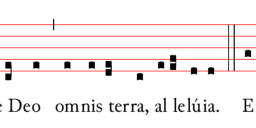 818 x 229 - 23K
 -
The Weimann graduals are available via CCW that do exactly this. It rather saddens me that this never caught on, as it is the best of both worlds in a way.Thanked by 1DavidOLGC
-
@CantorCole, while it would still require manual effort, using InkScape or some other vector graphic software instead of MS Paint would be much more effective. You can use it to edit SVG or PDF files directly (but don't use PNG or other raster filetypes). There are almost certainly better ways, but this would be a good start.
-
Hi, you might be interested in my new project: https://aretino-chant.github.io/ It's an old concept promoted by the Hungarian professor Laszlo Dobszay, and a new (early) implementation.
-
I'll be honest: I cannot fathom why you'd want to do that type of transcribing with a GABC-style editor, when regular notation software is so much faster, especially since you don't use the traditional GABC codes, but rather a two line system. Thousands and thousands of GABC files and you don't want to use the same language. OK. But then the notation isn't really chant either... OK. But then it's a lot harder to code and it doesn't look as good as normal notation editors... so I'm at a loss for what the advantages are in this case.Thanked by 1BRIFFHU
-
Thank you for your feedback. Aretino is not “GABC with different syntax,” but a Dobszay-inspired concept for transcribing Gregorian chant on its own terms: staff-readable for modern singers, yet still preserving the neumatic logic of chant. So while it literally is "GABC like chant notation on modern staff", as the discussion title says, might be not at all relevant for many people. I believe still could be interesting for some.
-
If it's of interest, here is a Claude-generated app that converts gabc to musicxml, ready for import into your regular notation software. Rename .txt to .html and launch.
-
I get that. What I don't understand is why you're writing a whole new syntactical language to code it, when this type of thing is already easily achievable in notation programs like Dorico. I do this type of transcription all the time.transcribing Gregorian chant on its own terms: staff-readable for modern singers, yet still preserving the neumatic logic of chant.Thanked by 1BRIFFHU -
this type of thing is already easily achievable in notation programs like Dorico
Thank you for your example (it is indeed beautiful), this clarifies your comment for me. Dobszay's system, with huge emphasis on neumes as single blocks and virgae as visual separators, which I try to support with software, is not easily achievable with Dorico I think. Take a look at Kyrie VIII's transcription from GABC. This shows the uniqueness of his system (and it is teached at cantor schools in Hungary, so it does have some established practice). A text format has some advantages (creating scores without installing software etc.), and the pecularities in the syntactical language (which borrows stuff from both GABC and ABC) is partly due to the nature of the system, which is half-Gregorian, half-Classical... So in a nutshell, these are the reasons. But to be honest, this project was born to replace a 25 years old Hungarian system for this kind notation, used in the country in countless liturgical books... but I though this would be interesting abroad as well. -
you might be interested in my new project: https://aretino-chant.github.io/
This looks great. I also like the syntax of the coding system, which is quite close to abc and is much better readable than gabc: with your coding system, it is possible to sing directly from the ASCII code (not that this is what it was meant for). And the music notation system that it produces is IMO better than the Gotteslob "pigeon egg" notation, yet -unlike the four line disatematic square neumes- seamlessly integrates with modern notation and is thus immediately understandable by all musicians.
On the website, I only see an interactive web application, but it says on the bottom "Released under MPL-2.0 (code)". Is the code somewhere accessible? And is it only a web application, or does it include a command line program that takes a file in your code as input and produces some graphics?Thanked by 1BRIFFHU -
On the website, I only see an interactive web application, but it says on the bottom "Released under MPL-2.0 (code)". Is the code somewhere accessible? And is it only a web application, or does it include a command line program that takes a file in your code as input and produces some graphics?
Thank you a lot for your feedback. All source code is public on GitHub, though I wouldn't fork it yet, as in this early phase of the project, everything is in motion. Currently the renderer needs a browser to properly render text, so no command line yet, but I will certainly prepare it for LaTeX workflows, so command line is coming for sure. -
nothing prohibits a separation of text and chant content in gabc. You can display jgabc this way albeit very imperfectly: perhaps a future revision to the descriptive language would allow for this. I think my basic problem would be that it transfers a problem of readability to another place (now you have to really know the language to find out what syllable goes with what part of the description…
that doesn't make it readable for singing, but since neither is meant to be sung without a graphical representation, it's not that big of a deal.
Also, having read more, I'm less fussed about a new language since it does the conversion for you (it just has to keep up with gabc, which, well, that might be challenging)Thanked by 1BRIFFHU -
Take a look at Kyrie VIII's transcription from GABC. This shows the uniqueness of his system (and it is teached at cantor schools in Hungary, so it does have some established practice).
Here is my own transcription of the same: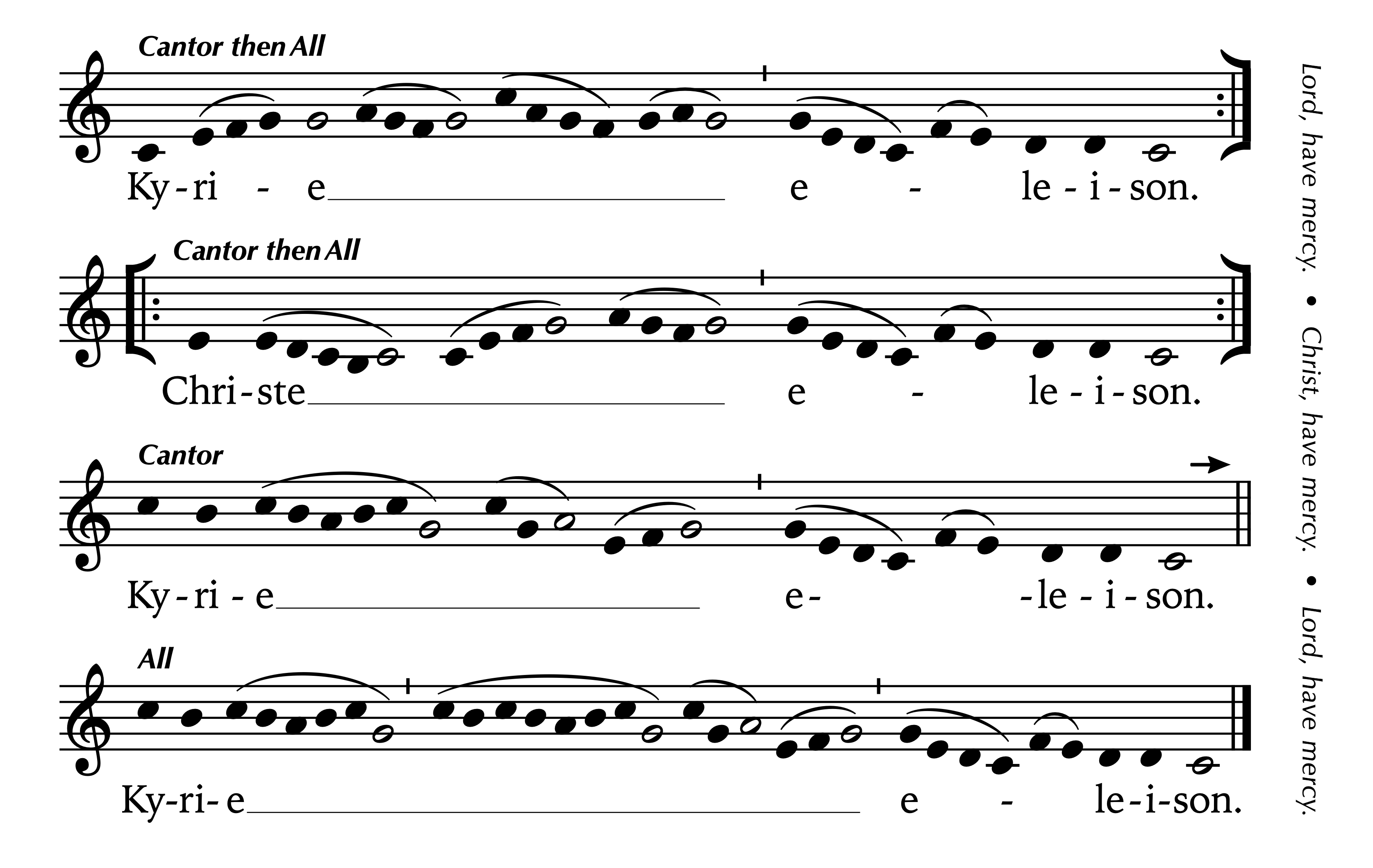
I prefer the white noteheads for "long" as it's simpler for a congregation to read (black means "short", white means "long") but it could be dune with dotted black noteheads just the same.
I confess, I find your example much more difficult to read than the one I've engraved. 3350 x 2118 - 474KThanked by 1BRIFFHU
 -
I prefer the white noteheads for "long" as it's simpler for a congregation to read (black means "short", white means "long") but it could be dune with dotted black noteheads just the same. I confess, I find your example much more difficult to read than the one I've engraved.
These are valid points, and I really don't want to convince or argue, even myself I used to have other transcription preference (beamed 1/8 notes for short e.g.). Dobszay's system is one particular approach to the problem. He was a highly trained musicologist, by far the best in his generation, and a warrior personality, happily involved in all imaginable Gregorian wars... I wish to keep myself far away from that... He wouldn't have liked your transcription, he would have said that a neume is not a sequence of "equal" notes. But then we can have a lot of arguments in favor of like congregational singing versus professionally trained scholae, so I really won't go into this debate, especially as I grew up with Gregorio, and this project grew up as a need to rework an obsolete but (in Hungary) widespread system, and not as a competition or something. If someone else finds it useful: I'm more then happy. -
I have also gone back and forth on how I wish to present things; I'm settling into stemless, using dotted ties (since I do ultimately use Mocquereau…), slurs only for parts actually connected meaningfully, and white notes for dots/the mora vocis: however, I do use the tenuto for the episema, which I still mark in.
I used to beam things like Mocquereau's older transcriptions, but that's a little less clean in the end.
I appreciate seeing the virga; the slur doesn't represent this effectively. You have to know what kind of neume it is in the square notation (or whatever notation you used originally), whereas this Hungarian system at least makes it more clear what kind of neume the square notation is representing (however accurate or inaccurate this is itself representing an earlier form).Thanked by 1BRIFFHU -
Indeed any transcription is a pragmatic decision, and I haven't been able to anchor myself to a final system. And my favorite look is still Gregorio... just I need something myself which I can use with the congregation and our high school schola.Thanked by 1ServiamScores
-
Yes, on the sidelines and I have no data for comparison to Western Europe but primary school music education is still strongly Kodaly influenced and we still have a strong elementary music education system (essentially free 1:1 lessons on classical music instruments until end of high school). Surprisingly my feeling is that music literacy in general is not as good as it should be based on the circumstances, but still, giving sheet music to the congregation is clearly improves their singing/participation, so I guess there is some effect from primary school years.
-
I found a book published in 1990 that follows this Hungarian notation system, a Good Friday lamentation. Exactly this is what Aretino software was created to support.
From 1990: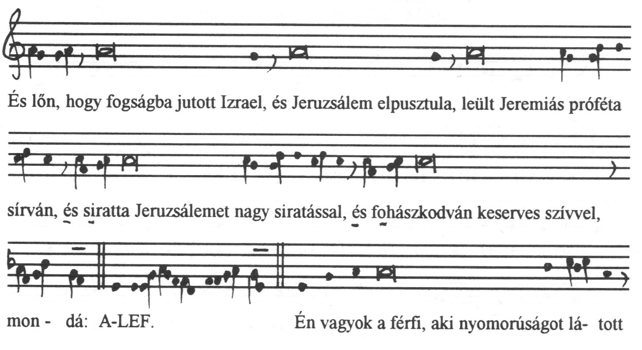
With Aretino Chant notation: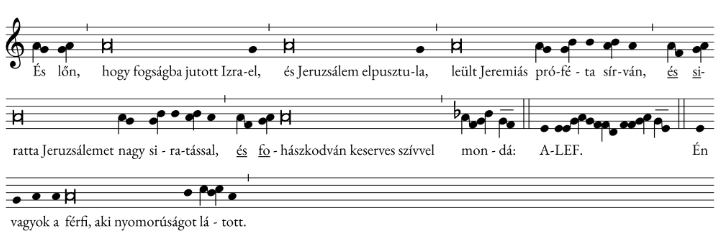
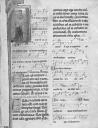
And I've also attached a manuscript page from the 14th century, where the basic elements of this notation are visible: a neume is strictly not a sequence of notes, but one musical gesture, but also it is denoted using the X axis as time. This is the tradition this system tries to preserve.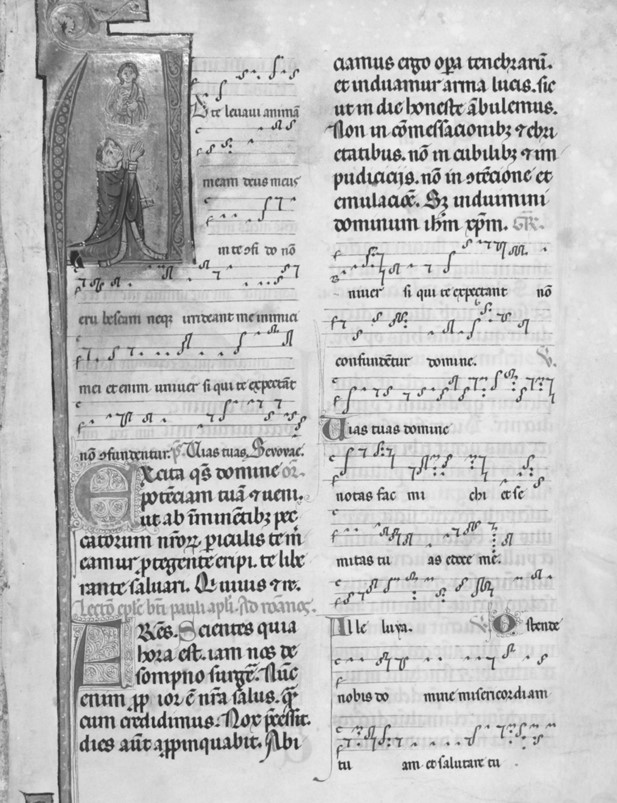
 642 x 350 - 117K
 722 x 241 - 33K
 617 x 803 - 155KThanked by 1CHGiffen
 -
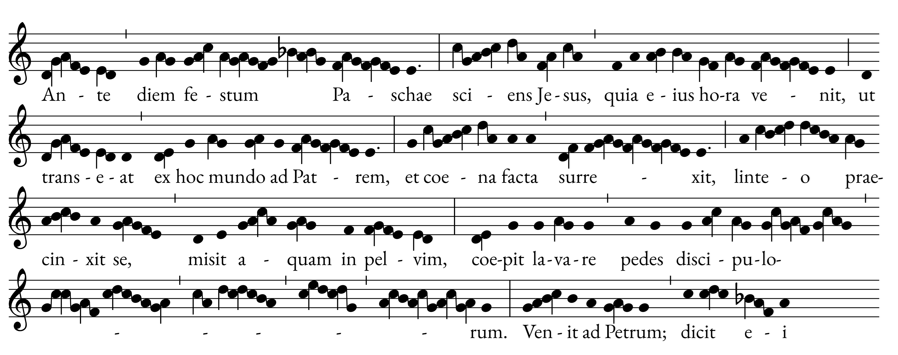
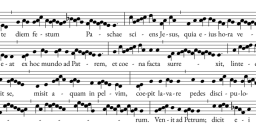
@davido I think I can show you the authoritive interpretation of a score (with some slight textual variations, not exactly the same edition, but almost), as both of them are coming from the same source: https://www.youtube.com/watch?v=sdop9YT9OWg
 898 x 355 - 75KThanked by 1CHGiffen
 -
Excellent. Thank you so much for this work on the notation. Those old Dobszay recordings are absolutely wonderful, and it is very enlightening to compare it with your score. My mentor Tom Kelly was also involved in some of these in some way as well.
-
From the sidelines, not a fan of what a friend of mine called "those black blobs" and the hollow white notes. I encountered the problem of choir members who sat on the white note. "It's a whole note, isn't it?" Adding a dot to a black blob is less likely to cause a problem. But I much prefer seeing eighths (with beaming) and quarters. It makes chant more accessible to those with little or no training in music. But, I'm looking to start a fight. I understand the rationale for all of the other fine notation systems put forth here.
-
Surely different dialects of music notation, where we're overloading/reinterpreting meaning of music symbols, they will surely cause issues for some (or many).
-
Classic "de gustibus...". I really loathe that style lol. I think it is harder to read, and it tempts people into more literal rhythms because of the beaming (at least in my experience). Lots of clutter and extra schtuff in the score.But I much prefer seeing eighths (with beaming) and quarters.
(That's one of the reason I highly prize reciting tones; I don't like having a note for every syllable if it's not necessary. People get all ploddy, whereas they will just sing the text naturally on reciting tones. That's one thing that Briffhu and I can certainly agree upon, and I'm glad to see their system supports it.)
As acknowledged above, transcribing is an exercise in compromise... I think it's dangerous, tbh, to try and make overly detailed transcriptions. You cross a threshold where it's better to simply do the real thing (ie- square notes). -
@ServiamScores
I largely agree with you about the effects of transcription. You really put your finger on a fundamental issue of notation. There is no "neutral" position; even stemless noteheads such as Hiley and Maloy use imply a lack of "literal" rhythms as you put it, which is hardly a neutral choice. I just want to point out that of course square notes are a transcription too! Such is our lot.Thanked by 1ServiamScores -
I recently saw some medieval music from Germany transcribed to be analyzed and performed (I can’t remember the context but it’s religious music as well as things like Sequences which were the easiest transcriptions). The musicologists couldn’t agree exactly! It’s a form of notation that I had never seen and I was about to complain about the use of modern notes, but then I saw the original notation, and I was like yeah never mind, I get it now.Thanked by 1Chant_Supremacist
-
@BRIFFHU
Thank you! This is basically what I was looking for! Is there a way to transpose easily (without manually altering the notes in the code)? -
@CantorCole Yes, that is planned, I'm happy to add this feature today.
-
@CantorCole it's done, see how to use: https://aretino-chant.github.io/user-guide#_21-transposition
-



Welcome to the MusicaSacra Forum!
To participate in the discussions on Catholic church music, sign in or register as a forum member, The forum is a project of the Church Music Association of America.
Categories
- All Discussions21,844
- General Music Discussion8,548
- Job Openings292
- Management of Music Programs862
- Choral Matters539
- Church Documents and Rubrics540
- CMAA Notes307
- Events760
- For Newcomers: Read First26
- Sacred Polyphony567
- Hymnody898
- Gregorian Chant: General2,749
- ↳ Graduale Romanum and Liber Usualis372
- ↳ Graduale Simplex61
- ↳ Semiology65
- Vernacular Plainsong704
- Anglican Use and Anglican Chant73
- Organ, Other Instruments and Repertoire452
- New Composition/Works in Progress1,342
- Recordings238
- Music for Hispanic Ministry163
- Music Education: Children217
- Music Education: General223
- News Items247
- Positions Wanted3
- General Discussion: Catholicism742
- Amusements185
- General Discussion1,048
- Opinions119