
Women Cantors EF Divine Office
-
To think that a woman in a cassock singing a cantor’s duty will somehow cause grave confusion or scandal? Has anyone seen a man in a cassock at Mass and wondered if they’re a minor order or not?
I’m not suggesting that a woman wear a cassock. I’m suggesting that solemn vespers doesn’t require the schola to enter the sanctuary or, if your church architecture actually has a choir, the choir. All my solemn vespers notes has the priest doing the intonations. I’m fairly confident the FSSP aren’t violating the rubrics.And I’m sure I’ll be reprimanded for this: what of gay, trans, non-binary, and intersex Catholics?
It’s way too early in the morning where I am, and I am still half asleep to hash this out rationally based on policy and church teaching, and it is possible. There are requirements that people in such ministries are at the bare minimum required to be living their life in accordance with Catholic moral teaching. I know that pastors can handle this on a case by case basis, but there is a legitimate issue of managing potential scandal.
There’s no issue with someone who has SSA who is living in accordance with Church teaching. Intersex doesn’t fall under the same bracket, as it’s a medical matter. It would likely become an impediment if the person wanted to be ordained since there’s the matter required for a valid ordination. -
I’m not suggesting that a woman wear a cassock. I’m suggesting that solemn vespers doesn’t require the schola to enter the sanctuary or, if your church architecture actually has a choir, the choir. All my solemn vespers notes has the priest doing the intonations...
If the cantors are not in choir (on the sanctuary) it is no longer Solemn Vespers...Thanked by 1Chant_Supremacist -
It’s interesting that the discussion went from having women fill men’s liturgical roles to having transsexuals fill the roles. It’s as if the dismantling of functional distinctions between the sexes leads inevitably to deeper sexual confusion.
-
Yeah. Our organist and the organ are a combo that means that we have coped assistants but I’m not in the choir. This is a problem but only solvable in the long term. tomjaw is completely right that my situation means that we have Vespers that are deprived of something.Thanked by 1tomjaw
-
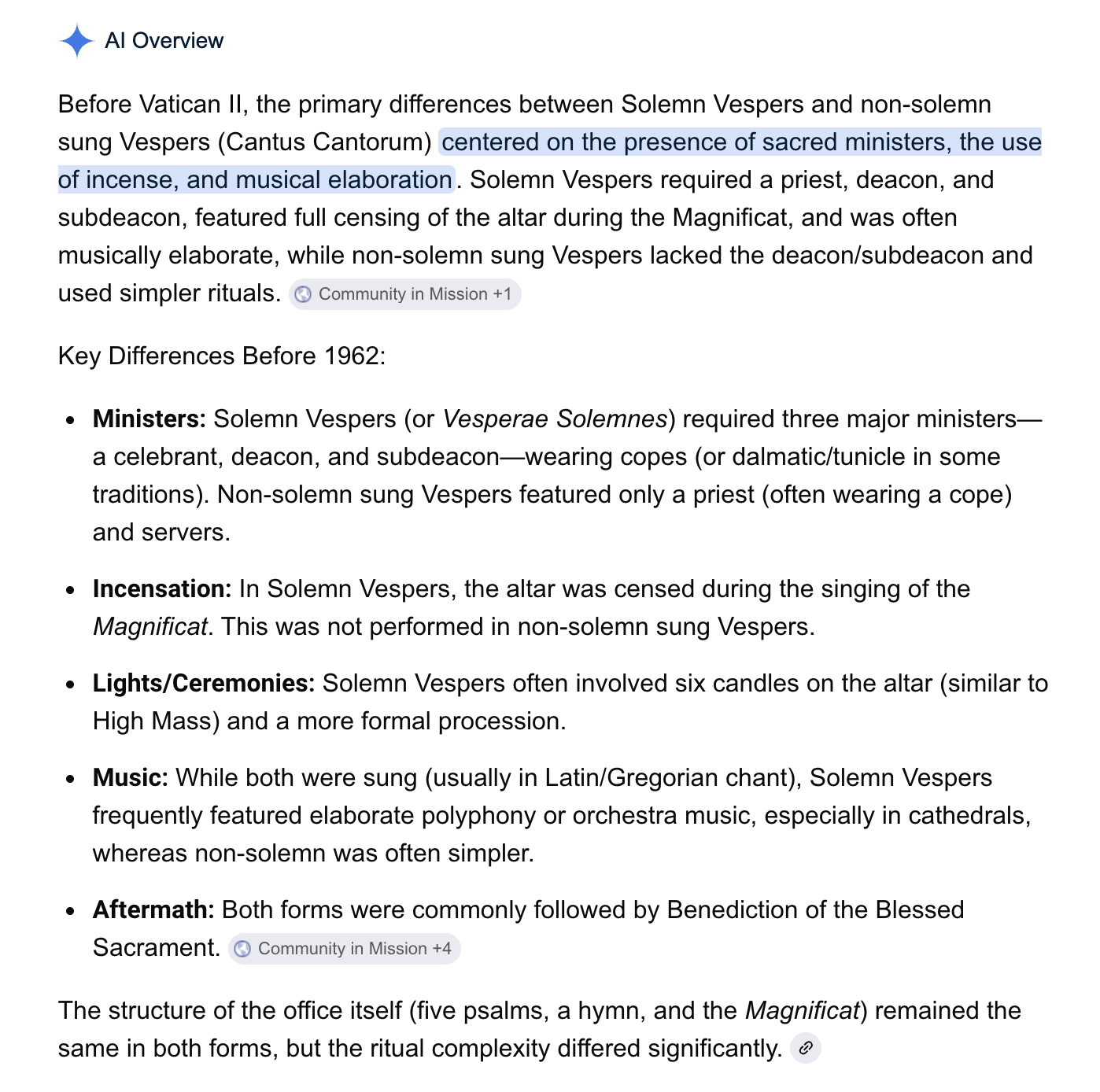
Not being personally experienced or conversant in preconciliar Vespers ritual, I asked Google AI a question and y'all can decide how accurate it is or not:
 1398 x 1388 - 365K
 -
If the cantors are not in choir (on the sanctuary) it is no longer Solemn Vespers...
That’s not what determines what makes vespers solemn or not.
-
Yes, it is, Sponsa, in the full sense: two coped assistants plus cantors = solemn Vespers. Coped assistants with no cantors should not exist. Vespers with only a cantor are licit but if possible there should be a cantor, in cassock and surplice, as close to the altar area as possible.Thanked by 1tomjaw
-
I believe it is a bit more complicated. For example, Pope Benedict XVI stated that post-VII legislation does not apply to the EF when it "contradicts the rubics of the 1962 liturgical books"; he did not write 'any legislation pertaining to liturgy valid in 1962' or anything like that. This is not the same thing, and we had a lot of discussion about it. As far as I know, there is no magisterial church document that is more precise on that matter - anyone who knows more?
If by plausible you mean tenuous, agreed. All of the EF-related instructions I'm aware of state that the rubrics and norms that govern it are to be faithfully continued.* It could be argued that changes to canon law such as the admission of women to the ministry of lector remove the bar to women as cantors even in the old rite. I think this is plausible.
Non-admission of women to the sanctuary in liturgy was valid discipline at the time, but it is not mentioned in the rubrics. One can argue that this has been omitted because it was unnessecary to mention due to the pertaining discipline - but on the other hand, pope Benedict explicitly said "contradicts the rubrics" and nothing else.
The same issue arises when it comes to the way of receiving communion by the faithful, which isn't mentioned in the rubrics either. -
Some of these things weren't mentioned in the rubrics because, unless I'm mistaken, they were explicitly forbidden by the 1917 Code of Canon Law.
-
Yeah.
-
Right - but pope Benedict didn't decree either that things that were allowed by CCC 1983 would remain forbidden in/around the EF as of CCC 1917 rules that regulated liturgy then, and thereby formed the background on which the 1962 rubrics were written... Did he mean to say that implicitly? Then why didn't he do so expressis verbis? (or did he)
-
I don't at all think Benedict implicitly intended that the EF would be governed by the 1917 Code, but that doesn't mean assumptions stemming from that Code have no meaning or effect in legal interpretation of the rubrics.
For instance, Ecclesia Dei ruled in 2011 that women and girls could not serve at the altar in the TLM, despite this not being expressly forbidden in the rubrics due to contemporary law, norms and assumptions, and despite it being expressly permitted in later legislation.
On a hyper-literalist reading there's no positive contradiction to that later permission within the rubrics, and thus the later law should be operative. But the standard is not a hyper-literal "do the old rubrics positively forbid this, and if not, it's fine" but a contextually sensitive one: it wasn't in practice, it wasn't contemplated, and it wasn't expressly permitted.Thanked by 1Elmar

Welcome to the MusicaSacra Forum!
To participate in the discussions on Catholic church music, sign in or register as a forum member, The forum is a project of the Church Music Association of America.
Categories
- All Discussions21,844
- General Music Discussion8,548
- Job Openings292
- Management of Music Programs862
- Choral Matters539
- Church Documents and Rubrics540
- CMAA Notes307
- Events760
- For Newcomers: Read First26
- Sacred Polyphony567
- Hymnody898
- Gregorian Chant: General2,749
- ↳ Graduale Romanum and Liber Usualis372
- ↳ Graduale Simplex61
- ↳ Semiology65
- Vernacular Plainsong704
- Anglican Use and Anglican Chant73
- Organ, Other Instruments and Repertoire452
- New Composition/Works in Progress1,342
- Recordings238
- Music for Hispanic Ministry163
- Music Education: Children217
- Music Education: General223
- News Items247
- Positions Wanted3
- General Discussion: Catholicism742
- Amusements185
- General Discussion1,048
- Opinions119