
Women Cantors EF Divine Office
-
In the 1962 Divine Office, can women be cantors? I’m looking for some legislation or rubrics that would justify this. This would be a public Office with lots of people in attendance, and more than enough competent men. As far as we have been able to work out, hebdom and cantor are clerical roles, and so are reserved to men in the EF.
-
Quit being sexist. They’re not clerical roles. Women religious do it all the time as did religious brothers who are not clerics.
[Please assume good will; don't accuse. Questions about how to understand the old rubrics restricting choirs to men have been around for years, so it's no surprise that people ask to clarify what is permitted. --admin]
Thanked by 1wspinnen -
I’m not seeking confrontation, so thanks for your rudeness - we’re in a situation which went very badly when women altar served in the EF, so badly that the EF is no longer celebrated, and so this needs some actual legislation/rubrics behind either practise.
-
I presume they will be in choir, with full ceremonies. So customs from Religious Communities will not apply.
-
A practical (perhaps non-legislative) sticking point is that the hebdom and cantor are to be sat in choir - what is women’s choir dress in the EF?Thanked by 1FSSPmusic
-
Quit being sexist
What a ridiculous and profoundly unhelpful thing to say. -
If they are to be in choir the legislation governing the traditional liturgy gives an unequivocal "no". For details consult the 1958 instruction De musica sacra on persons having principal functions in the liturgy.
-
No, a choir including women or girls cannot be placed inside the sanctuary. The inclusion of even a single female cantor constitutes a mixed choir by definition. For Solemn Vespers with officiant in cope, incense, etc., it is understood that the cantors will be "in choir," i.e., inside the sanctuary if there are no choir stalls, even if the other singers are placed outside of the sanctuary. The designated cantors have not only a musical role but also a ceremonial one. Those who have received tonsure wear copes. A layman can substitute but should not wear the cope.
I know of no circumstances in which an ordinary laywoman can substitute for a vested cleric in the old rite celebrated solemnly. You could possibly justify an all-women's choir with their own cantors singing Vespers from the choir loft or nave, but not a mixed choir with female cantors. You already said that "more than enough competent men" will be present, so why are you seeking to justify an untraditional, unrubrical, and disobedient practice, adding that women altar servers were tolerated and that it went badly?! I don't mean this as a rhetorical question either. Please share your reasons/motivations with us. -
A layman can substitute but should not wear the cope.
Although much like straw subdeacons this happens a lot, especially outside of the part of trad-land where you exist…
Now our cantors are normally banished to the loft but I think that this was an egregious mistake: the ceremonies matter.
Anyway yeah men should be cantors doubly so if you have them present in the choir/sanctuary.Thanked by 1tomjaw -
I’m not seeking confrontation, so thanks for your rudeness - we’re in a situation which went very badly when women altar served in the EF, so badly that the EF is no longer celebrated, and so this needs some actual legislation/rubrics behind either practise.
It’s not rudeness. It’s the truth. Look to your Diocesan policy on discrimination against women holding positions in choir and being cantors. Those are your current legislations, whether you like them or not. -
ROFL!!! As though diocesan policies trump universal liturgical norms! Next you'll tell us that TLMs should be compelled to use women as acolytes and lectors. Get a clue, will you?
-
First I've ever heard of diocesan discrimination policies having anything to do with liturgical rubrics...
-
Thanks everyone for your contributions. @FSSPmusic, don’t worry, I’m not personally seeking to justify the practise, I was trying to write the question in such a way as to not bias the answers, not that that worked. In my view, women can’t cantor at the 62 Office, as @Chant_Supremacist linked to in de Musica Sacra. We have one very vocal woman in the schola who is demanding to cantor and the issue will now go to the priest, and we are not sure how it will go - he is not that familiar with the EF.
So the thing I’m most interested in is legislation or rubrics which apply to women cantoring (or acting in a clerical role) in the EF, that can be brought to the priest.
One concern is that if women can cantor in Vespers without ceremonies, but not with ceremonies, then the priest will require us to change to do vespers without ceremonies. Thoughts on women cantoring in these circumstances?
@FSSPmusic, you address this a little - do we have any legislation which supports the idea that we can’t have a ‘mixed choir with female cantors’? If there is no one sat in choro in the sanctuary, no one is vested, there is no preference for vested cantors possible, and so how do we defend the men only as cantors? -
We could spill a lot of ink on this (edit: report from the future: we have), but I think the most direct answer for you is that the 1958 permits a choir of the faithful - which can include women - only when a true choir "cannot be organized," meaning that reducing the solemnity simply to find a technicality by which to allow a female cantor is already excluded.
-
My take on the question is this:
* The restrictive rubrics were designed for churches with enough room to include a choir in the sanctuary. This is seldom the case in the US, so sing from the loft. A choir there is clearly non-clerical, so the choir can be mixed and it is permissible for a woman cantor to participate.
* It could be argued that changes to canon law such as the admission of women to the ministry of lector remove the bar to women as cantors even in the old rite. I think this is plausible.
* What is permitted is not always prudent. If your congregation would be shocked at a woman cantor, that is a reason to forbear it in public celebration of the Office.
NB: Those are just my opinions, not CMAA's.Thanked by 1CHGiffen -
In the above discussion, what's the difference between “cantor” and “singer”?Thanked by 1Chant_Supremacist
-
That said, I'm not aware of any official distinction in the 1962. There is a common-sense distinction of leadership, and in a customary sense that is again broadly preferred for men in the liturgy, but if the question is about legality plain and simple I don't think cantor vs. singer is salient. If an official distinction exists, someone let me know - maybe I'll add Cantor to my email signature.
@chonakA choir there [in the loft] is clearly non-clerical
Proximity to the altar is a factor, but the liturgical function is auditory - it doesn't consist of sitting near the altar but of singing the texts. So even at a remove from the sanctuary the principles of TLS regarding clerical substitution don't just vanish, though it's fair to say they're attenuated.
Perhaps more importantly, the role ought to be carried out in choir - like St. John's voice of myriad angels round about the throne - and the existence of issues preventing that (lack of or incompetence of the male singers, accidents of interior design or architecture, etc.) shouldn't be turned into self-perpetuating obstacles to that aspiration.* It could be argued that changes to canon law such as the admission of women to the ministry of lector remove the bar to women as cantors even in the old rite. I think this is plausible.
If by plausible you mean tenuous, agreed. All of the EF-related instructions I'm aware of state that the rubrics and norms that govern it are to be faithfully continued. -
It could be argued that changes to canon law such as the admission of women to the ministry of lector remove the bar to women as cantors even in the old rite. I think this is plausible.
This is not plausible.
If this woman won’t be quiet get rid of her. -
The legislation seems to imply that a mixed choir is only admissible where a choir of men and boys is unavailable to sing polyphony—which is most places nowadays. We need more information about what is envisioned for this Vespers before making a judgment. Will some polyphony be included, or will it be sung entirely in Gregorian chant? If the latter, is the choir singing anything that could not be sung by the congregation? You mention "a public Office with lots of people in attendance," so this sounds like a situation with some people (the choir) leading worship and others (the congregation) attending and listening silently, not a group of the faithful all singing Vespers in common. Again, more information is needed. Cantor in this context refers to the one who intones the beginning of the antiphons and psalms.
According to De musica sacra:
You have already established that competent men are available and that there is no necessity for a woman to lead. Now, the role of a cantor at Vespers isn't the same as a commentator at Mass, but there is at least some imperfect kind of analogy. We previously had a women's schola here, but they sang complete Masses alone, when the men's schola was not present.in case of necessity, a woman would be permitted only to lead the prayers, and singing of the congregation. -
I would be fine alternating chant such that the women can sing the propers and the other half of the ordinary pieces which alternate (Kyrie, Gloria, Credo). We treasure congregational singing too much and the men’s voices are needed to anchor that just as having women from the choir anchor it with the present schola singing. But I take the point that a strict separation may be ideal and/or “required”; what is certainly not in the spirit even of the rubrics and conducive to developing singers is alternating in one Mass the chant of the propers between the two groups.Thanked by 1tomjaw
-
@FSSPmusic:
Thanks for your comments. The intention is that to begin with, all will be sung in Gregorian chant, but as more members of the schola start attending, we will eventually move to polyphonic Magn etc.
The faithful will be given booklets, with the instructions to sing at the appropriate times - alternating sides for the psalms and Magn, all for the hymn, joining in the responses and so on. The hebdom will intone the antiphons (or the clergy in choir, if they come and are keen to participate). The cantor (eventually two in all likelihood) will come out to the middle and intone the psalms.
@Andrew_Malton:
The distinction between cantor and singer that I can best work out from the rubrics, and that we have followed when celebrating Vespers (or the other hours) previously, is that the cantor has the ceremonial role of coming to the middle (with the relevant genuflections) to intone the psalms, whereas a singer is just someone singing at Vespers - ceremonially, they are just one of the faithful.
@chonak
Thanks for your thoughts. Our congregation probably wouldn’t be shocked, but this sort of thing apparently got to the media before (this was before my time) so I guess that might count for something. Though unfortunately it was also before the current priest’s time too.
For sitting outside the sanctuary, I think I agree with @Chant_Supremacist, the role ought to be carried out in choir, so we will try to do that. -
The cantors also sing the versicles (or rather, one cantor might, but they move together) and pre-intones antiphons at an office with no assistants in cope or with only two.
-
Here is an excerpt from Stehle's Manual of Episcopal Ceremonies, 1916. The rubrics do not envision women wearing cassock and surplice, let alone cope, going to and from the high altar, or uncovering their heads in choir! I'm afraid your "one very vocal woman in the schola who is demanding to cantor" needs a reality check.
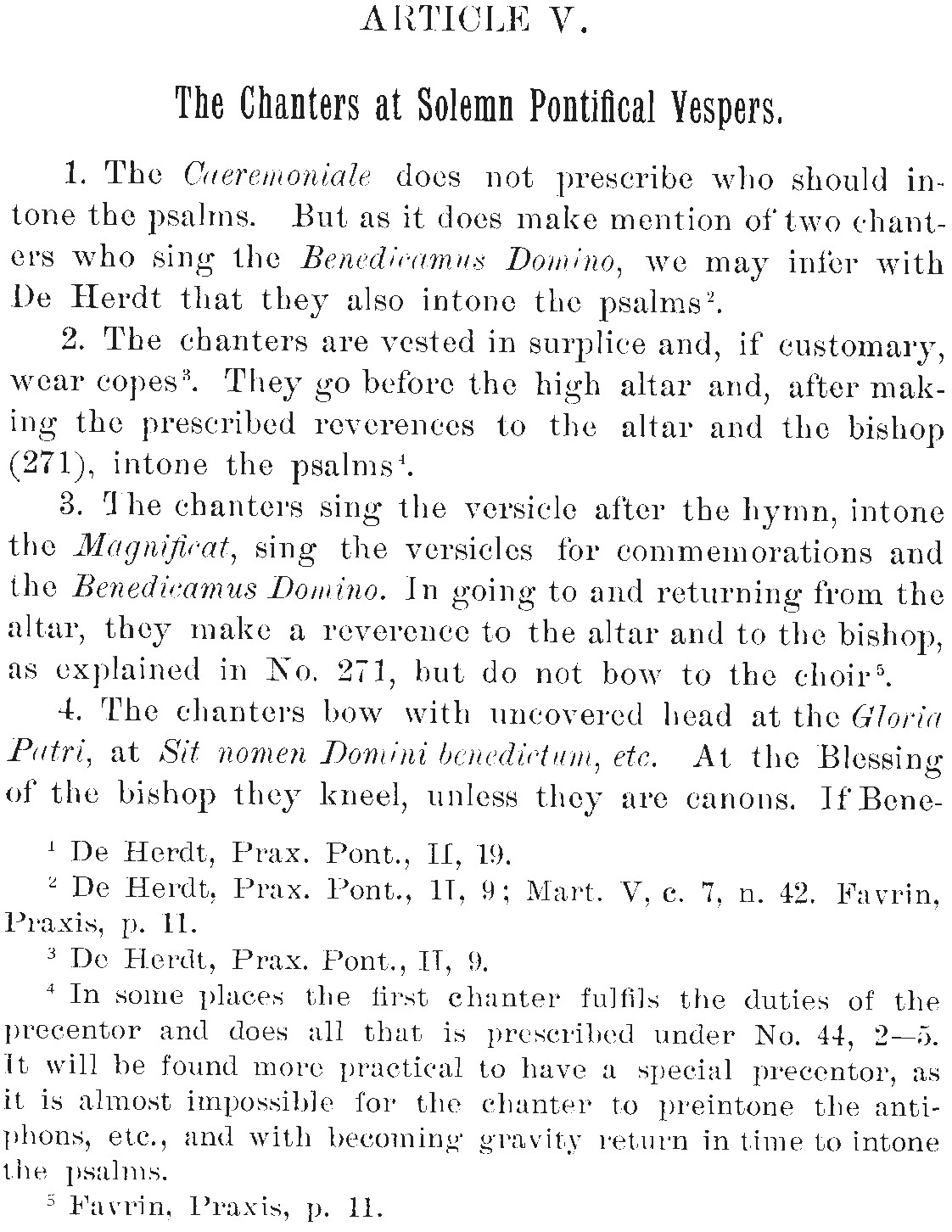
 1122 x 1452 - 408K
 -
@FSSPmusic, thank you for the excerpt. I do agree, it is that I hope our priest will too!
-
Cantors also intone commemorations if these are not done by the clergy in descending order. That isn’t the custom here so I do it. (We rarely have five capable clerics and that includes our two assistants for want of something better when we have solemn Vespers.)
-
Having made my arguments against women serving liturgical functions when men are available (especially in the TLM, but I am a noble custom enjoyer), I want to throw in a little something on the other side.
It doesn't sit well with me when women who love singing gregorian chant are told to be quiet or get out, or to get a clue. They may well be kindred spirits even if they're acting pushy and causing difficulty. I know how upsetting it is to be excluded from something you love, though I don't think rules and customs should be cast aside because someone is upset about them.
Plenty of people love gregorian chant but not many love it in the way that compels them to put in time and effort to investigate its secrets. Every one of these is a kindred spirit to me and some are, no surprise, women attached to the TLM. I don't know if the one at DOAdvocate's parish is of this breed and just feeling upset, or more of a Parish Susan trying to push the envelope. That difference matters, but I'll take the more charitable assumption here.
For chant propers, we do all male and I intend to keep it that way. Permissions exist for polyphonic propers and we occasionally make use of them. When for a year or so we had with us a young woman with a real love and aptitude for chant (she moved away for school), I found a few opportunities for her to sing serious repertoire at mass, like O Quam Glorifica (with an alto on organum it was stunning) and the verses of Rorate Caeli. She will be a great asset for the liturgy throughout her life, and I like to think I made a little contribution to her musical formation. If she goes on to reject the customs I support then so be it - in the moral fabric of the world, as I understand it, talent and effort have their own prerogatives.
The last paragraph could be construed as somewhat self-congratulatory for a man who was in fact oppressing and indoctrinating her with dark age sexist rules - and sure, guilty - but it doesn't come from a stony heart devoid of sympathy and contemptuous of women's gifts, it's just that I'll be damned if I let every last venerable custom fall apart under my watch. -
I genuinely appreciate all that you have said above, @Chant_Supremacist, but it doesn't sit well with some of us when a person with the username meaning "Bride of Christ" calls us sexist and discriminatory for being content with tradition and following the rubrics.It doesn't sit well with me when women who love singing gregorian chant are told to be quiet or get out, or to get a clue. -
I do also appreciate what you have said, @Chant_Supremacist. In our case, the schola (which is mixed) sings the propers together from the loft on a Sunday, and it is not as if she can’t sing at Vespers. And perhaps most importantly, the cantors really don’t sing anything interesting, musically speaking, so although in fairness to her she does love chant, in this case I don’t think that can be the driving factor - perhaps in other people’s situations though, there is something to be said for this.
-
I agree with both of you. The original comment was not kind, and it’s tough getting the balance. I want help from the women on weekdays for benediction. This worked well when Nick Botkins was at St Francis de Sales, but I can’t get enough commitment. :( so I have to stop serving and sing, provided that a server steps up.Thanked by 1Chant_Supremacist
-
Fully support the all-male propers as the parish Sunday norm wherever possible, with generous exceptions for schools, religious communities, special occasions.... That said there are many places in the traditional liturgy where the congregation should be joining in the chant, but often doesn't. Those are areas where women can contribute--responding to the Kyriale of course, but also joining in "Lumen ad revelationem" on Candlemas, the "Pueri Hebraeorum" and "Gloria laus" on Palm Sunday, the "Pange lingua" and "Crux fidelis" Holy Week hymns, the Veni Creator on Pentecost, singing the alternating parts on the Sequences, responding to psalmody, at funeral masses joining in the responding parts of the Libera me and the In paradisum... And of course when Gregorian pieces are used as motets or hymns, there can be no objection to female-only, mixed or alternating arrangements. Gregorian Chant is the song of the Church, and should be sung and loved by every Catholic. It is said that in Europe, in former times, whole congregations would sing the Requiem Mass by heart at funerals. Hard to think of anything more moving.Thanked by 1tomjaw
-
We would treat the Crux fidelis like the propers, but the hymns are otherwise done in alternation. When we get the organ back and can get the women in early enough to practice we might introduce alternatim for the sequences; my pastor is not opposed especially with congregational singing as a goal of ours, but without organ it's not going to happen.
The congregation doesn't really join the Pueri antiphons sadly, but they do seem to join for Gloria, laus et honor, and women sing at Vespers (we do cantors-all to give them help from at least one strong schola voice). -
In my experience adding women *to* the schola for things like the Pueri antiphons, or the "Lumen ad revelationem" is a kind of clue to the congregation that they are *allowed* to join in. It's helpful if some more talented women are invited to sit in the loft and be directed by the schola director for those parts. Alternatim is fantastic of course, but in cases where congregational participation is desired, a mixed-voice group in the loft "alternating" with the schola (you can assign a couple of schola members to the mixed-voice group) can create a sound braver congregation members can blend into. Obviously having your organ to emphasize this with "schola" vs "congregational" stops would be extremely helpful!Thanked by 1tomjaw
-
Yeah we did that for Palm Sunday and they still don’t entirely get it. We basically already do that for the office and it works well enough. I should specify that I mean including the women when I say alternatim. Currently we do that with the schola cantors and the rest of the schola, no women due to the problem of the difficulty. I don’t want the congregation joining in at all.Thanked by 1tomjaw
-
Oh yes I see. It is hard getting the congregation to join in... In France they do a pretty good job of it, but I think it's because there are so many traditional Catholic schools where the students are taught to sing everything. Building a culture takes time...Thanked by 1tomjaw
-
As an aside: one pattern that I notice occasionally is that in mixed choirs the men generally seem to have more familiarity with singing the chant. Many of us have been involved in the chant revival for a long time, some for 40 years or more.
My pet theory about this is that in the 80s and 90s, Catholics learning chant generally weren't doing so at their regular parish churches, but had to visit some underutilized church in a bad neighborhood at night. It's no wonder that most of the participants willing to go there were men.
Now that opportunities to sing chant are more common, I hope we can make room for women singers to get more experience with this music. -
We take as an assumption that the rubrics are immutable. I see no harm in questioning that assumption. I am a lover of chant, polyphony, the TLM etc etc etc like the rest of you, but I hesitate to make the leap and assume that mere rubrics are somehow on par with divine revelation and thusly cemented, never to be questioned.Thanked by 1a_f_hawkins
-
I don’t think people understand the dimension of the rubrics that call for ordination. Also the role of chant in the liturgy and it’s significance to the ordained. If this was spelled out more clearly in an article or a book gathering the historical tradition of why men sing the chant, I think it would shed light on this subject. Perhaps a journal issue of Sacred Music could be dedicated to this very subject.
-
It’s tradition, but does that mean it needs to stay that way no matter the circumstance? I can understand people’s desire to adhere to that, and even laud efforts to do so. Is there something in the way of tradition being flexible in unique circumstance? I do not believe anatomy and lower frequencies are somehow less.
-
The problem we have, is that we allow laymen to perform the duties of clerics. Once you put on your cassock / cope etc. No one knows if you have a minor order or not.
Now if we have female cantors, dressed as clerics, we have confusion... So if we have female choirs we need different rules to make a distinction between clerics and non clerics.
Blurring the lines between different roles just gives the wrong ideas. -
The proximity to Christ required is such that someone who could be a cleric should do the task even if not able to become a cleric either because of something like marriage or simply by not being one for some reason.
And clerics can only be men because Christ left us that. ergo…Thanked by 1tomjaw -
I'm glad you're here, Ariasita. Jesus came to us in a particular time and place and,although he spoke in the idiom of that time and place, his mission was to bring us closer to God by teaching love and forgiveness and mercy, not locking in the social mores of that particular time and place.
-
.I don’t think people understand the dimension of the rubrics that call for ordination. Also the role of chant in the liturgy and it’s significance to the ordained. If this was spelled out more clearly in an article or a book gathering the historical tradition of why men sing the chant, I think it would shed light on this subject. Perhaps a journal issue of Sacred Music could be dedicated to this very subject.
There are actually numerous journal articles written in Sacred Music that were written in support of women singing chant, including the Propers. They also highlight the history of women (Consecrated Virgins, to be exact) singing the antiphons in the early Church. There’s even sacred art from the medieval period that depict women and men sitting in the choir part of the church singing together. The patron saint of music and church choirs is a woman, and let’s not forget the significant contribution to the Church’s chant repertoire that St. Hildegard of Bingen made to the Church.
There are also numerous letters from Rome to Bishops asking Rome for granting permission for women to sing in church with men. I spent a weekend in one my city’s university’s library going through books on the history of music, chant, and women singing in Catholic Churches, including a book entirely made up of church documents on music, letters from Rome and from bishops asking for permission to allow women to sing in church, and also explained the historical context of what was going on at the time the documents were written. It was for a presentation I gave at my church after a priest forbade me from singing with our schola for a Mass. I wasn’t allowed to sing because we were in a modern church that didn’t have a choir loft and he was worried about pictures of a woman singing with men would end up on the internet and he didn’t want to have to explain to people why a woman was singing with men. Instead I was told to accept it as a penance, which didn’t sit right with me. Me being a woman isn’t a sin that I need to do penance for. Even the other men disagreed with the priest’s decision, but none of them were willing to speak up and say something. I would be lying if I didn’t say I felt letdown. I come from a family where the men call out other men for such behaviour, even if they’re in a position of authority.
Because of me our schola was technically mixed because I’m a woman with a contralto voice and a rather low tessitura. I primarily sing tenor, but have no issues singing most baritone lines. Prior to this incident, every traditionalist priest and seminarian had no issues with me singing the propers with men, or even singing Solemn Vespers and always encouraged me in my endeavours.
Because our church doesn’t have a choir and the schola wasn’t made up of clerics, the seminarians who oversaw Solemn Vespers told me that the proper place to sing from was either from outside the sanctuary at the front of the church, or from the choir loft. That’s why I’m not sure why it’s such an issue for whomever posted this. The rubrics for the Divine Office were changed in the 1950s. The book mentioned above is from 1919.It’s tradition, but does that mean it needs to stay that way no matter the circumstance? I can understand people’s desire to adhere to that, and even laud efforts to do so. Is there something in the way of tradition being flexible in unique circumstance? I do not believe anatomy and lower frequencies are somehow less.
It’s actually not the tradition. My grandmother was the organist and choir director at her parish in the 1940s. I would not exist if women and men weren’t singing together. My grandparents met in the choir loft. They didn’t have a schola. They sang mixed and my grandmother ran a tight ship and kept the boys in line when they got out of hand. They also didn’t even sing chant throughout Mass, even during solemnities and the Triduum. I inherited some of her choir notes. She even attended our Latin Mass’s Corpus Christi Mass once and commented that it was very beautiful, but it’s not at all how Mass was like “back in the day”.
It was much the same at the Hungarian church my dad served Mass at before Vatican II. There was a woman who played the pump organ and sang the music. The choir loft had maybe room for three people, despite being a huge beautiful stone church modelled after the cathedrals in Hungary. They were all farmers. They were too busy working in the fields and fixing machinery to be spending hours every night of the week at church.
It’s not even about low frequencies, since there are women who have low ranges. There’s at least 5 of us in the tenor section of my almost 200 person chorus. It’s a problem within traditional Latin Mass communities. If I’m being completely honest, I have never been made to feel more objectified, dehumanized, and degraded as I have been as a single woman not built like a pencil as I have been at the Latin Mass. I feel more like a chicken broken down into parts or a prized heifer. Last night I was at a different parish and for the first time a priest actually told me I should be respected because I’m a person, not because of my uterus and assumed ability to have babies. -
There’s even sacred art from the medieval period that depict women and men sitting in the choir part of the church singing together
If you're referring to the painting(s) I believe you are referring to, these have been clarified and debunked. Mixed ensembles sitting and singing liturgically in choir did not exist during the middle ages. See link here. I can never get links to work properly here, so you may have to copy and paste it.
https://forum.musicasacra.com/forum/discussion/22025/depiction-of-mixed-medieval-choir#Item_8
Nobody in this thread is contesting that women should be able to sing in choirs at all. What's being contested is women dressed as men singing in the liturgical, architectural choir and also, as cantors, performing a role which is historically closely associated with being a cleric. I fail to understand how that is not a clear-cut no-no. -
If exceptions are going to be carved out anyway, then"someone who could be a cleric should do the task even if not able to become a cleric either because of something like …"
Sex, maybe? -
Of course not. You clearly missed the point. I’m not going to badger a single man to become a deacon or priest, but he is able to become one. A woman simply can’t, ever, conform to Christ in that way, therefore she can’t cantor a public office outside of a convent setting.Thanked by 1tomjaw
-
Since the subject line specifies "EF," even if the context is the Divine Office, it is still a traditional Latin Mass community that is under consideration. Having been a part of the so-called traditionalist movement under various auspices for 25 years (and I'm sure there are others who post to this forum with longer experience), I can say categorically that the overwhelming majority of the faithful who attend the TLM have no desire to see or hear women in the sanctuary unless they're receiving a sacrament. If a woman today demands to perform the ceremonial role of cantor in the liturgical choir, what next? Leading the Litany? Chanting a prophecy? Serving at the altar? This is not an appropriate forum for promoting untraditional, unrubrical, and disobedient practices.
-
As far as I can tell, the relevant authorities in Rome have shown that they did not want to take strict stands about enforcing details of music rubrics in the old rite, and that includes back when the EF-friendly Ecclesia Dei Commission was active.
So I would urge participants against making apodictic statements about what is supposedly not allowed.


Welcome to the MusicaSacra Forum!
To participate in the discussions on Catholic church music, sign in or register as a forum member, The forum is a project of the Church Music Association of America.
Categories
- All Discussions21,844
- General Music Discussion8,548
- Job Openings292
- Management of Music Programs862
- Choral Matters539
- Church Documents and Rubrics540
- CMAA Notes307
- Events760
- For Newcomers: Read First26
- Sacred Polyphony567
- Hymnody898
- Gregorian Chant: General2,749
- ↳ Graduale Romanum and Liber Usualis372
- ↳ Graduale Simplex61
- ↳ Semiology65
- Vernacular Plainsong704
- Anglican Use and Anglican Chant73
- Organ, Other Instruments and Repertoire452
- New Composition/Works in Progress1,342
- Recordings238
- Music for Hispanic Ministry163
- Music Education: Children217
- Music Education: General223
- News Items247
- Positions Wanted3
- General Discussion: Catholicism742
- Amusements185
- General Discussion1,048
- Opinions119