
Duruflé and Solesmes rhythm
-
The following paragraph was posted by Incantu in June 2013. I welcome comments from anyone (including Incantu) who can elaborate on Duruflé's "entirely incorrect theories." I'm virtually illiterate in matters of chant and chant history and am dependent on others who are "fluent." I'm writing an essay on Duruflé's life as a chorister in Rouen and would like to have a better grasp of this issue.
"We would not have, for example, the masterful choral works of Maurice Duruflé had he not based his compositional style on what has turned out to be entirely incorrect theories concerning the rhythm of Gregorian chant."
Thanks to all!
-
He’s saying that Dom Mocquereau’s theory was wrong, although as @Charles_Weaver reminds us regularly, Mocquereau was also establishing a grand, universal theory of rhythm as well.Thanked by 1CHGiffen
-
@5744SHAW
I learned from Eaton's dissertation that Duruflé wrote the following in a set of program notes (1980) to the Requiem:Thus I have endeavored to reconcile as far as possible Gregorian rhythm, as it has been established by the Benedictines of Solesmes, with the requirements of the modern measure. The rigor of the latter, with its strong beats and weak beats recurring at regular intervals, is in fact difficult to reconcile with the variety and flexibility of the Gregorian line, which is nothing more than a series of successive impulses and relaxations.
The strong beats had to lose their dominant character to take the same value of intensity as the weak beats, in such a way that the Gregorian rhythmic accent or the Latin tonic accent can be placed freely on any beat of our modern measure.
Thus, a lot of the rhythmic suppleness that you hear both in the Requiem but also in the Messe cum jubilo and in the chant-based motets is a direct consequence of Mocquereau's theory. That theory was once the dominant way to sing chant in the Anglosphere and is still present in Church circles, but it is no longer considered the cutting edge of medieval performance practice, the practitioners of which generally favor semiology, mensuralism, or some other sui generis approach. Hence Incantu's comment.
As Matthew says, I have maintained that Mocquereau is best considered as a turn-of-the-twentieth-century theorist of rhythm quite apart from the question of chant performance practice, and should be read as part of an ongoing discourse about: what exactly an accent is; the nature of musical meter; what is the nature of upbeats and downbeats; and how this interacts with text accentuation in Latin or in various other languages. Mocquereau in general is what you might call an upbeatnik, believing that all musical motion is a movement from an upbeat (arsis, élan) to a downbeat (thesis, repos). Other nineteenth-century writers who are somewhat along the line of Mocquereau are Momigny, Lussy, and Riemann. There were and are also plenty of downbeatniks (i.e., those who believe that music is best chunked in time units that begin on downbeats, and the upbeat is sort of an aftereffect). Among these we might include A.B. Marx (the good Marx!) and Heinrich Schenker.
Duruflé and Messiaen were both heavily influenced by Mocquereau's theories in their compositions. I also find Mocquereau's ideas about rhythm/meter in general to be very sensible and musical. Plenty of others here and elsewhere disagree about their value! I have long been an incorrigible upbeatnik. -
Charles,
You've responded to my inquiry with grace and with compelling expertise. I appreciate it deeply.
It's enormously informative--and brand new to me--what you have to say about Mocquereau and his influence upon Duruflé. I knew none of it previously and now have something worth further pondering. Thanks for that!
I will re-read your message and may return to you with further questions.
Jim Frazier -
@Liam
Absolutely, I think language has a lot to do with it. There is an excellent article out there by my grad-school advisor William Rothstein about "National Metric Types." His point in that article is that, on the whole, native German speakers are more downbeatnik and native French speakers are more upbeatnik. This difference becomes more apparent when you are looking at phrase rhythm (or hypermeter). Ask, for instance, which measures of Beethoven's Ode to Joy are strong and which are weak? The most interesting cases are when people cross national style boundaries (like Mozart's Italian operas). Haydn's emperor hymn was originally barred one way and then turned around, and of course his music has heavy Italian influence.
These styles/language patterns also seem to change over time as well, and the language a composer speaks is not completely determinative. For instance, there is no more downbeat-heavy (thinking of the phrase level) composer I know of than Poulenc; he is practically the opposite of F. Couperin in that way.
In his more recent book on Italian opera, Rothstein suggests that we should develop different ears for different language/meter styles: a wonderful idea. He offered a course on rhythm that was one of the most interesting classes I've ever taken. We spent a ton of time on Beethoven.
I believe that Mocquereau's theory as laid out in Le nombre is one of the best and most coherent statements of an upbeat way of thinking. -
We spent a ton of time on Beethoven.
in the spirit of a prospective conservatory student in 19th century Paris, perhaps… :)
Yes, although ironically, Couperin lived at a time where certain forms of prepared speech (or so I'm told) were more like modern Italian to my ears a. There's a guy who makes videos in period dress with the rhetorical equivalent of HIP to recite the fables of Jean de La Fontaine; now, it leaves me a little queasy, but it's still interesting. -
@Charles_Weaver
Regarding language - also remember that Durufle was writing for French Latin, not Italian Latin, which makes the “uptick” or “lightness” - even that more pronounced. If his Requiem is sung in French Latin, it is an entirely different experience than sung in Italian Latin (we tried it in a conducting lab in grad school - and it was amazing).
@5744SHAW
Although there were mensuralist theories at the time of Durufle’s compositional writing, Mocquereau’s theory was perhaps the best-known and most widely-practiced. Mocquereau was trying to develop a theory that would appeal to musicians with little experience with Gregorian chant, since it had all but disappeared until the Solesmes revival in the mid-19th to early 20th-centuries. It was widely successfully. However, Mocquereau was the best paleographer in his monastery and refuted his theory at the end of his life, knowing it was incompatible with the neumes he was studying.
All that is to say, Durufle was a product of his time. -
remember that Durufle was writing for French Latin, not Italian Latin
@Mora citation needed
Depends what you mean by 'French Latin' - if you're referring to Latin with French vowels like with historical performances of Charpentier's Te Deum, I think you might be mistaken. I'll find a source for that claim (or retract it) when I get the chance. -
The umtramontane battles between the Curia and the French hierarchy were largely over before Duruflé was composing. Not sure how much Italian Latin pronunciation had permeated French choir culture, but I doubt church Latin was being intentionally taught with a French accent by the mid 20th century.
Also, this is easily verifiable as we have recordings of choirs of this era. -
And there is a 1948 recording of the Durufle Requiem on French radio. I will have to go back to listen. FYI; he revised it after this recording.
-
Duruflé conducts his Ubi caritas (French choir):
https://www.youtube.com/watch?v=JzGnfxsEF0g
Sure sounds like Italianate church Latin to me. -
Mocquereau's own theory accounted for more accord with the manuscripts.
French choirs have a very forward sound and the middle ground is between that and what Italians produce. I’m probably the one who asks for IPA symbols the most here and uses them a lot, but if you use Italian interpretations of that you get « Mario ! » lol
Anyway, that is to say that there is less and less /y/ and /ʒ/: you won’t hear /ʒe.zy/ in modern performance for the name of the Lord, but it’s a decidedly French sound more often than not. And on that one: the voiced consonant is one that everyone seems to devoice correctly…would that people could do it consistently.Thanked by 1Mora -
I must’ve been mis-remembering something! I apologize! Dom Mocquereau never recanted his rhythmic theory. However, I found some other interesting pieces of information that point at least to the inconsistencies between his rhythmic theory and his research of the neumes. When asked by Pope Pius X in 1904 how long it would take for a performance practice of Gregorian chant to be produced, he replied, “Oh, about fifty years”. The Pope essentially told him he only had a couple years to figure it out. That is revealing because it shows that he knew from his neumatic studies that understanding all the neumes would take decades(1), but he was given an ultimatum to produce a theory that could be disseminated throughout the world. What ensued was his Solesmes method. Cardine, importantly, saw his work as a continuation of Mocquereau’s scholarly work, stressing that Mocquereau was concerned that someone would continue in the pursuit of a more critical edition of Gregorian chant(2). Cardine was never convinced of the theory(3), and I find it difficult to believe that Mocquereau could reconcile his theory of two’s and three’s with the manuscript evidence that pointed to the contrary. I know human beings are full of contradictions - myself having plenty - but these are very large contradictions. I guess I wonder if he ever had private reservations about the system he was promoting.
I’m sorry again for the mis-information! Not intended!
1. “The Role of Semiology”, Fr. Columba Kelly, published in Sacred Music (no volume number given), originally given at a conference on Gregorian Semiology between June 26-28, 1988 at California State University, pg. 6.
2. Ibid, pg. 6
3. Private interview with Professor Godehard Joppich, Frankfurt, March 2005, pg. 6.
https://isidore.co/misc/Res pro Deo/Greg Chant/semiology_sacredmusic.pdf
Thanked by 1FSSPmusic -
Yes, and there were aspects of Mocquereau's interpretation that weren't incorporated into the "official" Solesmes method, such as the quilisma as a portamento and repercussion of each repeated note. Cardine discarded the ictus placement theory but retained the theory of rhythmic nuances. I have no problem with binary and ternary groupings per se—4 is simply 2+2, 5 is either 2+3 or 3+2, and an isolated upbeat has a silent eighth rest before it forming a binary grouping—but a lot of the Solesmes ictus placement is demonstrably wrong. He managed to convince nearly everyone that the long clivis and pes quadratus were long-short figures rather than entirely long, based on a faulty application of the "golden rule" principle, and he erroneously treated the normal syllabic value as short and indivisible on that same basis.
-
In practice Mocquereau is not wrongly applying the golden rule. It’s much more sensible at the end of lines or words (and trying to get people to not separate out syllables is a challenge no matter what). But Fontgombault has long modified certain examples of the clivis where only the first is explicitly marked long.
But I can only refer people back to Dr Weaver’s post and let them see for themselves.
And in Moc’s defense he does put the episema over both notes sometimes, plus it’s Pothier who gave him this tradition! -
@Mora
I think it is useful to separate Mocquereau's paleographical studies from his theoretical concerns. Also, it would be good to separate questions of melody and rhythm. I believe the fifty-years idea was primarily about melodic readings and the work of the Vatican commission, which was separate from his rhythmic theorizing. The end result of the fifty-years-versus-a-few-years controversy was not the Solesmes theory of rhythm (which anyway was almost fully developed by Paléographie Musicale 7 a few years before) but rather the fact that Mocquereau and the other Solesmes monks left the Vatican commission over the lack of deep and substantive debate about melodic readings, so that the Vatican Edition was based more or less on Pothier's early melodic readings.
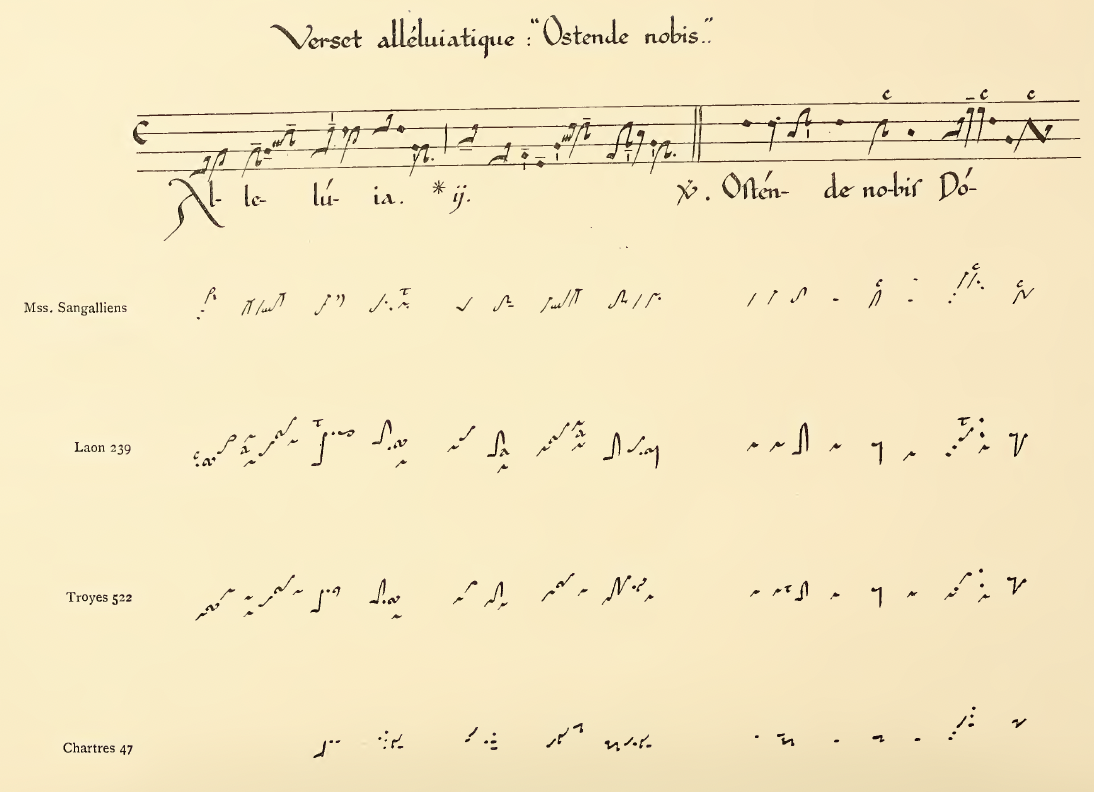
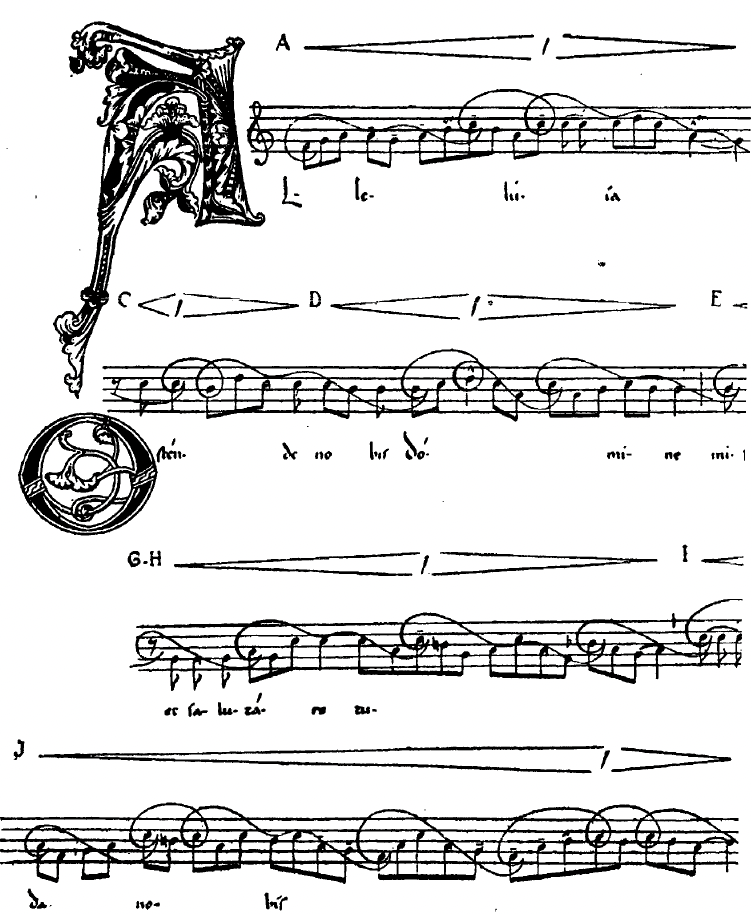
As for separating theory and paleography, there is, of course, no basis for 2s and 3s in the Gregorian manuscripts, and Mocquereau never would have suggested there was. He based that idea on basic musical psychology and physiology: humans tend to chunk series of undifferentiated pulses into small prime numbers; groups of two remind us of walking; groups of three remind us of breathing. This is quite separate from his paleographic study, which was quite sophisticated. On the other hand, Mocquereau would suggest that any string of pitches of more-or-less equal length is going to be grouped into 2s and 3s just by nature of how our brains work and regardless of how the neumes are drawn. I don't think that's such an unreasonable idea. I have run across many writings of Mocquereau where he sounds more semiological and less dogmatic about the ictus, but then he turns around and is completely dogmatic. The little monograph on Alleluia Ostende is a case in point of this. He gives a very nuanced and detailed study of each neume and a kind of proto-semiological reading, but he also gives a full Solesmization, which is also replicated in Suñol's textbook. I don't think these things have to be mutually exclusive or contradictory. I've attached examples of each.
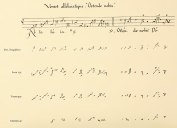 1094 x 792 - 523K
 752 x 914 - 319K
 -
As an addendum, the whole controversy over rhythmic signs and the reception of the Vatican edition meant that the time was not ripe for semiological editions in the early twentieth century. I think this was why Mocquereau preserved these investigations for his more speculative rather than practical publications. Happily, living as we do more than a century later, it is possible to read Pothier, Mocquereau, Cardine, and Guilmard as part of a single tradition of performance with many varied branches.
-
Which is a problem of great consequence, as Laon 239, a nearly complete Graduale from perhaps 880 and a manuscript source of the greatest value, was not rediscovered until 1906—five years later—according to Mocquereau himself, and published in PM X, 1910. They didn't fully know what they were talking about yet.the Solesmes theory of rhythm (which anyway was almost fully developed by Paléographie Musicale 7 a few years before)
Regarding the golden rule, the preface to the Vatican edition states that, “there must be no pause at the end of any neum followed immediately by a new syllable of the same word; by no means must there be a lengthening of sound still less a silent beat, for this would break up and spoil the diction.” Elsewhere in the preface, pause means a lengthening, not a rest or breath. In contrast, Engelbert of Admont (ca. 1250–1331) uses the word pausa to refer not to a lengthening, but a rest. I think the thirteenth-century golden rule refers to a breath/rest, not an episema, long note, or mora vocis. Regardless, it tells us nothing about first-millennial performance practice. In the oldest manuscripts, long notes before syllabic breaks are more the norm than the exception; more on that momentarily.
In the Al. Ostende nobis example above, note the different ictus placement at -lu- than in the official Solesmes edition, where there is an ictus on the first and third notes, and the liquescent note is disregarded. The authentic rhythm according to the ancient manuscripts is short-long-short-long. In my edition, I have placed an ictus mark on the lower note as a warning of syncopation. The fourth note is also ictic. Another possibility is that the lower note is a grace note and the second note is dotted. Either way, the neume has a value of three long beats, not two. Of the seven syllabic breaks in Mocquereau's quintuplex example, four of the preceding neumes conclude with a definitely long note, and two others are long by interpretation, leaving -no- as the sole example of a short note before a syllabic break. At least the Cardinians have more sense about this "golden rule" than the Mocquereauvians and generally respect more of the long values. -
But the Cardinian semiologists still prefer SG to Laon anyway…
-
Well you probably have an idea of what I might say: it is perhaps not that earth-shattering in their view, and for whatever departures Cardine — and Saulnier — made, they did not jettison the traditions of the abbey, and indeed despite removing printed signs they sing as if they are there. Saint-Benoît du Lac added them I. by hand. Who knows what the Solesmes monks do in choir now, especially since the Liber Hymnarius is now without signs and also without Cardine’s preface.
Even if, perhaps, the dogmatization comes out at the last minute in Mocquereau’s writings, if the Laon tradition really was that big of a deal, it’d come up in PM.
I also do think that while it is possible that we have exhausted our sources, the idea that Mocquereau et al. had not fully understood something leads me to, well, get nervous; what will the next revolution be? I’ve posted before the article on the Deus in loco sancto introit, I’m pretty sure. The rhythmic and melodic questions are separate but certainly overlap, and for various reasons, I’m dubious of attempts to reform the melodies even if they are less, well, clunky than the attempts to reconcile mode 5 and tone 7. (I tell Matthias Bry every now and again that I’ll eventually buy his books, but we’re not changing Christmas or Tenebrae.) -
To circle back momentarily to the OP's point, it is Mocquereau's theory—specifically that chant (and indeed all music) has downbeats and upbeats but that the downbeat is not necessarily strong—that was so influential on Duruflé.
I don't know how Mocquereau's paleographic/semiological views might have evolved. At any rate, his description of the Laon source in PM 10 seems pretty clear. But again, he was limited by what he could print in his chant editions, which still had to adhere more or less to the Vatican edition. The Solesmes theory as we have it (and as still transmitted by Laus in Ecclesia etc.) is designed for users of the Solesmes books, who don't have all the paleographic information to hand. It produces a good result (a subjective judgment, but one I still experience viscerally and frequently when chanting or listening to chant). We must indeed admit that as a historical reconstruction of ninth-century performance practice it is way too full of conjecture to pass muster. But inasmuch as that is not the goal of most chanters or most conductors of Duruflé, it can still be useful. -
Right, and Solesmes seems content with the Graduale Triplex. I don’t think that they feel inclined to move beyond the Vatican Edition as some would wish they would.
I’m always ready to call out longwinded poetic nonsense from French scholars, but I don’t see why it’s unreasonable to hold that the Laon manuscripts are not entirely disruptive or inconsistent with what those more aligned with Cardine hold about chant. Perhaps the unspoken assumption is “earlier is not necessarily better in the end”. I don’t know. Maybe Dom Guilmard would have some more insights. Or Père Damien at Le Barroux who is also very open-minded IMHO (he is working with Matthias on the Nocturnale). -
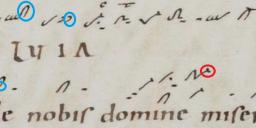
If we add the relatively late St. Gall 376 to the mix, relying on St. Gall sources alone, we get definitely long notes at five of the seven syllabic breaks, circled in red:
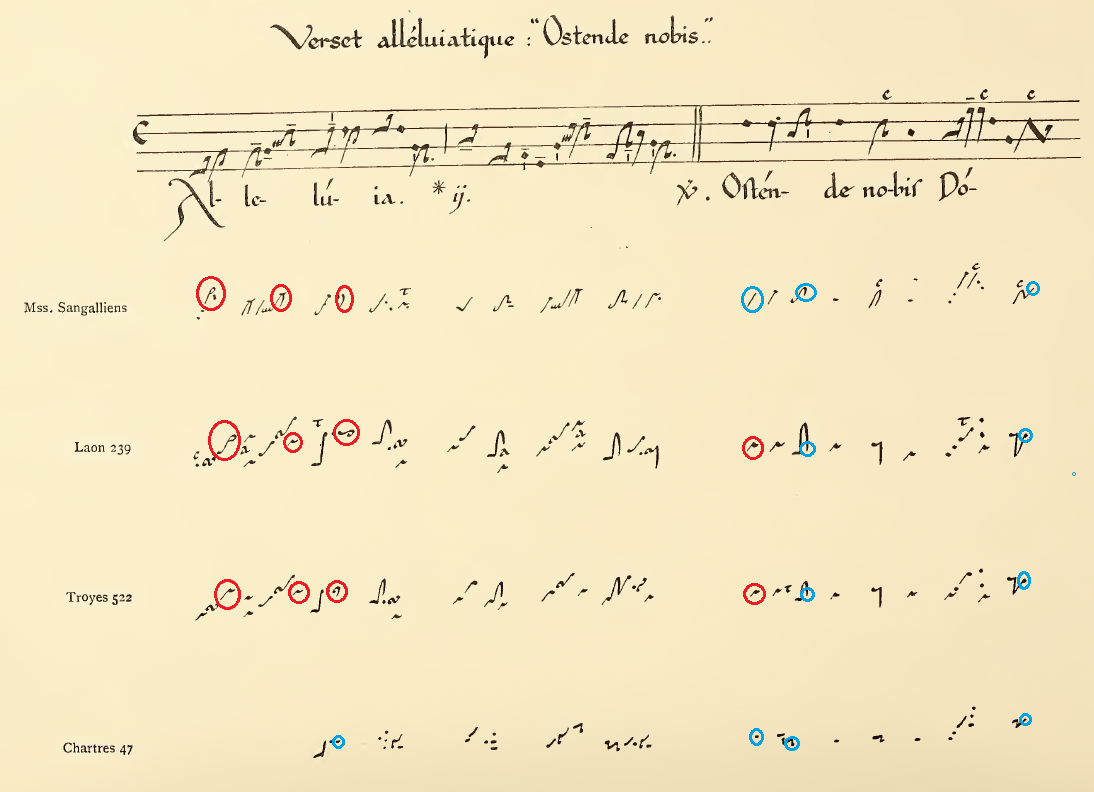
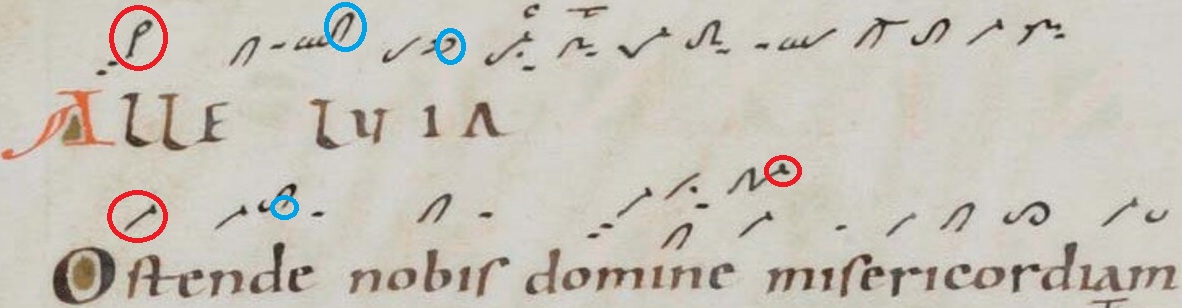
The notes at syllabic breaks circled in blue are of a neutral character open to some degree of interpretation, not marked definitely long or short, but when we compare the manuscripts to each other, the correct reading becomes clear. My position is not that the Laon Gradual is "disruptive or inconsistent with what those more aligned with Cardine hold about chant," but rather that it is a preeminent manuscript source of great antiquity that merits serious attention. It absolutely refutes the long-short pes and clivis misinterpretation of the Solesmes method, but I suppose that inconvenient fact alone may be disruptive and inconsistent enough! Acknowledging the length of both notes doesn't require any modification to the notes of the Vatican edition, just a longer episema. If the golden rule really means no long notes at syllabic breaks, it isn't much of a rule when it applies only 14% of the time.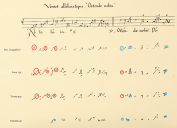 1094 x 792 - 374K
 1182 x 308 - 85K
 -
But you have very particular ideas about what is true or not true about chant. I don’t really care about the long-short thing. I don’t, in the end, for pretty much every reason that Dr. Weaver has laid out, just as much as I don’t sing with historical ternary meter for polyphony as much as I’d like to do that.
But I think that you’re in a bit of a tough spot if people (as early as Gajard) have more clearly acknowledged the problem and when those folks today already agree with you but don’t clearly agree about the need to really focus on Laon and what it brings.
I don’t speak for Solesmes and the Atelier paléographique of course. But I would say that pretty much no one has a problem with the examples from the end of word syllables so that may be why folks like me sort of shrug our shoulders in the end.
But anyway my point is simpler: I think good, reasonable scholars not singing from Laon is probably bad if what you say is true, but on the other, that’s the case, so we should ask why this is. -
If you "don’t really care about the long-short thing," then why make the claim that, "Mocquereau is not wrongly applying the golden rule"? Your position seems incongruous, as Mocquereau's misapplication of the golden rule presumes that it
involvesproscribes long notes before syllabic breaks rather than breaths or rests. As I have shown above, this has nothing to do specifically with Laon and can be demonstrated entirely from the St. Gall sources. -
I don't think we are really in disagreement, nor do I think you're really refuting my point. I have suggested, based on what I have read of Mocquereau, that the reason the episema-over-clivis figure is drawn over the first note only in the Solesmes editions (with a few exceptions at ends of sections, like in the introit for Advent I) is because he felt constrained by the rules (specifically the so-called "golden rule") laid out in the preface to the Vatican edition, which he did not write. I do not think Mocquereau did this because he believed, as a matter of semiology, that the non-cursive clivis was long-short. The upshot of this is that singers working within the Solesmes/Fontgombault tradition should feel empowered to lengthen both notes of the clivis-with-episema; and indeed this is something that I have observed in the oral tradition.
To the extent that there are singers who lengthen only the first note, this seems like a predictable consequence of the particularly acrimonious debate over what signs should be allowed in chant editions in the early twentieth century. I'm not sure there's really anyone defending such an interpretation on semiological grounds. Of course, people are free to follow the notation they are singing from, without delving too much into the history behind it. What lesson can we draw from this? Especially as the Church has moved away from a heavy-handed involvement in performance practice and towards a hands-off lack of implementation of the pro-chant language of Sacrosanctum concilium? Can you imagine an official of the DDW now telling one of us that we cannot extend an episema over an entire two-note neume in a published edition because it would undermine the interpretation of the Vatican Edition?
In Duruflé, I'm trying to think of examples where such a single-note-lengthening happens. As far as I can recall, Duruflé often either ignores the episema or applies it to both notes. One spot where that is not true that comes to mind is the podatus in "In paradisum" at "suscipiant," where just the first note is lengthened. Maybe I even sing it that was as a result of listening to Duruflé!Thanked by 1FSSPmusic -
1. The thirteenth-century golden rule was a proscription against breath before a syllabic break, not against a long note there.
2. The Preface to the Vatican Edition misinterprets the golden rule as pertaining to note length.
3. The Solesmes editions do not respect the long note values of the various manuscripts at syllabic breaks, both single-note and longer neumes, presumably because of the golden rule, but see no. 5 below.
4. This is a fundamental difference between the classic Solesmes method and Cardine's semiology.
5. The Solesmes editions often write a long-short form of the clivis and pes in contexts other than immediately before syllabic breaks, even within a melisma far removed from the syllabic articulation, and the clivis sometimes also before quarter and half bar lines. Now here's my question: What Vatican edition rule applies in such contexts that would have constrained Mocquereau?
Here is my initial claim above, which opened up this whole can of worms:
I stand by what I wrote. Are we really not in disagreement here?[Mocquereau] managed to convince nearly everyone that the long clivis and pes quadratus were long-short figures rather than entirely long, based on a faulty application of the "golden rule" principle, and he erroneously treated the normal syllabic value as short and indivisible on that same basis. -
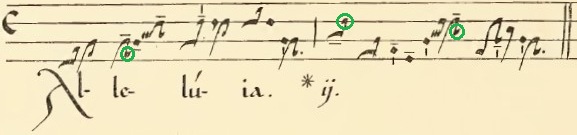
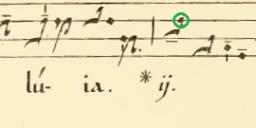
In the third instance, the Solesmes edition contradicts the melismatic mora vocis of the Vatican edition.
 577 x 135 - 23K
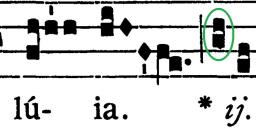 2958 x 495 - 205K
 -
The thirteenth-century golden rule was a proscription against breath before a syllabic break, not against a long note there.
Certainly that it is your interpretation. But even if it’s right: in practice long notes lead to breaths. So I see how Pothier got there, and if Mocquereau has to work within that, then I can also see why he wouldn’t push back.
Notably, and this is why I’m just not that interested in the long-short question, in actual practice coming from Fontgombault no less you hear long-long at places where it will not introduce a breath in an inappropriate place.
Whether they lengthen the second note mid-word is another matter. The In Paradisum is a place where this can actually work practically. Dom Gajard certainly hints at that the possibility. But context matters too.
I suspect the tradition of the abbey, consistency, and context are the answer as with nearly everything. In other words lengthening both notes when only one is written long at a bar would not faze Mocquereau and that he felt that it was redundant. Again, take the Nocturnale chants. That’s a perfectly valid approach but honestly I’ve heard a lot of what amounts to yapping from people who don’t like rhythmic signs at all; I would say that they should be happy that Mocquereau did not intend (as best he could and with some exceptions) to completely determine performance by means of musical notation and that you had to know the bigger picture or otherwise judge for yourself. Maybe this is why Saulnier went the other way and removed the signs (to our detriment given the abbey’s change in official interpretation in the new Liber Hymnarius). -
I want to give Mocquereau the benefit of the doubt. Here's what he wrote in Le nombre musical Grégorien:When [the episema] appears above a clivis, for instance, it may double the value of the first note, or again, it may indicate merely a delicate touch, or the least lingering of the voice. (p. 174)
@Charles_Weaver, is there evidence that his views changed later? If, as you claim, he did not believe, "as a matter of semiology, that the non-cursive clivis was long-short," then he deliberately chose to continue propagating a known misinterpretation of the oldest manuscript sources. Instead of incorporating an error only in some instances (i.e., at syllabic breaks) out of misguided obedience, it would mean he incorporated the error in the overwhelming majority of instances, presumably for consistency.The influence of the episema does not extend further than the note to which it is joined. In the [long] clivis, only the first note, the virga, is lengthened, and carries the ictus. (pp. 175-6)
I wrote the following elsewhere:
If, however, it was a matter of conscious misinterpretation and/or deliberate deception, that should be exposed and condemned, not praised, respected, or defended.A claim that a scholar misinterpreted evidence, with no insinuation of deliberate deception or otherwise malicious intent, should not be construed as an attack on the person. -
I think you are being way too harsh with Mocquereau here. I am going to defend him by trying to explain his motivations for his seeming inconsistency on this question. Please understand that I am not necessarily defending his semiological interpretation; I am merely trying to explain how he arrived at his interpretation.
Mocquereau wrote about this issue with the clivis with a little more clarity in PM 10, which is not so far removed in time from Le nombre. Here too he suggests that sometimes only the first note is long in the SG clivis, but that sometimes there are other circumstances that make both notes long. This naturally raises the questions: what can be his motivation or purpose in arriving at this conclusion? Why can the clivis-with-episema, which he elsewhere equates to the non-cursive forms in Laon and Chartres, be interpreted as sometimes long-short and sometimes long-long? The answer, as I have suggested before, is that he felt constrained by the rules of rhetorical chanting as handed down by Pothier and enshrined in the Vatican Edition preface to allow the second note of such a clivis to be long only at the ends of groups. I refer here both to the golden rule (which I would paraphrase as "no lengthening of the last note of a non-final syllable, which cuts the word up like a centurion tearing the seamless garment of our Lord") but also to the general principle that the most usual function of length within the system is an ending function: mora ultimae vocis. For Mocquereau, when editing chant, to lengthen the end of a neume is to make a mora vocis, that is, doing so creates the end of a rhythmic group of some size.
You are welcome to dismiss this idea! But to respond to my explanation of why Mocquereau's editions are the way they are by attacking the golden rule itself misses my point. What I am suggesting is that Mocquereau accepted Pothier's idea of the mora vocis, both as a principle of good performance and as a binding rule of interpretation to be followed in his making his chant editions. I believe with some confidence that it is why the second note of the non-cursive clivis is only marked as long in the Solesmes editions either when combined with a following quilisma-group or when it is at the end of a rhythmic group. By marking the episema over the first note, he is taking a rhythmic cue from the early manuscripts but not trying to add a mora vocis where there should be none, and therefore he does not disturb the basic connecting-principle of rhetorical chant performance. That is why I say that his interpretation is not really a semiological one. He has other factors at play.
In particular, he was writing all this at a time when his critics were attacking the Solesmes rhythmic signs as undermining the free rhythm of the Vatican edition. I am not suggesting that he argued disingenuously. I am saying that he was even more strongly constrained by this controversy to moderate the number of rhythmic signs added to his editions and to avoid especially too many ending-function lengthenings (mora ultimae vocis), in which I include any indications that the last note of a particular neume is long. Obviously the situation was somewhat different later and is even more different now.
As both Matthew and I have said, within the Solesmes-chant tradition, it is common now to allow the episema on the clivis to affect both notes. This is something you can already see in Gajard, and it has become even more pronounced under the influence of more recent scholars like Cardine. This represents a shift in the understanding of the relative weight of the golden rule and semiological concerns, especially as the controversy over the inclusion of signs drawn from SG/Laon died down over the course of the twentieth century.
The turn of the twentieth century was really just the beginning of the performance-practice movement. Both Pothier and Mocquereau, like other scholars and performers of the time, believed that they could find one style of performance that could apply to the whole history of the Gregorian melodies. For both of them, this involved a style of rhetorical delivery that I would say is a highly creative and evolved development of the idea of the mora vocis, drawing especially on Guido's Micrologus chapter 15 and on the golden rule. Mocquereau later folded into this the rhythmic indications of SG/Laon/Chartres etc. This idea of combining sources that are separated by centuries from one another to come up with a performance style is very characteristic of the early decades of the performance-practice movement. It is also very different from the approach of later scholars like Cardine or yourself, who narrow the diachronic focus of interpretation.
It is for this reason that I think it's a little unfair to criticize writers of the Mocquereau era for their semiology. Performance practice has changed a lot over time: consider Wanda Landowska and Jean Rondeau! I don't know whether Mocquereau would have thought that the non-cursive clivis was always long-long in the ninth century, because he doesn't seek to answer only that question in his writings, since he is not only a semiologist. Or at least it's impossible to separate that question out from all the other layers of interpretation and musical ideas that go into his synthesis.
For my own part, I am unreserved in my admiration for Pothier and Mocquereau and Gajard and Cardine in their writings! Long live Dom Guéranger and his chanting progeny! They are all a constant source of inspiration for me. My attitude as a chanter leans more toward the earlier writers on that list with regard to performance practice and to what degree I wish to replicate a ninth-century performance style (to the extent that this is even possible). In my own case, this is all tied up with my own scholas of which I have been a part but also my newly adopted Abbey of Clear Creek (I recently became an oblate). It is from within this community that I am inclined to be more lenient with Mocquereau's paleographic/semiological musings.
That was rather long-winded, but I hope within it there is a good explanation for Mocquereau's motives and my own. -
In like manner I went (way) off track in explaining to my course taught using Laus in Ecclesia that you need to be familiar with the traditions handed down from Pothier; the example was a torculus before a (half or full) bar that in the Ordinary Mocquereau would more freely give an episema but that would not necessarily get one in the propers even if it “should” be sung as if the sign had been added.
-
@Charles_Weaver, I appreciate your lengthy and thoughtful reply. As I said, I want to give Mocquereau the benefit of the doubt. I am not "attacking" the golden rule either. It refers to a breath and possibly a mora vocis, not to the episema, and certainly not to the normal syllabic value. The German edition of Pothier's Der gregorianishce Choral (1881) states it succinctly in chapter 9:
The problem is that they misinterpret that normal syllabic value as short and indivisible, equivalent to an eighth note rather than a quarter note. That error permeates their entire system of interpretation and the entire "tradition" of that abbey, already invoked in this thread. Their principle of the shortness and indivisibility of the normal syllabic value simply doesn't correspond to what is notated in the oldest extant sources. The misinterpretation is not unique to Solesmes but is also to be found in the writings of P. Wagner and perpetuated with Cardine's "diminished syllabic value," when said value is notated with uncinus or tractulus in the manuscripts.Let us therefore hold fast to the rule, which Elias Salomon rightly calls a golden rule: Within a single word, one must never take a breath immediately before a new syllable.
[Halte man daher die Regel fest, welche Elias Salomon mit Recht eine goldene Regel nennt: Innerhalb leines Wortes darf nie unmittelbar vor einer neuen Silbe Athem geschöpft werden.]
Congratulations on your admission as a Benedictine oblate! -
which opened up this whole can of worms:
Please take no offense.
My worm eyes are glazing over… I dont know why you are all trying to “arrive” at the “correct” interpretation of chant notation. Please explain.
I don’t think God cares whether one note is longer than the other as much as our hearts are in the right place when praying/chanting and are applying artistic merit. But this may be too simplistic a view, I suppose.
Is this a case where we have run headlong into a tree and can not see the forest?
From the OP…"We would not have, for example, the masterful choral works of Maurice Duruflé had he not based his compositional style on what has turned out to be entirely incorrect theories concerning the rhythm of Gregorian chant."
Object of musical humanity
criticalmasterful choral works
Point in passing
superfluouswhat has turned out to be entirely incorrect theories
When one brings the element of Gregorian chant into a polyphonic composition, one is forced to deal with rhythm directly. Choices have to be made or the end goal cannot be attained. It’s as simple as that.
Sincerely
A simple minded musician
——————
On further reflection
Please do not misunderstand.
Trying to figure out what is historically accurate in terms of a particular period is admirable. We tip our hats to you all!
However, the chant is a growing, living art and metamorphosizes, or should we say, develops (unlike dogma, which is constant and unchanging.) Hence we have early music, Renaissance music, Baroque music, classical music, impressionistic music, modern music, minimalism, avant garde, etc. I believe chant evolves, or progresses in a similar fashion.
For instance, the Solemnes method has always had me scratching my head right from the beginning when I learned it in 2005. I was never able to totally buy into its rhythmic theory. But so many of my colleagues follow it like it’s the law, so I go along. But that doesn’t make it or any other school of thought the definitive law of the land.
C’est la vie.Thanked by 1a_f_hawkins -
@francis, that's not exactly the point when we're discussing the oldest notated rhythm. If the chant handed down from the Fathers of the Church is itself sacred—not just the words, but the melodies—does God care if musicians tamper with the rhythm? Maybe rephrasing the question that way will give you a different perspective. If so, the next step is to determine which are the authentic versions and which are the tampered versions. Is holy mother Church infallible in matters of musicology, and can she promulgate a tampered version? If you compare the official chant from the time of Leo XIII to the official chant promulgated by Pius X, the two versions are so contradictory that the answer to the second question has to be a resounding yes.I don’t think God cares whether one note is longer than the other
Yes. Duruflé followed the Solesmes rhythm, and that is the style referred to as based on incorrect rhythmic theories. You can view the original thread from @incantu here:When one brings the element of Gregorian chant into a polyphonic composition, one is forced to deal with rhythm directly. Choices have to be made or the end goal cannot be attained. It’s as simple as that.
https://forum.musicasacra.com/forum/discussion/9072/the-horizontal-episema-over-the-clivis/p1
If you think your eyes are glazing over now...
Here's the next sentence in the older thread, not previously quoted here:
I have written very similar words myself. Some people use a literal interpretation of the Solesmes method. Fine. Some use their own take on the Solesmes method. Fine. Some use Cardine's semiology. Fine. Some prefer the Vatican edition without rhythmic markings. Fine. Some adopt a rhetorical/oratorical/accentualist style of chanting. Fine. Some simply do whatever they want to the chant and call it "free rhythm." Fine. Some put it in the vernacular. Fine. Let them! This list could continue. What is not fine is for them to present their version as authentic first-millennial performance practice. Keep the alterations in their own historical context instead of trying to pass them off as the original version. There is conclusive evidence in favor of long and short note values in 2:1 proportion. After several years of exploring first-millennial sources, I have found no evidence whatsoever in favor of a contrary interpretation.It is an entirely different matter to go about peddling this mixed-breed chant as beloning to the pedigree of any 9th or 10th century source.
PS - See also The Received Historical Narrative. -
@FSSPmusic
It would be very difficult to know the historical development of chant rhythm which is very much unlike theological dogma. The melodies are indeed sacred music, but I don’t think ‘sacred’ in the case of Gregorian Chant means one rhythmical method simply because, there is no way to KNOW how rhythms developed over time. Dogma becomes crystallized. Chant evolves depending upon geographical and time based variables. Gregorian Chant is more like music attached to a particular rite. The music is NOT the rite. It is a vocal interpretation of pitches and note values.@francis, that's not exactly the point when we're discussing the oldest notated rhythm. If the chant handed down from the Fathers of the Church is itself sacred—not just the words, but the melodies—does God care if musicians tamper with the rhythm?
I do not believe you can establish an ‘authentic version’ of GC. On what suppositions can you support this effort? Solemnes is a time and reason based ‘authentic’ version of GC. Do I like it? Not particularly as I mentioned previously. Does it ‘WORK’? Yes! It standardizes the notation at the lowest level where one can easily sing the chant with anyone around the globe with little effort in study. You might call it the Volkswagen of GC. It works for everyone.the next step is to determine which are the authentic versions and which are the tampered versions.
What you dub ‘tampered’ I believe is simply an evolving species of GC. Can we find earlier versions? Yes! Are they the same as the later versions? No! Are they the same as the earliest versions? No! So, labeling a chant as one that has been ‘tampered’ with is a narrow view of chant development.Is holy mother Church infallible in matters of musicology, and can she promulgate a tampered version?
Chant notation and interpretation is not dogma. Theology is dogma. Theology does not change from epoch to epoch. Truth does not evolve. The chant, however, is a living organism of sorts. It changes on circumstantial situations. Can you capture a time capsule of a particular interpretation? Well, isn’t that what the various schools of thought are attempting to do?
Exactly my point. BOTH the Leo and Pius chants are "official"! Different time, different circumstances, different influences. That is the way of Art as contrasted to Truth.If you compare the official chant from the time of Leo XIII to the official chant promulgated by Pius X, the two versions are so contradictory that the answer to the second question has to be a resounding yes.
LOLROTF... but we have GAINED some beautiful sacred music, even with the embedded "imperfect rhythmic values"!Yes. Duruflé followed the Solesmes rhythm, and that is the style referred to as based on incorrect rhythmic theories… If you think your eyes are glazing over now...
OK… All of the above are an interpretation of GC… some are abuses. Some are erroneous. Some are inaccurate. Which flavor do you prefer? It appears to be antiquarian when one reaches back and INTERPRETS through one's best guess how the chant was executed... and try to label it as authentic.Here's the next sentence in the older thread, not previously quoted here:
It is an entirely different matter to go about peddling this mixed-breed chant as beloning to the pedigree of any 9th or 10th century source.
I have written very similar words myself.
Some people use a literal interpretation of the Solesmes method. Fine. Some use their own take on the Solesmes method. Fine. Some use Cardine's semiology. Fine. Some prefer the Vatican edition without rhythmic markings. Fine. Some adopt a rhetorical/oratorical/accentualist style of chanting. Fine. Some simply do whatever they want to the chant and call it "free rhythm." Fine.
NOPE! That is no longer GC. That is VC (vernacular chant). I have often called it plainsong which you might say is English superimposed on the Gregorian melodies.Some put it in the vernacular. Fine. Let them!
That is absolutely correct! I don’t believe there IS an ‘authentic first-millennial performance practice.” Is it possible to assert this fact with absolute unconditional proof? I don’t think it will ever happen. Imperfect world. Is it your intention to claim that label? If so, why?This list could continue. What is not fine is for them to present their version as authentic first-millennial performance practice. Keep the alterations in their own historical context instead of trying to pass them off as the original version.
OK… the 2:1 proposition is interesting. Yes. I am still investigating that proportion. Some are probably already singing and praying in the 2:1 proportion, I suppose. Meanwhile, we will be singing and praying the Solemnes method for the next (put x number of years here) until a new ‘official’ version is promoted... "The Proportioned Method."There is conclusive evidence in favor of long and short note values in 2:1 proportion. After several years of exploring first-millennial sources, I have found no evidence whatsoever in favor of a contrary interpretation.
I guess the ‘schools of thought’ will always continue with their schooling, continuing to spin out newer, fresher, and more accurately defined interpretations. Godspeed! It is fascinating to know people that pursue this effort. Don't stop singing/praying however! That is much more important than the length of note values for sure!
In other words, we can stop the presses, but we can not stop the prayers! -
None of the above! Stick with a performance practice that corresponds to the oldest notated sources. The information there is the most reliable we have. @francis, do you think that the Vatican and Solesmes editions are not largely antiquarian, or that the Medicaean edition represents an evolution rather than a deliberate mutilation, along with its successors up to the time of Leo XIII?Which flavor do you prefer? It appears to be antiquarian when one reaches back and INTERPRETS through one's best guess how the chant was executed... and try to label it as authentic. -
Well, in my little mind, they are ALL antiquarian.
They are ALL stuck in situation.
They are ALL stuck in time.
We have no way to regurgitate their intentions, interpretations except for our best guess.
We are trusting in you for the next official edition! Moreover, if we don't suffer an EMP on a global scale, we may have recorded versions of your next edition to pass to our future colleagues... if we make it that far, they could possibly know EXACTLY how we executed the chant in 2026... but they might not have the Windows version of our apps, and they might not be able to play them back!
Nonetheless, THEY might skew THEIR edition a little after THEY study the "earliest authentic manuscripts" and make revisions based upon THEIR assumptions about THEIR discoveries... if you get my drift.
Do you think heaven will have the answer if we get there? -
If Durufle offers us one possibility of dealing with chant, then Tournemire offers us insight also. In his l'Orgue Mystique suites, Tournemire pushes together repeated notes, sometimes changing the shape of the chant and tinkers with the chants quoted for his compositional needs. Also, Tournemire is using an old antiphonarium to quote antiphons used in the office.
For what it is worth, Tournemire spent a lot of time at Solesmes and was friendly with a number of the monks there. -
In the Palm Sunday chants, there are several podatuses with and without an explicitly marked episema where the post-Gajard tradition would seamlessly have long notes on both notes and ditto the clivis. I went a little bit more in the Cardine direction today, and it worked out alright, but I did think of this thread in the middle of Mass lol.

Welcome to the MusicaSacra Forum!
To participate in the discussions on Catholic church music, sign in or register as a forum member, The forum is a project of the Church Music Association of America.
Categories
- All Discussions21,826
- General Music Discussion8,540
- Job Openings291
- Management of Music Programs862
- Choral Matters539
- Church Documents and Rubrics540
- CMAA Notes307
- Events758
- For Newcomers: Read First26
- Sacred Polyphony566
- Hymnody897
- Gregorian Chant: General2,749
- ↳ Graduale Romanum and Liber Usualis372
- ↳ Graduale Simplex61
- ↳ Semiology65
- Vernacular Plainsong704
- Anglican Use and Anglican Chant73
- Organ, Other Instruments and Repertoire451
- New Composition/Works in Progress1,339
- Recordings238
- Music for Hispanic Ministry163
- Music Education: Children217
- Music Education: General223
- News Items246
- Positions Wanted3
- General Discussion: Catholicism742
- Amusements185
- General Discussion1,048
- Opinions119