
Ash Wednesday (1962 MR)
-
For some years now, I’ve noticed that the two antiphons and the responsory set out in the Graduale are inadequate to cover the entire imposition of ashes when there is a larger congregation.
Are there any other sources that provide either other works or psalms to use with the two antiphons? Either that, or is there a general point of liturgical law that allows for psalms to inserted into a rite wherever there is an orphan antiphon? I can’t imagine that these two antiphons have been without psalms for their entire history…
I note the same problem on Good Friday for the procession of the Blessed Sacrament and for the communion rite. -
By way of a postscript…
I’ve just looked at the Dominican and Norbertine books and note that they have some psalm verses with one of their antiphons during the imposition of ashes.
There must be some way of recovering the heritage, as was done with the psalm verses for the Communios. -
It seems to me that nothing forbids to sing psalm verses also outside Dominican or Norbertine chapels. Only that the priest is not under obligation to read them from the missal. On the other hand, it is not strictly required to cover all the proceeding with sound of chant.
-
Indeed. Silence is golden. If your celebrant seems allergic to it, you might add the psalm Miserere, or a penitential chant such as Parce Domine or Attende Domine.it is not strictly required to cover all the proceeding with sound of chant -
Or sing a polyphonic (or fauxbourdon or whatever) version of the chant.
I imagine that there was often no need for psalms, although I appreciate using them, e.g. on Palm Sunday; the repetition in polyphony of the plainchant would be more than sufficient to make up for the fact that you might sing the two antiphons upwards of ten times each. The one that I can't make work is the distribution of candles. The canticle is too short for polyphony to make a difference. -
I can see the sense of the suggestions above, but they bring me no closer to what is actually correct or, historically, what the alternatives were. The path that leads to ‘alius cantus aptus’ is uncomfortably wide!
I don’t know that I agree with the argument that silence is really golden in this context - the processional chants of the Church are meant to cover the corresponding liturgical action. Whether the imposition of ashes was very late and so didn’t have psalmody, or has been dislocated from its original position, I don’t know. It’s a bit like the Mandatum - the succession of antiphons without psalms is a bit bewildering.
I’ve gone through a few of the medieval graduales and not found any psalm verses there either. -
I don't know that there were any.historically, what the alternatives were.
No, it's not. Motets have been permitted during the liturgy for centuries. If you never sing anything but psalm/canticle verses to prolong the Offertory or Communion chants, I can't fault that, but the remaining alternative to a freely chosen Latin text, suitable for the occasion, which you find uncomfortable, or silence, which you find unfitting, is to repeat the appointed chants. The rubrics and other liturgical regulations are not necessarily meant to address every possible foreseeable circumstance, so there is no single "correct" answer as to what may be sung when time remains.The path that leads to ‘alius cantus aptus’ is uncomfortably wide!
The situation is not entirely analogous with Candlemas, as a rubric of the Missal (not included in the Gradual) directs that the canticle and antiphon be repeated until the distribution is finished. The Good Friday processional antiphons are borrowed from the feasts of the Holy Cross. The rubric for Communion recommends psalm 21 or any of the Matins responsories from that morning. Would you find the traditional Vexilla regis inappropriate on Good Friday if time remains? -
My hand missal has Attende Domine listed to follow the antiphons.Thanked by 1Roborgelmeister
-
FSSPMusic, I seem to recall the legislation providing for Offertory and Communion motets explicitly. That would suggest to me that their use is restricted to those parts of the liturgy, and only after the propers had been completed.
In relation to the Vexilla Regis, while I would not find it inappropriate personally, that it was replaced in the Holy Week reforms for Good Friday with other material would make me think twice about using it. The optional relocation of the Tenebrae responsories to the Good Friday liturgy makes me think that had the option been desired, it would have provided for explicitly. The rubrics are so prescriptive in relation to all these things. I wonder whether the Congregation ever expressed a view… -
@SponsaChristi, the Attende Domine ... is to the second part of the chant before the verse, not the other chant with the same title.
@Palestrina, the legislation mentioning motets covers the normal High Mass, not other ceremonies before Mass, the Triduum, etc.; like I said, not every possible circumstance is addressed.
Well, that is indeed the situation under discussion here. You are apparently looking for nonexistent supplementary ad libitum propers. At the the other end of things, what if the distribution of ashes or the veneration of the cross finishes well before the assigned chants have been sung? Today, I think the chants have to be completed; I see no rubric suggesting that any of the chant may be omitted or abbreviated. Good Friday is another matter, however, as there are rubrics stating that the chant is continued until the conclusion of the veneration and that the final doxological stanza of "Crux fidelis" is never omitted. (The latter rubric doesn't appear in the "pre-55" books; incidentally, the 1961 Graduale gives two versions of the hymn: the same one included in the Liber, and a "textus antiquus" option.) The rubrics don't specify what should or may be sung when all of the appointed chants are insufficient, which happened here one year.only after the propers had been completed -
It has occurred to me that the 1958 instruction provides a principled road map for repertoire shortages.
In the case of the Offertorium, apart from using the ancient verses of the Offertoriale, it is permitted to extend the piece by use of psalm verses if the Offertorium itself is a psalm text.
The permissions for the Communio are more generous still, allowing for the use of an appropriate psalm if the antiphon itself is not a psalm.
The legislation doesn’t speak to situations outside the Offertory and Communion, but the use of psalmody seems to be a desirable option in the legislation, and I wonder whether, had the congregation turned its mind to the issue, it would have approved such solutions in other related circumstances. This would have the added benefit of ensuring nothing was omitted, only that what was prescribed explicitly was augmented with related material.
Applied to Ash Wednesday, I could see the first two antiphons sung with psalms and the responsory started towards the end, concluding as the celebrant washes his hands.
On Good Friday, perhaps this could be applied at the Veneration of the Cross by the extension with more verses of Crucem Tuam, but less successfully at the Procession of the Blessed Sacrament. At Communion, it is difficult to see how one could get through all the Tenebrae responsories! -
@Palestrinaand I wonder whether, had the congregation turned its mind to the issue, it would have approved such solutions in other related circumstances.
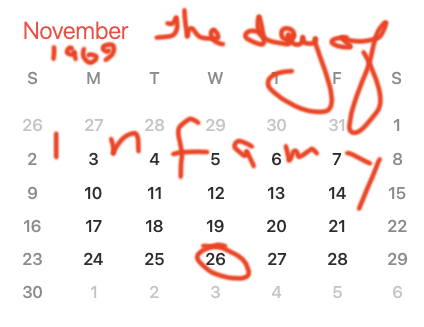
Most unfortunately, "it" was turning its mind toward the New Mass, and all the old traditions were about to be scrapped. Paul VI famous audience bears the fact:
some of his quotes:Pope Paul on the New Rite of the Mass (11/26/1969)
“We ask you to turn your minds once more to the liturgical innovation of the new rite of the Mass. This new rite will be introduced into our celebration of the holy Sacrifice starting from Sunday next which is the first of Advent, November 30 (1969).
“A new rite of the Mass: a change in a venerable tradition that has gone on for centuries. This is something that affects our hereditary religious patrimony, which seemed to enjoy the privilege of being untouchable and settled. It seemed to bring the prayer of our forefathers and our saints to our lips and to give us the comfort of feeling faithful to our spiritual past, which we kept alive to pass it on to the generations ahead…
“So what is to be done on this special and historical occasion? First of all, we must prepare ourselves. This novelty is no small thing…
“It is here that the greatest newness is going to be noticed, the newness of language. No longer Latin, but the spoken language will be the principal language of the Mass. The introduction of the vernacular will certainly be a great sacrifice for those who know the beauty, the power and the expressive sacrality of Latin. We are parting with the speech of the Christian centuries; we are becoming like profane intruders in the literary preserve of sacred utterance. We will lose a great part of that stupendous and incomparable artistic and spiritual thing, the Gregorian chant.
“We have reason indeed for regret, reason almost for bewilderment. What can we put in the place of that language of the angels? We are giving up something of priceless worth. But why? What is more precious than these loftiest of our Church’s values?
“The answer will seem banal, prosaic. Yet it is a good answer, because it is human, because it is apostolic.
“Understanding of prayer is worth more than the silken garments in which it is royally dressed. Participation by the people is worth more—particularly participation by modern people, so fond of plain language which is easily understood and converted into everyday speech.”
So now, we have to recover that which has been ejected from the church in the name of 'moving forward'. Let us continue to work together to preserve promote the timeless heritage of the chant.
Ya gotta love this ultimate ruse...
“The answer will seem banal, prosaic. Yet it is a good answer, because it is human, because it is apostolic."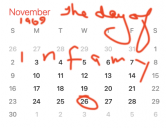 424 x 327 - 51K
 -
There's a lot of water that flows under the bridge between 1958 and 1969, that's for sure...
Looking over things again, I was surprised to see that the earliest edition of psalmody that I was able to find for psalms with the Communio was from 1962.
Is anyone aware of any earlier editions that were in use? I am wondering whether the 1958 document re-establishes an ancient practice that had completely fallen out of use from that date, or whether the liturgical movement had already been on that path and the Congregation simply confirmed the practice.
I note also note extracts of the 'E ritibus servandis' from the preface to the 'Versus Psalmorum and Canticorum', which I presume are from the Graduale Romanum? Does anyone know whether this was updated after 1958 or whether the instructions always had the option of psalm verses? -
It is an update of the rubrics incorporating the wording of the 1958 instruction. You can find older editions of the Gradual and Liber online and compare for yourself, also a footnote in some editions concerning separation of the Sanctus and Benedictus. Additional repetition of the introit is also addressed in the newer printings. That an option isn't expressly mentioned in the rubrics doesn't automatically make it illicit or innovative, especially in instances where singing a freely selected text is perfectly permissible. Attached is a screenshot from O'Connell's commentary on the 1958 Instruction, which gives some background. There is a previous thread here that may be of interest.
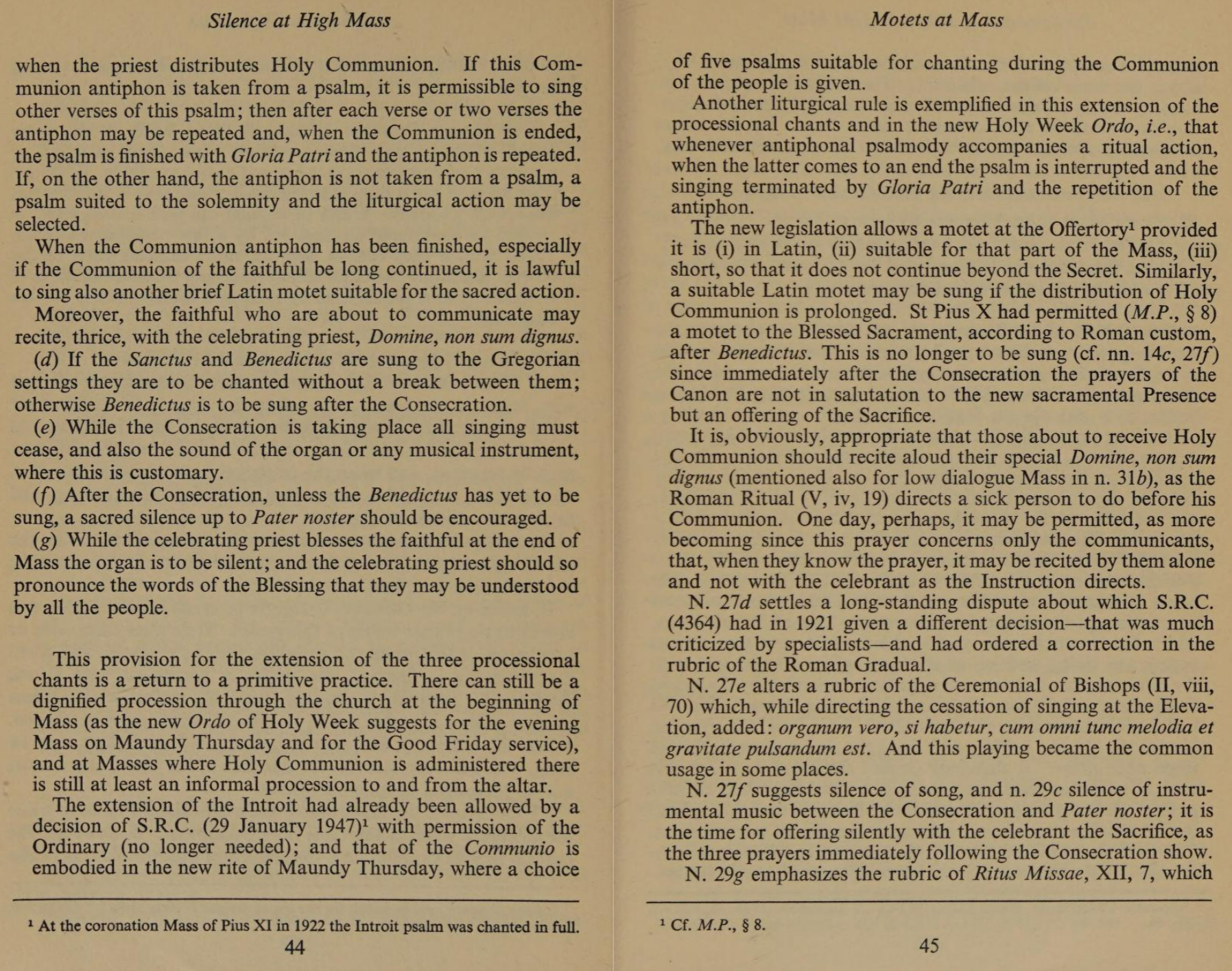
PS - The former rubric was that the Introit was not begun until the priest had reached the foot of the altar. 1796 x 1416 - 4M
 -
And at the TLM I attended last night, the priest read the text of the antiphons, and other music accompanied the imposition. We're privileged to be arguing "the best" when so many haven't even caught up to adequate.
-
Thanks, FSSPMusic. O’Connell’s commentary shows which way the wind had been blowing in Rome for a few decades…
I agree that there are some principles here that are potentially transferrable to other contexts.
I am some wariness in terms of supplementing a liturgical text but think that the distinction can be made between additions in the manner of tropes and additions that are implicit in the original form of the text. An antiphon without a psalm is, to my way of thinking, rather like a bird without feathers.

Welcome to the MusicaSacra Forum!
To participate in the discussions on Catholic church music, sign in or register as a forum member, The forum is a project of the Church Music Association of America.
Categories
- All Discussions21,844
- General Music Discussion8,548
- Job Openings292
- Management of Music Programs862
- Choral Matters539
- Church Documents and Rubrics540
- CMAA Notes307
- Events760
- For Newcomers: Read First26
- Sacred Polyphony567
- Hymnody898
- Gregorian Chant: General2,749
- ↳ Graduale Romanum and Liber Usualis372
- ↳ Graduale Simplex61
- ↳ Semiology65
- Vernacular Plainsong704
- Anglican Use and Anglican Chant73
- Organ, Other Instruments and Repertoire452
- New Composition/Works in Progress1,342
- Recordings238
- Music for Hispanic Ministry163
- Music Education: Children217
- Music Education: General223
- News Items247
- Positions Wanted3
- General Discussion: Catholicism742
- Amusements185
- General Discussion1,048
- Opinions119