
Latin pronunciation
-
Please help settle a dispute: the world "clemens". Isn't it pronounced "clehmens?" I've heard "claymens" , but I was taught that the "e" in Latin is pronounced "eh".
-
It Italianate Church Latin, it's pronounced the same as the first two syllables of clemency in English (including the unvoiced s).
-
In the Roman Rite in the USA, we'd normally use Italianate Church Latin pronunciation, not, say, English or German Latin. Comparison:
https://en.wikipedia.org/wiki/Latin_regional_pronunciation -
Quick solution: order many mainstream hymnals and you won’t need to deal with the Latin issue.Thanked by 1CharlesW
-
I would say most people in the USA pronounce it "clehmens" but soft vowels are almost non existent every where else- however when Americans pronounce a hard vowel its often much more exaggerated. Thus, technically speaking "claymens" but its a very slight emphasis. You should shoot for somewhere in between if its Americans we are dealing with.
I have been told many times, the main problem with American pronunciation is that we are lazy with the shape of our lips. -
from the pbc
-
The functional reason many American church choir directors try to avoid unnecessary diphthongs like "clay" is that they have a tendency to go flat in the mouth of a typical volunteer American church chorister.Thanked by 1Chant_Supremacist
-
But there must be exceptions to always pronouncing "e" as "eh". What about "Salve" or "Christe"?
Thanked by 1Chant_Supremacist -
As a Brit, I don't know how you pronounce 'eh'. When it stands alone, as it does in English colloquial meaning "I didn't catch what you said" it rhymes with 'pay'. As indeed does Salve.
http://hull-awe.org.uk/index.php/Pronunciation_of_Ecclesiastical_or_Church_Latin -
It depends what exactly you mean by "eh". Sometimes people mean the sound in "bed", sometimes that in "bared" without the -r- (as I’d pronounced it in my non-rhotic south English), but “eh” also spells an English word, pronounced as a diphthong or even triphthong.
I think you can safely say that the -e-'s in clemens and salve and Christe are all exactly the same value. (They are all long vowels except in Christe which is short. But Ecclesiastical Latin doesn't have vowel length.)
-
E is never a diphthong in Church Latin.But there must be exceptions to always pronouncing "e" as "eh". What about "Salve" or "Christe"? -
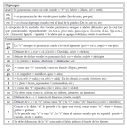
For those who understand spanish- here is another version of pronunciations. Although I really disagree with the mihi pronunciation here. For me thats just because of a natural thing spanish people tend to do with that particular letter combination.
 781 x 787 - 136KThanked by 1CHGiffen
 -
So, I contacted one of our Sisters who actually has her doctorate in Latin. And she sent me this:
Vowels
a is pronounced as in father: sanctam (sahngk-tahm).
e is pronounced as in egg: ante (ahn-teh).
i is pronounced as in machine: filii (fee-lee-ee).
y is pronounced the same as i: Kyrie (kee-ree-eh).
o is pronounced as in tone: omnia (ohm-nee-ah).
u is pronounced as in ruler: unum (oo-noom).
Note: When two vowels appear together, each is pronounced: mei (meh-ee). (This rule does not apply in the cases of certain diphthongs—see below.)
Diphthongs
ae and oe are pronounced like e: saeculum (seh-koo-loom).
au and eu are treated as single syllables, but each vowel is pronounced distinctly.
In singing, the first vowel is sustained, as in other combinations of two vowels:
lauda (lah-oo-dah).
Consonants
The consonants b, d, f, k, l, m, n, p, s, t, and vare pronounced as in English.
c before e, i, y, ae, oe is pronounced ch: coelo (cheh-loh); in all other cases,
c is pronounced k: cantus (kahn-toos).
cc before e, i, y, ae, oe is pronounced tch: ecce (eht-cheh).
ch is pronounced k: cherubim (keh-roo-beem).
g before e, i, y, ae, oe is soft (as in gel): genitum (jeh-nee-toom); otherwise, g is hard (as in go): gaudeamus (gah-oo-deh-ah-moos).
gn is pronounced ny: agnus (ah-nyoos).
h is mute, except in special instances, when it is pronounced h as in English (however it is more like a mix between h and K close to the Spanish J: mihi (mee-hee) and nihil (nee-heel).
j is pronounced as y: Jesu (yeh-soo).
qu is pronounced as kw: qui (kwee).
r is lightly rolled with the tongue.
sc before e, i, y, ae, oe is pronounced sh: ascendit (ah-shehn-deet).
th is pronounced as if the h were absent, as in Thomas.
ti before a vowel and after any letter except s, t,or x is pronounced tsee: gratia (grah-tsee-a).
x is pronounced ks: ex (ehks).
xc before e, i, y, ae, oe is pronounced ksh: excelsis (ehk-shehl-sees).
-
I understood the initial question to be about closed (/e, o/) and open (/ɛ, ɔ/). One might try to pronounce both the O's of Domino the same, but is the effort worth it? The door-stopping tome to settle most of these arguments is Copeman's Singing in Latin, or, Pronunciation explor'd (1990), and in the chapter on Italy he takes pleasure in observing that while Italian choirs are taught that there are only 5 Latin vowels, in actual practice they employ the 7 of their vernacular: a, è, é, i, ò, ó, u.
-
None of which is a diphthong. Ay as in clay is.while Italian choirs are taught that there are only 5 Latin vowels, in actual practice they employ the 7 of their vernacular
-
Was the initial question about diphthongs? "Ay" minus the Y is as close as English offers to é; one teacher at the SF conservatory actaully uses the phrase "Attention K-mart Shoppers" to teach the closed vowel.Thanked by 1FSSPmusic
-
Do you mean clemens with the first e pronounced like clam? (very different from clay)
-
Is that a petition for clemency?
-
I think Henry is right about /klɛmɛns/ and /Kriste/, with /klemɛns/ being the German variant.
-
"Is that a petition for clemency?"
I don't know, but this time of year, this is what a lot of people are petitioning for about 20 miles from me, especially big bellied clams (so-called "clam strips" need not bother for recognition):
 3576 x 1074 - 7M
 -
From the Oxford Classical Dictionary entry "Pronunciation, Latin":
Whilst the short ă and the long ā were of similar quality, the other long vowels were distinctly higher than their short counterparts. In fact, in the Romance languages, the mid-long ē and ō developed in the same way as the high short ĭ and ŭ. The approximate values of these vowels in terms of modern languages are as follows: ă/ā as first/second vowels of Italian amare; ĭ/ī as in Eng. bit/beat; ŭ/ū as in Eng. put/fool; ĕ as in Eng. pet; ē as in Fr. gai or Ger. Beet; ŏ as in Eng. pot; ō as in Fr. beau or Ger. Boot.
Note how the authors of the article (W.S. Allen and J.G.F. Powell) were hard-pressed to give an English word that has the sound ē. As a U.S. English speaker, it is virtually impossible for me to pronounce the sound without adding a -y to it and pronouncing it as a diphthong. In the Latin word clemens (nom/voc sing), both vowels are long. Be careful, as in other forms of the word, the e after the m is short (clēmĕntem). -
Hi,
coming from Germany but I found to singing chant and polyphony in Britain. Now back in Germany Latin pronounciation remains a constant source of frustration (although I try to tell myself that there are much more important topics).
One thing which puzzles me a bit is that even the Italianate pronounciation here, which is common not in ecclesiastical but in HIP settings, has some slight difference to what I learnt in the UK or what I can read in the typical introductions like the one from the PBC. Compare e.g. this video introduction from a German soprano singer:
https://www.youtube.com/watch?v=obI4mlwk39M
The most striking difference: At 2:45 she talks about aspirated consonants with the example "terra". In her Italiante pronounciation it becomes more like "derra". How would you do that? -
The aspirated consonants k (also hard c and qu), p, and t are pronounced with a strong puff of air in good English or German diction. In church Latin, we should use a dental t, just as in Spanish, Italian, or French. It's not a d. More like a d? Yes, somewhat, but t is not a voiced consonant. Qui tollis peccata doesn't become gui dollis beggada, but the hard aspirated consonant sounds of English or German are out of place. I'm afraid they're ubiquitous among British choirs singing in otherwise Italianate Latin, and the situation isn't much better on this side of the pond. Terra is a good example because the word descended unchanged from Latin to Italian.
The rolled r is another problem for English speakers, as are avoiding ay diphthongs instead of a pure [ɛ] vowel (coupled with hypercorrection of the real diphthong where it occurs, such as ejus becoming eus and eleison become elesson), and au coming out more like [ɔ] than a diphthong. Intervocalic s is another can of worms. The Italians don't really say Jessu or vissibilium, but the voiced z sound is sometimes considered an "informal" pronunciation. German speakers have no difficulties with [ɛ] or [aʊ̯], but in my limited experienced, they have a tendency to forget that h is silent when attempting Italianate Latin, and semper and other -er words come out rhyming more with uh than air.
-
PS - I think some of the lazy pronunciations stem as much from what is tolerated in the Latin classroom as from the choir room or voice studio.
-
I never encountered ecclesiastical Latin in the Latin classroom!Thanked by 1tomjaw
-
Yeah, but did you encounter dental t's or non-diphthongized long e's in the Latin classroom? Should be the same for classical Latin, but few teachers are picky about pronunciation.I never encountered ecclesiastical Latin in the Latin classroom! -
I did encounter the dental T (then again, I preceded my Latin class in college with 9 years of Spanish starting at age 9 - my public school district required foreign language instruction to begin early and be sustained - by the time I was in high school, I had occasional dreams in Spanish).
Also, I grew up in a family with parents from Connecticut who at the time still had that fairly neutral (by US accent standards) Western New England accent. I learned Latin in Charlottesville, where the Piedmont American English accent ran riot (very easy to pick up inadvertently, and I can readily lapse into it if I am talking with college friends even at a 45 year remove - the danger of learning multiple languages young!) along with Tidewater and other sub-regional accents, so I suspect the professor picked his battles accordingly. -
TIL that “eh” in Latin pronunciation guides does not mean “eh” as in the Canadian expression, “Eh?”
-
This reminds me that people use diphthong to mean digraph when it refers to vowels that were diphthongs but became /e/ (or some other singular vowel sound) in later forms of Latin and in ecclesiastical Latin.
/klɛmɛns/ is what I ask for sometimes versus /klemɛns/ because I’d get /ai/. Laus in Ecclesia gives examples like maid when it is trying to get you to sing the close (really close-mid) vowel in a word like Deus. And then it gives pen but that didn’t account for pin-pen merger. Red works though.
We struggle with the hyper correction of the semivowel to /u/.
I second the comment about the /t/. I don’t do anything but lighten the /r/ because we have a native Portuguese speaker, a Miami English speaker with some Spanish influence on his English, myself who unfortunately learned the /r/ of French but never could manage it in Italian or Spanish as an alveolar tap or trill, and the rest of the bunch can’t do any of them.
Eleison is only shortened when the polyphony calls for it. We’re good about that one.
Now I have to watch my /b/ lest it become /p/ like at the beginning of the Requiem tract. But I do think that having had experience teaching language helps; I do think of lighter French vowels as my reference point: /ɛ/, /œ/, /ø/, and /ə/ (and, with the middle two you also have /ɔ/ for that matter) sometimes hard to distinguish. And luckily most of those are close to English sounds.
I’m not going for a super-rounded /u/ for example, like a French kid who says hello to an owl (Coucou, hibou !) but it’s pulled back a bit, if that makes sense…Thanked by 1Liam -
Prima facie I don't see why a vowel in any language, even a dead one, should have one singular and precise way of being pronounced in all places and linguistic contexts. In the word ecce for instance I doubt anyone naturally pronounces both e's in exactly the same way. The first one is naturally shorter, it's leading into a 'ch', and the second is naturally longer, without sliding into a noticeable diphthong.
-
[ˈɛt.t͡ʃe], but not [ˈɛt.t͡ʃeɪ]. Also not [ˈɛkt͡ʃe], which I sometimes hear.
-
@Chant_Supremacist ding ding. Hence my point about the wobbly nature that means that transcriptions for a study can be a beast.
But Patrick is right, it’s ideally not a diphthong: it’s /e/, the close-mid front unrounded vowel, and I think that the point is better made for vowels in the same position of a word: yes, on paper the close vowel should be used when a syllable ends, but that more easily becomes a diphthong which is unwanted, so we switch vowels. Or maybe even better we think of the other vowel on the chart to sing the desired one.
Also, Dom Pothier emphasizes double consonants but except for some such as liquids (at least some of the time) or “p” not dropping the first and making it a vowel followed by a consonant-vowel is what happens for most of us, it seems.
And I just had the chance (for better or worse!) to explain why people use the same sounds as English “eggshell” in the Gloria or other places where “excelsis” occurs…Thanked by 1Chant_Supremacist -
I think double consonants are very good to observe in Latin singing, and I got that idea from Dom Pothier, as you said, @MatthewRoth.
-
I borrowed that observation from you in turn!
I wish, like his vowel rearticulation, he had left a bit more in the way of instructions. -
>>> For those who understand spanish- here is another version of pronunciations
OOH! Monasteryliturgist - do you have a page 1 for this, which covers pronunciation of the vowels?
Your sheet's description of "magnificat" and "agnus Dei" as "manificat" and "anus" with tilde over the "n" is brilliant, and will forever be my method of explaining the pronunciation to ENGLISH speakers. Thanks!Thanked by 1monasteryliturgist -
That's how I've always explained it to the Spanish and English choirs. I never knew it was a groundbreaking method!
-
One can think of Spanish as a bastardized late antiquity-era Latin (with Arab vocabulary added; the intervening Germanic additions are relatively few, and the most enduring of those are names/surnames) and Italian as a bastardized early medieval-era Latin.






Welcome to the MusicaSacra Forum!
To participate in the discussions on Catholic church music, sign in or register as a forum member, The forum is a project of the Church Music Association of America.
Categories
- All Discussions21,832
- General Music Discussion8,542
- Job Openings292
- Management of Music Programs862
- Choral Matters539
- Church Documents and Rubrics540
- CMAA Notes307
- Events759
- For Newcomers: Read First26
- Sacred Polyphony566
- Hymnody898
- Gregorian Chant: General2,749
- ↳ Graduale Romanum and Liber Usualis372
- ↳ Graduale Simplex61
- ↳ Semiology65
- Vernacular Plainsong704
- Anglican Use and Anglican Chant73
- Organ, Other Instruments and Repertoire451
- New Composition/Works in Progress1,340
- Recordings238
- Music for Hispanic Ministry163
- Music Education: Children217
- Music Education: General223
- News Items246
- Positions Wanted3
- General Discussion: Catholicism742
- Amusements185
- General Discussion1,048
- Opinions119