
Salve Regina, De la Rue
-
We have been looking at this beautiful piece, but my choir has complained about the edition found on the excellent CPDL. Has anyone got a copy in a more singable format?
-
Tom,
Is the problem that the word "Virgo" is missing from the end of the prayer, or the bar lines or the translation or something which the choir finds unsingable?Thanked by 1tomjaw -
The missing "Virgo" isn't really a problem, since several of the earlier composers omitted it: Tye, Fayrfax, Cornysh, Browne, Dufay - just to name a few. At least one inserts "semper" after "Virgo" ("O Virgo semper dulcis Maria"). And there are other textual variants.
We see this also in the treatment of "Ave verum corpus": "O Iesu dulcis, O Iesu pie" - where others omit "Iesu".
Thanked by 1tomjaw -
The lack of bar lines in sensible positions...
The different texts associated with this Antiphon / prayer are irrelevant to us, the Marian Anthem at the end of Mass is customary not Liturgical.Thanked by 1CHGiffen -
There is a published Anne Bank Edition, commercially available.
Thanked by 1tomjaw -
I'll fight on this; now, I don't care if you sing the Sarum text or not, though, e.g. the Tye can be worked into the Roman chant just fine, which we did at the 2015 Colloquium. But the antiphon follows the last office in choir, which would be the Mass at this part of the day, until the reforms of the 1950s and early 1960s. It is therefore wise to treat it as more liturgical than anything else, even if Terce is of course not obligatory before the parochial sung Mass and I really like that our pastor does the verse and the collect.
-
I once simply explained Mensurstriche to my choir, noting that it's a fairly widespread convention since the 1920's in Renaissance music editions. If anyone had complained further I would have assigned them to blacken white notes and pencil-in tied ones, but my singers are pretty game to try new things.Thanked by 1CHGiffen
-
Matthew,I'll fight on this
With whom are you picking a fight? -
I'm just being hyperbolic with respect to tomjaw's answer, since the Marian antiphon with its verse and collect is, if not strictly liturgical in a parochial setting, then very important (but as I said, I'm not gonna complain if someone wants to use a polyphonic setting or even the chant from a usage that didn't yet include the "right" words).
-
To expand upon those composers who have used a text other than the Tridentine text (and these don't all use a specifically Sarum text, either), mostly with the omission of "Virgo" or using "Virgo semper" -- here is a list of more of these composers whose non-Tridentine settings are at CPDL:
Trent codices codex 88
Trent codices codex 91
Beausseron
Castilleja
Conseil
Davy
Genet
Gombert
Lambe
Misonne
Nucius
Praetorius
Richafort
Sermisy
Sutton
Upton
Vaet
-
LaRue scholar William Kempster has prepared performing editions of the complete works of LaRue, available on a per-score basis at a nominal charge — so a clean score more to your liking is probably available there. Apparently LaRue composed six settings of the Salve Regina, and Dr. Kempster has helpfully provided audio files of all the pieces; the piece in question is Salve Regina VI. Judging from the audio, the score is pitched a whole-step lower than the Hetland edition on CPDL, so if you really like that key for your singers, you might ask the good Dr. to raise the score a whole-step for you. It appears that his scores were made with Sibelius, so transposition should be a snap.
-
I have been searching for polyphonic music now that we’re getting more into it at my parish (finally…long story, but things had to click at the right moment). So I’m coming back to this.
Hetland’s editions are ugly in addition to the choices made for the bar lines. I also am not sure that I could transcribe from the source, but I think that one of us can; the trouble is that there’s not really much indication in the way of editorial choices.
I don’t like the lack of modern bar lines, although some of you can live with that. I am really not a fan of the output of his self-developed engraving program, and I groan when that’s the only edition available of a piece at CPDL.
I would include an incipit, and I prefer an ambitus as well. I really like original note values, or halved, but occasionally 4/4 or cut time will do just fine. Aristotle Esguerra’s editions look nice to me otherwise.
Anyway as to La Rue, it’s bizarre to not offer any previews and to make the audio files of the Ordinary one complete file without a break between movements. :( -
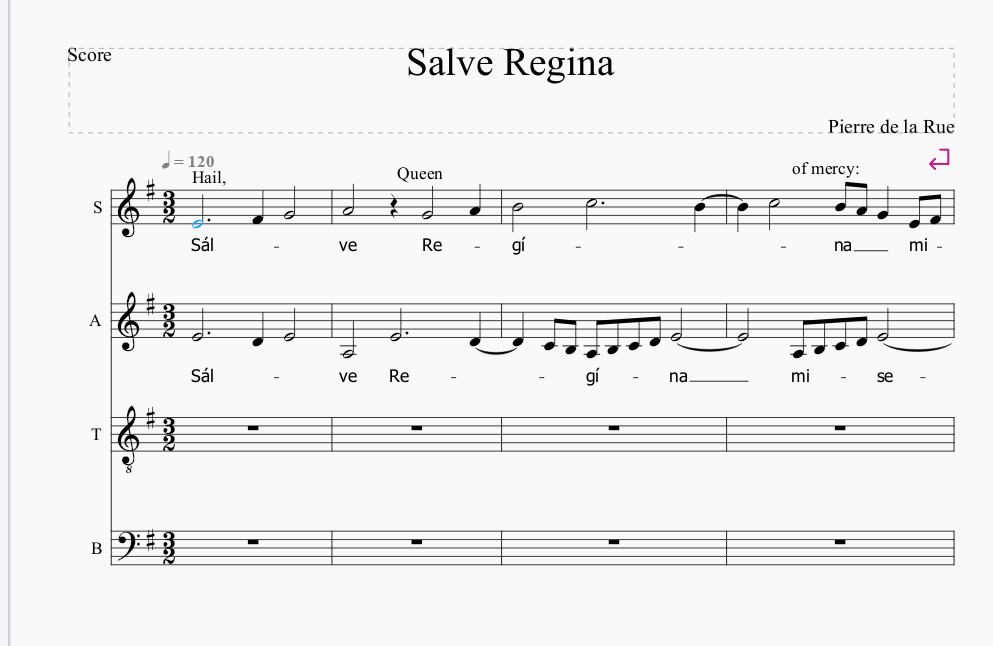
If you open the mxl in your notation software, it will look more conventional.
Is this pdf printed from the score more helpful?
I also attach an mp3 of a rendering by cantamus.app from that mxl file. Some singers might like these recordings for home rehearsal, usually with their part emphasised.
 993 x 646 - 48K
 124KThanked by 1CHGiffen


Welcome to the MusicaSacra Forum!
To participate in the discussions on Catholic church music, sign in or register as a forum member, The forum is a project of the Church Music Association of America.
Categories
- All Discussions21,844
- General Music Discussion8,548
- Job Openings292
- Management of Music Programs862
- Choral Matters539
- Church Documents and Rubrics540
- CMAA Notes307
- Events760
- For Newcomers: Read First26
- Sacred Polyphony567
- Hymnody898
- Gregorian Chant: General2,749
- ↳ Graduale Romanum and Liber Usualis372
- ↳ Graduale Simplex61
- ↳ Semiology65
- Vernacular Plainsong704
- Anglican Use and Anglican Chant73
- Organ, Other Instruments and Repertoire452
- New Composition/Works in Progress1,342
- Recordings238
- Music for Hispanic Ministry163
- Music Education: Children217
- Music Education: General223
- News Items247
- Positions Wanted3
- General Discussion: Catholicism742
- Amusements185
- General Discussion1,048
- Opinions119