
Name that psalm plainchant tune
-
Asking for curiosity. For the Advent Sunday psalm 'I rejoiced because they said', I'll use Tone 8 plainchant for simplicity. However, another tune is going around my head - I may not be remembering it correctly - like this. Does anyone recognise it?
-
Definitely not a traditional Gregorian Psalm tone. But it has Tone 1 like qualities.Thanked by 1probe
-
Thanks @monasteryliturgist, it might be something I half-remembered from the 1970s.
Thanked by 1monasteryliturgist -
The only one I know isn’t chant at all. It’s the two-step version by Trevor Thomson: https://youtu.be/rzsSCc0zOHs?si=HPc9bzEM1xvcdcUB
Vocal sheet music here:
https://dh8zy5a1i9xe5.cloudfront.net/shared/pdf/preview/30126421.pdf
However, when you sing it a cappella and less two-steppy it can feel more free flowing.
It’s in Spirit & Song and has a catchy sound to it. Perhaps that’s what you’re thinking? -
It works as "simplified Anglican chant."
-
I refute that robustly!...works as..."
Thanked by 1CHGiffen -
-
Not that one, @SponsaChristi :)
You sure about that? It sounds pretty legit to me. -
Dom Laurence Bévenot psalm tone 1
-
@sponsachristi I'm sure it's legit, C&W is just not my personal taste.
-
@A_F_Hawkins That sounds plausible, I was in the UK in the early 1970s and may have heard it there. Do you know of any recordings of the Bévenot tones? I found this, at 11:55 https://www.youtube.com/watch?v=BUM5Ur44ql8&t=9s
I found a PDF of three tones! https://www.cbcew.org.uk/wp-content/uploads/sites/3/2019/11/Evening-Prayer-full-text-music.pdf
Thanked by 1Liam -
simplified Anglican chant is
Reciting note 123
Reciting note 123
Reciting note 123
Reciting note 123
Despised by some, used by many. -
It could as well be called 'simplified' Meinrad chant, or 'simplified' Gregorian tones, or 'simplified' Geleneau, etc. It is what it is, its own thing, Though it bears a 'bare-boned' familiarity to other systems for the singing of psalms, it should not be dignified by such familial characteristics with any of the other, more mature tones. It isn't Anglican chant and shouldn't be equated with it. It is for people who won't take a few minutes to learn a real, developed chant system.Thanked by 1CHGiffen -
Simplified Anglican Chant has been on the scene since the mid 50s. It was disigned for congregational chanting, and should never be confused with Anglican Chant which is largely the domain of Cathedral Choirs, although come congregations in England, Canada, and the US have learned how to sing it, with differing results.
-
Rob, this is the kind of thing I recall from the Evangelical Lutheran Book of Worship, and perhaps also in the United Methodist Hymnal?
-
Okay.
Anglican chant is indeed for choirs, not for the people, and for the psalms of the office - not for the mass. That isn't to say that its use with responsorial psalms and such cannot produce admirable results. So called 'simplified Anglican chant' is so simple that it is insulting; but then, so are some other chant repertories (I shan't name names) current in Catholic usage.Thanked by 1Roborgelmeister -
The funny thing with the "simplified chant"- I find it so much more complicated to sing- it feels un-natural the way it works with 4 or 5 reciting notes.
-
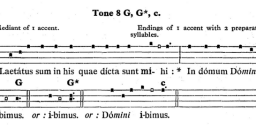
Seeing as we're talking about the reciting notes, I'd like to ask:
If I'm singing two phrases for Psalm 121/122 to these two lines:
I rejoiced when I heard them say:
‘Let us go to God’s house.’
In Tone 8 I bold the re in the first line.
But that feels like an unnecessary emphasis on 'heard' to me. I feel that after the so-la incipit, I feel I should stay on do until the word 'to' next line where I go down to ti.
Or, stay on the reciting tone for one long first line, (does that sound more Anglican to you?) so that I go up to re for 'God's'. Making them two long lines
I rejoiced when I heard them say: ‘Let us go to God’s house.’
And now our feet are standing within your gates, O Jerusalem.
I imagine it's my choice, but I'd like to ask for more informed opinions.
 691 x 273 - 77K
 -
Surely in English it should be 'I rejoiced when I heard them say, ...' It shows the difficulty of applying Gregorian tones to accented English.
-
From the mid 70s for about a decade I went regularly to Sunday Morning Prayer at Westminster Cathedral, and often EPI on Saturday, both of which were in English and congregational using Bevenot tones. I found the tones to have just about enough variety to use without tedium, and simple enough that the casual visitor could pick them up.
Returning after a few years I found that the DM had increased the rest at the end of each phrase (half verse) to match some Anglican ideas. Bevenot notated a quarter note (crotchet) rest, a longer pause destroys the natural rhythm of the poetry,Thanked by 1probe -
In our monastery we would do HEARD them say
Reason being- we dont use print outs, so instead we choose the third syllable as the accent closest to the end unless its extremely awkward then we would choose the second, but using the third makes the tonality closer to the latin form of application.
Its not a perfect system, but if you are not using pointing then it helps so everyone is on the same page.Thanked by 1probe -
From a 2009 thread https://forum.musicasacra.com/forum/discussion/1880/gregorian-psalmody/p1 a useful article by Bruce E Ford (3rd post) includes
My emphasisBut five other patterns that are anomalous in Latin occur in English with great
regularity.
5. Náme of the Lórd
6. wórds be-hínd your báck
7. greát Gód
8. greát mýstery
9. goód shépherd
The “Procustean bed” approach to pointing that the modern chant books prescribe,
when employed with English texts, impairs declamation far more than it does when
it is employed Latin texts because the frequency with which the formulas do not fit
English texts is much greater. If we are unwilling to adjust the psalm tones to
make them accommodate English texts, we ought not to use them to set
English texts, because their very purpose is to facilitate good declamation.
Some contemporary musicians have composed new modal recitation formulas
designed especially for English texts. Many who have experimented with these
tones, however, find them less satisfying than the “Gregorian” psalm tones. An
effort to adjust the “Gregorian” psalm tones to the requirements of English diction,
therefore, seems warranted. I have found that the difficulties involved are not
insurmountable.
Paul F Ford in the intro to By Flowing Waters, and Fr Samuel Weber in various places including the intro to Propers of the Mass have similar analyses.Thanked by 1probe -
Thanked by 1Richard Mix
-
I HATE that. Very, very few people do it in Latin, so when English chanters use it, I'm thrown off.
I would treat it as a dactyl like monasteryliturgist does. Only if there's no way to fit the formula in English do I adjust, but otherwise I adjust the English accent. The name of the Lord, for example. Sorry-not-sorry.Thanked by 1monasteryliturgist -
Luckily, Matthew, I don't care for your opinion.Thanked by 1Roborgelmeister
-
Luckily, Matthew, I don't care for your opinion.
if I said that so directly to someone, I'd be crucified on this forum. I have a reputation for being direct, maybe stubborn, maybe too opinionated. But actually rude like that? Never, or at least not very often when it would be very easy for me to be so.
There are a few of you who can't refrain from saying rude things to me, and at least one of you who ignores me. Good riddance then, I guess. (He's said as much in a public post, it's not a secret or a problem that I'm posting this.)
You (and I'm speaking not just to you) can whine that I've been fortunate to carve out places for myself in the church (at great cost, without knowing a thing about me and my own life—I once told some catechumens and candidates that our corner is full of mentally ill persons, not to mock them or to suggest that they were like us because we were crazy, but because it's where they found healing, and it got laughs because it's true; I'm surely not the only struggling one here). But when you have some experience it counts for something?
Anyway, there was a stretch when I didn't make it to a TLM I'd go to the Ordinariate Mass where they used a responsorial psalm more often than not, and where it was sung to tone 2 or 8, because they wanted congregational singing, they wanted to align with the NO, and they felt that the Gregorian tone was a better option. Whatever, not my monkey or circus in the long run, so I zipped it. But they did this for the monosyllables, and it was a bit of a mess: those who had never sung Latin and were in the choir expected it, those of us used to Latin and expected to sing from the congregation were unprepared every time (since it wasn't like we'd scan the psalm ahead of time as I do with my schola during the weekly rehearsal before public Sunday Vespers).
-
I HATE the rude and dismissive way you present your opinion on this forum. — there, is that better?Thanked by 1Roborgelmeister
-
No, it’s not better. The sarcasm is obvious. You were actually rude to me. At the very least, I gave a constructive reason even after being annoyed and actually agreed with someone else who’d already posted.
As I said, I’d be crucified for this direct rudeness. But really, it was just not that big of a deal— you don’t have to believe me, but you took the time twice to be rude to me. I won’t stand for it when you could do, as I often do, erase the message in the end. What is wrong with you? Seriously— you had what amounted to a temper tantrum, and I’m not gonna stand for it.
Also at least one sparring partner here has met me in real life and he’s at least as assertive as I am online but it’s fine, he was very nice and has been helpful to me. So I will absolutely not take the feedback that I’m rude and dismissive especially not after the actually rude comment that came first. -
I do agree with Matthew on that point, I think that interpretation really destroys the gregorian melody. I would rather take off from the recitation note rather than the end of the melody.
-
I think the problem is that it’s a deviation. Tone VII is what it is; you have to return to the reciting tone from the mediant, but if you aren’t expecting it and have to figure it out on the fly…
Indeed in tone VII there are a few endings (in Latin, at least) where you have to account for extra notes after the first final accent… so you will make mistakes. But repetition smooths it out (even if we only get that psalm, 111, in that tone once a year or maybe twice). But I am so used to just ignoring monosyllables that having to scan the whole psalm in between verses after that mistake would become necessary.Thanked by 1monasteryliturgist -
I'd be crucified on this forum.
I'd be sorry if Matthew actually thought that of us. While some are learning better than to tease, a comment like "sorry-not-sorry" might well sound like an invitation.
If I recall correctly, the Plainsong Psalter makes extensive use of the abrupt mediation.
-
And, to repeat myself, is a good reason for not attempting the Procrustean fitting of English texts to chant designed for Latin. We have modern chant styles devised for this, as well as Anglican chant. I agree with Matthew, disconcerting the chanters is a blunder.the Plainsong Psalter makes extensive use of the abrupt mediation
-
While some are learning better than to tease, a comment like "sorry-not-sorry" might well sound like an invitation.
TBH all I was saying is that I understand that there is disagreement here but if I must use chant in English I’m doing what I’m doing: I do not find it all that bad. It’s prose, not metered poetry, as far as English and even Latin go; the accent is not so steady as to be immutable, to me anyway. I read the original example of heard them say and sang it; I naturally make it a dactyl and can’t for the life of me make the accent on them.
I often can tell what’s meant as a ribbing or, in this case, where I encourage something that I know someone will not only disagree but will have strong feelings and argue against my suggestion or views; in particular: I am a paid-up member of the Mocquereau-Gajard school but at least one person here is very specific about chant interpretation and we just have to get along! I just don’t think that the comment which provoked my response was a ribbing. :(
I wonder if they copied that psalter in the Ordinariate context which I mentioned; we always had a booklet for Mass with the complete texts and music, so I didn’t have a way to discover the source of the pointing.
I appreciate keeping the Gregorian tones in English. I appreciate some of the EBC abbeys who have other styles. But most if not all retained the 1934 Vespers, and at that point the Regina Laudis and Flavigny solution (old office + Prime, new Mass) has a certain appeal -
@probe I dont know if its at all helpful- these are terrible recordings (hopefully its clear enough to get the idea) I made years ago for another community to learn chant-singing the same psalm in all the tones- just to show how you can apply it to all the tones using the same markings.
And yeah, its not always perfect, but if you want to stay consistent its a nice method. It works for us here at least.
I know Latin would be the best, but If I have to sing in English- Im glad to keep the traditional tones-they just help me pray so much better
__________________
When I call, answer me, O God of justice;
from anguish you released me, have mercy and hear me!
O men, how long will your hearts be closed,
will you love what is futile and seek what is false?
It is the Lord who grants favors to those whom he loves;
the Lord hears me whenever I call him.
Fear him; do not sin: ponder on your bed and be still.
Make justice your sacrifice, and trust in the Lord.
“What can bring us happiness?” many say.
Let the light of your face shine on us, O Lord.
You have put into my heart a greater joy
than they have from abundance of corn and new wine.
I will lie down in peace and sleep comes at once
for you alone, Lord, make me dwell in safety.
Glory to the Father, and to the Son,
and to the Holy Spirit:
as it was in the beginning, is now,
and will be for ever. Amen.
 1M 1M 2M
 -
I get that Matthew would prefer "I rejoiced when I heard them say" for the tone 8 mediation, but looking back I'm no longer sure what he hates (sorry, that's HATES): was it in reply to "I rejoiced when I heard them say" or in reply to "I rejoiced when I heard them say"?
-
The latter.
Easily the worst of the three solutions. -
If I recall correctly, the Plainsong Psalter makes extensive use of the abrupt mediation.
I would wish to use almost any solution (apart from putting an un-accented syllable where clearly an accented syllable belongs) rather than the abrupt mediation. Why? Becuase so often that word it HIT HARD, rather than lightly, and that is a very ugly sound. The mere change of pitch will accent that syllable, so BACK OFF. That's the training we got in a schola that sang for Dom David Nicholson OSB of Mt. Angel Abbey. -
this is the kind of thing I recall from the Evangelical Lutheran Book of Worship, and perhaps also in the United Methodist Hymnal
Clearly, there have been many attempts to make it possible for an untrained congregation to sing the Psalms with little or no preparation.
The ELW/ELCA/LBW tones are quite workable, but sometimes they have the cadance move on an un-accented syllable, which I don't care for very much. There is always one syllable (only) to every note, save for the final, which can have multiple syllables. Not always too attractive. However, ELCA congregations sing it enthusiastically.
I'm uncertain about what the various tones are in the UMH. -
On the topic of Englished Gregorian psalm tones, do any of you have experience with the St. Dunstan Psalter? I use it frequently but I find it quite awkward at times as far as accents are concerned.
-
Much to learn here. I have now rehearsed Psalm 121(122) in English with Gregorian Tone 8 and with Bévenot Tone 1. I find it difficult, even with the pointing marked in the text, to keep Tone 8 going without feeling an awkward placement of the accents. Bévenot works for me and feels more natural. As this is my first time as a cantor in public, I think it would more prudent, rather than adopting the Procrustean approach with Tone 8, to take advantage of any help that muscle memory of Bévenot can give me to sing without hesitation. I gather from the discussion that Tone 8 works in Latin, and having tried it with the Latin text, I am inclined to agree, but it does need marking up the text.
-
@GerardH
@MatthewRoth
Put on then, as God’s chosen ones, holy and beloved, heartfelt compassion, kindness, humility, gentleness, and patience,
bearing with one another and forgiving one another, if one has a grievance against another; as the Lord has forgiven you, so must you also do.
And over all these put on love, that is, the bond of perfection.
And let the peace of Christ control your hearts, the peace into which you were also called in one body. And be thankful.
Let the word of Christ dwell in you richly, as in all wisdom you teach and admonish one another, singing psalms, hymns, and spiritual songs with gratitude in your hearts to God.
And whatever you do, in word or in deed, do everything in the name of the Lord Jesus, giving thanks to God the Father through him.
(Colossians 3:12-17) -
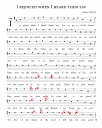
Well, let's try Tone 8 again. I attach my gabc and pdf files. Does that look like how the English words should be set?
-
1. For tone 8 (with a mediant of 1 accent), if the penultimate syllable is strong, I put it on the upper tone, as you did with standing and judgment.
2. When the penultimate syllable is weak, I put the previous weak syllable on the upper (accented) tone. There is not really an example of this in your text.
3. You did back up the stressed syllable to the median accent on “tribes” and “law”, but those are both accented words, so they are not the same situation as in #2 above.
4. For “brethren and friends” “house of the Lord” “Jerusalem pray” you have the issue of a final stressed one-syllable word and the nearest previous accent several syllables away. There are 3 solutions: a. The one you picked which leaves a lot of syllables on the last note and I perceive as awkward and ungainly; b. To put this one syllable word on the upper, accented note (“re” in your example) and omit the final note (“do”) (this is a historic Anglican solution which Matthew Roth condemns above in this thread); c. To use the option in #2 above, which will also sound odd.
Personally, I think “b” is the most elegant solution, but it is not authentic to the way Latin is chanted in the tones of the Liber Usualis.
However, as much as we may like the sound of the Liber psalm tones and feel that they are the “authentic” sound of plainchant psalmody, Fr Weber would remind us that they are only one version of the modal chant melodies selected by Solemes from a bunch of possible version found in the old sources. Further, they are geared toward Latin, not any other language. So there is nothing wrong with adapting the tones or writing new ones that better handle the accentuation patterns of a vernacular language.
-
You might study the pointing methods of Richard Rice, particularly in his “Sacrifice of Praise” for Vespers and his “Hostia Landis” for the Mass. He uses the psalm tones from the Liber and points the English words to fit following a regular set of rules for pointing.Thanked by 1CHGiffen
-
Thank you @Davido. I have Rice's Parish Book of Chant - is it in that?
(b, abrupt mediation) seems like a usable solution but controversial ;)
-
I would make these changes if it was me. but its very nice otherwise
 1048 x 1320 - 179K
 -
Not in parish book of chant because that is all in Latin. The ones I mentioned are some of his works that adapt the chant to the current English texts.Thanked by 1probe
-
@davido's option "b" (abrupt mediant) works but it does feel like a return to do is needed. I could carry on without a break, as the second line always begins with do and it would feel part of the pattern.
How about putting a re-do melisma on the monosyllabic end words like "Frie-nds", "Lo-rd", "pra-y"?
@monasteryliturgist that would also avoid putting the musical accent on weak words like 'in' and 'and'.
I'll write down whatever I decide so I don't accidentally improvise on the day and get lost.
-
I have seen that done before in some communities. In the end its what you decide. Personally, I dont like that method because again it messes up the Latin Form. When I was in Rome, studying Gregorian our professor was very insistent that when applying the Gregorian tones to Colloquial Tongue The Latin Form should be respected over the Colloquial. It might not work for everyone, but I think I am just so used to it that way that its hard for me to see it any other way. In the end you would need to make that decision based on whats easier for your choir to do. But my personal advice would be to avoid that if possible or else choose a tone thats easier to apply such as 4g.Thanked by 1probe
-
In Rome? Was that in the Pontifical Institute? Our choir (we can call ourselves a schola soon :) ) uses the PIMS videos by Fr. Robert Mehlhart.Thanked by 1monasteryliturgist




Welcome to the MusicaSacra Forum!
To participate in the discussions on Catholic church music, sign in or register as a forum member, The forum is a project of the Church Music Association of America.
Categories
- All Discussions21,844
- General Music Discussion8,548
- Job Openings292
- Management of Music Programs862
- Choral Matters539
- Church Documents and Rubrics540
- CMAA Notes307
- Events760
- For Newcomers: Read First26
- Sacred Polyphony567
- Hymnody898
- Gregorian Chant: General2,749
- ↳ Graduale Romanum and Liber Usualis372
- ↳ Graduale Simplex61
- ↳ Semiology65
- Vernacular Plainsong704
- Anglican Use and Anglican Chant73
- Organ, Other Instruments and Repertoire452
- New Composition/Works in Progress1,342
- Recordings238
- Music for Hispanic Ministry163
- Music Education: Children217
- Music Education: General223
- News Items247
- Positions Wanted3
- General Discussion: Catholicism742
- Amusements185
- General Discussion1,048
- Opinions119