
Are you a composer with a link for your music? Post it here!
-
If you are a composer and have a link to your music, I'm interested in perusing. It doesn't have to be free. Perhaps you have music published and you'd like to share. I think it would be fruitful to have a thread highlighting composers who frequent this forum.
Thanks! -
Motets in honor of the soon to be St. Carlo Acutis.
Soul of Christ (SATB)
O Salutaris Hostia I (SATB)
Some links to recordings by Matthew Curtis of O Salutaris and Soul of Christ!
https://youtu.be/UhkBGkDmuwA
https://youtu.be/1HAqCI8MJpYThanked by 1canadash -
Hi @canadash
I am sure you are probably familiar with one or two of my comps as I have been posting them here for many years...
there are over a thousand works in myopus (in my conservatory/oratory), however, a few of them have been posted here for a couple of decades
http://www.myopus.com
Thanks for your interest.
(of course, Mr. Giffen is a prolific composer on the forum too) -
I've written several pieces but so far have only published two that I consider worthy.
https://tinyurl.com/2zu898y2 (This piece will be premiered and recorded October 7)
https://tinyurl.com/2p9zzavw (Pending possible publication with a firm, self-published for now)
-
My Spanish mass setting just made it out of the print shop and is now available. Here’s the link:
https://giamusic.com/resource/misa-de-la-inmaculada-concepcion-printed-music-11306
It is very much not in the style of the average FyC setting, and (in my humble opinion) a love addition to the repertoire. It was written specifically to be usable a capella or accompanied, with or without choral parts. I started with the Santo, and then used motifs from that to craft the other movements—the goal being melodic unity throughout, hopefully making it easier to learn, without every movement vexing exactly a copy and paste melody. I have a general preference for through composed Glorias, so the Gloria is in the style of the John Lee setting. We sing it “antiphonally” between the choir and congregation here in Houston.
You would also be most welcome to browse my page on the CRCCM Repertoire Project. Many free offerings are available.
https://repertoire.crccm.org/browse?oc=Q2VyaXNpZXJ8TWFyYw== -
To start, I have posted a number of things to this forum, although you'll need to do a little digging.
I have over 1000 practice videos for various things (admittedly, heavily focused on my compositions or things I've arranged, but there are also lots of broader choral repertoire, as well as over 140 videos of Fr. Weber's antiphons) at www.YouTube.com/@ServiamScores
Lastly, my "official" repository for all of my arrangements, including my psalms (which are largely chant-based or at least distilled from chant melodies) all of which I'm now offering for free. [I'm currently working on building out a new portion of the website which would offer these as simpler downloads, but you'll have to "purchase" them for $0.00 for the time being.]
www.PsalliteDomino.com
_________
In terms of specific things to look out for:
One piece of which I'm particularly proud is my setting of Exaltabo te, Domine (free) which you can find here, including a stunning performance by a collegiate choir:
https://psallitedomino.com/blog/free-lenten-motet-exaltabo-te-domine-2025-elnca?rq=exaltabo te
I've also gotten a fair bit of traction for More Love to Thee, O Christ, as well as Tantum Ergo in Ab, both of which you can find more about here: https://psallitedomino.com/blog/two-major-releases-2025
I have nice easy SABar. motets for Holy Thursday (Foot washing antiphons) here: https://psallitedomino.com/store-1/p/suite-holy-thursday-foot-washing-antiphons-sab-motets
The all feature comprehensive practice tracks, too.
With Christmas ever approaching, you might want to check out Enixa est Puerpera (Our Lady was so fair and bright), https://psallitedomino.com/store-1/p/enixa-est-puerpera and especially Ecce Virgo Concipiet (Behold, a Virgin shall conceive) https://psallitedomino.com/store-1/p/ecce-virgo-concipiet-behold-a-virgin-shall-conceive-advent-motet
There are also a few organ works which people seem to appreciate, and lots more besides. Thanks for starting this thread; I look forward to perusing other people's posts! -
https://www.catholicliving.net/category/compositions/
The link above points to a slowly growing set of motets, Mass settings, and occasional hymns I have composed. The vast majority are on Latin liturgical texts. I have only a few recordings with a true choir -- most compositions posted have only Finale or MuseScore playback. It would be great to change that!
One notable exception is St. Luke's Passion, which I streamed live in 2024. I'm conducting at the link below -- but I'm not really a conductor. I consider myself an amateur composer. Below is the link to the stream:
https://www.youtube.com/watch?v=Mj4p9aFNisc&t=1140s
The motet Adoramus Te is embedded in that work.
A few motets that I think are among my better attempts include:
- Oculus non Vidit
- O Vos Omnes (also at the end of St. Luke's Passion)
- O Magnum Mysterium
- Ave Verum Corpus (recording)
- Tota Pulchra Es Maria
- Quo Abiit Dilectus Tuus
There's quite a bit of 3-part music at the site, too, especially for women's choir, in addition to SATB. You'll find PDFs with each post on my site licensed Creative Commons BY-NC-ND, to make them easy to use in a liturgical setting. -
jeffreyquick.com is the go-to place for all of my music, linking whatever is out there: published or on cpdl.
I'd like to particularly highlight my Ave Verum Corpus for one or 2 voices with organ. It's a dandy piece, and widely applicable (well, maybe not in Charlotte or Venice, lol bitterly). Some of the spelling is needlessly difficult to audiate (not my decision), but if my little schola can do it well, anyone can. And I'd like Gary Penkala to think that publishing it was not a horrid idea, so go make him some money.
I have a few recent English things that I'm thinking of setting up a shop at jwpepper for. (or if you ask politely). Right now I'm kind of embittered about writing for the liturgy, between the generally lame state of Catholic music execution, the attitude of the clergy, and the simoniac attitude toward the liturgical texts. Bribe me enough, and I'll write whatever you want. But if I do write anything in English motu proprio, it will probably be a prayer or other devotional text (if I can figure out if any particular English translation is PD). I might need to pray something in Latin (Thinking about a Vox in Rama for 2 part treble and organ, you know why :-( ) And I'm currently working on a Stabat Mater for 2 solo women and chamber ensemble, so I'll still be writing Catholic music. -
I don't get to hear this one every day (only when I can find someone who plays the theorbo), but you're welcome to give it a go. Two voices and theorbo. Obviously an imitation of the Bach/Gounod Ave Maria, but Kapsperger's harmonic language compared to Bach is certainly "unique," and I try to reflect some of those quirks in the vocal parts.
 60K
60K -
@Noctcaelador The Ave Maria on basis of the Kapsberger Toccata is a brillant idea. Incidentally, I play the theorbo and occasionally use it for my sacred music.
If you eventually find a theorbo player for the accompaniment, (s)he might find the original notation by Kapsberger much easier to read, which I have attached below. Note that the notation is rhythm-wise thinner than the edition on IMSLP (why does it interpret the 4th fret on the third course as d-sharp instead of e-flat?) and that it is ambiguous with respect to arpeggiation and leaves room for outstanding performances like this by David Taylor.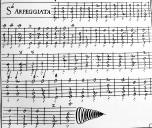 2637 x 2222 - 2M
 -
Xopheros,
Appreciate the suggestion! I wasn't aware there was a staff notation edition on IMSLP (I transcribed the chords from the tablature), but feel slightly vindicated that we (me and Jakob) independently came up with that D-sharp that becomes an E-flat... It's a thoroughbass convention, albeit with a weird spelling.Thanked by 1Xopheros -
alexchoyce.com
Score follower videos can be found here: https://youtube.com/@alexchoyce1991?si=PchQwW1goStzlxsM
Id recommend looking at the score follower videos.
Thanks and God bless!
- AlexThanked by 1canadash -
I have several dozen published pieces that are available on a number of different platforms. Most of these are arrangements of sacred pieces, with a major emphasis on solo organ and piano, with some choral and instrumental ensemble pieces as well. A handful of secular pieces and original compositions are also thrown into the mix.
The link to Sheet Music Direct contains a comprehensive catalog of my published pieces, while the Musicnotes link has a more limited selection. The link to my composer page on CanticaNova lists two of my organ pieces that are not available anywhere else. And finally, I am attaching an unpublished arrangement of “O Sacred Heart, O Love Divine” for SATB choir and piano. I originally posted this on another thread and since then have made some slight changes. Enjoy perusing these selections!
https://www.sheetmusicdirect.com/Search.aspx?query=kevin+frecker&u=1
https://www.musicnotes.com/landing?w=Kevin+Frecker
https://canticanova.com/cnp_info/frecker.htm
Thanked by 1canadash -
Sorry for contributing to this thread with some delay, but I wanted to include a link to the video with my English Magnificat a5, which took some time to be finished. Many of my pieces are in styles of earlier periods, or "period composing" as Bruce Haynes called it. If it goes beyond one-time-use Gebrauchsmusik, this compositorial approach requires a specific sujet or some other justification, I think. Here are some examples:
- Missa Phrygia for SATB
This has the weakest justification, because there are already so many mass settings in Renaissance counterpoint, but I was always fascinated by the phrygian mode and wanted to write something succinct (for use in modern services) and accessible for lay choirs with respect to difficulty and voice ranges. And the result is, IMO, very beautiful as can be heard in this recording of the Agnus Dei (ca. 1:30 min). - English Magnificat for SMATB
A setting that applies the style of the early baroque (Schütz, Monteverdi) in an idiomatic way to a modern English translation of the Magnificat. I have made a video that explains this setting in detail, in which the music starts at min 6:22 (ca. 4:30 min). - Mass in E-Major for SAB & organ
A mass setting in the style of Viennese Classicism, but for only three part choir and with a simple organ accompaniment instead of an orchestra. It thus fills a gap in the repertory.
Due to the chosen styles, the above pieces in some way look backwards. Unlike some other forum members, however, I appreciate that, throughout the history, musicians always wrote new church music in their contemporary popular style, albeit with varying success. I therefore also write some sacred music that looks forward and explores today's popular style and enhances it with traditional elements like counterpoint or word painting. Here are two examples:- Justorum Animae for SATB & accompaniment
I consider this my most beautiful piece so far. It combines different styles according to the meaning of the text, with renaissance counterpoint representing heaven (what else? ;-). I have even made an a capella version in Latin for traditionally oriented choirs. Here is a recording of the original version in my favorite language (ca. 2:30 min) sung by myself and my daughter. - Pentecostal Motet for SAT & accompaniment
The text was written by a friend, a catholic priest, specifically for the purpose that I set it to music. Here is a video explaining the music and presenting a recording (5:00 min, the music starts at min 3:12) sung by our family.
Thanked by 1canadash - Missa Phrygia for SATB



Welcome to the MusicaSacra Forum!
To participate in the discussions on Catholic church music, sign in or register as a forum member, The forum is a project of the Church Music Association of America.
Categories
- All Discussions21,851
- General Music Discussion8,551
- Job Openings293
- Management of Music Programs862
- Choral Matters539
- Church Documents and Rubrics540
- CMAA Notes307
- Events762
- For Newcomers: Read First26
- Sacred Polyphony567
- Hymnody898
- Gregorian Chant: General2,749
- ↳ Graduale Romanum and Liber Usualis372
- ↳ Graduale Simplex61
- ↳ Semiology65
- Vernacular Plainsong704
- Anglican Use and Anglican Chant73
- Organ, Other Instruments and Repertoire452
- New Composition/Works in Progress1,342
- Recordings238
- Music for Hispanic Ministry163
- Music Education: Children217
- Music Education: General223
- News Items247
- Positions Wanted3
- General Discussion: Catholicism742
- Amusements185
- General Discussion1,049
- Opinions119