
New USCCB Guidelines on "Publishing" Ritual Texts (incl. Psalm settings)
-
Today's new edition of the BCDW Newsletter included first notice of the release of the updated "Guidelines for the Publication of Liturgical Books." This policy historically was only applied to commercial publications, but the scope has been greatly expanded.
Firstly, here's a link to the whole document:
https://www.usccb.org/resources/guidelines-publication-liturgical-books.pdf9. In these guidelines the term “publisher” is applicable to any person or group, public or private, for-profit or not-for-profit, ecclesiastical, religious, or lay, engaged in the production of liturgical materials for distribution to others. “Publications” refer to materials that are intended for public distribution by whatever process they may be produced or reproduced, print or non-print (e.g., digital), whether for sale or for distribution without charge.
Another area that you'll want to review is Appendix IV: Policy for Musical Compositions for the Liturgy.
Important Highlights...
From paragraph 3Musical settings of the Ordinary of the Mass (cf. no. 14), of responses and acclamations of the people (chants of the priest, deacon, or lector and, if applicable, their responses; Responsorial Psalms; settings of the Our Father), and of the special rites of the liturgical year – whether intended for broad or only local use – require the approval of the Secretariat in order to be used in the liturgy in the dioceses of the United States of America that comprise the USCCB. It is the Committee on Divine Worship’s understanding that this approval is necessary even if the musical setting will not be published.
(Emphasis mine)8. In cases where out-of-date texts are used for newly composed music, permission for liturgical use and copyright permission will not be given.
From my discussions earlier this year with Mary, out of date means not the APC for anything related to psalms or canticles. I presume she might let you use the NAB text in the Lectionary, but she was hesitant when I asked (not that I'd want to use it anyway).
I'm fully expecting there to be a fee for the required review even for local, noncommercial use—I've been told the permissions office wants it, but I hope others might have pushed back on it. No mention in the newsletter or online yet. The amount of labor this will take on the part of the USCCB will be massive if these rules are actually followed and every person who ever writes one-off psalms settings, etc... submits for review. I know how long review of a psalter took for commercial review.
How does one comply with these regulations and write a psalm setting for a mass that you need this week when the review could easily take 6–8 weeks?
It'll be interesting to see how this turns out...
-
Is this really what the USCCB thinks of composers – that they are too bloody stupid to copy and paste the text of a psalm under tone 8, and someone needs to check their work?
-
Is this really what the USCCB thinks of composers – that they are too bloody stupid to copy and paste the text of a psalm under tone 8, and someone needs to check their work?
In short, yes, because that is the only thing they will be reviewing:The Secretariat does not make judgments based on style, artistic
merit, or musical tradition of the piece. While the Secretariat has
been granted authority by the GIRM, no. 393, over musical
settings of the Ordinary of the Mass, the people’s responses and
acclamations, and special rites, it chooses not to make judgments
based on style, artistic merit, or musical tradition. Instead,
composers, publishers, bishops, priests, musicians, liturgists, and
music planners are to make these judgments using the criteria
found in documents such as: Musicam sacram (SCR, 1967);
Chirograph on Sacred Music (St. John Paul II, 2003); Sing to the
Lord: Music in Divine Worship (USCCB, 2007); and the general
guidelines in “Catholic Hymnody at the Service of the Church: An
Aid for Evaluating Hymn Lyrics” (USCCB, Committee on
Doctrine, 2020). -
I’m normally one for a more maximalist compliance with licenses. But this is insane.
-
These people have already copyrighted the Bible to give themselves a revenue stream. Do you expect anything less?
-
Like I have been saying for decades… compose using Latin texts.
-
This is complete madness regarding psalms and antiphons, at least
-
The consensus among a few composing friends is that they will ignore this insanity. i would be inclined to do the same.
-
"It is the Committee on Divine Worship’s understanding that this approval is necessary even if the musical setting will not be published."
That's a particularly cherce (Brooklyn accent) piece of bureaucratese, esp because it's lurking within a piece framing publication as the starting premise. I wonder if the Committee chose that formulation because it did not believe it had full authority to legislate it as such but wanted to create an impression as if it had it. -
Simple solution — flood them. Every school Mass in the country should send every daily psalm setting it has ever cooked up at once.
-
While I think kevinf's thoughts above line up with what the reality of the situation will be, I would live to see NihilNominis' plan enacted. I have a feeling the policy would quickly be changed.
-
Is this a moral policy or a legal policy? Is this binding under sin or is it binding under copy rite?
There is no way that this can be possible. What about all of the monasteries that are chanting the psalms every single day in the mass? -
That's an interesting question... throughout the document, they quote many church documents to support their policy, so one one think they feel it might fall under both categories. I'd encourage you to share your concerns with the USCCB Office of Divine Worship. Maybe there are organizations like yours where they might extend a blanket license.Thanked by 1monasteryliturgist
-
The way they've written it underwrites maximalist non-compliance. Someone lacks an imagination to understand that's the practical effect.
-
I have a cynical read of this. By unexempting non-published settings, it seems like some of the big publishers got to them and said, look, so many people are putting out free resources online it’s undercutting our profit margin. Or in the case of OCP, our not-for-profit margin.
Because the practical effect of this will either be that everybody ignores it, or, if they decide to start getting strict about compliance, that people just have to buy everything from publishers who have approval built-in to their products.
It’s kind of a way of changing the game back to the old school in the Internet age.
-
Getting strict will just blow up in their faces.
There is approximately zero chance that only established publishers will be allowed to license these texts.Thanked by 1tomjaw -
"I have a cynical read of this. By unexempting non-published settings, it seems like some of the big publishers got to them and said, look, so many people are putting out free resources online it’s undercutting our profit margin. Or in the case of OCP, our not-for-profit margin."
That's not cynical, but by far the simplest rational explanation* for a bureaucracy to ... require itself to undertake more review work. It was my immediate understanding when I read it. I don't know if the bureaucrats will allow themselves to see how others will inevitably see it that way. Attempting to legislate in this way will have the long-term practical effect of bringing the "law" into disrepute and undercut the authority of its "legislator".
* The commercial publishers need only have complained about "unfairness" without mentioning profit margins, as the latter would be implied in the former but allow plausible deniability. -
On page 15, #54 it says that the Secretariat does not review one-time worship aids, and that the ICEL will not require royalties on one-time aids printed for a particular congregation or institution so long as they are not sold.
-
Yes, but they also say that materials even for local use require their approval just to be used in the context of liturgy. (In the quotes from my original post)Thanked by 1ServiamScores
-
Fortunately, "one-time use" is not crystalline in scope, and I would strongly recommend against seeking clarification.
OCD folk read no further:
One liturgy (a funeral or wedding Mass)? One liturgical observance (all of the Sunday/Sat evening Masses for a given weekly cycle)? A dated monthly/seasonal temporary pew participation aid that won't be reused (I just saw one of that type - for July/August 2025 - in the parish I attended this morning's Mass; where I normally attend Sunday Mass has one such aid for Masses on a given Sunday, et cet.)?
All we need now (/s alert) is an explicit echo of the thou-shalt-destroy-any-copies-upon-expiration-lest-thou-shalt-die commandment of the major publishers.
What is clear is that the policy/procedures are designed to service the needs and habits of the major publishers who provide for a mass market on a long advance timeline rather than a parish staff that does not have a bureaucracy dedicated to dealing with the USCCB but that is by necessity more agile at a local level than the major publishers in other respects, an agility that was turbocharged by the COVID19 pandemic and invited more reflection about the desirability of continued reliance on the resources of the major publishers.
-
I improvise the psalms at the moment... no written music... nothing in print... it just 'appears' in my mind and then disappears from my voice into thin air... how does one deal with that?! It is truly the same as a 'reading' of the lector, except I add note pitches...Thanked by 1GregoryWeber
-
Francis:
From my conversations with them, I think this general thought line that it's to service the publishers isn't correct, but that the concern is that things are being used at Mass that are not correct.
Maybe your improvised settings are fine if you're reading from an authorized copy of the Psalter as you improvise? They've said they don't care about the music... just that the words are correct.
Liam:
The bigger concern isn't really about reprint rights, which is what one time usage is talking about. The USCCB's current position is that you need their authentication of your usage of the text just to use a setting in the liturgy—even if there is nothing in the hands of the congregation. I'm sure someone thought that it would be good to ensure that all texts used for the Psalms and Mass Settings are correct, and I can see the value in that, but the administrative overhead for doing this will be massive. This has always been the case for Mass Settings (though often ignored), but this is new for Psalms. -
Don’t all if not most of us use the approved books?!?! Who is out there improvising the texts!?!Thanked by 1ServiamScores
-
Oh how easy it would have been for them to simply say:
With the promulgation of the new lectionary, it is necessary that all psalm settings match the revised text exactly. All editions which do not must be revised or removed from circulation.
This would be simple and clear. “Here is the official text, all other variants are illicit.”
Done. Simple.
For my part, I will no sooner submit my school mass psalms for review than fly to the moon. (Unless, of course, we all agree to let them receive their just desserts all at once, “by coincidence.”) I know how to read the lectionary.
I do find myself rather amused to think that everything will suddenly be “illicit” but there will still be oodles of errata on the usccb’s own website which publishes the daily lectionary. Then some poor unfortunate soul who doesn’t have a physical copy (or official digital copy via Verbum) will take the text right from the usccb’s website and then submit for approval and be denied because of the usccb’s own errata. Ah the folly. -
Perhaps it’s a blessing that they cannot tell us when the new lectionary will drop, and it’s likely going to be years more… I suppose that means we all get to keep composing with reckless abandon for at least a little while longer.
I also now find myself now exceptionally annoyed at all the publications that make such an ado about having “full ecclesiastical approval” when all they did was have someone email them that the text matches the lectionary… a whole rigmarole that shouldn’t even be necessary.
If I copy and paste from Verbum the literal official text, then what’s to keep me from making the same claim whilst cutting out the middle men? Honest question. It’s all asinine.
I’m all for making sure that people aren’t mucking the words up, but usually it’s the music that’s the problem anyway. Ugh. -
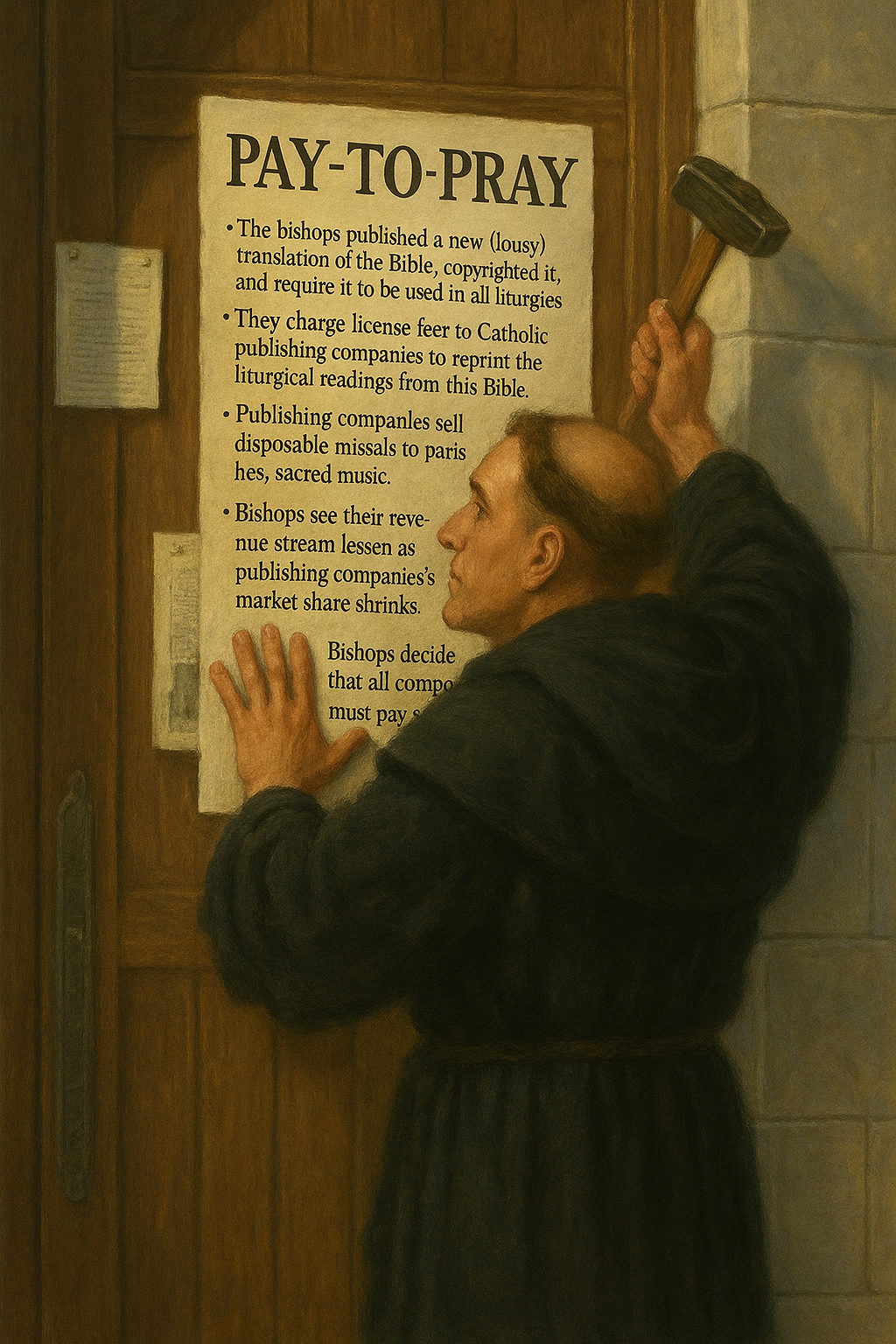
Let’s summarize and lay this out clearly for the people who lurk and learn from this forum. We’ll call this story:
PAY-TO-PRAY
- The bishops published a new (lousy) translation of the Bible, copyrighted it, and require it to be used in all liturgies
- They charge license fees to Catholic publishing companies to reprint the liturgical readings from this Bible.
- Publishing companies sell disposable missals to nearly every parish, creating a revenue stream for the bishops.
- Music from publishing companies is so profane that devout composers and the CMAA set the liturgical texts to sacred music at great personal effort and post it FOR FREE on the internet.
- Bishops see their revenue stream lessen as publishing companies’s market share shrinks from more and more parishes adopting free, sacred music.
- Bishops decide that all composers must pay a fee to have their musical scores approved, which will effectively stop composers from offering FREE resources and remove competition for publishing companies, thus securing bishops ‘PAY-TO-PRAY’ revenue stream. -
"With the promulgation of the new lectionary, it is necessary that all [new] psalm settings match the revised text exactly. All [new] editions which do not must be revised or removed from circulation.
This would be simple and clear. “Here is the official text, all other variants are illicit.” "
Exactly. That's why I think, despite MC's sense otherwise, what actually happened looks exactly like a bureaucracy handling things primarily from its habitual dealings with its principal large "users" and then addressing ad hoc concerns primarily from within that framework. But I don't believe the bureaucracy permits itself to see how it looks from a distance, so they would avoid having consciousness about that. -
:)
 1024 x 1536 - 3M
 -
An aside that might be reason for the panic…
https://www.catholicnewsagency.com/news/265945/study-9-in-10-cradle-catholics-leaving-the-church-experts-urge-stronger-faith-community -
Speaking to the errors on their website, their review of my psalter found a surprising number of issues with the Mexican lectionary text they publish there.
-
If the staff spend time policing the lack of authentication/approval on the part of textually-conforming non-commercial parish materials that come to their notice, I can only look forward to the *vaster* policing that would logically follow concerning the use of paraphrases (at best; often more accurately merely "inspired by") in liturgical moments for which they lack cognate authentication/approval - for example, "Shepherd Me, O God" in a program as a Responsorial Psalm in lieu of the proper lectionary verses of Psalm 23 and its approved antiphons for the given liturgical celebration - and hymnals that group, caption/title, and/or index such paraphrases as Psalms rather than songs/hymns. Et cet. (And if the staff object that is out of scope from their policy, then they have things upside down.)
-
Is this a moral policy or a legal policy? Is this binding under sin or is it binding under copy rite?
There is no way that this can be possible. What about all of the monasteries that are chanting the psalms every single day in the mass?
I consulted my copy of Jone’s Moral Theology Manual. Worst case scenario is it binds under venial sin, which is still really bad and not good for your soul. One would, objectively speaking, offend God, be required to make reparation either in this life or purgatory, or even both, cause damage to one’s soul and dispose it to committing more sins, often more grave than the previous and can ultimately dispose one to commit mortal sin, and leads to lukewarmness in the spiritual life, despair and final impenitence, spending eternity in Hell, etc. Venial sins are just bad and one should never intentionally commit them.
That being said, impossibility of fulfilling the law (policy), removes the obligation to observe it in that instance.Thanked by 1monasteryliturgist -
This is laughably non-enforceable and a product of someone who has never spent time working in parishes, or if he or she has, has never served as a church musician. In other words, good luck with that, bishops and your lay staff!
Further, until they (the bishops writ large) get serious about liturgical abuses across the US that have brought, and will continue to bring, havoc on the lay faithful's understanding of Real Presence and vertical worship, they are quite limited on credibility. -
From my discussions earlier this year with Mary, out of date means not the APC for anything related to psalms or canticles.---Marc Cerisier, in original post
What is APC? -
The current edition of The Abbey Psalms and Canticles, now owned by the USCCB.Thanked by 1GregoryWeber
-
So this is sort of a revised Revised Grail Psalms which we should use going forward?
-
https://www.usccb.org/news/2019/usccb-purchases-translation-psalms-and-canticles-conception-abbey
It is the current, most recent version of the Revised Grail Psalter, and with the many "copy and paste" introduced in 2010 by the Vatican to the 2008 version corrected. It might be fun to do a side by side between the originally submitted 2008 edition and the final, final APC release (I'm told there were a few corrections after the USCCB Publishing edition was released).
In the context of the earlier discussion, and knowing how popular LA has been on this forum from past discussions, I thought this snipped of the press release is worth sharing:In purchasing these copyrights, the bishops are following the guidelines of the Holy See’s Instruction Liturgiam authenticam, which requires that a Conference of Bishops possess all the rights necessary to promote and safeguard the accurate and appropriate use of the texts of the Sacred Liturgy.
This would be the same instruction, I presume, that guides their plan to require preapproval of all liturgical texts used in the liturgy. -
I wonder if the Committee chose that formulation because it did not believe it had full authority to legislate it as such but wanted to create an impression as if it had it.
"We had the impression that they had the authority to do so."
(apologies to Sr. Lucia...) -
"It is the Committee on Divine Worship’s understanding that this approval is necessary even if the musical setting will not be published."
Not being American I don't have skin in the game, but it does seem to me that most of the practical and moral questions raised ITT hinge on this incredibly unclear statement. I would feel comfortable disagreeing with their "understanding" solely on the basis that it's totally impractical, and therefore can't be the correct understanding. -
*Purple Bold*The correct understanding is whatever WE (the powers-that-be) say it is.
-
2. Those musical compositions that either adapt liturgical texts or use wholly original (newly composed) texts not found in the liturgical books, such as hymns, songs, or acclamations written for the assembly, which are intended for use when it is indicated that another text is allowed to be used in place of a liturgical text, fall outside of the purview of these guidelines. The suitability of these texts for use in the liturgy is determined by the Diocesan Bishop. The approval for liturgical use of one Diocesan Bishop of a musical setting of these texts is considered to extend throughout the dioceses of the United States that comprise the USCCB. [underline added]
All hail GIRM-US Options 4 and 3* with the approval of the Diocesan Bishop**.
*in that order
**wink, wink




Welcome to the MusicaSacra Forum!
To participate in the discussions on Catholic church music, sign in or register as a forum member, The forum is a project of the Church Music Association of America.
Categories
- All Discussions21,846
- General Music Discussion8,548
- Job Openings293
- Management of Music Programs862
- Choral Matters539
- Church Documents and Rubrics540
- CMAA Notes307
- Events761
- For Newcomers: Read First26
- Sacred Polyphony567
- Hymnody898
- Gregorian Chant: General2,749
- ↳ Graduale Romanum and Liber Usualis372
- ↳ Graduale Simplex61
- ↳ Semiology65
- Vernacular Plainsong704
- Anglican Use and Anglican Chant73
- Organ, Other Instruments and Repertoire452
- New Composition/Works in Progress1,342
- Recordings238
- Music for Hispanic Ministry163
- Music Education: Children217
- Music Education: General223
- News Items247
- Positions Wanted3
- General Discussion: Catholicism742
- Amusements185
- General Discussion1,048
- Opinions119