
Order of Sung Mass - 1962 Missal
-
I had a discussion with a liturgist friend this morning in which some interesting points were made about the inclusion of rubrics in relation to the people in the Missal of St Paul VI – that is, things that the people should ‘do’ at Mass, especially in relation to singing.
There are no rubrics in the Missal of St John XXIII in relation to the people (apart from those in relation to the renewal of baptismal promises at the reformed Easter Vigil).
It occurred to both of us that hand missals published before the Council, while including translations of the liturgical texts and rubrics, did not make it clear or easy as to how a congregation could participate in the singing at Sung Mass (of course, there were a number of hand missals published that incorporated aspects of the Dialogue Mass, which is always Low Mass).
There is a certain tension, potentially, between following along with the priest’s texts with recollection and devotion, and singing Mass Ordinary (especially at the Sanctus and Agnus Dei).
Has anyone published an Order of Mass for the 1962 Missal, specifically with the aim of congregational singing at Sung Mass in mind?
It is not so much a matter of having music inserted throughout the Order of Mass (the various ordinaries could form appendices) as it is about helping people to understand when their singing could (should?) take precedence over silent participation by reading the liturgical texts.
Neither is it a matter of mandating what people do at Sung Mass – Only making it clear that there are different ways of participating at Mass and that the Low Mass norm of silence does not apply at Sung Mass.
There is in some places a perception that it is the role of the priest and sacred ministers to ‘say’ the Mass, of the choir to ‘sing’ the Mass and of the congregation otherwise to ‘pray’ the Mass. That would not seem consistent with the aims of either the liturgical movement or papal legislation since St Pius X. -
I need to think about this more. But one problem that I face is people who wish to sing but from the middle of the missal with the bilingual ordinary instead of flipping for the relevant parts, where they can more accurately follow.
-
The Parish Book of Chant has the Order of Mass with an English translation for both the Current missal (in Latin) as well as the 1962 Missal. I don’t know of anything that that has both all the Readings and Mass Propers. My Baronius Press Hand Missal has a very small Kyriale in it, but it’s very limited. It doesn’t even have Credo IV in it.
I had personally had no issue with figuring out where or what to sing my first EF. I struggled with trying to follow along with the priest in the missalette. When I put that thing down and just followed the chant, it was easy. I grew up with sung Masses and the chant was basically the same.Thanked by 1StimsonInRehab -
The Angelus Kyriale is better; the best is the St Andrews (the one that’s reprinted anyway, and the editions for France, of which I have one from the 1940s; I don’t know about other languages, as I have one that lacks a Kyriale).There are no rubrics in the Missal of St John XXIII in relation to the people (apart from those in relation to the renewal of baptismal promises at the reformed Easter Vigil).
This is not strictly true. The people are to follow the clergy in choir; this was never deleted from the Caeremoniale Episcoporum, which is why the authors pretty much all agree on this (although they don’t necessarily agree on every last detail). I think that Richard Friend has pretty clearly made the case (PDF here). And for the traditional Holy Week: the people are to creep to the cross in the manner of the clergy (a rubric unfortunately undermined by the permission to venerate at the rail, although one need not avail oneself of this…)There is a certain tension, potentially, between following along with the priest’s texts with recollection and devotion, and singing Mass Ordinary (especially at the Sanctus and Agnus Dei).
That aside, and to the point above, the essay is actually worth reading in getting back to the original topic. I’m not going to go as far as the CRNJ’s superior would go, because if you want to kneel for the prayers at the foot of the altar, OK, but you should be meditating on the introit, not trying to follow the quiet prayers. It is true that, before the council, the Roman custom was for the clergy to recite the prayers quietly in pairs or groups of three in the choir stalls, a custom taken up by Westminster Cathedral as well, but the people can hardly manage this (this is where I point out that the Caeremoniale’s prescriptions or expectations, if you prefer, don’t ask to do silly, unedifying things…). But no matter what you do, you should, you know, resume paying attention to the choir (the schola and/or the polyphonic musicians) when those prayers finish, and it does sort of annoy me when people stand only as the priest intones the Gloria.
That’s not even getting to congregational singing. This is about following the Mass in a way that makes sense. Yeah, there’s a lot of liturgical movement tinkering that I prefer, and I’ve been told that the NO is better for me, except that those people never, ever consider that the NO is designed so that you don’t have to prepare at home, or at least before Mass, and that you don’t have to have two things going on at once. It’s all in and out, since the propers are optional and may be read in the vernacular (different propers from the graduale’s, but that’s immaterial). Following prayers that at the normative Mass are really not made for the congregation to hear is not coherent. Listen to the propers. I acknowledge that not everyone wants to sing, so they can follow along from the middle of the missal if they wish!
I sort of try to split the difference. I put out a sheet with the Ordinary for the day. I can’t do much, and it’s all a bit passive aggressive (they don’t love picking something up if they don’t need it, as they prefer the missal that they have chosen, so it’s gotta have some music on it that they need or otherwise will be curious in).
Putting out the order of Mass (with the propers integrated or not), with directions, even in the pew, would not be useful here, though I would consider doing that, based on what the Institute of Christ the King did in trying to replace the red booklets, if I had a blank slate. -
Here it might be helpful to take a longer view of things. Following the priest's prayers word-for-word in a parallel Latin-vernacular hand missal was presented as the preferred way of assisting at Mass for only a relatively brief period in Church history, and printed vernacular translations of the Mass weren't generally permitted until as late as 1897 (!). Let us recall also the older terminology to hear Mass. But how can one hear prayers that are said inaudibly by the priest?There is a certain tension, potentially, between following along with the priest’s texts with recollection and devotion, and singing Mass Ordinary (especially at the Sanctus and Agnus Dei)...
helping people to understand when their singing could (should?) take precedence over silent participation by reading the liturgical texts.
From the organ console, I have a frontal view of not only the choir but also about another 30 people plus part of the cry room. Very few of those in the church participate in the singing of the congregational chants. I simply don't know what they're doing during the Gloria and Credo after sitting down. Actively listening? Making devotions? Looking around? Some Catholics indeed seem to have the notion that silently reading those texts from the book Sunday after Sunday, year-round, is the best means of assisting at Mass. They think singing is solely the choir or cantor's responsibility.
As for the Sanctus, someone who knows the chant from memory may well be able to follow the prayers of the silent canon simultaneously without difficulty, but where is one's attention at that point? And where should it be, ideally? Likewise for the Agnus Dei and the pre-Communion prayers.
More than that, I think there's a prevalent idea that the Mass consists fundamentally in what the priest does and says; that everything beyond a private Low Mass without a server is essentially superfluous; and that the sung Proper, Ordinary, and everything else are just background music for what the priest says and does.There is in some places a perception that it is the role of the priest and sacred ministers to ‘say’ the Mass, of the choir to ‘sing’ the Mass and of the congregation otherwise to ‘pray’ the Mass. -
Many thanks, FSSPMusic, for your thoughts.
I think your advice to take a longer view of things is wise.
If one thinks that for the vast majority of the past millennium, participation at Mass has been by means other than missals, a rich array of different possibilities begins to emerge.
Your reply certainly highlights the issues with following a single text, especially when there are multiple layers of ritual occurring simultaneously.
Perhaps the hand missal movement had the unintended side effect of prioritising liturgical forms that ran sequentially (ie. Low Mass etc) rather than simultaneously.
Your response also highlights a most unhelpful reductionism that we would do well to counter: if focus on the priest is the sole matter of importance in the liturgy, our rites will no longer mirror the range of hierarchies and activities occurring in the ever-present-now of Heaven.
Finally, it seems to me that if the approach to participation is that we focus solely on the priest and his texts, it is inevitable that the rich musical world of propers and ordinaries will be destroyed. Perhaps, in that sense, the hand missal movement sowed some of the seeds of the destruction of the Roman Rite? An uncomfortable thought... -
Perhaps the hand missal movement had the unintended side effect of prioritising liturgical forms that ran sequentially (ie. Low Mass etc) rather than simultaneously....
Perhaps, in that sense, the hand missal movement sowed some of the seeds of the destruction of the Roman Rite?
THIS.
I've long said that the roots of the NO are in the pontificate of Pius X.
The effect of hand missals is to intellectualize and linearize one's perception of the Mass, and to introduce the notion that "praying the Mass" means interacting with the content of any specific day. Certainly meditating on the Scripture reading is a good thing. But it's not the only way to pray at Mass. -
An attitude that popes have been contesting at least since 1903.More than that, I think there's a prevalent idea that the Mass consists fundamentally in what the priest does and says; that everything beyond a private Low Mass without a server is essentially superfluous; and that the sung Proper, Ordinary, and everything else are just background music for what the priest says and does.
The relevant legislation for the 1962 Missal was De musica sacra ... Sep 3 1958 part of which isThere are no rubrics in the Missal of St John XXIII in relation to the people (apart from those in relation to the renewal of baptismal promises at the reformed Easter Vigil).
From the English translation here: https://adoremus.org/1958/09/instruction-on-sacred-music/26b) Secondly, the congregation can sing the parts of the Ordinary of the Mass: Kyrie, eleison; Gloria in excelsis Deo; Credo; Sanctus-Benedictus; Agnus Dei. Every effort must be made that the faithful learn to sing these parts, particularly according to the simpler Gregorian melodies. But if they are unable to sing all these parts, there is no reason why they cannot sing the easier ones: Kyrie, eleison; Sanctus-Benedictus; Agnus Dei; the choir, then, can sing the Gloria, and Credo.
Recommended Chants
In connection with this, the following Gregorian melodies, because of their simplicity, should be learned by the faithful throughout the world: the Kyrie, eleison; Sanctus-Benedictus; Agnus Dei of Mass XVI from the Roman Gradual; the Gloria in excelsis Deo, and Ite, missa est-Deo gratias of Mass XV; and either Credo I or Credo III. In this way it will be possible to achieve that most highly desirable goal of having the Christian faithful throughout the world manifest their common faith by active participation in the holy Sacrifice of the Mass, and by common and joyful song (Musicæ sacræ disciplina: AAS 48 [1956] 16). -
To Patrick’s point: my pastor can’t reasonably do a morning high Mass on holy days as they fall during the week. I’m trying to get him to switch to our usual Sunday time, 10 AM, on Immaculate Conception, and any non-HDOs (the ones in the US that would be a HDO if not for the day, Epiphany, etc.) when they’re on Saturdays, plus New Year’s (the paid musicians can pitch a fit, I don’t care; 6 PM Mass on a public holiday followed by a work day is outrageous).
But he will not say two Masses. Canon law allows him to do so now, but it’s hardly traditional, and it inevitably pulls people who would go to the high Mass no matter what time it is, so long as it is the only Mass. We had this happen once when a second priest came, and that’s exactly what happened, just as my pastor said would happen.The effect of hand missals is to intellectualize and linearize one's perception of the Mass, and to introduce the notion that "praying the Mass" means interacting with the content of any specific day. Certainly meditating on the Scripture reading is a good thing. But it's not the only way to pray at Mass.
I mean, it is! Why bother with the propers then? The question is of timing. Hand missals are good for more complex chants, for reorienting oneself when distracted or lost, and for before Mass. They’re often useless during Mass, after a certain point, and at low Mass, once I read the propers and we get past the readings, I put it away until communion, at least. -
Jeffrey Quick - "I've long said that the roots of the NO are in the pontificate of Pius X." If by that you mean there is some novelty, I suggest reading Aquinas here. Of course with the general lack of literacy and ignorance of Latin it was necessary, as Aquinas notes, that the participation of the people was effected by the proxy of the choir. Even so it is reported that in parts of rural France and Italy the 19th century peasantry knew and used the chants of a requiem themselves and not by proxy. It is possible that Pius X had observed this as a child and as a pastor in his own town.Thanked by 1Liam
-
Recognising that hand missals have been a potentially double-edged sword insofar as they have simultaneously made the texts of the liturgy more accessible to the faithful but entailed a risk of a linear-sequential perception of the liturgy, what can be done in terms of an introduction and an Order of Sung Mass to provide people with a better framework for their participation?
It has always seemed bizarre to me that the Introit has, in effect, ended up in conflict with the Prayers at the Foot of the Altar, with people following along devoutly with the latter, as though the former was some kind of distraction. It seems all the more bizarre to me when put in the light of Fortescue's characterisation of Low Mass as a kind of compressed High Mass.
At the Sanctus, the preface specifically ends with the plea that OUR voices should be mingled with those of the choirs of angels, yet the hush that falls over the church in some places would make it feel almost indecent to sing the Sanctus.
The Agnus Dei seems to be put at odds with one's personal preparation for Holy Communion, again, as though singing at this time was a waste of one's efforts. Omit the Confiteor before Holy Communion, however, at your peril!
What makes all of this even weirder to me is that the net effect is the 'Lutheran Mass' - ie. thundering the Kyrie, Gloria and Creed - with the Sanctus and Agnus omitted!
For all the criticism of the postconciliar liturgical forms, a congregation that cannot handle two things going on simultaneously is perhaps already on a trajectory towards the Missal of Paul VI! -
"At the Sanctus, the preface specifically ends with the plea that OUR voices should be mingled with those of the choirs of angels, yet the hush that falls over the church in some places would make it feel almost indecent to sing the Sanctus."
This is where there was a deliberate development in the conciliar reform in conception of the Sanctus-Benedictus as an eschatological foretaste. -
What makes all of this even weirder to me is that the net effect is the 'Lutheran Mass' - ie. thundering the Kyrie, Gloria and Creed - with the Sanctus and Agnus omitted!
Yeah. This is sometimes my experience, sadly.
It has always seemed bizarre to me that the Introit has, in effect, ended up in conflict with the Prayers at the Foot of the Altar, with people following along devoutly with the latter, as though the former was some kind of distraction. It seems all the more bizarre to me when put in the light of Fortescue's characterisation of Low Mass as a kind of compressed High Mass.
I don’t agree with the solution exactly (I would have put out a nice fat booklet and then strategically positioned knowledgable people in the reserved front pews), but at a Mass celebrated by Dom Daniel Augustine Oppenheimer as recounted by Richard Friend agrees with the diagnosis.When the sacred ministers arrived at the foot of the altar and began the preparatory prayers, I distinctly recall Fr. Hughes [Hugh] Barbour, O. Praem., who was sitting at the edge of the monastic choir pew closest to the people, turn to face the congregation and motion for us to remain standing while they continued chanting the Introit even as the sacred ministers had arrived at the foot of the altar and begun the preparatory prayers. We were somewhat confused but complied nonetheless.
-
I think FSSPMusic's earlier diagnosis also deserves some further attention at this stage. In particular, the idea that what the celebrant does is the 'Mass' and everything else is 'extraneous' seems to be an idea at least implicit in some hand missals.
The introduction to the St John's Missal for Every Day, for instance, quotes Lacordaire: "The Mass is too sublime and holy an action for us to occupy ourselves at that time with anything except what is said or done by the priest."
Unhelpfully, however, it removes the quote from its context. Lacordaire was once spotted attending the High Mass of one of his students. In response to a question about why he did not recite the office in choir, he offered up the reply above which, divorced of its context, takes on a rather different hue in several generations' worth of hand missals.
I have been thinking, too, about the hand missals with an almost dogmatic air declare that it is essential that a person follow along with every word and gesture of the priest, no doubt also taking another theologian, saint or pope out of context. Yet, even if Pius X truly DID mean that people should follow along with every word and gesture of the priest in their missals (and I am struggling to find the quote that I may be mis-remembering), he also meant that people should sing. The difference is the latter was embodied in a motu proprio; the former doesn't seem to have received the same attention. -
Yes; in fact, one is not even supposed to pray the office privately or do anything else in choir. I don’t care if people did before the council; it’s a fairly serious abuse!
-
I'm reminded of this passage from Fr. Bryan Houghton's Unwanted Priest: The Autobiography of a Latin Mass Exile:the hush that falls over the church in some places would make it feel almost indecent to sing the Sanctus
I don't want to belittle the genuine piety expressed in those words, but respectfully, there is much we can say—"Sanctus, Sanctus, Sanctus," for starters.God became incarnate to redeem us on the Cross. But at the Last Supper he left his body and blood under the appearance of bread and wine as the guarantee of our redemption. That is what the Mass is: the true presence of Jesus Christ, body, blood, soul and divinity, under the appearance of bread and wine. Before such an act there is nothing you can do or say. You can only remain silent. -
I've found the quote that I was looking for:
“The Holy Mass is a prayer itself, even the highest prayer that exists. It is the sacrifice, dedicated by our Redeemer at the Cross, and repeated every day on the Altar. If you wish to hear Mass as it should be heard, you must follow with eye, heart and mouth all that happens at the Altar. Further, you must pray with the priest the holy words said by him in the Name of Christ and which Christ says by him. You have to associate your heart with the holy feelings which are contained in these words and in this manner you ought to follow all that happens at the Altar. When acting in this way you have prayed the Holy Mass.” St Pius X.
While I was able to find the quote, I have as yet been unable to find its source.
The same Pope who said this, however, also gave us 'Inter Sollicitudines', with strong encouragement for the congregation to learn plainchant again. -
And the same Pope who was the pope to finally implement the Council of Trent's directive on more frequent communion by the faithful - illustrating that what has been thus for a long while is not always ordained to remain ever thus:
"The Holy Council of Trent, having in view the ineffable riches of grace which are offered to the faithful who receive the Most Holy Eucharist, makes the following declaration: 'The Holy Council wishes indeed that at each Mass the faithful who are present should communicate, not only in spiritual desire, but sacramentally, by the actual reception of the Eucharist.' These words declare plainly enough the wish of the Church that all Christians should be daily nourished by this heavenly banquet and should derive therefrom more abundant fruit for their sanctification."Thanked by 1StimsonInRehab -
How interesting, Liam. Not only frequent communion, but AT Mass (not before or after).
Controversial hypothesis… If this had been implemented after Trent properly, we wouldn’t have ended up with the Third Confiteor War! -
A further set of questions...
The 1962 Missal has overlapping layers of ritual occurring simultaneously. These are not all, in effect, everyone doing the same thing in different ways at the same time. The singing of the Introit is quite distinct and separate from the recitation of Psalm 42, for instance.
Where does the congregation's participation belong properly at each of these points, given the range of options at any given moment?
Is there a way of distinguishing between the prayers of the sacred ministers that are theirs alone and proper to them in a private manner and the prayers that they recite on behalf of all present?
The notion of 'hearing' Mass appears to be a sound one (pun intended!) for determining where the congregation's attention ought to be at any given point... until one reaches the Canon. How does one then characterise the silence and one's participation in it?
How do we shift the perspective of music in the Roman Rite away from something akin to Elizabeth I's 'for such as delight in music' to reinstating it as an integral and inalienable part of the Mass? FSSPMusic's characterisation of perceptions of plainchant as 'mood music' has stayed with me. It is apt, but also unsettling. If plainchant is only there to provide a suitable soundtrack and has no rights of its own in the liturgy, High Mass is little more than Low Mass 'dressed up'. That is clearly at odds with the historical development of the rite.
Byzantine perspectives welcome here too!
Thanked by 1tomjaw -
There may be a few exceptions (I'm not sure), but hands extended means the celebrant is praying on behalf of the people, hands joined means he is praying with them or for himself or his private intentions. I think that's how the use of the orans posture by the laity got started in the new rite, like, "We're all praying together and the priest has his hands extended, so let's extend ours too." In the 1962 Missal, when the faithful recite the Paternoster with the priest on Good Friday, the rubrics direct him to join his hands.Is there a way of distinguishing between the prayers of the sacred ministers that are theirs alone and proper to them in a private manner and the prayers that they recite on behalf of all present? -
Yes, and the NO rubric should do that too, although I think that for once they were conscious of the problem, i.e. the rubric was always to have the orans posture, it’s just that now the prayer is recited by all, so you have one rupture but not the other.
I think that prayers being out loud (sung) are what the people should pay attention to, my comment about the Roman clergy (and those following the custom) to recite the prayers at the foot of the altar quietly notwithstanding. This doesn’t prevent you from following something like the ascent up the steps or the incensation!
IMHO that means you should focus on the Sanctus until the consecration. After, I guess I’m okay with people kneeling and focusing somewhat more intensely, but the post-consecration half of the Canon is harder to follow, and it’s not meant for you…study it at home or when praying quietly in church otherwise.Thanked by 1tomjaw -
On a related note…
I’m aware of Ecclesia Dei writing in 1997 that it was permissible for the priest and ministers to join in the singing of the Gloria and Creed without needing to read the texts first…
Is there any equivalent provision for the Sanctus and Agnus Dei? -
No, because he has things to do.
-
You say that, but there is of course the precedent to the contrary in the Mass of Ordination, at least insofar as the Canon follows the sung Sanctus.
-
There’s not a precedent. There’s an exception by rubric. It can’t happen otherwise.
So it would not make sense to adopt the NO style — because at that point the Canon should be out loud.
And the Agnus Dei is particularly grueling since at solemn Mass he holds up the Pax at solemn Mass and his own communion if he waits for the chant to end. My pastor has, at least in the past, gotten through the Domine, non sum dignus before the schola finishes the Agnus (it’s no longer the case for reasons). -
Historically, I expect the exception was to continue the Canon without the Sanctus having concluded.
The current state of affairs, with this bizarre duplication of the Sanctus itself said sotto voce by the celebrant, can only have been a consequence of the cross-pollination of Low Mass and High Mass rubrics.
Ecclesia Dei’s rectification (at least as an option) of this in relation to the Gloria makes perfect sense. It would seem to make equal sense in relation to the preface.
It would seem to me that the duplications only ever make sense if the Ordinary is sung in polyphony. -
I have just checked the Rubricae generales Missalis and note that at XII. 6., it is written simply that the priest commences the Canon in the secret voice after the Preface.
The Ritus celebrandi missam indicates at VII. 11 that it is said by the priest and sacred ministers (I think).
The next rubric along, however, indicates that the Preface being finished, the celebrant commences the Canon.
This would suggest that the Sanctus is properly considered part of the Preface.
In any event, these seem to be the same rubrics as far back as 1570.
I wonder whether the practice of commencing the Canon during the Sanctus dates only to when polyphonic settings made their appearances in the Roman Rite.
Interesting (and of relevance here), it seems that in the Carthusian Rite (which preserved earlier liturgical forms), the celebrant was compelled to say the Introit, Kyrie, Agnus Dei, Offertory and Communion from 1582 at Conventual Mass (https://www.liturgicalartsjournal.com/2021/06/the-sources-and-shape-of-carthusian.html). The absences are as noteworthy as they are conspicuous: no Gloria, Creed or Sanctus. The inference I draw is that he does not say the Sanctus because he waits for it to be ended before he commences the Canon. -
Historically, I expect the exception was to continue the Canon without the Sanctus having concluded.
Well no, for at least 450+ years it has not been, and they didn’t dream it up out of nowhere.
But not continuing with the Canon would just be, at this point, outrageous, and there is a reason why Fontgombault insists that what works for them isn’t meant to be applied to everybody. -
MatthewRoth:
1. I have never suggested that a rubric in which the celebrant would continue with the Canon only after the completion of the plainchant Sanctus should be universal within the context of the 1962 Missal.
2. Fontgombault’s practices, in part, are extended to all users of the 1962 Missal by virtue of Ecclesia Dei’s 1997 letter.
3. I was unaware that Fontgombault did hold the Canon until the end of the Sanctus, as your reply suggests. This was indeed the purpose of my later post - to ascertain whether the practice existed anywhere (apart from, apparently, the Cistercian Conventual Mass).
4. Ecclesia Dei has provided a range of ‘optional’ things for the 1962 Missal, so I am unsure why a similar option for the Sanctus and Canon should be a cause of any consternation.
5. The evidence suggests that the silent recitation of the Sanctus dates only to the introduction of the polyphonic Sanctus. Its rigid extension across the Universal Church only appears to date back to the 1570 Missal (with other rites apparently holding out for longer).
6. The matter was made significantly worse when the original Gregorian Sanctus and Benedictus were separated such that the Benedictus was sung after the consecration. Thankfully common sense prevailed in the 20th century and the two were reunited. -
No my reply doesn’t actually suggest that the Canon is not begun in the usual manner of the preconciliar missal: my point is that Fontgombault itself does not insist that its indult be extended to the universal church, and the 1997 reply has not really been taken up. The main ex-PCED groups never, ever did so. I have never seen it in the wild. Saint-Georges in Lyon does, the celebrant waits for the Sanctus to end before beginning the canon, the minister (priest, deacon, or subdeacon respectively) reads the readings in French, facing the people even at sung Mass, but they also incense the celebrant after the Gospel, firmly suppressed in 1960 for the sung Mass, and the acolyte commits a grave liturgical abuse in spreading the corporal (this is the abuse; I don’t really care if he carries the chalice to the altar after the Credo, but it’s taking on the deacon’s role entirely which is firmly condemned). So they’re hardly a model of anything except trying to make an appeal to people who really prefer the Novus Ordo in key ways.
And really, why would you bother: a main selling point of traditional liturgy, Byzantine and Roman, is that two things can go on at once, one with the choir/schola, the other at the altar.
But you’re editorializing the quiet recitation of the Ordinary from the get-go. Fine, you don’t like it, but waiting for the chant Sanctus and Benedictus to finish drags out the Canon and just begs for it to be recited allowed. What I have seen is the silent Offertory and Canon along the lines of what Ratzinger proposed in The Spirit of the Liturgy: reciting the first words aloud as is already done at “Nobis quoque peccatoribus”, and this is one of the stranger things about the Byzantine rite. The anaphora can’t be heard by the people, but the consecration is sung aloud, and this is a longstanding thing, so they too obviously saw the tension (despite too the polemical insistence that the words of institution aren’t the most important part…)
Then with the Agnus Dei, you cannot proceed with elements which very obviously developed with the priest either not waiting at all or as is the case in the missal of Saint Pius V reciting this text before proceeding to the rest of the Mass, with the action at the altar continuing during and after the Agnus Dei.
Anyway the Pontifical Commission Ecclesia Dei is dead and buried, and all of the movement is away from 1965 and the Novus Ordo to the pre-Pius XII rite. Thank God.
But again, my answer remains the same: why is there no permission to wait for the Sanctus to end? Because the priest has got things to do, and nobody in their right mind would move away from this.
I’ve also thought that not reciting the Credo silently was obviously stupid, because the deacon still has to put the corporal on the altar, unless the PCED meant to imply that the subdeacon brings it for the deacon to spread as at Masses without a Credo, which defeats the point of this rubric — and again, why not just do the NO at this point?Thanked by 1tomjaw -
I’m not sure what you mean by ‘editorialising’, MatthewRoth. I’ve pointed out the incongruity of the treatment of the celebrant’s private recitation of the Gloria and Credo versus that of the Sanctus, per Ecclesia Dei’s 1997 ruling.
I accept that both the Eastern and Western Rites have significant ritual overlaps, and perhaps in ways that appear contradictory on the surface. I am not sure that duplications introduced in the 16th century are as defensible as separate sets of prayers going on simultaneously.
It’s abundantly clear that you don’t agree with an approach whereby the Sanctus could wait for the Canon. I strongly disagree with your characterisation of this as a “NO” characteristic; it was clearly thus until Trent (or at least until the advent of polyphony).
The situation I have noticed among many traditionalist communities, however, is that the people choose not to sing the Sanctus and instead follow the Canon silently. This would seem to defeat the purpose of the entire wording of the Preface as it leads into the Sanctus. It would almost seem better if the Sanctus was sung by the celebrant in the tone of the Preface before proceeding to the Canon in such circumstances. To my mind, it is all as incongruous with what is going on at that point as, in the 1954 Easter Vigil, the deacon telling us all that ‘this is the night’ at 10 o’clock in the morning.
I would also point out, gently, that the rites we are permitted to use are those of 1962 - NOT the earlier forms. Those who use those forms right now do so with the same disobedience as those who do not follow the current ICEL translation for the Missal of Paul VI. Equally gently, I would point out that Ecclesia Dei, for which you do not appear to have much regard, ultimately provided the authorisation necessary for the use of the pre-1954 Holy Week ceremonies.
I suppose the short answer to my original question from you is ‘no’ - you are unaware of any rubrical accommodations along the lines I have suggested, though your views on the idea of it generally are abundantly clear.
Now having your answer, I look forward to hearing from others in the forum who may have seen documentation to the contrary from Ecclesia Dei. -
so seeing that the advent of polyphony is 200 years before Trent, that’s not nothing!It’s abundantly clear that you don’t agree with an approach whereby the Sanctus could wait for the Canon. I strongly disagree with your characterisation of this as a “NO” characteristic; it was clearly thus until Trent (or at least until the advent of polyphony).
I mean you characterize it as “bizarre” (so it’s funny that you’re now defensive about this). Anyway, you just assume (like most everyone does) that it’s because the low Mass infiltrated the high Mass, but there’s an easier explanation: celebrants wanted to also recite the prayers (we tend to forget that even in the best of circumstances with the least elaborate music the priests are often elderly, at least the bishops…). In any case, since no one bothered to put their motivations in writing, we’re left guessing.I’m not sure what you mean by ‘editorialising’
It is certainly true that the original practice of the Dominican rite, for example, was to not duplicate everything, but given the conservatism of the Roman rite, such duplication being introduced only in 1570 would be inherently out of character with the reform, which was meant to be in keeping with the earliest printed edition of the Missale Romanum. There were some changes, but there was some variation in different editions that needed reconciling; it wasn’t a matter of introducing a new practice.To my mind, it is all as incongruous with what is going on at that point as, in the 1954 Easter Vigil, the deacon telling us all that ‘this is the night’ at 10 o’clock in the morning.
OK so what are you really on about? Because this is just wrong.
, it’s not that incongruous; the vigil ceremony was an AFTERNOON CEREMONY in East and West. To this day the baptismal vigil (which is the defining characteristic of the vigil) of the Byzantine rite is in the morning, celebrated with the Divine Liturgy of Saint Basil.
And what kind of person lights a fire when it is dark or about to be do?!?! Is it incongruous to sing “haec nox est” at twilight? Oh? Maybe it is! The church never claimed that it was historical literalism, and indeed, the vigil is not the resurrection of Christ per se, not even in the NO, because the custom of singing the Gospel with only incense and no lights has been retained. That would be either Matins or Compline if we wish to take it literally (the Regina Caeli returns after Compline, not after the short Vespers of the vigil at the end of the Mass, and the invitatory is “Surrexit Dominus vere”; none of these themes are present even in the NO texts of the vigil).
In any case, the 1955 reform makes it worse, insofar as the incongruity is transferred to the end of the vigil from the beginning.
I don’t care for your pointing out anything, gently or otherwise.
I don’t have any regard for Ecclesia Dei because IT DOES NOT EXIST.
And I’m angry that you chose to harp on what was probably the only yes or no question in this thread to go off on unrelated tangents where you are entirely wrong, when I tried in good faith to give you a good answer from the beginning, only to be entirely ignored. Not even a little press of the thank button. You know, that goes a long way. -
Not even a little press of the thank button. You know, that goes a long way.
Frankly, that would be because I'm not especially thankful for your commentary. I've not found it helpful. -
And I’m angry that you chose to harp on what was probably the only yes or no question in this thread to go off on unrelated tangents where you are entirely wrong
Is considering whether or not the priest should wait on the ordinaries to finish really something to get this upset about?Thanked by 1Palestrina -
Frankly, that would be because I'm not especially thankful for your commentary. I've not found it helpful.
Honestly, I didn’t even think that it was bait. But you commented anyway. Wow. You don’t have to find it helpful or to necessarily agree, but I went out of my way to give answers in good faith. But since you’ve invited questions of how one participates on this forum: I think that you ask a lot of questions where, frankly, your mind is either made up or you could do it an easier way. And I try to help you. Others do too, but you make it extraordinarily difficult — why should we bother helping you?Is considering whether or not the priest should wait on the ordinaries to finish really something to get this upset about?
Please reread what I actually wrote, and please consider Palestrina’s last reply. That’s not what I’m upset about. You quoted it, so I don’t know how you’ve concluded that the original disagreement is the source of the problem.
Palestrina is wrong about the Sanctus, I think, and that was a yes-or-no question which seems to have pricked him, but he’s definitely wrong about the vigil timing, which is his pet topic to introduce when he stirs the pot. And he’s simply wrong. He doesn’t have to like it, it’s just that claiming that the vigil timing is incongruous introduces violence when one sets about a path of reform: one totally breaks with the tradition by moving the liturgy to the night, even in not going quite as far as Pius XII did (since the NO requires darkness, but not that Mass take place at around midnight, since the Mass and vigil are combined into one service with the chasuble worn from the beginning).
The manuscript evidence from the 8th century is clear; Egeria from around three centuries earlier is clear as to the Jerusalem practice is clear. The vigil is not a nighttime liturgy. It takes place after None. One doesn’t have to like the anticipation to the morning, but it is a widespread practice in both East and West, and the creeping back allows for Matins, which is sung with Lauds, traditionally anticipated. In other words, Tenebrae took advantage of the custom already existing in the Roman rite to anticipate Lauds to the night, with Matins, and the combined office got moved towards the evening, which happens to make Tenebrae even more dramatic.
In contrast, Matins is, per the Rule of Saint Benedict, separated from Lauds in the monastic office, and Lauds is in the morning, except during the Triduum where they adopt the Roman rite in its entirety (they even adopted the Divino Afflatu psalms at the end of Lauds in 1911/1915). But it was just not that big of a deal to move the office back a few hours and with it to instead look forward to the rising sun in the Benedictus, just about the only part of the hour which refers to the time of day at Tenebrae. At the other hours, the few references to the time of day which do exist in the Roman office are entirely deleted for the Triduum; it hardly makes sense to sing about the hour of the Spirit’s descent at Terce when one is mourning the death of Christ.
And that’s not even getting into the more general reason that the office and Mass is anticipated: the fasting. We have entirely deleted not only our fasting discipline but the liturgical memory of it, which runs counter to how we handled things until the reforms of the 1950s. There are actually quite salient points to be made, but getting hung up on the literalism of “haec nox est” is a problem from the beginning, since it was never a nocturnal ceremony…4:00 (let’s be generous) in Rome is still broad daylight. -
And I go on about Tenebrae because what applies to the vigil applies to Matins and Lauds, which is exactly why Tenebrae was destroyed in the 1955 reform and completely abolished in the Liturgia Horarum. Tenebrae is just a special manifestation of what was done on every single day of the year, save a special exception for December 24 and 25, where Matins and Lauds precede and follow midnight Mass
Plus, the literalism was inconsistent; Good Friday retains the time after None (ish), but the events of the historical Passion finish before then, yet it too was anticipated to Terce, just like Holy Thursday, because the former is linked to the Mass, and the latter is anticipated because it is likened to a great feast, and the time for festal Mass is after Terce. 1960 flattens all of this and puts the Mass, festal or ferial, after Terce on every single day of the year (except on Christmas and All Souls and then the Easter vigil which follows ferial Vespers…which leaves Easter without I Vespers). -
MatthewRoth - Can you point to any indication of the duplication in the earliest printed edition?such duplication being introduced only in 1570 would be inherently out of character with the reform, which was meant to be in keeping with the earliest printed edition of the Missale Romanum. -
In the East, is it customary for the priest to duplicate texts that are sung by someone else? I don't think so, but I might be mistaken. Are those texts even printed in the Euchologion (or its non-Byzantine equivalent)? Isn't it more of a Sacramentary than a Missal?I accept that both the Eastern and Western Rites have significant ritual overlaps, and perhaps in ways that appear contradictory on the surface. I am not sure that duplications introduced in the 16th century are as defensible as separate sets of prayers going on simultaneously.
Jungmann cites several Carolingian-era decrees directing the priest himself to sing the Sanctus before continuing with the Canon.It’s abundantly clear that you don’t agree with an approach whereby the Sanctus could wait for the Canon. I strongly disagree with your characterisation of this as a “NO” characteristic; it was clearly thus until Trent (or at least until the advent of polyphony).
I am under the impression that nobody in 2025 has permission from Rome to use pre-55 liturgical books for the Roman rite. What superiors and local bishops allow or at least tolerate is another matter.Anyway the Pontifical Commission Ecclesia Dei is dead and buried, and all of the movement is away from 1965 and the Novus Ordo to the pre-Pius XII rite. Thank God. -
Yes, but the evolution toward the practice of the missal of Saint Pius V seems to have sprung up out of nowhere.
One might also reasonably conclude that they began the Canon not even having recited the Sanctus, so they had to be reminded to do the thing mentioned by the decree, and given what we know about the Carolingian reforms (I personally find it to be a deformation) wherein the genuflection before the prayer for the Jews was omitted but that this took a while to reach peripheries, to make it back to Rome, and so on, well, we just don’t know enough to say that beginning the Canon in essentially Byzantine style wasn’t an early innovation. If anything the no-later-than-1570 practice is an improvement.
As to the Byzantine rite, I hope that I had made clear that the Byzantine practice isn’t duplication (as much as I favor this having been active in the trad world for a long time at this point), it’s the practice closer to the Agnus Dei and the Pax or the rest of the Canon after the recited Sanctus: two things going on at once.
There is no especially good reason to draw out the liturgy by waiting for the end of the Agnus Dei. And there is also that much more singing required of the ministers. The celebrant should actually sing, not wait in silence. Which, honestly, what is the usual practice in the NO, since the priest is doing something at this point? Probably not really singing, right? That seems problematic!I am under the impression that nobody in 2025 has permission from Rome to use pre-55 liturgical books for the Roman rite. What superiors and local bishops allow or at least tolerate is another matter.
Well, we don’t know what we don’t know, but I don’t take especially kindly to the lecture to stick to 1962. Palestrina isn’t my local superior or bishop, and to be honest I don’t think that until he brought it up I explicitly advocated for the pre-55 except to correct the error that there are no rubrics ever for the laity. There was, and that applies today in places where one does the pre-55.
In any case, as a layman, I’m perfectly free to advocate for this stuff regardless of what is done on the altar when I attend Mass. (That is the usual situation, since people don’t post too much about pre-55 in their parishes!).Thanked by 1tomjaw -
a_f_hawkins and FSSPMusic, your posts provoked further thought.
What we now know as the "Missal" was of course a series of separate books. The merger into a single book seems to have occurred gradually, not uniformly (ie. still preserving a separate sacramentary) and over time. The reason for the emergence of the Missal as we know it appears to have been for use in private Masses rather than the full sung liturgy. This makes some sense; the priest would recite what was not sung in his private Mass. Fortescue's history of the Mass contains a useful discussion of these matters.
I note also that the general rubrics of the Roman Missal did not appear in its first printed edition (Milan, 1474).
Fortescue's characterisation of the Tridentine reforms as the establishment of a uniform usage of the Roman Rite is probably correct, but I would suggest it is more correct in relation to texts and less correct in relation to rubrics.
The notion that Pius V codified parts of the rite that were not, well... uniformly practiced or documented... does not really stand up very well as an argument! The idea that there was a wide range of sources of the rubrics of the Missal available to the reformers at Trent and that these accurately reflected the way that Mass was said in many places is hard to sustain when the rubrics themselves were not reproduced in the front of the Missal to this extent even 200 years before Trent.
And so we return to the poor Sanctus, which, at least in current practice in many places, seems tolerated with the same kind of awkwardness as "that" relative at one's annual Christmas celebrations. Whispered by the priest, sung by the choir, studiously ignored by the rest as they dive into the Canon so that, like the priest, they are not delayed in their attention, participation or devotions. Once a glorious part of the rites, once even sung by subdeacons... now, seemingly in practice, in many places, more hindrance than monument.
The Agnus Dei, rather like the Kyrie, makes more sense as something belonging to the choir and congregation rather than to the priest; at the Kyrie, the priest is making his own preparations for Mass or censing the altar, at the Agnus Dei he is reciting his private prayers of preparation...
The Agnus Dei makes far more sense when the original flow of things is restored, I also suggest. The interruption that the Confiteor presents (which, I hasten to add, Ecclesia Dei provided as an "option" in response to a dubium) to the sequence "Agnus Dei... dona nobis pacem" and then "Ecce Agnus Dei" would seem to add a grimy layer to the liturgical edifice, though I know the flashpoint that presents in some liturgical circles as well.
FSSPMusic, I have just consulted a Byzantine subdeacon who has confirmed that at no point does the priest say anything quietly that would be otherwise proclaimed by another minister. Increasingly, it appears to me that the silent duplications of the Roman Rite are a kind of historical accident, very much a product of their time, perhaps best put in the same archival box as the Medicean chant reforms, the bowdlerising of the Office hymns and (dare I say) the Pius XII Psalter.Thanked by 1FSSPmusic -
How much of the laity being able to follow along with the canon is an artifact of the invention of sound amplification?
I wonder how much of this thread is based on the normalization of the microphone when the rubrics of the Tridentine mass were originally developed well before sound amplification. -
Just because there was not a set of general rubrics available doesn’t mean that there weren’t rubrics available. John Burchard, master of ceremonies to Alexander VI, had done extensive work at the beginning of the sixteenth century. Anthony Chadwick’s bachelor’s thesis from Fribourg is a handy introduction, but see my comment below about Lang.
And we have very little documentation of the process to compile the breviary of 1568 and the missal of 1570, more on the former is available than on the latter.Fortescue's characterisation of the Tridentine reforms as the establishment of a uniform usage of the Roman Rite is probably correct, but I would suggest it is more correct in relation to texts and less correct in relation to rubrics.
As Gregory DiPippo makes pains to point out, Fortescue’s work is whatever it is worth for a book written a hundred years ago before peer review, or at least academic book reviews, was even a dream. Professional dilettante was the norm, and actual university scholarship was not necessarily better.
There’s Jungmann and now Uwe Michael Lang who have both superseded Fortescue.
And the missal emerged relatively late but not as late as you suggest; the Curia already had it when Pope Honorius III inserted the use of the curial rite in the Rule of Saint Francis already in 1223. The Franciscans could not have made their liturgy work with multiple volumes in addition to a sacramentary.Thanked by 1tomjaw -
"How much of the laity being able to follow along with the canon is an artifact of the invention of sound amplification?"
There's also the much older issue that the silent Canon developed - first considered as an abuse - in the early Medieval period as the incipient Romance vernaculars grew more distant from the Latin of Late Antiquity. -
@Palestrina
I have the following in a PDF. When the new mass came out St. Mary's in Akron, Ohio used this to aid in transition from the old Latin to the New. It's a side-by-side Latin/ English with the Mass of the Angels in the back along with some benediction hymns. Published around 1971 or 1972. Maybe this is not what you're looking for, but it might help in making some good decisions.
For nearly 30 years, St. Mary’s celebrated Mass in Latin in the Novus Ordo. There were no vestiges of the old Latin Mass that I am aware. We did not do a lot of chants; it was a sung mass with a full choir. Our mass setting was the Mass in G by Theodore von La Hache. It is a very easy Mass to sing by the choir, and I think by the congregation. We sang other mass settings in Latin, but this one was our “go to.”
We only offered the Latin NO once a month and only at one mass. Our organist started playing for St. Mary’s in 1929 when he was 13. I wish he was alive today to help new church musicians to implement Latin in the NO, but you’ll just have to settle for my recollection.
If you’re interested or anyone else for that matter, I would be happy to share my memories and the mass settings which passed into the public domain many years ago. Send me a PM and we can discuss without the whole thing being derailed.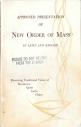 576 x 905 - 98KThanked by 1Palestrina
 -
On the issue of 'duplication', my question is - Is there any evidence, rubrics, commentaries, customaries, ... prior to 1570? I am very much an amateur in this field, and isolated from libraries, by geography, age, and disability.
What I have found on the internet is this (p.282) which seems to be an instruction/rubric for a server at Low Mass.Rubric from a Dominican Missal printed at Lubeck in 1502.
(Bodleian Laud Misc. 283.)
De missis priuatis.
...
meliusque vt epistolam relinquat sacerdoti dicendam . quam quod ipse dicat cum non est in aliquo sacrorum ordinum constitutus
That apparently envisages that where the server is in minor orders, (rather than the small boy which was not uncommon either then or when I was that boy in the 1950s) the lector/exorcist/... should read the epistle and the priest should not duplicate it.better to leave the epistle to be said by the priest . than to say it himself when he is not ordained in any of the sacred ordersThanked by 1Palestrina -
This is also a little-discussed issue in the development of Gregorian chant. We know that a pronunciation reform was introduced under Charlemagne by Alcuin, who used the very conservative spelling pronunciation he had learned in Britain. Before that time, it's possible that the liturgy throughout the Romance language area was essentially read and sung in the vernacular, from Latin books, intelligible even to the illiterate and young children, which would make the lack of notated chant manuscripts from the period unsurprising even if neumes had already been invented. Jungmann again:the incipient Romance vernaculars grew more distant from the Latin of Late Antiquity
This 813 synod is the Council of Tours and is considered "the first official recognition of an early French language distinct from Latin" (Wikipedia).it was the duty of the preacher... above all to find, by his own efforts, the proper medium between the language of the people and the pretensions of the more highly educated. And even when the homilies of the Fathers were read, they had to be rendered more or less freely in the language of the people. The Carolingian Reform-Synods of 813 expressly demanded the translation of the homilies in rusticam Romanam linguam aut Theotiscam quo facilius cuncti possint intelligere quce dicuntur.Thanked by 1Palestrina -
Really?What we now know as the "Missal" was of course a series of separate books.
Here is a Missale from 1301-1400 A.D. Plenty of others are available some of them very similar to an Altar Missal for say 1950. https://gallica.bnf.fr/ark:/12148/btv1b550057271/f11.item
Of course choir books with various names and are also available...Thanked by 1MatthewRoth -
Fr Augustine Thompson wrote years and years ago on the Dominican rite and the lack of duplication. They were forced to adopt it and did so under protest. But again, we are just assuming that the commission added this out of nowhere, when no other rite was introduced from what came before and the major changes were deprecations of things done in other uses (religious orders, other sees) but not part of the rite at Rome itself.
-
Wow today I learned the word theodiscus. Who'd'a thought deutsch, which it surely is, could have had such a form.
-
For others: https://en.wikipedia.org/wiki/Theodiscus
"rusticam Romanam linguam" covered local Romance language equivalents of vernaculars. (Celtic and Slavic vernaculars were in tributary states in relation to the Carolingian Empire properly speaking.)

Welcome to the MusicaSacra Forum!
To participate in the discussions on Catholic church music, sign in or register as a forum member, The forum is a project of the Church Music Association of America.
Categories
- All Discussions21,854
- General Music Discussion8,553
- Job Openings293
- Management of Music Programs862
- Choral Matters539
- Church Documents and Rubrics540
- CMAA Notes307
- Events763
- For Newcomers: Read First26
- Sacred Polyphony567
- Hymnody898
- Gregorian Chant: General2,749
- ↳ Graduale Romanum and Liber Usualis372
- ↳ Graduale Simplex61
- ↳ Semiology65
- Vernacular Plainsong704
- Anglican Use and Anglican Chant73
- Organ, Other Instruments and Repertoire452
- New Composition/Works in Progress1,342
- Recordings238
- Music for Hispanic Ministry163
- Music Education: Children217
- Music Education: General223
- News Items247
- Positions Wanted3
- General Discussion: Catholicism742
- Amusements185
- General Discussion1,049
- Opinions119