
Semiology, mensuralism ?
-
I've seen these terms but don't know what they refer to in this context.
May I ask for a pointer to a resource that describes them not-very-academically?
Even better, it would help to find two recordings of the same piece, one with traditional (Solesmes?) interpretation, the other using those methods, so I can hear the difference in a compare-and-contrast ?
-
Patrick Williams’ website www.cantatorium.com gives lots of great resources.
Both schools of thought are concerned with the oldest manuscripts we have and their rhythmic markings. Basically mensuralists argue that the long notes are double the length of the short ones, whereas semiologists believe that the distinction is always contextual and there is no constant steady beat. Others can recommend recordings as I am not well versed in the various recordings of these stylesThanked by 1probe -
Semiology is the study of the signs, that is, the earliest neumes notably from the Saint-Gall and Laon manuscripts (and related manuscripts, like from Einsiedeln). It is strongly associated with Dom Eugène Cardine of Solesmes who wrote a sort of academic guide to it (helpfully called Gregorian Semiology). Solesmes, at least in the 1980s and through the early 2010s, informed its chanting via his own understanding of what this meant for music, although in some ways it didn’t change much from the older practices, even when they officially removed the rhythmic signs from the new Antiphonale Monasticum of the 2000s.
Mensuralism means that the music is measured. There are a couple of ways that I think fall under this: post-1600 chant in much of Europe is mensuralist (I think if you’re considering Solesmes anyway). It could be proportionalist, and Patrick Williams (@FSSPMusic here) would define that as the notes being in a 2:1 ratio of long to short based on his understanding of the treatises and adiastematic neumes. This requires a semiological approach because the ratio is informed by the notation particularly the Laon neumes; in contrast, Cardinian practice tends to prefer Swiss manuscripts. I think that it’s helpful to separate out using the adiastematic neumes; many European scholars and chanters consider their work semiologically-based (as I understand it) without being strictly Cardinian…although there is certainly overlap. The new Nocturnale Romanum winds up taking that approach and uses more rhythmic signs than Solesmes historically did as a result.
Then someone like Mgr Turco is not quite as strict about proportions, but he’s still using the manuscripts to inform the melody and rhythm, as well as treatises etc.
Dom Gregory Murray went back and forth on Solesmes (he also switched rather violently to prefer the English Mass, I’m told), but he also wrote a lot on proportionalism and specifically against the equalist approach of Solesmes. I would agree that for many of us the traditional approach is Solesmes, abstracting from judging that for a minute.
It’s too bad Mgr Turco’s recordings are hard to find due to copyright issues I guess. Patrick once shared a link to the gradual of this Sunday (Laetatus Sum) that is semiological but not quite strictly proportional.
The impulse to compare is a good one; Dom Mocquereau and Dom Pothier did not record the same chants but they sang in a contrasting (although very much related style) at the beginning of the twentieth century at a major event in Rome. @Charles_Weaver made us sing a chant in a contrasting style: I took the easy way out and did Solesmes and Vatican style. Others did semiological (Cardinian) approaches, and in reality I inform my own chant with the living tradition of the abbeys and occasional checking against the Graduale Triplex; it’s semiology lite. I don’t know if anyone sang a proportional chant. It’s probably the most foreign to us even though Patrick’s argument for it in part is because every other kind of music that we sing is measured! -
There are a lot of similar threads on this here already. I'll try to define the terms as simply as I can.
There are a bunch of different ways to interpret the rhythm of Gregorian chant. In the context of the performance of chant, semiology means singing the chant from an edition that incorporates early neumes copied from some of the oldest extant manuscripts. The singer reads the notes from the staff and decides how to perform the pitches rhythmically by interpreting the neumes and various signs. The most famous such edition is the Graduale Triplex. Semiologists generally interpret the neumes in a fashion pioneered by Dom Eugène Cardine in his book Gregorian Semiology. The signs indicate different ways of performing the same neume. In general, there are fast and slow versions of each neume.
Mensuralism, in general, refers to singing the chant in a way where the rhythm can be measured proportionally. Most modern mensuralists are also semiologists, in the sense that they base their rhythmic interpretation on principles drawn from Cardine. The difference is that they interpret the fast and slow versions of the neumes as being in a strict time proportion, so that the fast notes are exactly twice as fast as the slow notes. Thus a mensuralist interpretation can usually also be notated using quarter notes and eighth notes.
Non-mensuralist semiologists interpret the signs instead as not indicating strictly proportional rhythms. There's a whole spectrum of viewpoints here, ranging from people who are practically mensuralists to the view of Susan Rankin, who wrote a whole book about the early neumes without ever actually committing therein to the idea that the different signs really mean fast or slow. -
May I also suggest that the terrain or context in which these distinctions are effectively applied and encountered are chants that are sung by scholas/choirs, rather than the Ordinary chants and responsories that are also sung by faithful in the pews?Thanked by 1Andrew_Malton
-
@probe There was a thread a couple of years ago https://forum.musicasacra.com/forum/discussion/20988/introduction-to-mensuralism#Item_28 pointing to a talk illustrating various interpretations, if you can detect the differences.
https://www.youtube.com/watch?v=BfBMUSNpcjUThanked by 1probe -
In practice that’s the case Liam but I hesitate to say that it’s strictly true; as much as I also hesitate to speak for others. That is I get the sense that there are proportionalism advocates who would do that to the Ordinary as well.
-
Thank you all for taking the trouble to post such detailed replies! At our Saturday workshop the leader, Dr. Giovanna Feeley, handed around a copy of the Graduale Triplex with the neumes marked in red. We didn't use them, it was just shown for interest.
I'll follow up those links.
-
Here's the Turco recording @MatthewRoth mentioned:
https://www.youtube.com/watch?v=yj-sx-HO4Tk
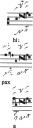
Play the attached mp3 and listen to what they do with the same figure when it occurs, including the repeat of the respond: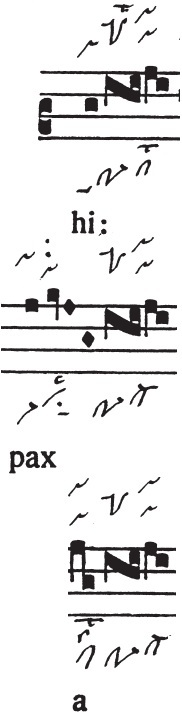
Three out of four times, I hear the first interpretation below. The third time, I hear something closer to the second, which is what the adiastematic notations actually say: long, short-short-long, long-long.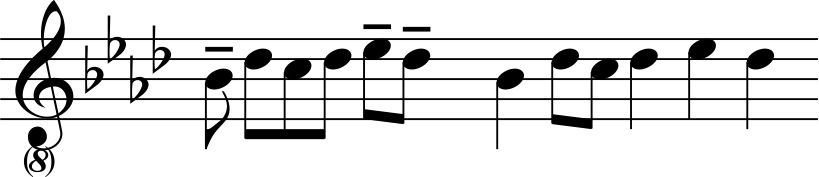
It's beautiful singing in my opinion, but I find it difficult to justify an interpretation where the length of the fourth note is not apparent—a note affected by the addition of an episema, the letter t, and a neumatic break. It should have the same duration in each instance, that of the other long notes, namely, double the short value. It's difficult for many to accept the revolutionary idea that 1+1=2 because it's not what they think of as chantlike. So what are the paleographical/semiological, textual, or musical/artistic/expressive arguments against interpreting the figure consistently? Find another semiological recording, and there's a pretty good chance they'll do something different with it.
Respectfully, @Charles_Weaver, this is not so well stated. Most modern mensuralists are semiologists to the extent that they follow the adiastematic neumes. Most of us (not all!) take Cardine seriously, but what is there in my style of chant, for instance, that comes from Cardine rather than Vollaerts or Murray? Weak beginning notes, including what I call "initio debilis by comparison," are dealt with by Murray. The expressive neumatic break? It differs little from the melismatic mora vocis of the Vatican edition and the late Solesmes approach to disaggregate/praepunctis neumes well before Gregorian Semiology was published.Most modern mensuralists are also semiologists, in the sense that they base their rhythmic interpretation on principles drawn from Cardine.
@Liam, which way do you mean? I think it would be easy to get a congregation to sing proportionally once they've become accustomed to hearing from the schola—but not with the Solesmes edition in front of them. For now, I don't touch the Ordinary or anything else the congregation sings.But would they be able to get a congregation to sing that way?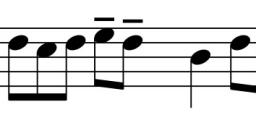 819 x 177 - 32K
 182 x 712 - 32K
 -
That YT link is not available - searching for the title finds
https://www.youtube.com/watch?v=tcj8zOteQtk
I've listened to the mp3 and honestly I find it difficult to hear any difference between the phrases. This topic may be above my grade.
IMO the congregation will go at their own collective pace whatever they hear. Even with an organ accompaniment to a conventional popular hymn I have heard them sing faster if they feel like it and wait for the organist to catch up and start the next verse.
-
@FSSPMusic Perhaps I'm giving too much credit to Dom Cardine here, but I suppose what I meant is that in the old days, mensuralists based their arguments on all kinds of things, such as assigning equal time values to each syllable in melismatic chant, etc. I'm thinking, e.g., of Riemann's version of the Te Deum.
The more recent mensuralists base their findings on paleography and its interpretation, of the type popularized by Cardine. You are quite right to point out that Fr. Vollaerts and Dom Murray do this, without being directly influenced by Cardine. -
I think it would be easy to get a congregation to sing proportionally once they've become accustomed to hearing from the schola—but not with the Solesmes edition in front of them. For now, I don't touch the Ordinary or anything else the congregation sings.
Because the congregation is not going to just hear the schola singing the Ordinary, but also each other (at least other people singing in the pews, as it were), and foreknowledge of semiology would be rare at best in a typical parish context. A schola that tried push that over a congregation would more likely simply be run over like a car sitting on a railway with an oncoming train.IMO the congregation will go at their own collective pace whatever they hear. Even with an organ accompaniment to a conventional popular hymn I have heard them sing faster if they feel like it and wait for the organist to catch up and start the next verse.
Yea. -
We are without the organ (not for Lent, it's a long story, but we're not even in the loft indefinitely), and oh boy the mode I Kyrie of Mass XVII is a bit of a mess; at "e-" they keep running through the peak note, and I'm like…please don't do that. The Sanctus and Agnus are better albeit I have to really fight at a couple of places. Credo IV seems to be kept together.
Vespers is fine, actually. That surprised me. (I just have to give myself pitches because I definitely don't have perfect pitch, relative or otherwise, and it's dangerous if I don't.)Thanked by 1Liam -
(Edited)
This is better worded and entirely accurate.The more recent mensuralists base their findings on paleography and its interpretation, of the type popularized by Cardine. You are quite right to point out that Fr. Vollaerts and Dom Murray do this, without being directly influenced by Cardine.


Welcome to the MusicaSacra Forum!
To participate in the discussions on Catholic church music, sign in or register as a forum member, The forum is a project of the Church Music Association of America.
Categories
- All Discussions21,824
- General Music Discussion8,540
- Job Openings291
- Management of Music Programs862
- Choral Matters539
- Church Documents and Rubrics540
- CMAA Notes307
- Events758
- For Newcomers: Read First26
- Sacred Polyphony566
- Hymnody897
- Gregorian Chant: General2,747
- ↳ Graduale Romanum and Liber Usualis372
- ↳ Graduale Simplex61
- ↳ Semiology65
- Vernacular Plainsong704
- Anglican Use and Anglican Chant73
- Organ, Other Instruments and Repertoire451
- New Composition/Works in Progress1,339
- Recordings238
- Music for Hispanic Ministry163
- Music Education: Children217
- Music Education: General223
- News Items246
- Positions Wanted3
- General Discussion: Catholicism742
- Amusements185
- General Discussion1,048
- Opinions119