
Peregrinus: a free web app to transcribe square-note chant (PDF, photo or GABC) into modern notation
-
Dear friends,
I direct a small parish choir in Tuscany (Italy), and like many of you I have often needed chant in modern notation for singers who don’t (yet) read square notes. Transcribing by hand takes time, so I built a tool for it, and I’d be grateful for your feedback.
Peregrinus: https://www.peregrinus.app/en/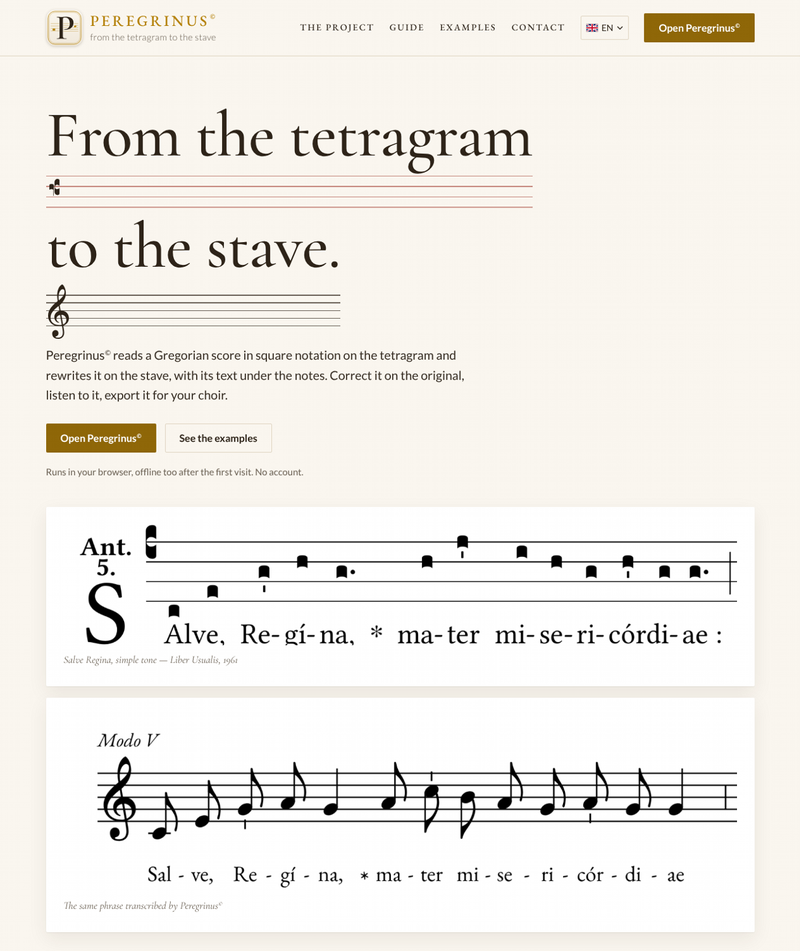
How it works:
1. You load a PDF, a photo or a scan of a chant in square notation (or a GABC file).
It recognizes clefs, neumes, divisiones and the text, and marks on the original image everything it has read. If something is wrong, you correct it right there; the modern transcription updates as you go.
2. You can listen to the melody, transpose it, and export PDF, PNG, MusicXML (for MuseScore, Sibelius, Dorico, Finale…) or the recognized chant in GABC.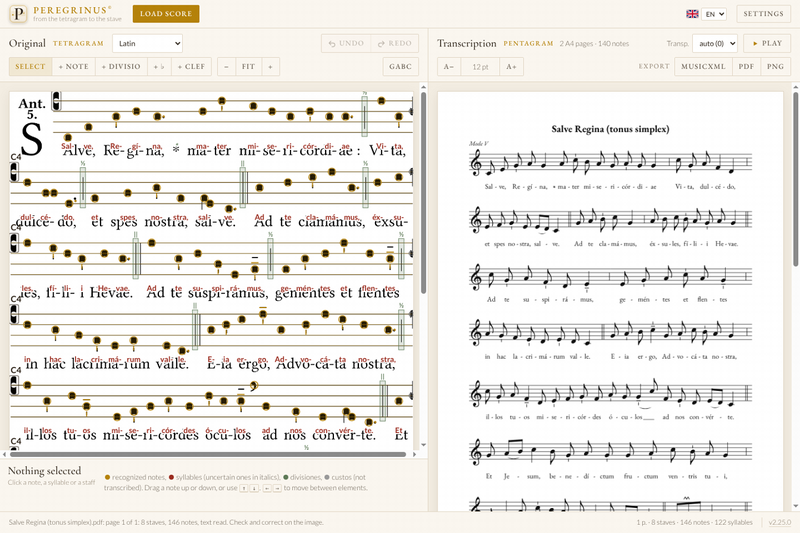
A few details that may interest you:
- The melody is automatically transposed to a comfortable key for singing.
- The Euouae can be kept as is or expanded into the full Gloria Patri in the recognized tone.
- Besides Latin, it now reads texts in English (and Spanish, in an early version), so it can also help with vernacular propers.
It is free, needs no account, and runs entirely in your browser (offline too, after the first visit): your scores are never uploaded to any server. The interface is in English, Italian, French, Spanish, Portuguese and Polish. I’m a choir director, not a professional programmer: I wrote it with the help of AI coding tools, and the examples on the site come from the Liber Usualis and the Graduale Romanum.
I’d especially like to know:
- which editions or scans give poor results;
- whether the transcription conventions suit your choirs, or whether you’d prefer something different (e.g. stemless noteheads);
- how the MusicXML behaves in your notation program.
Replies here are very welcome. If you’d rather send me a score that didn’t work well, you can use the contact form on the site, where you can attach the file: https://www.peregrinus.app/en/contact/
Thank you!
Andrea -
This is quite impressive!
Some feedback I noticed right away is that it ranges slightly too high for a congregational melody. The first example (Salve Regina) is C to C which is perfect. But then the Ave Maris Stella opts for C to D. To fit the average it should be A# to C, especially if people are singing in the morning (which most Masses are.)
You want to aim for C to C first, then go lower if necessary. Not until the lowest note is a Bb/A# should you consider going above a C.
Basic reason is human behavior - if the note goes too low, people tend to laugh it off and then keep singing. If the note goes too high they get embarrassed and stop singing.Thanked by 1probe -
Thank you, that's a really useful observation!
The automatic key is chosen with a choir in mind, because that's where Peregrinus© was born: I built it first for my parish choir. So it aims for a range of roughly C4 to D5 (written in treble clef, with the men an octave below), which is why Ave Maris Stella comes out from C up to D.
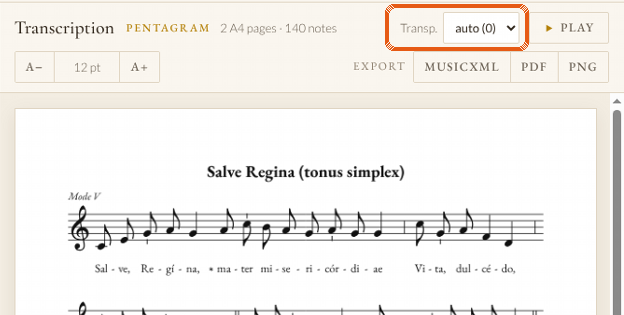
For a congregation you're absolutely right that lower is better. That's why you can change the key proposed by the app at any time with the "Transp." menu above the transcription: it goes from −6 to +6 semitones, and PDF, PNG and MusicXML are exported in the key you choose.
If you choose −2 for Ave Maris Stella, the final moves from D to C and the melody goes from B♭ up to C, as you suggest. -
@andreasimone I think that with the key ... it would be best to allow you to set it in the desired key you want as @StPatricksSongs mentioned some parishes will prefer lower tonality but on the opposite end of the spectrum others will prefer higher tonalities ...in my experience there is never a one size fits all with key, and it very much depends on each situation.
-
@monasteryliturgist I completely agree: there’s no one-size-fits-all key. That’s why the automatic key is only a starting point: with the “Transp.” menu above the transcription (see the screenshot below) you can already set any key you like, from −6 to +6 semitones, and the PDF, PNG and MusicXML are exported in that key.
 624 x 315 - 56KThanked by 1monasteryliturgist
-
Excellent! Again great work!
Just out of curiosity, are there any more features you are planning to add in the future? -
Thank you for asking! These are the main things I’m working on:
- Search the GregoBase repertoire directly from the app: type the first words of a chant and open it without downloading any file.
- A sung voice for playback: a real voice singing the Latin text, instead of the current plain sound.
- Better reading of older printed books: if you have scans that don’t work well, I’d be glad to receive them.
- An option for the distropha and tristropha, to transcribe them either as one sustained note or as separate repercussed notes, following a request from a user.
I can’t give dates yet, as I work on Peregrinus in my spare time, but suggestions are always welcome.Thanked by 1davido -
Peregrinus is extraordinary.
What a time to be alive -
Thank you, @davido! That means a lot. If you have any advice or ideas for how Peregrinus could develop, they'd be very welcome.

Welcome to the MusicaSacra Forum!
To participate in the discussions on Catholic church music, sign in or register as a forum member, The forum is a project of the Church Music Association of America.
Categories
- All Discussions21,915
- General Music Discussion8,578
- Job Openings306
- Management of Music Programs863
- Choral Matters539
- Church Documents and Rubrics540
- CMAA Notes307
- Events765
- For Newcomers: Read First26
- Sacred Polyphony568
- Hymnody901
- Gregorian Chant: General2,753
- ↳ Graduale Romanum and Liber Usualis372
- ↳ Graduale Simplex61
- ↳ Semiology66
- Vernacular Plainsong708
- Anglican Use and Anglican Chant73
- Organ, Other Instruments and Repertoire452
- New Composition/Works in Progress1,344
- Recordings238
- Music for Hispanic Ministry164
- Music Education: Children217
- Music Education: General225
- News Items248
- Positions Wanted3
- General Discussion: Catholicism742
- Amusements186
- General Discussion1,050
- Opinions119