
Preface Dialogue Chant - Custom vs Missal
-
Have we been singing the Preface Dialogue incorrectly?
I am curious whether others have encountered this.
For years I have noticed that, in the Preface Dialogue, our congregation consistently sings a G on the word “the” in the response:
“We lift them up to the Lord.”
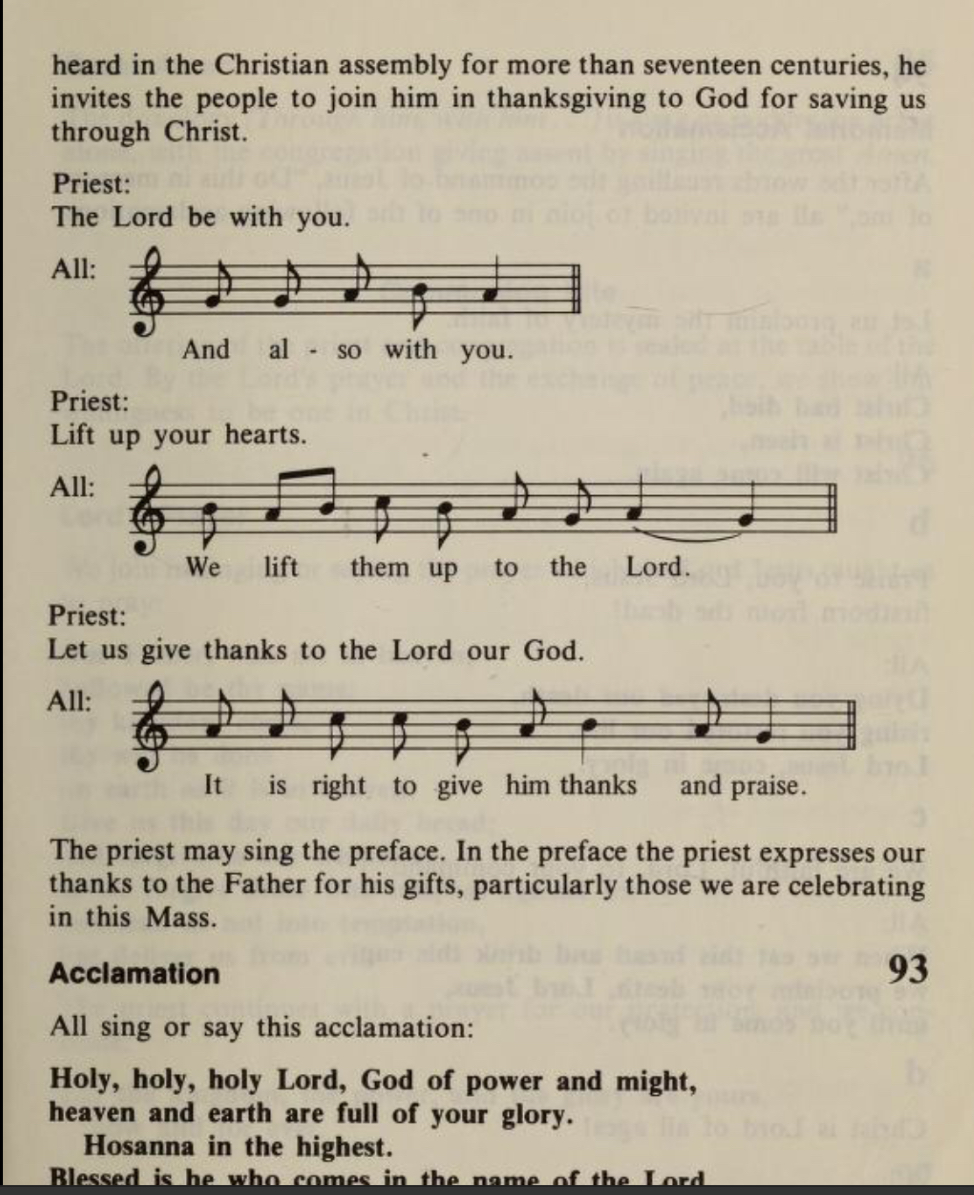
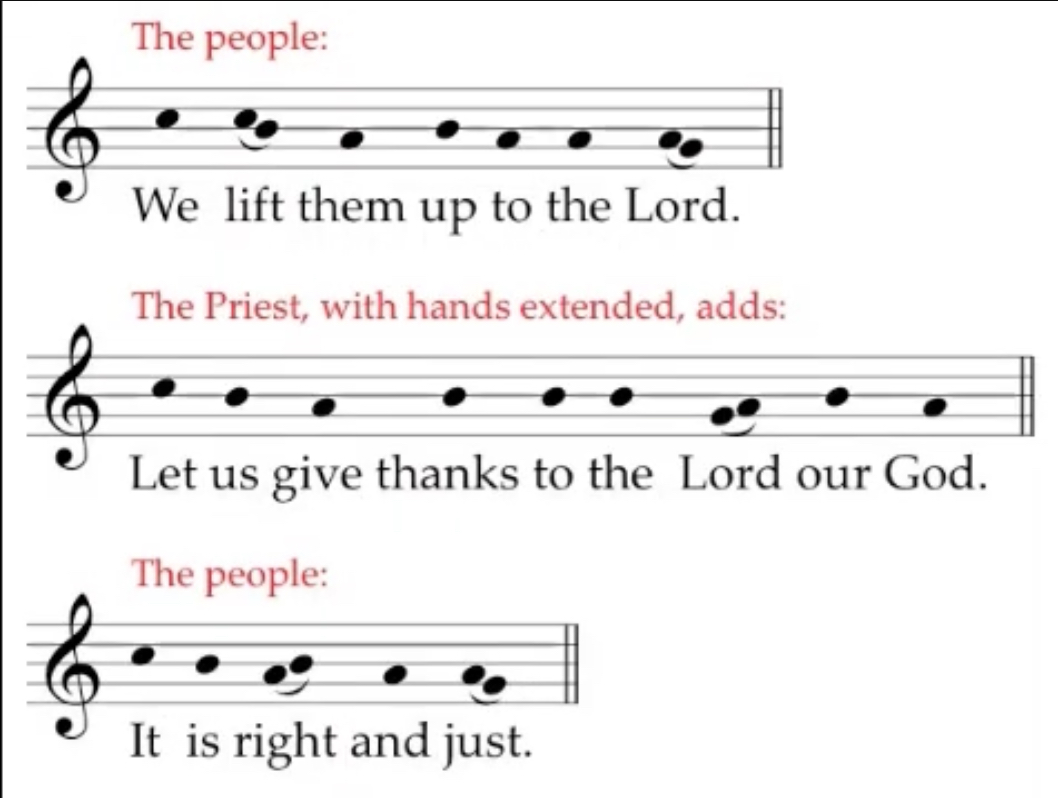
However, that is not what appears in the official chant notation in the Roman Missal. I have attached photos from the Missal as well as another published source reproducing the ICEL chant, and they agree. I also remember singing it growing up in other parishes the way our congregation does.
For approximately five years I have tried to encourage the congregation to sing the response as it is actually notated, but the alternative version is remarkably persistent. At this point it has made me wonder whether this is more than simply a local habit.
I initially wondered whether the G might be a remnant of the pre-2011 Sacramentary. However, from what I have been able to determine, ICEL retained the existing Preface Dialogue melody when the revised translation was introduced, and of course the text “We lift them up to the Lord” itself did not change in 2011.
So I am curious:
Does your congregation also sing a G on “the:?
If so, does anyone know the origin of this variant? Was it ever printed in an earlier edition or commonly used resource, or has it simply developed as an oral tradition over the years?
I would be particularly interested to hear from musicians who remember how this was commonly sung well before the 2011 Missal. If the same variant occurs in many unrelated parishes, there may be an interesting history behind it.
-
When the Corrected Translation of the Roman Missal came out, ICEL changed the Preface introductory chant. Not only did that note change from a “G”, but the starting note of that line changed as well (not to mention other notes). I included a copy of the Order of Mass from CBW II, which has the old ICEL preface chants and indicates the G you speak of. I also included the new ICEL preface chant for you to compare and contrast.
The original ICEL is based off the Latin Solemn Tone Preface that ICEL tried to replicate in English. Page 99 of the Liber Brevior shows this.
I suspect the majority of your congregation isn’t aware that the preface chant changed and most of them are singing the old “obsolete” chant (it’s still sung that way in the Missal of Divine Worship at the Anglican Use Ordinariate, which may mean it comes from the Sarum Rite). You might just need to get up in front of the congregation before Mass and clearly educate them on the “new” norms.
While I prefer the old version of my youthful days, I sing the current correct ICEL version because it’s the universal norm. I’m fairly confident my congregation is still singing the old ICEL chant. I know the choir was at one point because I distinctly remember looking up the chants when I noticed the discrepancy between myself and the choir (and congregation). Shortly after I started singing it more loudly, the choir started sounding more correct.
 974 x 1195 - 665K
 1058 x 798 - 215K
 -
Sigh. I prefer the solemn tone, even in English (if I must go to the sung NO), but: it should be B—A-B-C—B—B—A-B—A—A–G. So We—lift—them—up—to—the—Lord.
Two notes instead of the quilisma podatus on one syllable and going down to G before going back up to B makes it a) hard to sing IMHO and b) dreary. On the flip side, the adaptation of the ferial tone could have been straightforward: Start B-C-B… -
I was looking for this yesterday, but couldn’t find it. Here is the documents ICEL released regarding the chants of the entire Mass compared to the Latin chants. I was wrong about when the chants changed. They changed in 2002, which was right around when priests stopped singing the Mass where I was growing up. I think this means no one got the memo that they changed.
https://www.icelweb.org/ICELMusicIntroductionRev809.pdf
They analyzed different chants to fit the English. It explains their rationale, gives examples of what they rejected, etc.Sigh. I prefer the solemn tone, even in English (if I must go to the sung NO), but: it should be B—A-B-C—B—B—A-B—A—A–G. So We—lift—them—up—to—the—Lord.
Two notes instead of the quilisma podatus on one syllable and going down to G before going back up to B makes it a) hard to sing IMHO and b) dreary. On the flip side, the adaptation of the ferial tone could have been straightforward: Start B-C-B…
Truth be told, I loathe the changed chant and sing it begrudgingly and because my brain won’t allow me to knowingly sing something that is different than what is prescribed.
What I’ve noticed in my congregation down in the pews is they’re getting the starting note wrong (they have to remember it from the start of the priest’s part), which then throws off the chant with those who are singing it correctly. There is a “diversity of responses” in the pews.
As much as I dislike the idea, sometimes I wonder if having temporary organ accompaniment for the congregation to get on the right starting notes of the preface dialogue may be necessary. It doesn’t sound very good in the pews, as it’s not unified.
It doesn’t inspire the same awe and wonderment of what’s about to happen as it does when everyone is singing the same thing. I know as a kid, this (and the old CBW III psalm tones) was the part that always got me excited and drew me into chant and singing at Mass. Some kids played priest growing up. I sat at the piano with my mom’s hymnals and played music director/cantor/accompanist growing up. That’s the power of good solid liturgical music.
-
Yeah, and pretty much everyone with any experience in the Anglo-Papalist world and now the Ordinariate would agree that Dr Mahrt was right, ICEL wrong. Just use the solemn tone.
-
Yeah, and pretty much everyone with any experience in the Anglo-Papalist world and now the Ordinariate would agree that Dr Mahrt was right, ICEL wrong. Just use the solemn tone.
Then someone needs to make a definitive decision and clearly communicate said decision to the congregation about what the norm will be.
There may be some leeway according to the aforementioned ICEL document I linked, especially for those congregations still singing it according to the ICEL chants from the 70s.• To retain vernacular chants now in use where possible, since “there must be no innovations unless the good of the Church genuinely and certainly requires them” (SC 23
I reiterate the need for an authoritative decision to be made in parishes and for that decision to be clearly communicated to the congregation. Or we could just use Latin. Those chants haven’t changed in probably a thousand years.
Welcome to the MusicaSacra Forum!
To participate in the discussions on Catholic church music, sign in or register as a forum member, The forum is a project of the Church Music Association of America.
Categories
- All Discussions21,849
- General Music Discussion8,551
- Job Openings293
- Management of Music Programs862
- Choral Matters539
- Church Documents and Rubrics540
- CMAA Notes307
- Events761
- For Newcomers: Read First26
- Sacred Polyphony567
- Hymnody898
- Gregorian Chant: General2,749
- ↳ Graduale Romanum and Liber Usualis372
- ↳ Graduale Simplex61
- ↳ Semiology65
- Vernacular Plainsong704
- Anglican Use and Anglican Chant73
- Organ, Other Instruments and Repertoire452
- New Composition/Works in Progress1,342
- Recordings238
- Music for Hispanic Ministry163
- Music Education: Children217
- Music Education: General223
- News Items247
- Positions Wanted3
- General Discussion: Catholicism742
- Amusements185
- General Discussion1,048
- Opinions119