
St. Gregory Hymnal and Choirbook Treasury - www.sacredmusiclibrary.com
-
https://sacredmusiclibrary.com/_product/IJt14frX1efpvvsV?variant=mfKG5l3H0PgOteh5
Free download, no licensing fees...special choir price now in effect for printed books.
For generations, The St. Gregory Hymnal since 1920 was the standard Catholic choir hymnal in thousands of parishes, schools, seminaries, and convents. Its continued demand more than a century after its publication is a testament to the enduring beauty of its music and its place in America's Catholic musical heritage.
Our The St. Gregory Hymnal and Catholic Choirbook Treasury is a historic collection of traditional Catholic hymns and motets, sacred choral works extracted from Nicola A. Montani’s historic The St. Gregory Hymnal and Catholic Choir Book.
The music reflects the prayerful and reverent character of traditional Catholic worship. The collection includes music for Lent and Passiontide, Pentecost, devotion to the Blessed Virgin Mary, the Holy Eucharist, Benediction, and other important occasions in the Church year.
It includes rare works such as different versions of Stabat Mater, Veni Creator Spiritus, Ave Maria, Adoro te devote, Panis Angelicus, Ave Verum Corpus, and Christus Vincit, most in different versions that are unknown yet beautiful.. The book also features music by composers such as Palestrina, Mozart, Gounod, Michael Haydn, Lorenzo Perosi, and Pietro Yon, together with traditional Catholic melodies.
The music ranges from simple, singable hymns to more developed choral pieces. It is suitable for parish choirs, choir directors, organists, cantors, schools, seminaries, and anyone interested in the Catholic sacred-music tradition.
Every score has been newly engraved in a clear, easy-to-read format and presented on letter-size pages for enhanced readability. Montani was known for his highly detailed expressive markings; by omitting them from this edition, we give you, the director, greater freedom to interpret the music as you see fit.
Many selections include both English and original Latin texts, allowing choirs to sing them in either language. Spanish translations are also included to help readers understand the sacred texts.
This practical collection brings treasured Catholic music from the past into a modern edition for worship, rehearsal, study, and enjoyment.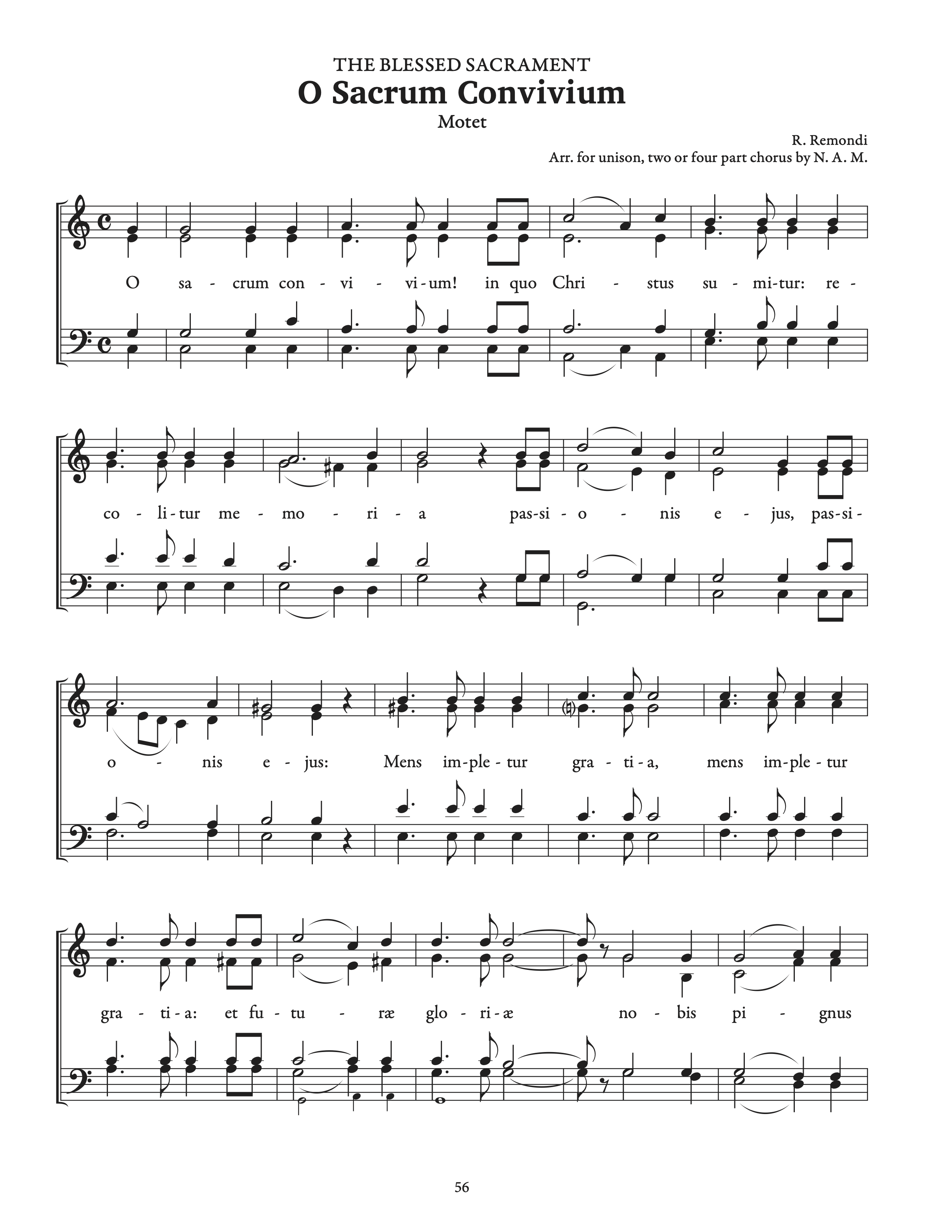
-
Thank you for Verbum_Gloriae, Don9of11, CHGiffen, Serviam Scores, Chrism, old hymns and irishtenor!!!!
-
Holy guacamole. This is wonderful. I’d toyed around with the idea of re-engraving important bits, but you’ve saved me the trouble. lol. Thank you. You do so many wonderful labors of love for the Church.Every score has been newly engraved in a clear, easy-to-read format and presented on letter-size pages for enhanced readability. -
Using The St. Gregory Hymnal & Catholic Choirbook Treasury
With People Living with Alzheimer’s and Dementia
When Words Become Difficult, Music May Still Reach Them
A person living with Alzheimer’s or dementia may have difficulty remembering names, recent events, or even familiar people. Yet music learned many years ago can sometimes remain remarkably familiar.
For Catholics who grew up singing the traditional hymns of the Church, until the 1970's sacred music can carry memories of childhood, family, Catholic school, Sunday Mass, Christmas, Easter, May processions, Benediction, weddings, funerals, and countless moments of prayer.
The St. Gregory Hymnal & Catholic Choirbook Treasury offers families, caregivers, chaplains, musicians, nursing homes, and memory-care communities a collection of this familiar sacred music.
A Simple Way to Begin
Choose a hymn the person is likely to have known. Begin quietly by singing, playing the melody on a piano or organ, or using a recording.
Do not ask,“Do you remember this?”
Instead, simply begin the music.
Watch for a response. A person may begin humming, moving their lips, tapping a finger, singing a few words, smiling, or becoming noticeably more attentive. Even quiet listening can be meaningful.
Let the Person Lead
There is no need to finish the hymn or sing every verse. If one familiar refrain or verse brings a response, repeat it.
Keep the experience relaxed. This is not a memory test or a music lesson.
If the person begins singing, join them. If they want to stop, stop. If another hymn seems to bring greater recognition, follow that path.
Create a Personal Hymn List
Families can help caregivers identify hymns that were particularly important in the person’s life.
Consider music associated with:
Christmas and Easter
The Blessed Virgin Mary
Benediction and Eucharistic devotion
Catholic school
First Communion and Confirmation
Weddings and family celebrations
Favorite parish hymns
Music the person once sang in a choir
Missa de Angelis
Write down the hymns that produce the strongest response. Over time, this can become that person's own Sacred Music Memory List.
Make It Personal
Whenever possible, have a family member, parish musician, volunteer, or caregiver sing with the person. A polished musical performance is not necessary.
The familiar human voice may be more important than musical perfection.
A short session of ten or fifteen minutes may be enough. The goal is companionship, prayer, recognition, and enjoyment—not accomplishing a particular musical task.
A Resource for Catholic Memory-Care Ministry
Parishes might also use The St. Gregory Hymnal & Catholic Choirbook Treasury to establish a simple ministry bringing familiar Catholic music to parishioners living at home, in assisted-living facilities, or in memory-care communities.
A pianist, organist, cantor, choir member, family member, or parish volunteer can participate.
No elaborate program is required.
Bring the hymnal. Choose a familiar hymn. Sit beside the person. And sing.
The music they have carried with them for a lifetime may still be there.
An Important Note:
Music can provide enjoyment, comfort, social connection, and opportunities for participation, but it is not a cure or substitute for medical care. Individual responses vary, and caregivers should always respect the person's comfort and wishes.
Sometimes, when ordinary conversation becomes difficult, a familiar sacred melody can become another way of saying: “I am here with you.”
www.SacredMusicLibrary.com
The St. Gregory Hymnal and Catholic Choirbook Treasury
For Missa de Angelis: Cantus Ecclesiae for Gregorian Chants is one choice.

Welcome to the MusicaSacra Forum!
To participate in the discussions on Catholic church music, sign in or register as a forum member, The forum is a project of the Church Music Association of America.
Categories
- All Discussions21,833
- General Music Discussion8,542
- Job Openings292
- Management of Music Programs862
- Choral Matters539
- Church Documents and Rubrics540
- CMAA Notes307
- Events759
- For Newcomers: Read First26
- Sacred Polyphony566
- Hymnody898
- Gregorian Chant: General2,749
- ↳ Graduale Romanum and Liber Usualis372
- ↳ Graduale Simplex61
- ↳ Semiology65
- Vernacular Plainsong704
- Anglican Use and Anglican Chant73
- Organ, Other Instruments and Repertoire451
- New Composition/Works in Progress1,340
- Recordings238
- Music for Hispanic Ministry163
- Music Education: Children217
- Music Education: General223
- News Items247
- Positions Wanted3
- General Discussion: Catholicism742
- Amusements185
- General Discussion1,048
- Opinions119