
Status of Mass Propers Added by Pius XII
-
In another recent thread, someone asked about the official status of the Vatican edition and legislation concerning it. Where exactly were the chants added during the pontificate of Pius XII promulgated? Was it the initiative of the Holy Father himself, the Sacred Congregation of Rites, the monks of Solesmes, or someone else? Do the melodies of these chants as they appear in post-Pius XII (but pre-novus ordo) editions of the Graduale Romanum and Liber Usualis have "official Vatican edition" status, and how do we know?
--Queenship of Mary (May 31)
--St. Joseph the Workman (May 1)
--Assumption (August 15) revised Proper of the Mass
--Immaculate Heart of Mary (August 22)Thanked by 1tomjaw -
I've mentioned it elsewhere, but the Pius XII gradual for the Assumption uses the Vulgate text in the Missal but the new Bea Psalter text in the chant books, resulting in the most significant Missal-Gradual divergence of any text.Graduale Romanum: concupiscet rex pulchritudinem tuam. ℣. Tota decora ingreditur filia regis, texturæ aureæ sunt amictus ejus.
Missale Romanum: concupiscit rex decorem tuum. ℣. Omnis gloria ejus filiae Regis ab intus, in fimbriis aureis circumamicta varietatibus. -
I don’t like the change but not changing the text to the new psalter would have been great.
-
FSSPmusic wrote:the Pius XII gradual for the Assumption uses the Vulgate text in the Missal but the new Bea Psalter text in the chant books
I've checked several altar missals from 1951 through 1962 and none have the Vulgate text for this gradual. What is your source?
I would guess "concupiscit" is a typo, because the Vulgate text is "concupiscet rex decorem tuum".
The authentic gradual (Audi filia ... quia concupivit, with verse 5 as the verse), which is the gradual designated for the usus recentior solemnity of the Assumption, is that of the feast of St. Cecilia in the usus antiquior, GR1961, p. 655, and its text is from a pre-Vulgate translation ("quia concupivit rex speciem").
Interestingly, the OCM doesn't even list the Bea psalter (v. 14 verse) version for ad libitum use, unlike many other neo-gregorian chants listed in the ad libitum section.Thanked by 1igneus -
Well, this is embarrassing! I relied on a faulty text from the St. Edmund Campion Hymnal (
2nd1st ed.):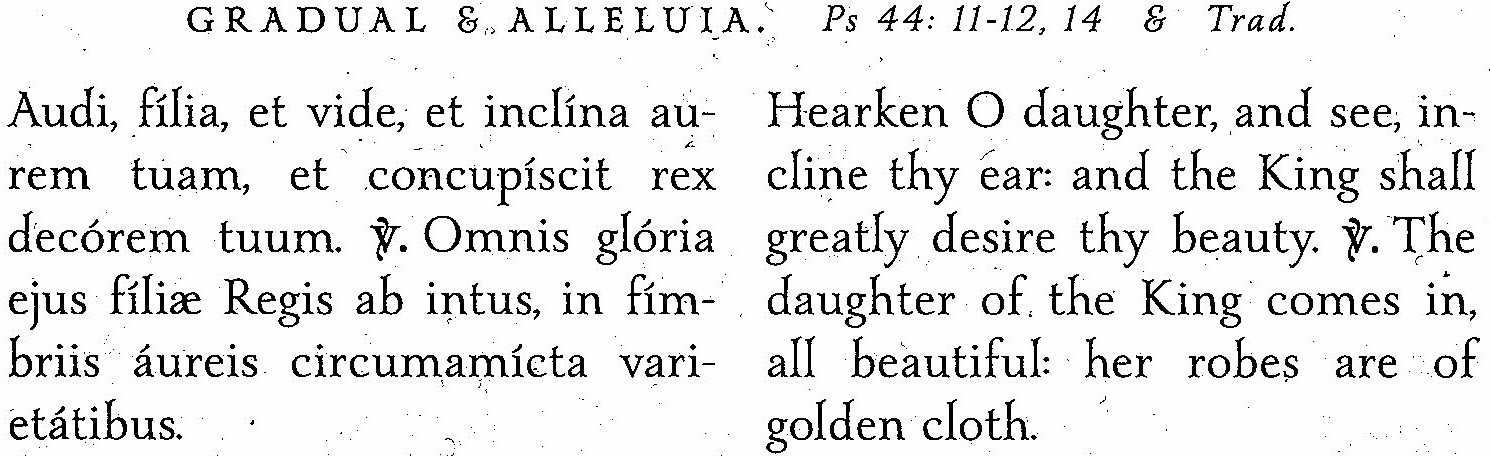
Here is the 1962 typical edition of the Missal: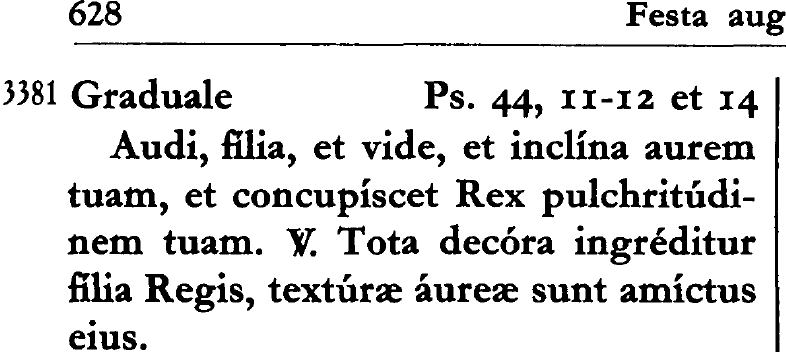
Thank you for the correction! 786 x 352 - 24K
 1490 x 456 - 190K
 -
It has come to my attention that the 1908 Graduale Romanum gives the text Crux fidelis... Pange lingua.. Praelium certaminis for Good Friday. The 1932 modern notation Liber Usualis has the same, but the 1953 Liber has Lauream, which corresponds to the Missal text, as do subsequent editions of the Liber. By what authority was this change to the Gradual text introduced? The 1953 Schwann Graduale Romanum gives both versions (see attachment), as does the 1961 Solesmes Graduale Romanum. When and by what authority was Urban VIII's revised Missal text reinserted into the chant books? This seems like a retrograde step. Were the editors or printers just sneaking these things in, or is there some pertinent decree?Thanked by 1novusgordo
-
It is "lauream" here:
https://media.churchmusicassociation.org/pdf/hebdomadae.pdf
According to Hayburn (I'm looking at page 271), after 1912, the Vatican Commission had finished its work, and the monks of Solesmes agreed with the SCR to resume the preparation of chant editions. It seems their first task (since the Graduale and Antiphonale were done) was to focus on Holy Week. Hayburn says they worked on in in 1914.
In 1922, their new publication (I presume this is what is copied in that book linked above) was declared to be the editio typica for Holy Week. This is phrased in such a way that it is clear that this is the successor to the previous books of the Vatican Edition.Thanked by 1FSSPmusic -
I don't mind using the older text at all, but I assume that it was inserted in the Roman books for the benefit of places that had never abandoned the old texts. For better or worse, one couldn't just start using them, at least not until the reform of the 1950s when both texts are given with no directions as to their usage.
-
For clarification, only the older "praelium" text appears in the 1908 typical edition; it is the Urbanite "lauream" text from the Missal that was substituted in the 1920s. Note the rubric in the pages I shared from the 1953 Schwann Gradual: qui adhibeatur ad libitum. I think it means exactly that: one may sing either text as desired.one couldn't just start using themThanked by 1Liam -
Yeah but I think that the typical edition made a mistake. The older hymns are explicitly not authorized for general use (whether I care is not the question), and I don’t see why this is different for Good Friday.
The 1953 gradual is not official, even if it’s the Vatican edition, since that part is replaced by the Solesmes edition (later deprived of its signs!). And notice which text is given priority (like it or not). However (if this book has it: I cannot find the Roman version), the OHS first used in 1956 is official and would therefore it seems that for that reform one may indeed use either text as one pleases without regard for what one does at the office. Which is obviously stupid: they should be the same. But they didn’t ask me.
Indeed the Vatican commission wanted to restore the older hymns to the office; Pius X overruled them. Also, I’m disposed to the idea that it’s a mistake slash inconsistent and not a rubrical change per se (or if it was, then Benedict XV’s approval of the OMS reversed it) in 1908/1912 because there were things in flux that mean that the first editions are not correct. The antiphonal has the old rubrics! It is a mess. The Divino Afflatu rubrics and calendar only became available in something like 1913 or 1914. -
The Catholic Encyclopedia on Pange:
And Vexilla:In the hands of the correctors the hymn suffered many emendations in the interest of classical exactness of phrase and metre. The corrected form is that found today in the Roman Breviary. The older form, with various manuscript readings, will be found in March (Latin Hymns, 64; with grammatical and other notes, 252), Pimont (Les Hymnes etc., III, 47-70, with a note on the authorship, 70-76), etc. The Commission on Plain Chant established by order of Pius X in many cases restored older forms of the liturgical texts. In the Gradual (the Antiphonary has not appeared as yet) the older form of the "Pange lingua" is now given, so that it can be compared with the form still used in our Breviary.
I'm hard-pressed to find any scholarship in favor of the Urbanite revisions, and it's really unfortunate that some accept the alterations as though they were the authentic tradition.It is unnecessary to indicate more in detail the changes wrought by the correctors, as our Breviaries give the revised text, and the Vatican Graduale gives the ancient text. In general, the changes made by the correctors in the Church hymns are not liked by hymnologists. Some exceptions taken by the Abbé Pimont to those made in the "Vexilla Regis" are noted in the appended bibliography. The Vatican Graduale gives plain evidence of the desire and purpose of the Commission on Plain Chant, established by Pius X, to restore the original texts. The Antiphonary (1912) gives equal evidence of an intention to retain the revised texts. Thus the Graduale (1908) gives only the ancient form of the hymn, while the Antiphonary gives only the revised form. Curiously, the Processionale (1911) gives both forms.Thanked by 1tomjaw -
I don’t think that people have said that anywhere, certainly not here. We can only play with the deck in front of us.
Indeed the antiphonal explicitly says in the appendix that the older hymns are for places which retained them, although everyone seems to accept that Dom Pothier et al. intended to restore the texts and that Pius X overruled them, such that the antiphonal is diplomatic on that point.
The Vesperale excerpt and the Solesmes editions omit the ancient versions entirely. They are also published with only the first verse in chant, and you have to really know the alternate doxologies.
In any case the editio typica of even the ancient Holy Week gives the Urbanite form. Should someone use the other, more venerable form? That’s not the question being asked.
And if the Solesmes edition inserted rubrics that one might deem to be mere suggestions or even incorrect, then the same goes for Schwann! -
That would depend on what the OHS says as an editio typica (as I said several comments ago). I am only making the point about the original change in 1922.
I can’t find the Roman OHS, only the monastic. If that makes the change and does not comment on who may use the old text, great, use it. But if the OHS does not say that one may actually use the text ad lib, then indeed, I do not believe that one may freely use the old text. How-ev-er, I also do not care since I think that excluding the authentic polyphonic repertoire is goofy (if you do the pre-55 or the rite of Gricigliano, singing the Palestrina or Victoria settings of the Vexilla Regis with the new text jammed on to it would be horrendous), and even if you do the chant, the original text is that much better.
But since the question was about liceity, then that’s what I answered.


Welcome to the MusicaSacra Forum!
To participate in the discussions on Catholic church music, sign in or register as a forum member, The forum is a project of the Church Music Association of America.
Categories
- All Discussions21,844
- General Music Discussion8,548
- Job Openings292
- Management of Music Programs862
- Choral Matters539
- Church Documents and Rubrics540
- CMAA Notes307
- Events760
- For Newcomers: Read First26
- Sacred Polyphony567
- Hymnody898
- Gregorian Chant: General2,749
- ↳ Graduale Romanum and Liber Usualis372
- ↳ Graduale Simplex61
- ↳ Semiology65
- Vernacular Plainsong704
- Anglican Use and Anglican Chant73
- Organ, Other Instruments and Repertoire452
- New Composition/Works in Progress1,342
- Recordings238
- Music for Hispanic Ministry163
- Music Education: Children217
- Music Education: General223
- News Items247
- Positions Wanted3
- General Discussion: Catholicism742
- Amusements185
- General Discussion1,048
- Opinions119