
What is a Catholic Hymn?
-
Over the past year I’ve been working on two small projects that grew out of my decades singing in the choir at St. Mary’s Parish in Akron, Ohio. The first is a brief pastoral outline called What Is a Catholic Hymn?, written to clarify the characteristics that traditionally shape Catholic hymnody. The second is a Parish Hymnody Study based on every hymn sung in my parish both past and present. Both documents are descriptive rather than prescriptive, and they’re offered simply as resources for anyone interested in how devotional and traditional hymnody functioned in an ordinary parish setting. I’m sharing them here in case they’re useful for discussion or comparison with your own parish experience.
https://www.motherofmercycatholichymns.com/what-is-a-catholic-hymn/
-
An interesting perspective.
In our parish, we do not include vernacular hymns within the mass, only hymns in Latin, taking up your idea that it must be universal. We do include vernacular hymns before and after mass. Do you have any further thoughts on this approach? Does your article address the TLM, the Novus Ordo or both? -
Thank you for your thoughtful reflection. My work on defining and studying Catholic hymnody really grows out of the Ordinary Form, since that is the parish world that formed me—I began first grade in 1966, so my musical and liturgical life unfolded within the early years of the reformed Mass.
At St. Mary’s, where I sang in the choir, we occasionally used Latin hymns at the Offertory and Communion, but only at one Mass and only once a month, simply as a way of keeping older traditions alive within the rhythm of parish life. Because of that background, my focus has been on how hymnody serves prayer in the Novus Ordo rather than on comparing different forms of the Mass.
My hope is simply to clarify how hymns can be understood and used well in the Ordinary Form, where so many of us first learned to pray through music.
edited
In my own parish experience, Latin was already a living part of the Ordinary Form—woven into the monthly sung Mass and carried by a choir that tried to preserve the older traditions with care—so my reflections come from that kind of setting rather than from comparing different forms of the Mass. -
"Faith of our Fathers" was written by Frederick Faber, who was a convert to Catholicism, so it was originally a Catholic hymn, though the verse about Mary's prayers has been omitted in most modern hymnals. I would not call it liturgical, since the text is not part of the liturgy itself. However, Don9of11 uses a broader definition of "hymn" than I would use. FWIW.Thanked by 1Don9of11
-
“Faith of Our Fathers” is a hymn that many Catholics know well, and it has been sung across Christian traditions for more than a century. In the framework I’m using, it falls into Category C3, which includes hymns that come from the broader Christian repertoire rather than from distinctly Catholic liturgical or devotional sources.
The original Catholic editions—such as Fr. Faber’s Oratory Hymns—did include explicitly Catholic stanzas, including the verse invoking Mary’s prayers. But in American parish life, the hymn was transmitted largely through ecumenical and Protestant hymnals, and the Catholic stanzas were often omitted.
For that reason, it wasn’t part of the core repertoire at St. Mary’s, which drew more directly from the classic Catholic hymnals of the early twentieth century. Even so, it remains a sound and prayerful expression of Christian faith, suitable for certain devotional or patriotic settings, even if it does not occupy the same place as the distinctly Catholic hymns that shaped the parish’s identity.”
It may also help to remember that a hymn’s author does not automatically determine its category. Some hymns written by Catholics—Faber included—were embraced across many Christian denominations and gradually took on a more general devotional character.
When a hymn no longer carries the distinctly Catholic themes, imagery, or sacramental worldview that mark our liturgical and devotional tradition, it fits more naturally into Category C3, even if its origins were Catholic. This simply reflects how the hymn has lived in the Church over time, not a judgment on its beauty or spiritual value.
On another note, I just update the Parish Hymnody Study to clarify where the hymns from St. Mary's originated from. In the section "Hymns We Lost" I added "The repertoire of hymns used at St. Mary’s was drawn largely from the popular Catholic hymnals that shaped parish life throughout the first three quarters of the twentieth century — especially the St. Basil’s Hymnal, the Sunday School Hymn Book, and the St. Gregory Hymnal.”" -
Okay - I don't necessarily agree that FOTF was reintroduced from Protestant sources, especially since it appears in the St. Basil's and St. Gregory's and had been sung in Catholic churches across the Atlantic since it was composed.
But I would ask the same question about Faber's "There's a Wideness in God's Mercy" and Chesterton's "O God of Earth and Altar". I'm sure there are others in this category. -
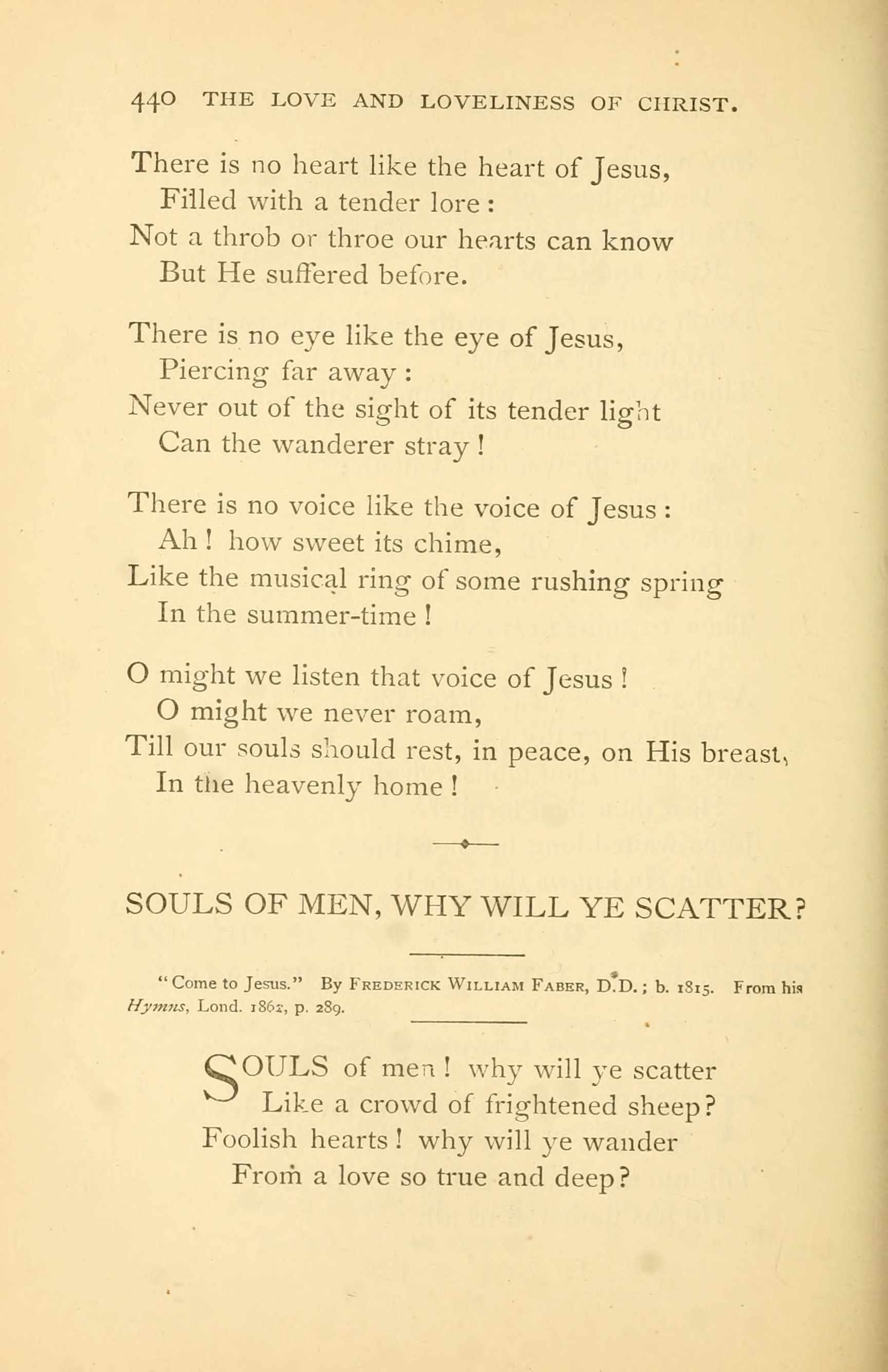
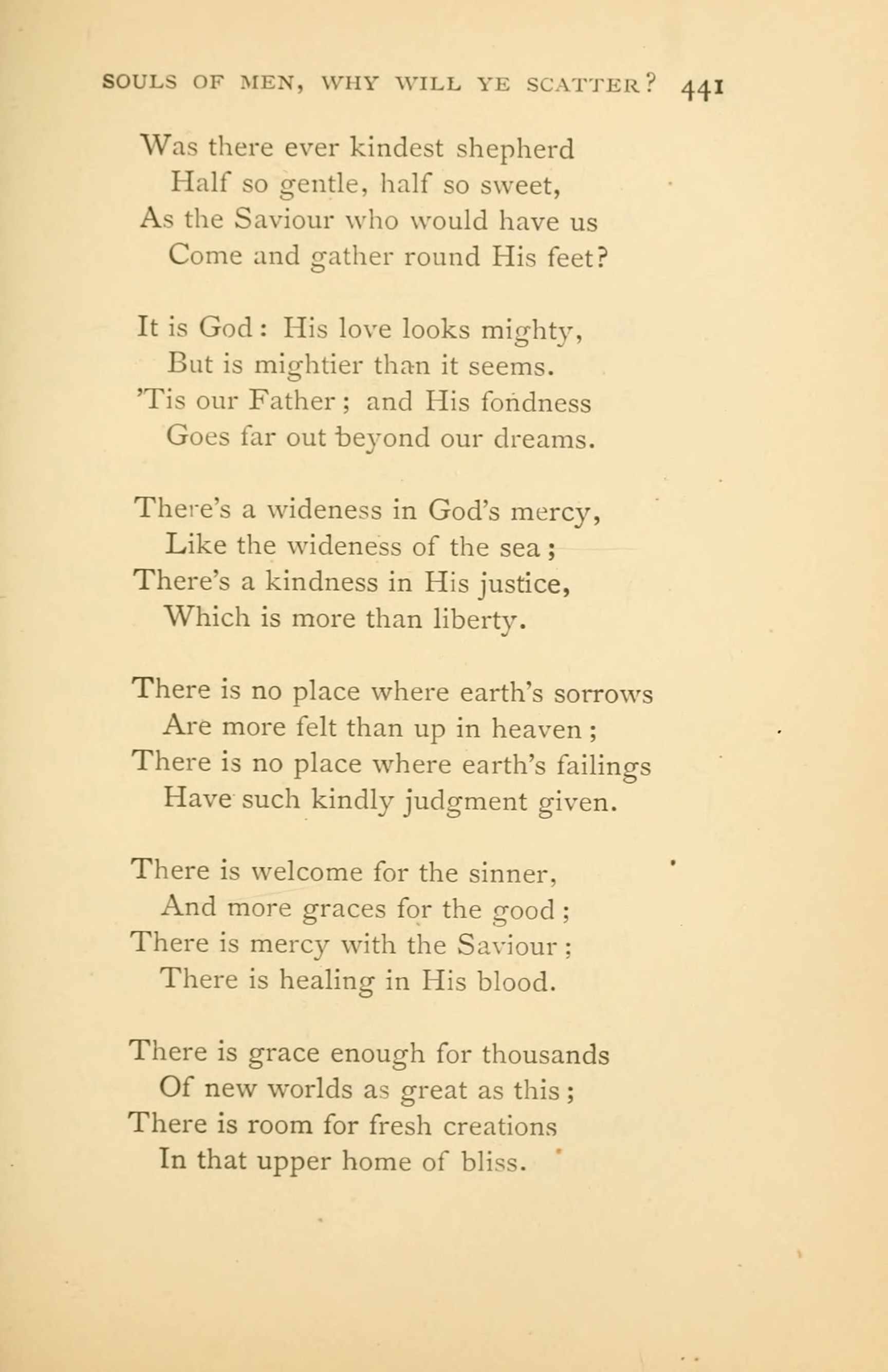
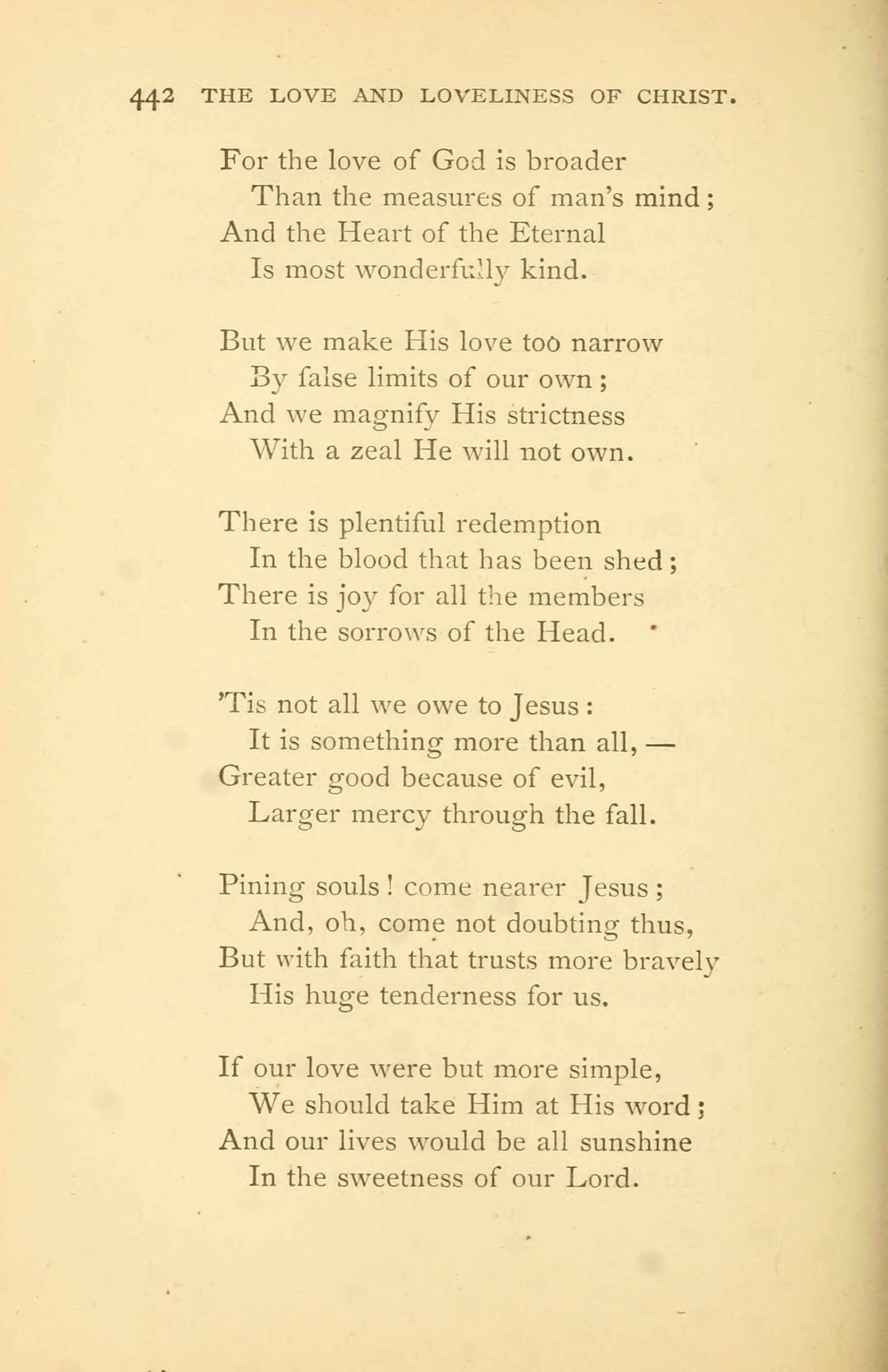
"Souls of men, why will ye scatter?"
The entry in hymnary.org cites John Julian's 1907 article on this text:
https://hymnary.org/text/souls_of_men_why_will_ye_scatter/ -
Thanks to everyone for the thoughtful engagement. I want to clarify one point of intent and then summarizing what the primary sources show.
First, that’s a helpful clarification, and I agree with the distinction that was raised earlier. I didn’t mean to suggest that Faith of Our Fathers was “reintroduced” from Protestant sources in terms of origin. Historically it clearly wasn’t, and its presence in hymnals like St. Basil’s and St. Gregory’s confirms that. My point about ecumenical transmission was descriptive rather than genealogical — a way of explaining how the hymn functioned in American parish life over time, where many Catholics encountered it in a form normalized across denominations and often without the explicitly Catholic stanzas.
Turning to the related case under discussion: the text beginning “Souls of men, why will ye scatter” does not appear in Oratory Hymns (1854), at least not in my copy. It appears instead as part of a longer, unified hymn titled “Come to Jesus” in F. W. Faber’s later collection Hymns (1861) and Faber's Hymns Illustrated (1894). That original hymn consists of many stanzas intended to be read or sung as a whole.
From that single hymn, later editors extracted shorter centos. Both “There’s a wideness in God’s mercy” and “Was there ever kindest Shepherd?” are selections drawn from Come to Jesus, not independent original compositions. Over time, those extracted stanzas circulated far more widely than the parent hymn and came to function as self‑contained hymns, often detached from Faber’s original missionary and devotional framework.
Biographical sources suggest that Faber himself was not always happy, as a poet, with how some of his hymns were shortened or rearranged, but he accepted this pastorally for the sake of wider devotional use. That tension between original intent and later reception is part of the hymn’s historical reality.
For that reason, in the terms outlined in What Is a Catholic Hymn? and The Pastoral Hymns We Sing, this hymn falls squarely into Category C3 — not because of questions of authorship, which are not in doubt, but because of how it actually came to live in the Church’s sung repertoire over time. Its later function as a broadly Christian, ecumenically normalized hymn is a matter of reception rather than origin.
I appreciate the careful and substantive engagement from everyone. It’s been a genuinely helpful exchange. -
Faith of our fathers! living still. F. W. Faber. [A Pledge of Faithfulness.] This hymn appeared as the first of two hymns, one “Faith of our Fathers," for England; and the second the same for Ireland, in his Jesus and Mary; or, Catholic Hymns for Singing and Reading, 1849, in 4 stanzas of 6 lines. It was repeated in his Oratory Hymns, and several Roman Catholic collections for missions and schools. Its use illustrates most forcibly how in hymnody, as in other things, "extremes meet." In the original stanza iii., lines 1, 2, read:—
"Faith of our Fathers! Mary's prayers
Shall win our country back to thee."
In 1853 Drs. Hedge & Huntington altered these lines to:—
"Faith of our Fathers! Good men's prayers
Shall win our country all to thee."
for their Unitarian Hymns for the Church of Christ, No. 455. With this alteration it has passed into several Nonconformist collections in Great Britain and America. With the alteration of these few words the hymn is regularly sung by Unitarians on the one hand, and by Roman Catholics on the other, as a metrical embodiment of their history and aspirations.
--John Julian, Dictionary of Hymnology (1907) -
Again, I'm coming back to the three categories:
Liturgical Hymns
Devotional Hymns
and the third isNon‑Catholic Hymns
Texts originating outside Catholic tradition or expressing non‑Catholic theology.
May contain ambiguity, incomplete doctrine, or ideas inconsistent with Catholic teaching.
Require careful discernment before use in a Catholic liturgy.
Not automatically excluded but must be evaluated for doctrinal clarity.
Should never replace liturgical texts or obscure Catholic identity.
But there is clearly a fourth category of hymns originating within the bosom of Catholic tradition, and expressing Catholic theology, which are neither liturgical in origin nor devotional in object. In here you find many venerable hymns such as the ones mentioned above (There's a Wideness, O God of Earth and Altar, Faith of Our Fathers).
The problem with introducing a fourth category is that you now need to distinguish between Catholic and Non-Catholic hymns by quality rather than category, but that is indeed the rub, let's not shirk from it. Catholic author, approval for worship, customary use in Catholic worship, nihil obstat, imprimatur, etc. - these all may work pre-conciliarly but not post-conciliarly due to legitimate and praiseworthy reforms and theological developments. Whatever one may say of Faith of Our Fathers on these accounts, one might also say of "Hear I Am Lord", yet our hearts (rightly I presume) rebel against equating the two.
So I have a criticism of your scheme but not a perfect or neat solution. -
Thanks for the comment — it gives me a chance to clarify how What Is a Catholic Hymn? and A Pastoral Look at the Hymns We Sing: The Parish Hymnody Study are meant to work together. They were written intentionally as companion documents, something I note in both, and they really are best read side by side: one establishes a theological and liturgical framework, and the other reflects pastorally on how those principles were experienced in the life of a particular parish.
In What Is a Catholic Hymn?, the comparison chart (liturgical, devotional, non‑Catholic) is normative and theological. It addresses what kind of hymn a text is in relation to Catholic worship and doctrine.
The Parish Hymnody Study is pastoral and descriptive. The C1–C4 categories are not a competing classification. They describe how hymns of various kinds were actually received and experienced within the life of this parish. In my own thinking, the C3 and C4 categories fall broadly within what I elsewhere describe as non‑Catholic hymnody, but are further distinguished pastorally to account for differences in reception, longevity, and use.
Read together, the documents reinforce one another. Even when read separately, there is no conflict between them — only a difference in purpose. Any difficulty arises less from the categories themselves than from the fact that companion pieces are not always read side by side.
My hope was to keep theological definition and pastoral observation in dialogue, without collapsing them into a single framework, and I’m grateful for the chance to continue the conversation if others have thoughts or questions.Thanked by 1Roborgelmeister


Welcome to the MusicaSacra Forum!
To participate in the discussions on Catholic church music, sign in or register as a forum member, The forum is a project of the Church Music Association of America.
Categories
- All Discussions21,846
- General Music Discussion8,548
- Job Openings293
- Management of Music Programs862
- Choral Matters539
- Church Documents and Rubrics540
- CMAA Notes307
- Events761
- For Newcomers: Read First26
- Sacred Polyphony567
- Hymnody898
- Gregorian Chant: General2,749
- ↳ Graduale Romanum and Liber Usualis372
- ↳ Graduale Simplex61
- ↳ Semiology65
- Vernacular Plainsong704
- Anglican Use and Anglican Chant73
- Organ, Other Instruments and Repertoire452
- New Composition/Works in Progress1,342
- Recordings238
- Music for Hispanic Ministry163
- Music Education: Children217
- Music Education: General223
- News Items247
- Positions Wanted3
- General Discussion: Catholicism742
- Amusements185
- General Discussion1,048
- Opinions119