
Interlinear English-Latin hymnals?
-
Are there "interlinear" Latin-English hymnals? Angelus Press's 2nd ed. hymnal contains very literal interlinear English translations for many hymns, but are there hymnals with "slavishly literal" translations of hymns like Te Ioseph, etc.?
What prompted this question was another: Why is Te Ioseph Celebrent's Latin so "dense"? As a newcomer to Latin, it is one of the harder-to-understand texts for me, probably because of the rarer vocabulary and word order. Does anyone else have this problem? It reminds me of the Latin of the St. Michael prayer, which was more difficult for me to memorize when I first learned it.1. Te, Joseph, celebrent agmina caelitum Te cuncti resonent christiadum chori Qui clarus meritis junctus et inclytae Casto foedere Virgini. 2. Almo cum tumidam germine conjugem admirans dubio tangeris anxius, afflatu superi flaminis angelus conceptum puerum docet. 3. Tu natum Dominum stringis ad dexteras, Aegipti profugum tu sequeris plagas: amissum Solymis qaeris et invenis, miscens gaudia fletibus. 4. Post mortem reliquos sors pia consecrat, Palmanque emeritos gloria suscipit: Tu vivens, superis par, frueris Deo Mira sorte beatior. 5. Nobis Summa Trias parce precantibus: da Joseph meritis sidera scandere, ut tandem liceat nos tibi perpetim, gratum promere canticum. 1. Let the hosts of heaven celebrate you, Joseph, Let all the choirs of Christendom resound you who, famous for your merits, was joined to the glorious Virgin in chaste wedlock. 2. When your betrothed became great with precious seed, amazement and doubt made you anxious. It is by the breath of the divine Spirit, an Angel tells you, that the son has been conceived. 3. You did embrace the new-born Lord, and to the furthest Egypt coasts you followed Him in exile, Lost in Jerusalem, you sought and found Him, mixing joy with tears. 4. After death most are blest by a loving destiny and, when they have won the palm, they are welcomed into glory. But you, while you lived, like the saints above, were with God, blest more than others by this wondrous lot. 5. Spare us, highest Trinity, as we pray, Grant that through Joseph's merits we may rise to heaven, So that at last we may offer perpetually our grateful songs. -
Eὕρηκα! This is exactly what I'm looking for:
- Chants of the Church: Selected Gregorian Chants by Solesmes with interlinear translations by Msgr. Charles E. Spence.
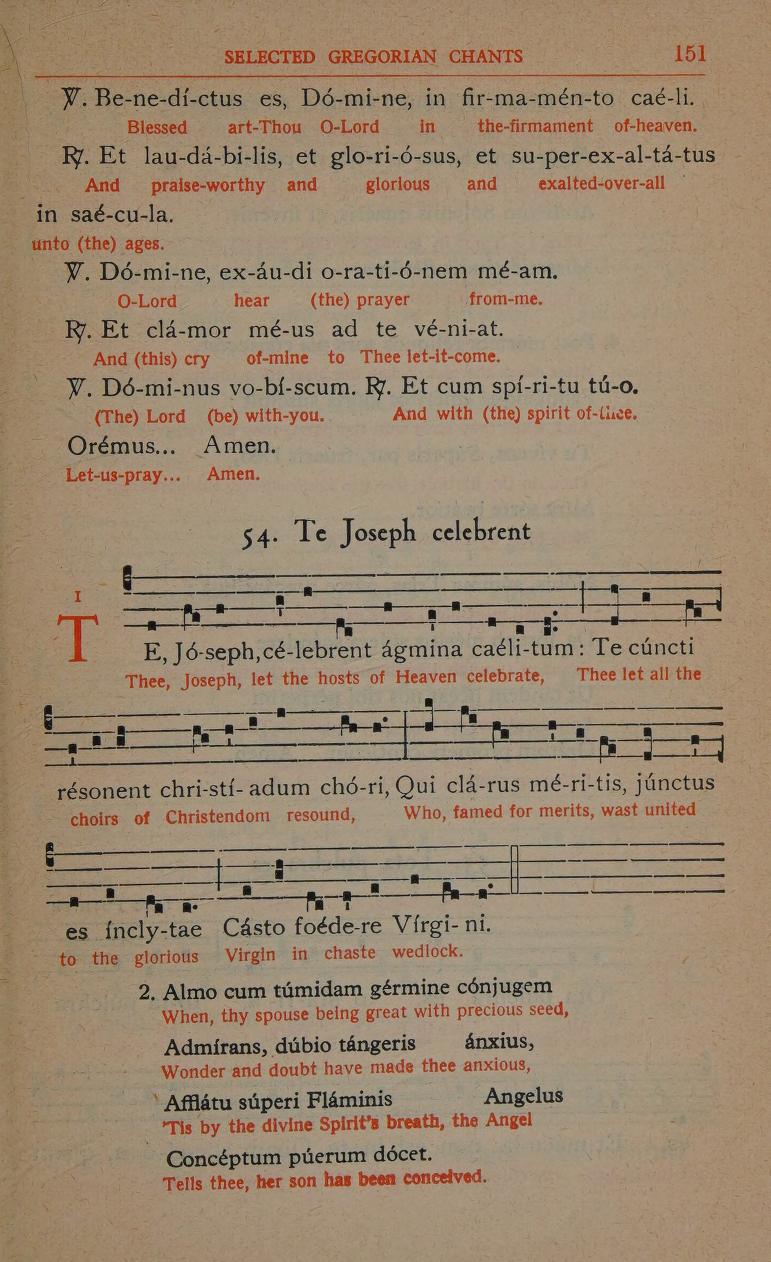
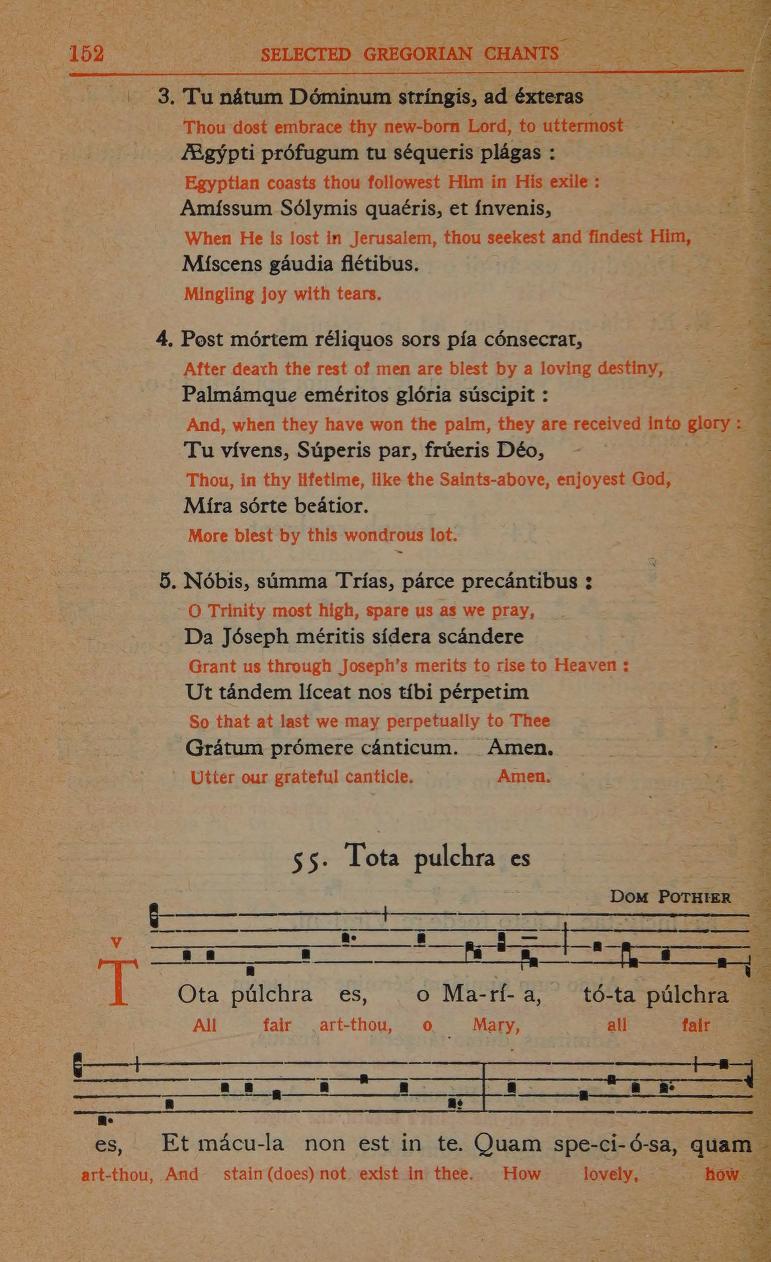
-
The answer to your question is because that hymn dates to the late seventeenth century in Spain [or, according to another answer that I've found, a cardinal who was an official of the Congregation of Rites, but in any case, he died in 1700, so the period is correct], not to the most prolific period of the corpus of hymns or even to the lifetime of Aquinas or Bonaventure… the opening line of the St Michael prayer is the Alleluia of the Mass for September 29, but I believe that Leo XIII composed the rest, which would also explain its text…
-
The Latin that Pope St. Pius X used in his letters, for example, is quite dense and prolix (very long sentences).
I figured Te Ioseph might have been from a later era; poetry is quite dense/concise anyways. -
I forgot all about "chants of the church". I have a copy, although my edition is different and things are transcribed into modern notation... I'd like to acquire the same square note version as that pdf...
-
Here's DeepL's Latin→English transl. of it:
1. Te, Joseph, celebrent agmina cælitum       1. Let the heavenly host celebrate you, Joseph,
Te cuncti resonent christiadum chori          let all the Christian choirs resound for you,
Qui clarus meritis junctus et inclytæ         who, renowned for your merits and united
Casto fœdere Virgini.                         by a chaste bond to the Virgin.

2. Almo cum tumidam germine conjugem          2. When, admiring your wife, fruitful with child,
admirans dubio tangeris anxius,               you are touched with anxious doubt,
afflatu superi flaminis angelus               an angel, by the breath of the divine Spirit,
conceptum puerum docet.                       teaches of the conceived child.

3. Tu natum Dominum stringis ad dexteras,     3. You hold the newborn Lord in your right arms,
Ægipti profugum tu sequeris plagas:           You follow him as he flees to Egypt's lands:
amissum Solymis qæris et invenis,             You search for him lost in Jerusalem and find him,
miscens gaudia fletibus.                      Mingling joys with tears.

4. Post mortem reliquos sors pia consecrat,   4. After death, a gracious fate consecrates the survivors,
Palmanque emeritos gloria suscipit:           and glory receives the palm for the departed:
Tu vivens, superis par, frueris Deo           You, living and equal to the gods, rejoice in God
Mira sorte beatior.                           by a wondrous lot, more blessed.

5. Nobis Summa Trias parce precantibus:       5. O Supreme Trinity, spare us who pray:
da Joseph meritis sidera scandere,            grant that Joseph, by his merits, may ascend to the stars,
ut tandem liceat nos tibi perpetim,           so that at last we may be permitted to offer you forever
gratum promere canticum. a grateful song. -
I think why the Latin is more difficult than many hymns' is that this one uses many ablative phrases:
Casto fœdere = "by a chaste bond"
afflatu superi flaminis = "by the breath of the divine Spirit"
Mira sorte beatior = "by a wondrous lot, more blessed."
Joseph meritis = "Joseph, by his merits" -
If anyone's still looking for a square-note copy of Chants of the Church, it's available as a free download on the CMAA site under "Music Resources", and as a reprint book through the CMAA shop site.
The version in modern notation is also available as a download through the same resource list.
-
Geremia, right. They were classicizing everything; what becomes Romance and the Latin of the Middle Ages start to replace the ablative with prepositions when the ablative used to not take one. Then the cases fell away almost entirely. And they were not writing in the early Christian classical style either but more of Cicero’s.
-
CCWatershed has many hymns like that but you have search engine them which can take a while.
with a quick search- this one is not interlinear but it does have the translation on the sidelines https://archive.ccwatershed.org/media/pdfs/21/03/17/03-31-40_0.pdf


Welcome to the MusicaSacra Forum!
To participate in the discussions on Catholic church music, sign in or register as a forum member, The forum is a project of the Church Music Association of America.
Categories
- All Discussions21,824
- General Music Discussion8,540
- Job Openings291
- Management of Music Programs862
- Choral Matters539
- Church Documents and Rubrics540
- CMAA Notes307
- Events758
- For Newcomers: Read First26
- Sacred Polyphony566
- Hymnody897
- Gregorian Chant: General2,747
- ↳ Graduale Romanum and Liber Usualis372
- ↳ Graduale Simplex61
- ↳ Semiology65
- Vernacular Plainsong704
- Anglican Use and Anglican Chant73
- Organ, Other Instruments and Repertoire451
- New Composition/Works in Progress1,339
- Recordings238
- Music for Hispanic Ministry163
- Music Education: Children217
- Music Education: General223
- News Items246
- Positions Wanted3
- General Discussion: Catholicism742
- Amusements185
- General Discussion1,048
- Opinions119