
Koerber's Illuminated Hybrid Modern (Metrical) Notation
-
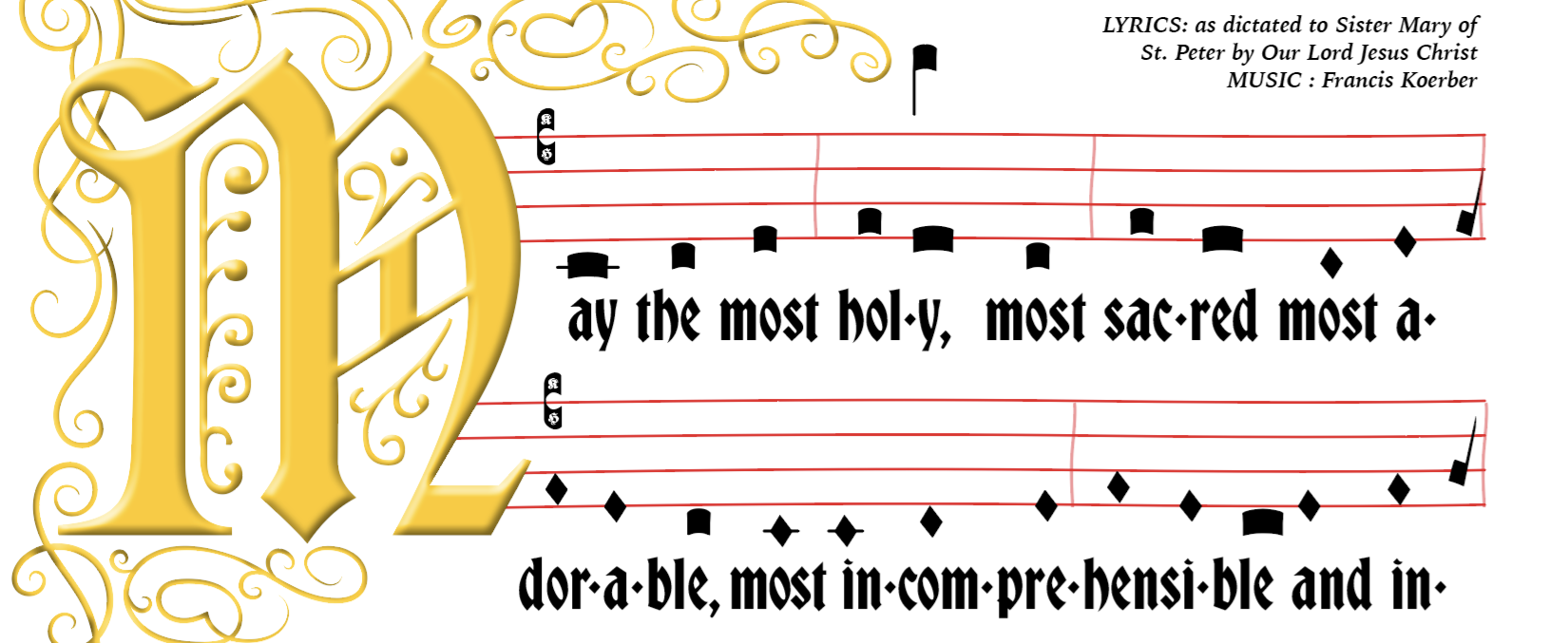
I am creating a devotional booklet for our Confraternity of the Holy Face, and I am continuing to develop the tour de force of making the music beautiful and not just functional, by harkening back to tradition in illuminated manuscripts. I also wanted to create a hybrid that is beautiful that also presents metrical modern notation, and this is where it is headed. I developed my own note shapes that would fit on a four line staff and use moveable DO.
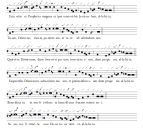
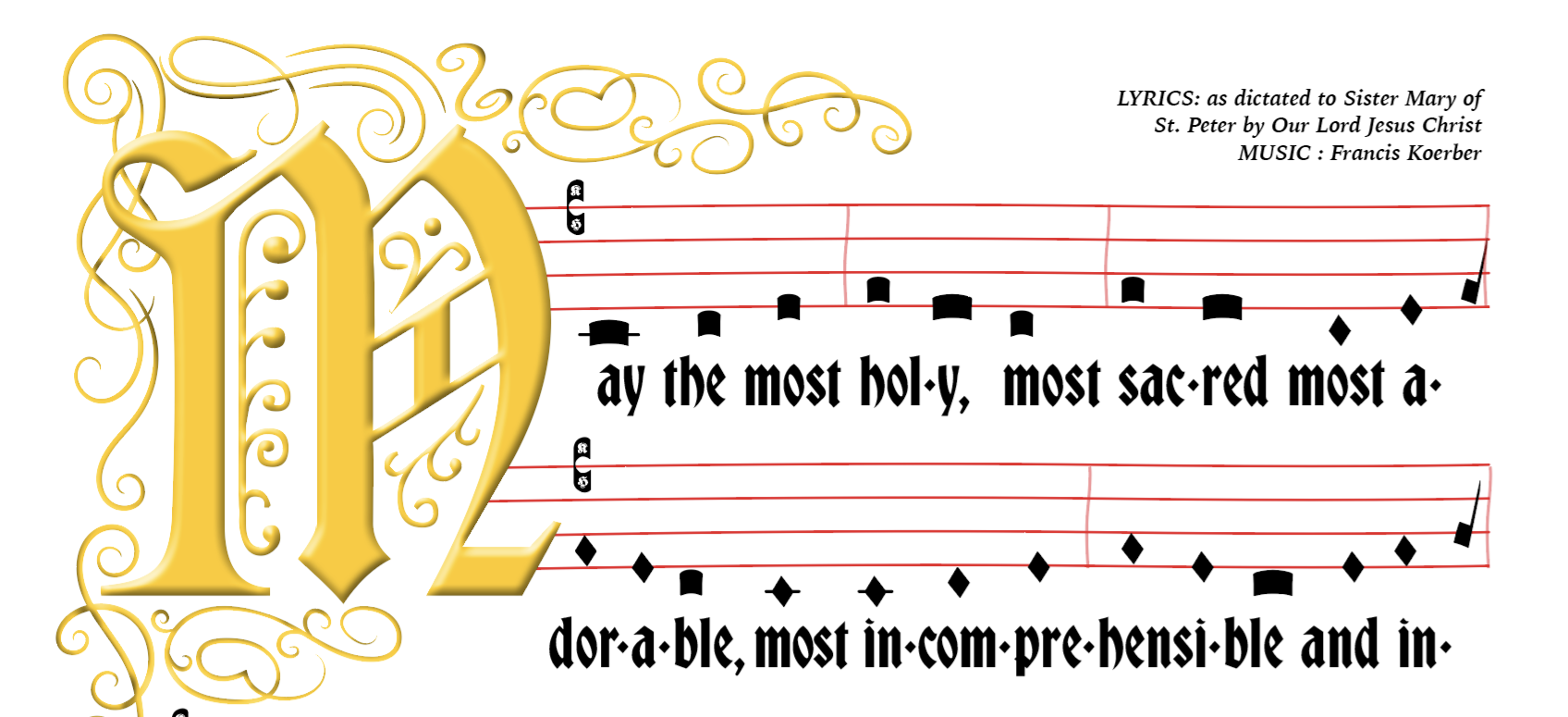
Here are a couple of examples (far from perfected)... these are still in the idea phase.
For those of you who are promoting a metrical form of GC, what is the equivalent of breve, semi-breve in Gregorian Chant notation? I was thinking of experimenting with that also.Thanked by 1hilluminar -
In GABC the forms borrowed from Gregorian chant for long, breve & semi breve are (gv) (g) (G).
-
If I understand what you're up to:name: ;
user-notes: ;
commentary: ;
annotation: ;
centering-scheme: english;
%fontsize: 12;
%spacing: vichi;
%font: OFLSortsMillGoudy;
%width: 4.5;
%height: 11;
%%
(c4) May(gv) the(h) most(i) (,) ho(j)ly,(iv) most(h) (,) sa(j)cred,(iv) most(H) ad(I)(,)o(J)ra(I)ble,(h)
I see though that the barline kills the hyphen, and there might not be a way to make stemmed minums.Thanked by 1francis -
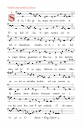
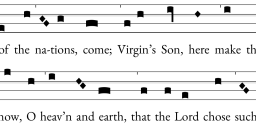
Francis, here is what I use. The square is long and the diamond is short (breve and semi-breve, if you want to call them that). The rectangle is a double long, and the tiny notes are grace notes, which add no time and come before the beat. The jagged comb-like thing is the qualisma, which indicates a slide or very light grace note between the two notes that it connects.
I've developed this based off of historical notation systems, combined with ideas of what would be most intuitive for someone who has never learned any notation before (whether child or adult). I'm inclined to say that in simple measured music (hymns, and especially the measured chant) measure lines are not completely necessary. The are just one more thing on the page, and often you can "feel" the measure in the music just fine without them. Polyphonic music is a different story though. I'd like to get this notation to work for polyphony etc, but I've mostly just been using it for chant. What's really lacking is a good system of rests, and how to show dotted duration (1.5 length). It just hasn't been a priority yet, but maybe soon.
Here are the examples: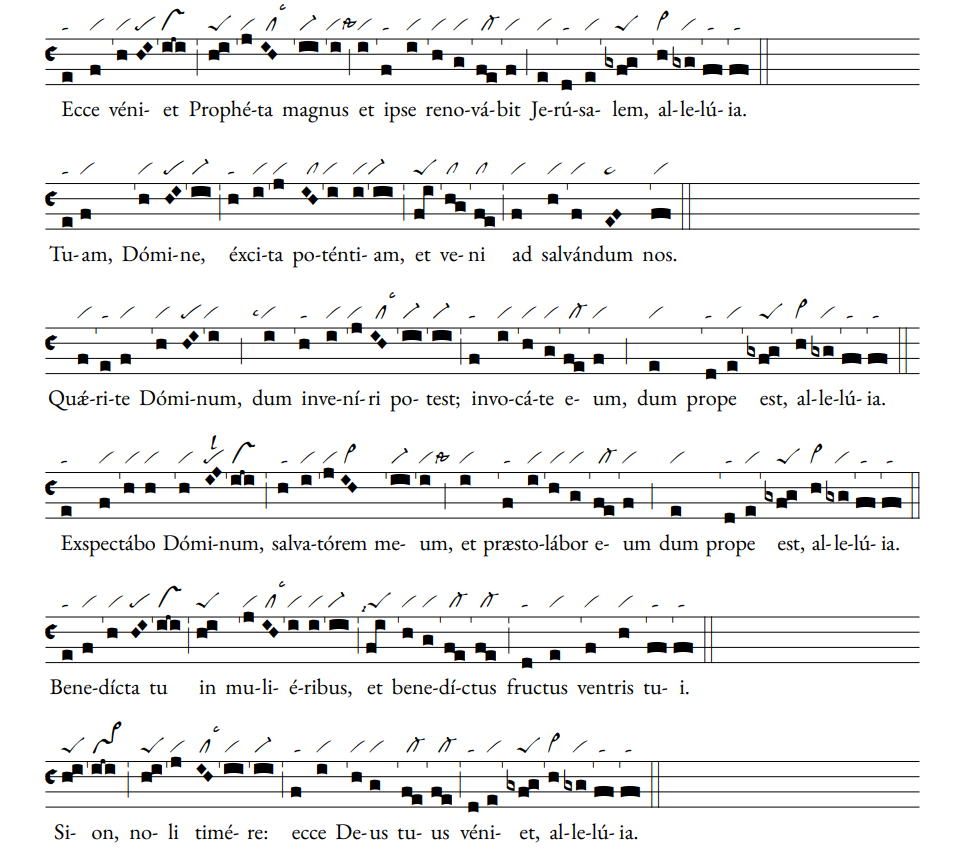
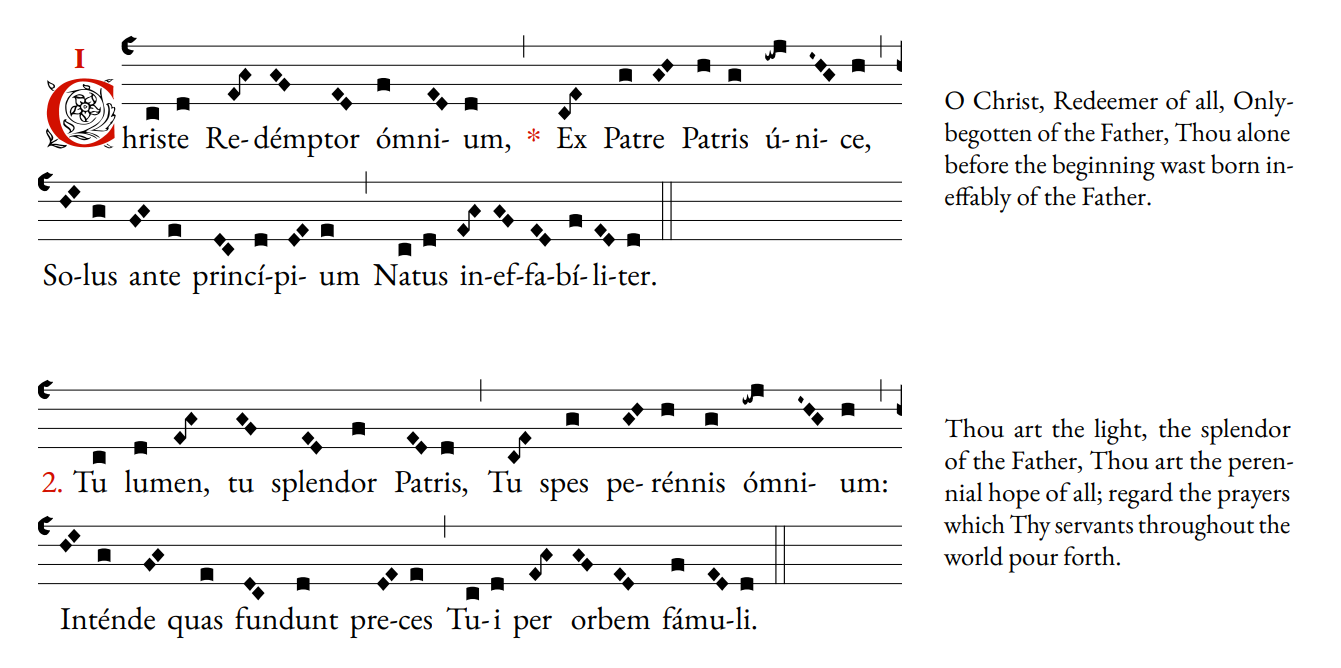
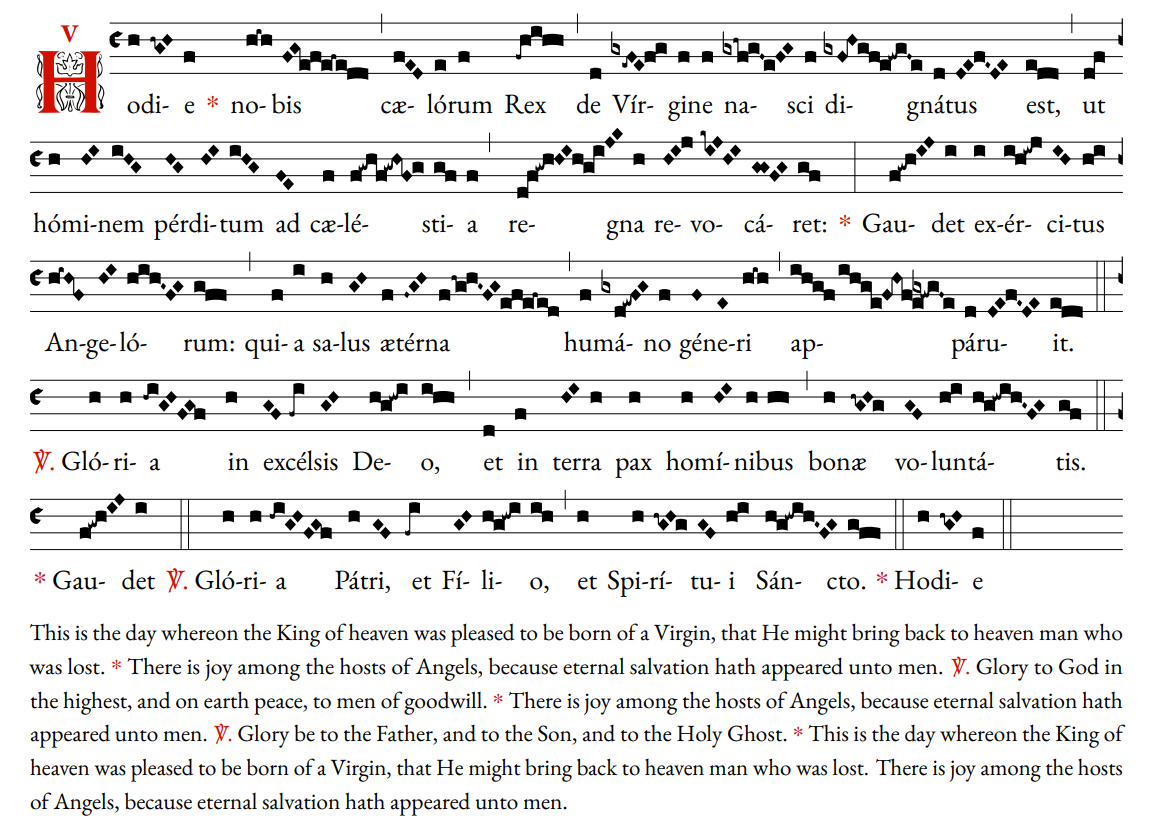
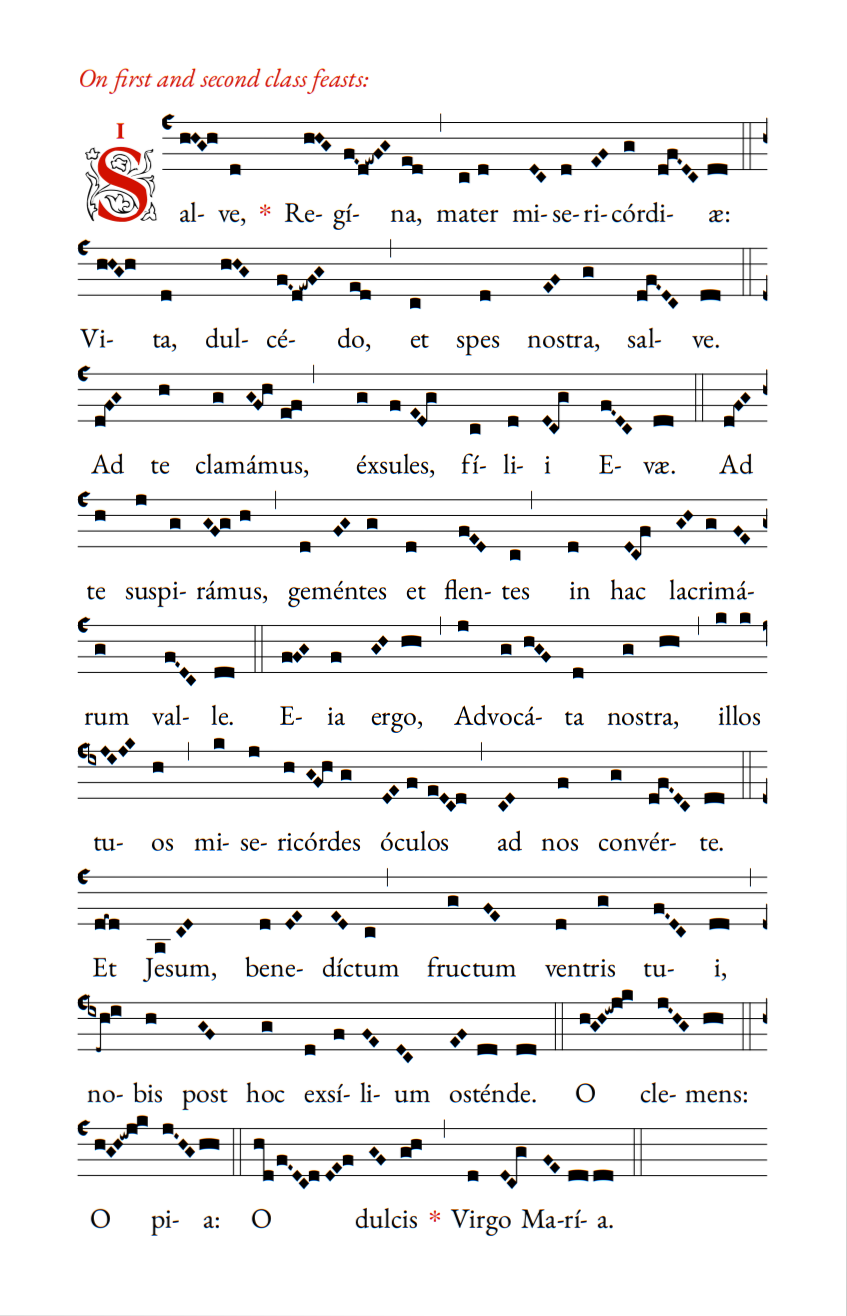
 959 x 859 - 90K
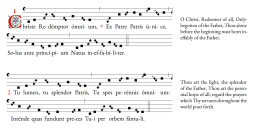 1341 x 668 - 116K
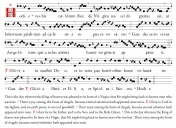 1149 x 838 - 167K
 847 x 1316 - 245K
 1652 x 613 - 53K
 -
Here is an accompaniment for the Golden Arrow with a couple of other pieces as a medley.
http://www.myopus.com/preview/AdorationOfTheHolyFace.mp4 -
New item... hybrid blending modern chant notation with organ accomp... I don't see where this is even practical or desirable.
-
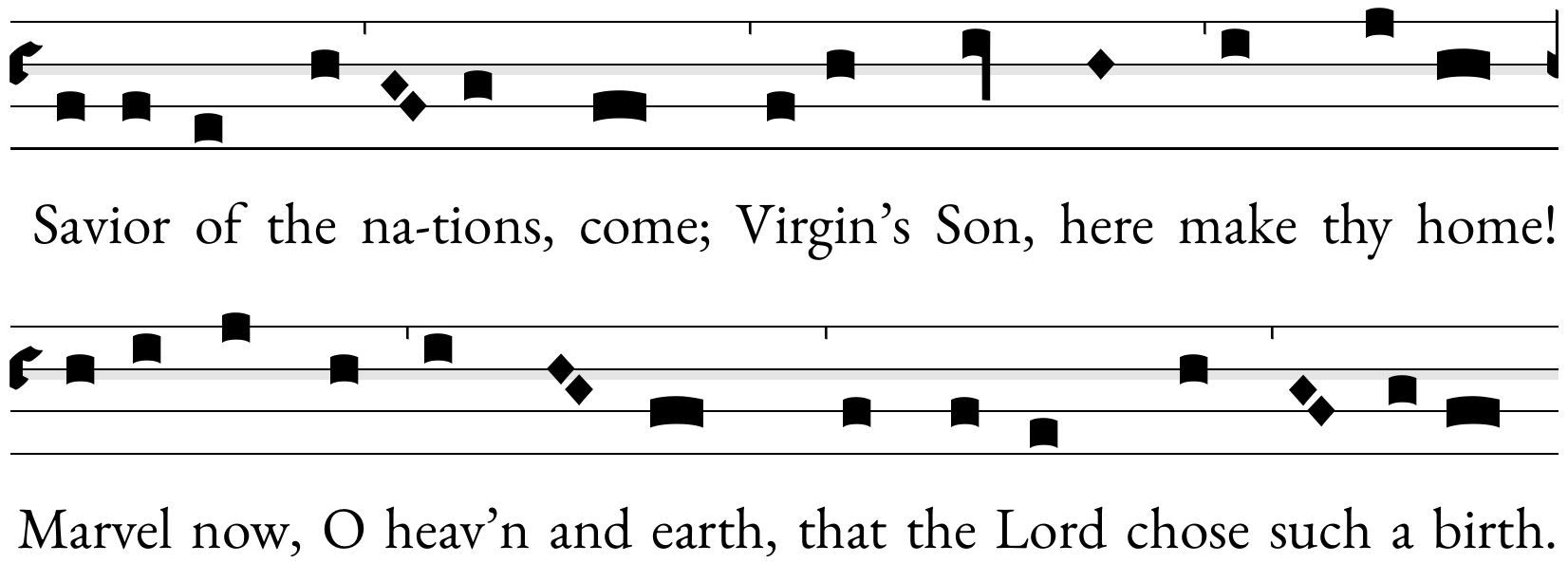
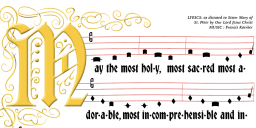
Using Gregorian Notation based upon suggestions by Richard and OMag, here are two examples. One uses the vowel rule of placing the neume, the other uses a mathematical preference to duration of note, which is how modern notation is rendered.
Personally, I am not sure that bastardizing the chant notation in this way is a 'beautifying' addition. I think the smaller modern note heads which I created for this purpose tend to look better, but I would have to live with them for a while I suppose.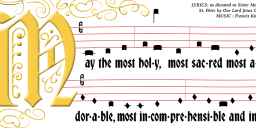 1650 x 677 - 443K
 1696 x 775 - 469K
 -
Hmmm... I just realized that the notes in the original version are sitting on the wrong lines and spaces... everything has to go up one line or space... fixing now.
Here is corrected version. 435K
435K -
Francis, I beg your pardon, I've been feeling under the weather, and I lost my voice Thursday. Once I'm feeling better I can give a good answer to all your questions and I'll be able to make some recordings. But I wanted you to know that I wasn't ignoring you.Thanked by 1francis
-
Francis, here are the recordings you asked for. The notation I use isn't meant to convey nuances (unless perhaps the grace notes and qualismas could be considered nuances). The idea is that a steady beat is kept, and the nuances are in the dynamics and tone, which are unwritten, but arise from basic musical considerations (tasteful rise and fall, location of strong beats in music, etc) as well as the beautiful expression that comes from piety in praying the text while singing it (sort of how you could have a hundred people all singing Holy God We Praise Thy Name together, and there's no durational nuances, but if the people really mean what they are singing, it will come out in ta beautiful way).
The qualisma and grace notes might be seen as nuances, but even if they aren't sung as exactly the same length by everyone, it still turns out sounding fine, because it's a very subtle different, and there value is subtractive, not additive (they steal their time from the following note) so everyone should come in on the following beat together regardless. And the grace and qualisma are more frequently part of the chants sung by the trained schola anyway, as opposed to the chants for the congregation.
I don't think my untrained voice does these chants justice, but hopefully you still get the idea (also, the restoration of the Hodie Nobis needs some more work, but I'm singing it as notated anyway).
Yes, I did try to have a thick stem (the virga) indicate dotted (1.5) duration; that was from Advent 2024, I haven't really played around with non-chant music in the notation since then. The thing is, I don't want people to be confused between the ligature stem, which is thinner, and the thicker augmentation stem for dotted rhythms.
I engraved these using Gregorio in LaTeX, with a customized font that I pieced together myself in FontForge. I am frequently continuing to make small tweaks in FontForge
I'm opened to suggestions, although it will probably just take more field testing and wider application over the next few years for me to solidify what'll really work for my endeavors. 324K

Welcome to the MusicaSacra Forum!
To participate in the discussions on Catholic church music, sign in or register as a forum member, The forum is a project of the Church Music Association of America.
Categories
- All Discussions21,824
- General Music Discussion8,540
- Job Openings291
- Management of Music Programs862
- Choral Matters539
- Church Documents and Rubrics540
- CMAA Notes307
- Events758
- For Newcomers: Read First26
- Sacred Polyphony566
- Hymnody897
- Gregorian Chant: General2,747
- ↳ Graduale Romanum and Liber Usualis372
- ↳ Graduale Simplex61
- ↳ Semiology65
- Vernacular Plainsong704
- Anglican Use and Anglican Chant73
- Organ, Other Instruments and Repertoire451
- New Composition/Works in Progress1,339
- Recordings238
- Music for Hispanic Ministry163
- Music Education: Children217
- Music Education: General223
- News Items246
- Positions Wanted3
- General Discussion: Catholicism742
- Amusements185
- General Discussion1,048
- Opinions119