
Nineteenth century chant accompaniment notation
-
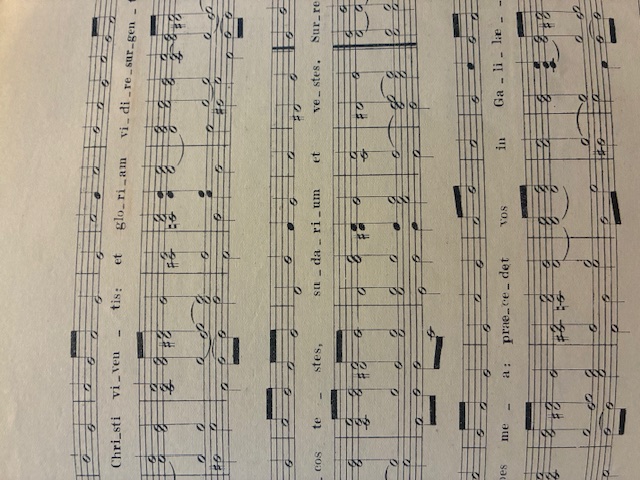
This is in a volume of chant accompaniments by Jean-Baptiste LaBelle, printed in Montreal in 1894. The harmonizations throughout the book are pretty wild French Romantic, including seventh chords and altering melodies for a raised "leading tone". But what has me stumped is how the notated rhythms were expected to be played. Has anyone run across this before?
-
The stems on the white notes are just to mark melismas.Thanked by 1john m
-
Thank you! I see now - that got right by me. So they serve the function of a slur then...
-
Yes, the beaming is a neumatic and there's nothing to forbid an equalist execution if one so wishes, regarding the notation as a transliteration rather than a transcription. Less clear to me is the significance of the black noteheads, though they are placed on lighter syllables; Pustet 1871 is less help than I expected. You can compare with Gagnon's Accompagnement d'orgue des Chants Liturgiques en usage dans la province ecclesiastique de Quebec.
-
Compare the 1883 Haberl & Hanisch accompaniment, which also has quarter notes for the same syllables and corrsponds to the aforementioned Pustet edition:
https://archive.ccwatershed.org/media/pdfs/13/07/11/19-33-35_0.pdf#page=56
The sharp is unsurprising and typical of the era, especially in the French style. But yes, I think the beamed half notes are equivalent to a slur. -
This is a hybrid notation to regular Pustet chant, to accommodate the organ.
This is how it was done in the US at the cusp of the Civil War
(Rev. J. H. Cornell, C. SS. R.,, A manual of Roman Chant. Baltimore: Kelly, Hedian and Piet, 1860)
"4.—Considered from the former point of view, the notes used in the actual Roman chant are three: the Long (^), the Breve (a), and the Semibreve ($); concerning.the relative value of which, as indicative of different durations of time, the Dircctorium Chori teaches, that the Breve must be sung in the time of one, the Semibreve in half that time, and the Long in the time of one and a half. These proportions are, however, given as approximate only, and cannot always be rigidly observed."
The characters in the print didn't survive OCR, but correspond to virga, punctum, and rhombus, or to the corresponding characters in mensural notation

Welcome to the MusicaSacra Forum!
To participate in the discussions on Catholic church music, sign in or register as a forum member, The forum is a project of the Church Music Association of America.
Categories
- All Discussions21,809
- General Music Discussion8,534
- Job Openings290
- Management of Music Programs862
- Choral Matters539
- Church Documents and Rubrics540
- CMAA Notes307
- Events758
- For Newcomers: Read First26
- Sacred Polyphony566
- Hymnody896
- Gregorian Chant: General2,745
- ↳ Graduale Romanum and Liber Usualis372
- ↳ Graduale Simplex60
- ↳ Semiology65
- Vernacular Plainsong704
- Anglican Use and Anglican Chant72
- Organ, Other Instruments and Repertoire450
- New Composition/Works in Progress1,338
- Recordings238
- Music for Hispanic Ministry163
- Music Education: Children217
- Music Education: General222
- News Items246
- Positions Wanted3
- General Discussion: Catholicism742
- Amusements185
- General Discussion1,047
- Opinions119