
Diocesan Websites
-
Does anyone belong to (or know of) a diocese that has a link for musicians (music leaders) that would guide them on appropriate music. For example, I'm looking for a layout that may have diocesan approved ordinaries, with links to free, public domain PDFs, like the ICEL chants. Or simple polyphony and sacred music with links, if they are in the public domain, that would be appropriate for a fledgling choir.
-
I don't know the answer, but I would sure love a resource like that!Thanked by 1canadash
-
I know the Archdiocese of Portland does (or did…).Thanked by 1canadash
-
I've been on most of the archdiocesan sites and haven't seen anything like this. In fact, I'm under the impression that very few dioceses have official or approved Mass settings. A few resources you might want to check out:
https://englishmotets.com/
Mass of Saint Francis by Horst Buchholz: https://adoremus.org/wp-content/uploads/2024/05/BuchholzMassofStFrancis.pdf
Saint James Music Press: https://sjmp.com/ -
It was more of a thing in 2011 where some dioceses tried to have a Mass setting in common; Louisville tried to push one that I found very dignified, by a local DM as it happened, a setting also named for the saint of Assisi. But I think that it never got anywhere; stuff was just too dug in.Thanked by 1canadash
-
I'm glad it's not common. We want our diocese to care about music, but not to care too much. Look at what the cathedral does, and ask yourself if that's the ideal you want for your parish. We laugh at Montana's Black and White Lists, but think of them being mandated for a diocese.
To the larger issue (curation of sacred music): there are sites that point out use according to liturgical feast (Canticanova, CPDL). There needs to be sites that do something like the educational music grading system, or even better, detailed analysis of where the pitfalls are (similar to GIA's "Teaching Music Through..." book series)
Personal anecdote: there's an Ave Maria by Gerald Near for men/women that I sang while guesting, and was quite pleased with. I was particularly taken with the way the entrances were eased in. Except: I had sung it with quite a competent musician. I bought it, and we've done it several times. But 90% of rehearsal time was used on one measure: a descending minor 7th for the women. And every time we did it, 90% of our review time was that note, and every time we did it at Mass it was "peccato-ri(splat)-bus". It's not word-painting when it sounds accidental. I didn't manage to teach that interval because there was nothing in the repertoire that reinforced it. This would have been a great Grade 1 piece; instead it was a challenging Grade 3 piece. I was going to do it again for Holy Family, looked at personnel and the rehearsal landscape, and said "Homie ain't got time for that." -
Responding to your personal anecdote: If I were in that situation, I'd strongly consider adjusting the accompaniment to help "give" them the pitch that they're struggling with. If that doesn't work, I'd even consider changing the melody to a note that "works" and that they can sing accurately. It would be nice if we all had quite competent musicians all the time, but sometimes you have to try to make a silk purse out of a cow's ear, so to speak!!
-
Oh, that's a nasty descending interval given the accompaniment context - there are parallel fifths between "S" and "T" voices in the accompaniment that function to reinforce the "T" voice therein that's in dissonance with the sung vocal line. It's a setup virtually asking for typical amateur voices to ... splatter.
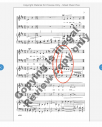 994 x 1242 - 461KThanked by 1canadash
 -
I'd even consider changing the melody
That occurred to me. If this weren't a living composer, I'd consider it. But there's a Golden Rule issue at play. The only simple note-substitution that makes any sense is G. Descending 5ths aren't QUITE as bad, but still problematic. And if you look at the line, you can see that really, E is where it wants to go. I'm not sure how I'd reconceptualize the passage in this instance; it would probably involve raising some of the bottom notes in the women's line, which would have other effects on the men. In any case, Nie mój cyrk, nie moje małpy
Otherwise, for the old guys, as the late Prof. Schickele once said, "PDQ has been dead a long time; no use covering up for him now."Thanked by 1canadash -
It was more of a thing in 2011 where some dioceses tried to have a Mass setting in common;
Our diocese did this with the new translation. It was supposed to be for a year. Now, we're stuck in a rut and if you try to introduce a new Mass setting, you get complaints. -
Our Diocese tried to have the Mass of Wisdom for all parishes, but that was over a decade ago. It is rarely used now.Thanked by 1canadash
-
Archbishop Sample's Pastoral Letter on Sacred Music
This dates from 2019, shortly after Archbishop Sample arrived in Portland, Oregon. He had done something similar in the diocese he served previously. It showed up on the current newsletter from the Archdiocese (which is a poor substitute for the Catholic Sentinel).
https://files.ecatholic.com/12494/documents/2022/4/Sing to the Lord a New Song 25-1-19.pdf?t=1649959316000 -
Thanks very much.
It doesn't look like there is something already out there that would be a helpful example of what I am looking for.
The idea is that if there is a fledgling choir director out there who wants to go from P+W to chant and polyphony, where does he begin. Yes, directing to Cantica Nova is a great idea, but I think we need more. Something to consider.Thanked by 1CHGiffen -
This could be useful for someone: The Cathedral of Saint Paul | Birmingham, Alabama https://stpaulsbhm.org/sacred-music/orders-of-worship-music-lists-prior-years/
-
NPM has anthem lists for various feasts. That can be a good place to start looking for repertoire. The evaluation part is still tricky.
Unfortunately, much of the repertoire recommended on this forum over the years is quite difficult and originally written for professional choirs. -
The diocese of Leeds used to have a fantastic site set up at http://www.dioceseofleedsmusic.org.uk/advice_materials . (you might still be able to access it via wayback machine). It appears as though they've switched directions and are doing much more in terms of actual training and development for people in the diocese.
I imagine you're using CBWIII. If your parish is considering adopting the new hymnal (whenever it actually comes out!) then maybe that's the time to introduce a smaller booklet produced in-house with a few chant ordinaries, antiphons, and missing hymns?
I'll echo support for SJMP, and also https://organistsonline.org/small-choirs/downloads/
The RSCM also publishes Sunday by Sunday which the lectionary readings (RCL, CW, and Roman Catholic) listed and then gives hymn/anthem suggestions. You might want to consider membership in RSCM Canada. They've also other resources you might find useful. -
whenever it actually comes out
Of course, since it's now 2026, it's time for them to announce that it will definitely be released in 2027. -
Interesting to note that Leeds Cathedral Choir School was set up in 2009 by the then Bishop, Arthur Roche.
-
I imagine you're using CBWIII.
We actually have the Cathedral Hymnal: "With Angels and Archangels". Our pastor was frustrated with the wait time and decided to take that one. It actually has excellent mass settings, quite a bit of chant and solid hymns. The one problem is that there is no choral or organ edition. -
Lucky you! It's an excellent hymnal. They're still working on the accompaniment/choral edition from what I've heard.
-
It's been in the works for at least 5 years. I don't know that anything is coming.



Welcome to the MusicaSacra Forum!
To participate in the discussions on Catholic church music, sign in or register as a forum member, The forum is a project of the Church Music Association of America.
Categories
- All Discussions21,851
- General Music Discussion8,551
- Job Openings293
- Management of Music Programs862
- Choral Matters539
- Church Documents and Rubrics540
- CMAA Notes307
- Events762
- For Newcomers: Read First26
- Sacred Polyphony567
- Hymnody898
- Gregorian Chant: General2,749
- ↳ Graduale Romanum and Liber Usualis372
- ↳ Graduale Simplex61
- ↳ Semiology65
- Vernacular Plainsong704
- Anglican Use and Anglican Chant73
- Organ, Other Instruments and Repertoire452
- New Composition/Works in Progress1,342
- Recordings238
- Music for Hispanic Ministry163
- Music Education: Children217
- Music Education: General223
- News Items247
- Positions Wanted3
- General Discussion: Catholicism742
- Amusements185
- General Discussion1,049
- Opinions119