
Inv. Christus natus est + Venite : flatted ti or not?
-
LH1983: no flat in antiphon or psalm setting
AR2020: no flat in antiphon, flat in psalm (matching LR1895 and Liber Usualis)
NR project restitution: flat in both
As a matter of preference, the natural ti sounds right here (and I've been singing that way from the Liber Hymnarius for years). I've also noticed in the Nocturnale project's restitutions a strong preference for flatted ti in the fourth mode, which is baffling to me. But they're experts and I'm not. -
When I was learning Gregorian in Rome, we were taught that the flat is a modern rendition.Thanked by 1CHGiffen
-
Yeah but Saulnier apparently did not think so, unlike Dom Mocquereau’s successor at the Atelier paléographique.
Matthias might be able to ask Dominique Crochu, but otherwise a flat in mode IV seems normal to me tbqh. -
Lol… It always seems a bit daring to try to claim historical accuracy when you’re talking about GC
-
@monasteryliturgist the flat is a modern rendition
Not that modern: "Una nota super la semper est canendum fa" is quite an old rule. -
Yes, but it’s not always rendered such even in the Roman chant editions of 1908-1912 and there’s a hard hexachord so we know that not all of these notes are actually a half step above. The point that the monks make (made, anyway), as I understand it, is that the Fa super La came later perhaps away from the Gregorian repertoire and was imposed on the chant as a alteration.
(This reminds me that, on a social media post of all things, I saw an eighteenth century solfeggio exercise from Italy using the hexachord which is my way of getting @Charles_Weaver in here organically.)Thanked by 1monasteryliturgist -
The flat/natural question is notoriously difficult. Saulnier's idea of the pentatonic substrate and the mobile degree on B is one way to approach it systematically. Who knows if such a system could ever be definitive, though? I sometimes feel that Saulnier's modal theory blurs the line between musical opinions and scientific findings.
DCM's instincts make sense, but my own instinct here would be flat in the verse but not in the antiphon. It's just an opinion though, and I think any editor in this situation would have to have such an opinion as the true basis for which reading to go with. Who could possibly untangle the rich web of musical instincts and associations that must be behind any opinion on the subject? As Xopheros points out, "una nota" is a very old rule, but how far back can one stretch it?
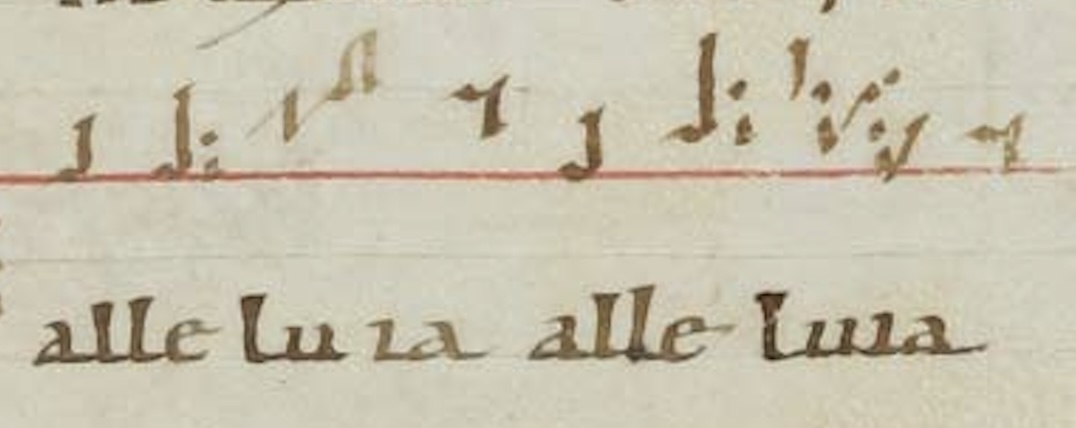
I was just grappling with this recently in a class I was teaching. Attached is the ending of the Easter Day communion ("alleluia, alleluia") in one of the Old Roman sources. Such passages abound in those manuscripts. It's an F-mode melody that repeatedly tops out at B. What could be more "natural" than singing B-flat? But who is to say that that's how anyone did it in Rome in 1071 when Bodmer 74 was written down, not to mention in the seventh century when the melody was presumably composed? Maybe my desire to sing B-flat comes from all the renaissance music I have in my ears all the time, not to mention the more modern things.
Matthew, if you do ask, I would love to hear what the reasoning behind the Nocturnale Project's preferences are on this matter.
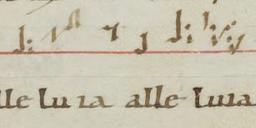 1076 x 428 - 72KThanked by 1CHGiffen
 -
With respect to Matthias’ view in particular: I think that he feels that the flat is better. I noticed that someone who posted O Sapientia from the Liber had a French edition (the 800, in other words) where the flat was accidentally left out, and I mentioned its omission in the monastic books, at which Matthias pointed out that in fact the new books have a flat, and he seemed disappointed that the AM1934 doesn’t have flats where the Roman does.
So I will ask if Dominque Crochu has an elaborate view in particular.
And I had to reread things again. I wonder what the principal editor of the new(-er, at this point) volume of the modern AR from Solesmes feels insofar as I assume it matches the revised LH (I hope it does anyway). And that would signal some internal discussion at Solesmes has occurred regarding these things. -
What does "Una nota super la semper est canendum fa" mean?
-
It refers to the old solfège system, in which the scale contained six notes: C do D re E mi F fa G sol a la [do was originally ut but that's irrelevant to this explanation]. The scale is also replicated on G: G do a re b mi c fa d sol e la. So every half step in this system is between mi and fa. The two scales overlap at G and a: G is both sol and do, while a is both la and re. If you are singing a melody with a wide range, you switch scales on these overlapping notes; switching scales is called mutation. In singing polyphony, a rule developed where in any melody that only goes up to la and one note above, you don't have to make a mutation; rather you sing the top above as only a half step above la and you give it the syllable fa (proper to the upper note of half step): "one note above la is always sung fa (i.e., flat)". What this means for accidentals is that a melody that only goes up to b but not beyond up to c should be sung as b-flat, whther it is notated explicitly or not. It's important for knowing when to apply editorial accidentals in Renaissance polyphony and the like.
If you apply it to chant, it means that figures like the beginning of the introit "Rorate caeli" should have the b-flat in them (in the old system you would solfège do-re-re-la-fa-la for the word "rorate"). The problem is that if you look at the manuscripts, you see that but you also see plenty of instances where the penultimate note of that word is c. There's a pretty wide range of melodic readings in medieval chant manuscripts, and the scale degree between a and c is always a particular point of instability. Hence the need for some kind of system or rubric. The editors of the Vatican edition often favored b-flat if it is used as an upper neighbor note to a. Dom Gajard in editing the AM in the thirties liked b-natural in general. More recent editors seem to have gone back the other way. Hence the discrepancies you pointed out in the original post. There is no easy answer for this, I think. -
In the Vatican edition, it also seems that if there’s a flat, it is ascending far more often than not. This is not to say that there are no flats when the melody descends; the flat below the staff — for which Guido’s hand doesn’t account in the first place — in the responsory Subvenite or the introit Dicit Dominus are a good example, but I know that there are a few in the Mass propers coming from Do or even Re when Do is on the third or fourth line as usual.
Not are these ascending notes always flat. In mode VIII you frequently have naturals, and in some cases (many mode VIII tracts, mode II graduals) they are flat and then natural in the same incise or member, both ascending, without the note being used going down in the meantime.
The instability and a perhaps implicit recognition that on the one hand a half step (whether it’s Mi-Fa, La-Si flat, or Si-Do) is a half step but on the other hand the pull is different causes an occasional issue when chanting; the natural is somewhat unexpected, and you have to force yourself to reach the natural and then Do; it feels the same yet different from Re-Mi-Fa. Perhaps because Do is essentially a structural note [if I’m using that right] as it is where the clef actually lies, where it is a center but not the center (that’s still the mode’s final to me); in any case, I am starting to understand the hard (durum) or even just our sharp language and molle and flat (and I don’t know about other Romance languages but French still cuts to the chase: the words merged to form bémol but it’s said exactly like B mol like how we would say B flat).
From a purely aesthetic POV, given that I sing from the Solesmes editions for the ancient rite, I cannot be inclined to give (almost) every B a flat, because I would not be used to it, but I agree with Matthias Bry that the flat is lacking in the monastic office where it is present in the Roman. I’m glad that the monastic use retained the Roman gradual with supplements.
I don’t know how one could easily indicate which flats should more often than not be natural or even vice-versa according to an editorial preference based on one’s understanding of sources. In other words how do you make an edition that would accommodate both camps if such is even possible or desirable ? -
From a purely aesthetic POV
In the imperfect world in which we live, best rule is to pick one and enjoy it. -
I personally am of the opinion that since the Liber is the official edition- just stick with that version.
-
If the CMAA has been praying for the next William Mahrt, I think they have found him in Charles Weaver. Ille est vox clamantis in deserto musico. Charlie, you have an artful way of communicating erudite information to all of us. Thank you!Thanked by 1CHGiffen
-
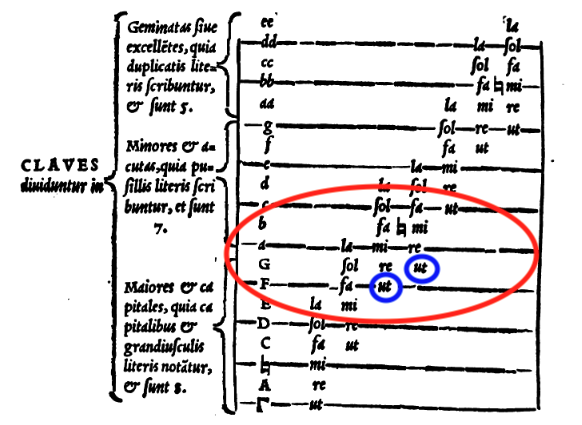
In addition to the explanations by @Charles_Weaver, let me explain why B flat is called "Fa" and B natural is called "Mi" in hexachord terminology.
If you look at the attached figure from Finck's "Musica practica" (1556) with the (modern!) note names in the left column and the hexachord solmisations on the right, you will notice that there were two starting points for the hexachord mutation: one on F and one on G. If you start the new hexachord on F, B becomes Fa and requires a flat, whereas, when starting on G, it becomes Mi and is natural.
Thereby the solmisation of each note was ambiguous and dependent on the context. Incidentally, notes were also identified by their possible solmisations, e.g. G = "sol re ut" or c = "sol fa ut".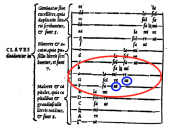 582 x 425 - 107K


Welcome to the MusicaSacra Forum!
To participate in the discussions on Catholic church music, sign in or register as a forum member, The forum is a project of the Church Music Association of America.
Categories
- All Discussions21,838
- General Music Discussion8,544
- Job Openings292
- Management of Music Programs862
- Choral Matters539
- Church Documents and Rubrics540
- CMAA Notes307
- Events760
- For Newcomers: Read First26
- Sacred Polyphony567
- Hymnody898
- Gregorian Chant: General2,749
- ↳ Graduale Romanum and Liber Usualis372
- ↳ Graduale Simplex61
- ↳ Semiology65
- Vernacular Plainsong704
- Anglican Use and Anglican Chant73
- Organ, Other Instruments and Repertoire451
- New Composition/Works in Progress1,341
- Recordings238
- Music for Hispanic Ministry163
- Music Education: Children217
- Music Education: General223
- News Items247
- Positions Wanted3
- General Discussion: Catholicism742
- Amusements185
- General Discussion1,048
- Opinions119