
Hodie: Pronunciation of (arch)ANgeli ?
-
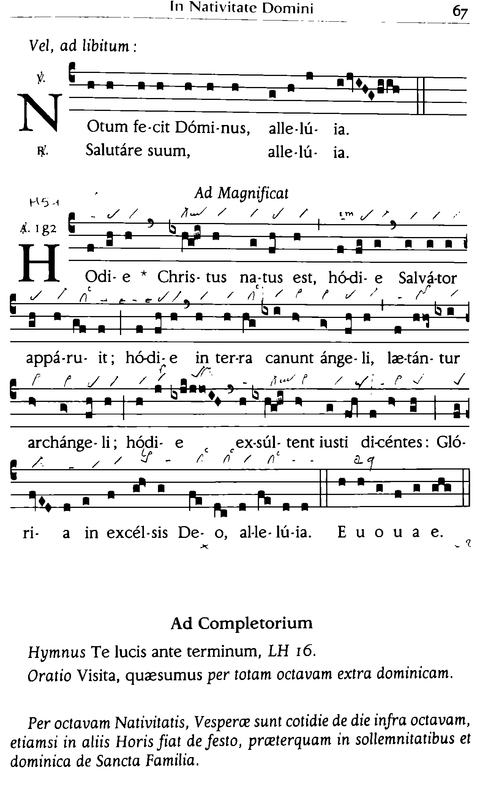
We're preparing the Hodie Christus Natus Est for Christmas.
As written, and sung the downward inflection on the 'ge' of 'An-GE-e-li' and 'Arch-an-GE-e-li' makes it sound uncomfortably to my English-speaking ears as if we're singing about jelly.
Would it be a violation of a thousand years of practice to rephrase that as 'ca-a-nunt AN-ge-li' to put the stress on 'An'; and '-tur A-arch-AN-ge-li' similarly?
It's not specifically mentioned in the Gregorian Musical Values PDF.
Maybe I'm running into a question of Italianate Ecclesiastical Latin versus Classical Latin.
-
Text stress is on first syllable of Angeli. Musical stress is on the second syllable “ge.” The two stresses are in tension, which is one of the advertised features of Solesmes chant.
I would teach my choir to be aware of the tension, but to sing into the text stress and de-emphasize the musical stress so as to not make it sound like they are putting the emPHAsis on the wrong sylLABle. -
Even if you’re not doing Solesmes (or rather Mocquereau in particular) I think that the above idea is a Very Bad Idea.Thanked by 1tomjaw
-
Thanks, @davido, I was not aware of that intentional tension. I'll do as you say.
Although I should not be surprised, I'm currently setting a 19c. poem to a 20c. piano piece without doing too much damage to either and the word stresses can be a bit ... offbeat.
-
I think of tension between word stress and musical stress as an artistic opportunity.
I like davido's answer but personally I don't solve in favour of the word stress in every case. -
When I sing it I don’t hear anything about “jelly”. Perhaps this is more about how you’re singing your Latin vowels?
-
The problem is that there is no way to know from the Vatican edition or the Liber Usualis that An- is notated with a cephalicus in the manuscript and should have the same duration as the pes of -ge-. If you're using the 1934 Antiphonale Monasticum or one of the newer (21st-century) Solesmes editions, you at least have a chance because you can tell that it's an "augmentative" (to use Cardine's terminology) unison cephalicus without referring to another edition, but the classic Solesmes method treats it as a short note, which cannot get the ictus as it precedes a two-note compound neume, and that would result in a syncopated compound beat. Of course all of that is 19th-century theory with no basis in the oldest sources.
Here is my attempt at a literal version based on Hartker and the 2005 Antiphonale Monasticum I: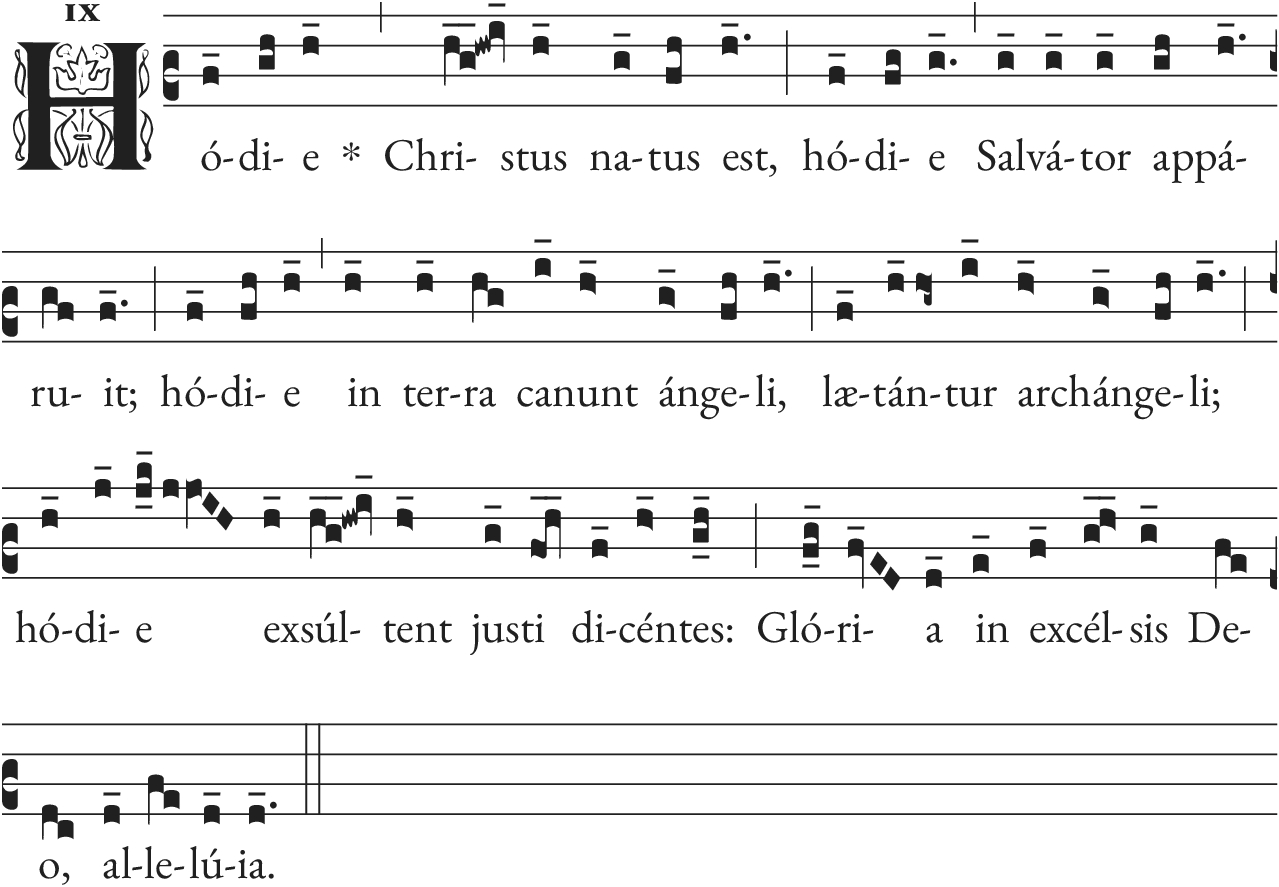
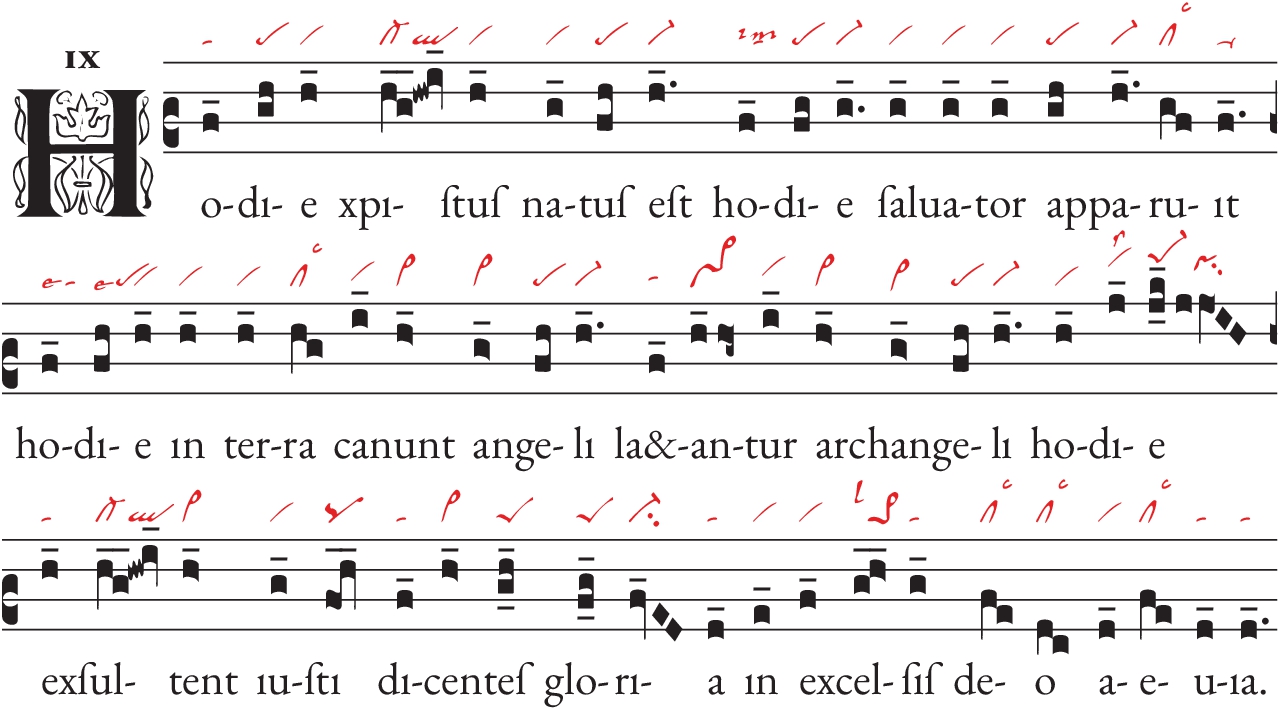
They use the B-flat throughout, even at the hodie before exsultent, so I have situated it as mode IX, Aeolian, since the characteristic raised sixth of the Dorian mode is absent. See also Jan van Biezen's edition. Although not an exact match, this recording by Cappella Romana is worth a listen. -
although there are examples of a final note of a compound beat with the episema, maybe in a ternary group only, in later Solesmes editions, so…
As to the flat, I was told today that Daniel Saulnier's antiphonal (and I presume that it's a scan of his Antiphonale found at Gregobase, since the adiastematic neumes are written in) adds flats back to chants such as the O antiphons where Mocquereau et al. felt that they were later developments and had removed them in the monastic antiphonal of 1934, and so they are in the AM of the 2000s and in the modern AR as well. So although Saulnier is no longer here to explain things, and Solesmes has since seemingly moved away both from him and Cardine (in part, not in whole I would say…), I wonder if this is a peculiarity of Saulnier's interpretation more than anything. -
It looks like Dr. Schaefer's edition is the same except that for that one B-natural and the notes at Glo-.
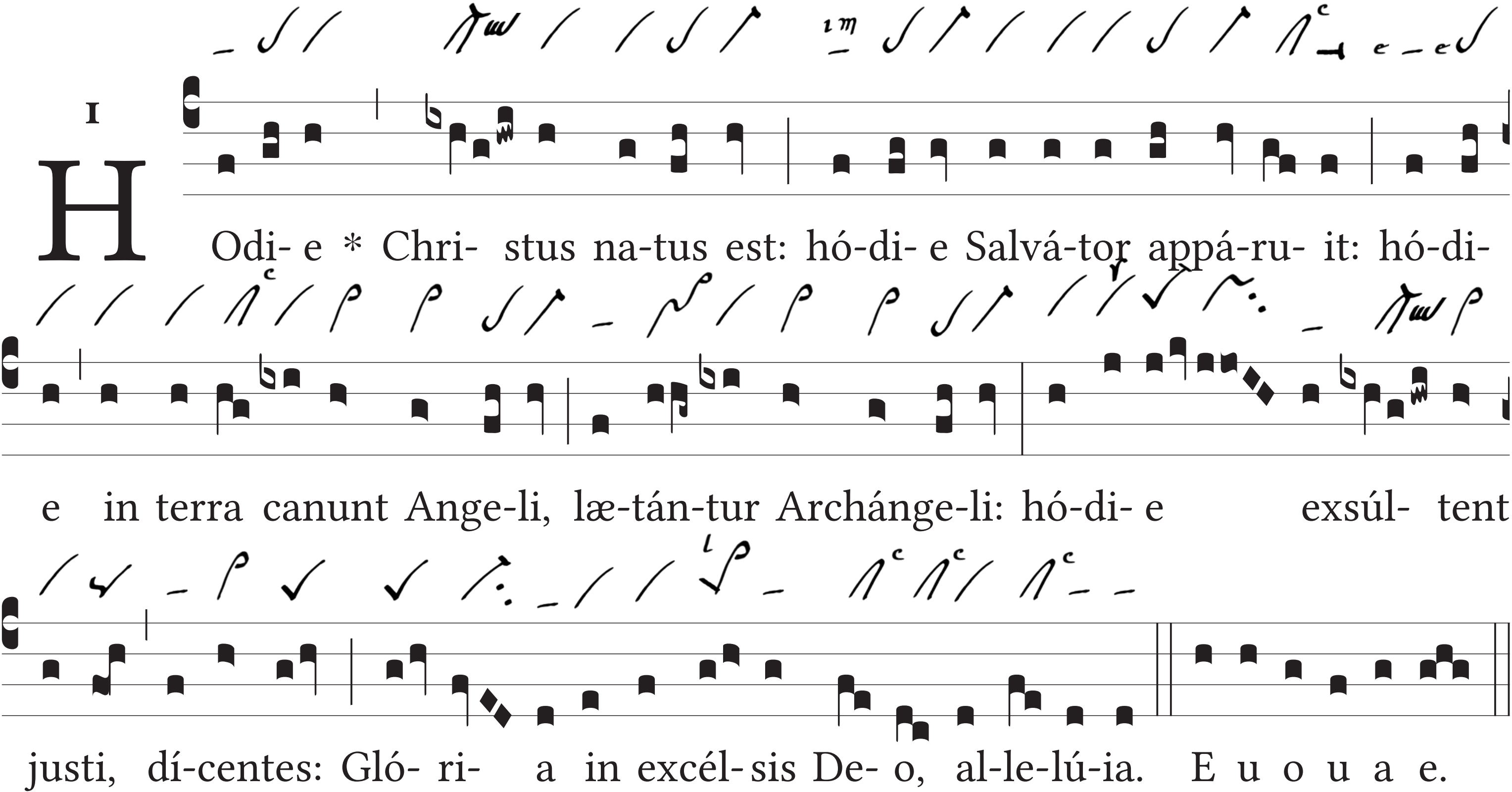
 3055 x 1600 - 494K
 -
I am again reminded that in actual practice (and it is less obvious perhaps because the monastic editions sometimes deviate substantially from the Roman) you can essentially achieve this with a Solesmes edition, you just have to know what to do, slash by listening you get a sense of what has dots and episemata that maybe should have had different note heads instead, had Mocquereau gotten his way in 1906 instead of whoever decided on the notation of the official editions.
Other than repercussions (which aren’t forbidden by Mocquereau, and I know Mocquereau followers who do them!) that chant is in the ballpark of what I would sing normally. The salicus is another matter, but Dr. Schaefer’s notation is also familiar at least (I really respect what Matthias Bry is doing with the new Nocturnale Romanum, but one could balk at the amount of new note forms in one shot.)
Honestly if I had two wishes it would be the 1930s version of the Graduale Romanum from Solesmes in duplex form (SG) and then an original 1949 Liber antiphonarius also in duplex form. I’d be very happy to sing that way more consistently.Thanked by 1Andrew_Malton -
You know about the Graduel neumé, right?the 1930s version of the Graduale Romanum from Solesmes in duplex form (SG) -
Of course, I just need my own clean copy…
-
@sponsachristi do you mean that we should be singing gé (jay) rather than ge (jeh) ?
I'm staggered by the scholarship on display in this forum, (and eg the other thread on the Picardy ending) it's a great learning experience for an amateur to pick up details from the professionals, even if much goes over my head.
About the natural B in the third 'hodie' - I picture that, in a piece with B flats that sounds to modern ears as the key of F, as a brief burst of the dominant C major descending scale, like a flash of a star, before we return to earth with Bbs in the exsultet. (I'm allowed a little imagination, right :) ?)
-
It’s tough. A consonant-vowel here leads to /e/ but that often becomes a diphthong or otherwise unstable, and the second vowel that you list is also a legitimate variation in this same position (it happens in French a lot for example), one that might be easier to sing well.Thanked by 1probe
-
I think of it as forming the mouth as if to say "ay" but avoiding the diphthong. It's brighter, more open, than "eh".Thanked by 1probe
Welcome to the MusicaSacra Forum!
To participate in the discussions on Catholic church music, sign in or register as a forum member, The forum is a project of the Church Music Association of America.
Categories
- All Discussions21,844
- General Music Discussion8,548
- Job Openings292
- Management of Music Programs862
- Choral Matters539
- Church Documents and Rubrics540
- CMAA Notes307
- Events760
- For Newcomers: Read First26
- Sacred Polyphony567
- Hymnody898
- Gregorian Chant: General2,749
- ↳ Graduale Romanum and Liber Usualis372
- ↳ Graduale Simplex61
- ↳ Semiology65
- Vernacular Plainsong704
- Anglican Use and Anglican Chant73
- Organ, Other Instruments and Repertoire452
- New Composition/Works in Progress1,342
- Recordings238
- Music for Hispanic Ministry163
- Music Education: Children217
- Music Education: General223
- News Items247
- Positions Wanted3
- General Discussion: Catholicism742
- Amusements185
- General Discussion1,048
- Opinions119