
We need better (i.e. Catholic) Communion Hymns
-
I always thought many communion hymns found in OCP’s hymnals were a little bit too much on the “table” and “bread and wine” symbolic side, and not really on the transubstantiation side of things.
This past week I found myself in a Presbyterian place of worship for a relocated choir rehearsal. I was perusing through their hymnal only to find that a) they changed their Apostles Creed and removed all the male pronouns for God and made Him gender neutral*, and b) many of their communion hymns were the same hymns from OCP that have theologically unsound text for Catholic theology on communion and the Mass itself. Sacrifices happen on altars, not tables. The only table that was ever referred to in Catholic tradition was the communion rail that separated the Sanctuary (which represents Heaven) from the nave (which represents the Church on Earth) where our Lord comes to the laity to give himself them to them in communion.
Unfortunately, the “Spirit of Vatican II” caused changes to be made that were never called for, which over time watered down the faith that was being passed down to the point where not many people believe that Jesus is truly present, body, blood, soul and divinity in the tiniest fragment of communion. Unfortunately, many of our English Catholic communion hymns are sorely deficient, and apparently Latin is too hard and “inaccessible”. The manner in which we receive communion and speak about it strongly resembles that of Protestants who do not believe what we believe. Lex orandi, lex credendi, lex vivendi.
*OCP has started doing this as well, btw. Sing a New Song was changed from, “ O come before the Lord And play for him on glad tambourines” to “O come before the Lord. And play for God on glad tambourines.” If God isn’t masculine then the Bible is completely wrong; the story of salvation is completely wrong; it’s all wrong.Thanked by 1canadash -
I would like to come before the Lord and smash the tambourine. Could throw in a couple of lightning bolts toward the guitarists, as well.
When I played for many years, it was a struggle to find decent communion hymns. They were, by and large, dreadful. I ended up having the choir/cantor chant the communion proper for the day then singing a shortened version of some of the hymns. I used the same hymns far too often when I did find an acceptable one.Thanked by 1ServiamScores -
My congregation is actually currently working on a hymn book with hymns in basically every language written by our religious written around the word "transubstantiation". Im not sure when it would come out, but it is a project.Thanked by 1ServiamScores
-
Well, what might be labeled as "communion hymns" in a hymnal or index should not be thought of a what "communion hymn" texts are necessarily about. If you think a communion hymn is necessarily about teaching sacramental theology on the one hand or singing around the meal table on the other hand, then the compass will be limited ... by that hand.
The Magnificat in its myriad guises and inspired derivatives is the model of a quintessential communion hymn: proclaiming and praising the loving-kindness of God for the gift of receiving his self-gift, and remembering God's many mercies to his people. Many communion antiphons (in the Missal or in the Gradual) take up this register and ambit of theme, even without any express mention of Eucharistic species.
Here's just one example of a non-Magnificat text that in some ways is inspired by it and that would be suitable as a communion hymn - but is very unlikely to be indexed as such: My Song Is Love Unknown. -
OCP has started doing this as well, btw.
OCP has been doing that for years (perhaps at the initiative of the composers), notably to several of the St. Louis Jesuits and Mr. Gregory Norbet "hymns." Ditto the others of the former Big Three (WLP, GIA). Check out Omer Westendorf's texts from 1960s editions and compare with today's. The liturgical music grift is controlled by modernists. -
Your observations are accurate. And OCP is anathema to me. But looking outside the hymnal-industrial complex, we Catholics do have good hymns for Communion. To name a few:
Adoro te devote / Humbly We Adore Thee / Godhead Here in Hiding
Soul of My Savior
O Jesus, We Adore Thee
Let All Mortal Flesh Keep Silence
Jesus, My Lord, My God, My All
Various settings of Pange Lingua
Et. al. And as others have mentioned, a hymn sung at Communion need not always be an explicit exposition of Eucharistic theology (though it certainly should not exhibit any poor Eucharistic theology!). Taking our cues from the proper antiphon might suggest other appropriate topics for a hymn at Communion.
I tend to rotate through those as Communion Hymns following the proper antiphon. Once in a while we throw in a polyphonic motet. Lots of good options with solid Eucharistic theology if you’re willing to eschew the novelty of needing something new and different every single week. Also nothing wrong with skipping a Communion hymn altogether if you sing the antiphon. Follow it with a choral motet or fitting organ piece or improv. I know many disagree, but I’m not a huge fan of congregational singing at Communion anyway. On the rare occasions I assist at Mass with no official musical role, I’d much rather a meditative Communion of *interior* active participation, rather than receiving Our Lord and immediately moving on to more “doing.”Thanked by 1DavidOLGC -
How about checking out the psalms in the Simplex that can be used for communion on any day and then finding some metrical settings of the same, like the Genevan psalter?
-
Sounds like you are limited by your (OCP) hymnal resource?
There exist lots of good hymns for communion, the problem usually is that congregations don’t know them and/or directors don’t have a way of putting the music in the hands of the congregation.
Some examples which you can research on the internet:
O food of exiles lowly
Hail true body, life and light
Let thy blood in mercy poured
Deck thyself my soul with gladness
Jesus, food of angels
Jesus, priest and victim
O bread of heaven
I living bread from heaven -
Some more (sorry if I'm repeating some)
At the Lamb's High Feast
Bread of Heaven on Thee We Feed
Come, Risen Lord and Deign to be Our Guest
Draw Near and Take the Body of Thy Lord
Humbly We Adore Thee
O Food of Travelers, Angels' Bread
O Jesus, Joy of Loving Hearts
What Shall I Render to the Lord
Praise to the Holiest in the Height
There are SO MANY translations and versions of Anima Christe. And once you sing it in English, sticking Latin in there isn't hard (I just tell them they already know the words). -
--Father, we thank Thee who hast planted
--O Sacrum convivium
--And the other hymns mentioned above, all which don't involve incessantly repeating short, trite refrains! -
When I started singing gregorian Communions we did a post-communion hymn when everyone had recieved and was within reach of a hymnal. We almost never get to it now, though I still list one in the bulletin. So maybe we don't actually need Communion Hymns at all.
-
Ave Verum (and translations)
O Esca Viatorum (and translations)
Sweet Sacrament Divine
O Jesus Christ Remember
Where There is Love and Loving Kindness (Knox)
Jesus, Gentlest Savior
O Lord, I am Not Worthy -
Sort of a side note (and not to take away from your point about the one-sided nature of a lot of post Conciliar hymn for communion), but the term "table" has a very well-established place in the Catholic tradition as a name for the place where Christ's body and blood are consecrated and offered. Mensa is the standard term for the top of the altar. Augustine referred to the Eucharist as sacramentum mensae Dominicae (Serm. 227). In the liturgy, the Corpus Christi sequence refers several times to the altar as a table:The only table that was ever referred to in Catholic tradition was the communion rail that separated the Sanctuary (which represents Heaven) from the nave (which represents the Church on Earth) where our Lord comes to the laity to give himself them to them in communion.
Dies enim solemnis agitur,
in qua mensae prima recolitur
huius institutio.
In hac mensa novi regis,
novum Pascha novae legis,
phase vetus terminat.
Plus, the Eastern Churches commonly refer to their altars as "the holy table" and I don't think we have any real disagreement with them on eucharistic theology. -
While not all altars perjoratively referred to as a Cranmer table are so (today I saw this in reference to a Baroque altar placed in front of another Baroque altar…), his insistance on a table and then the same after 1970 in too many places rules out “table” for Latin discourse I think.
-
At this juncture, I can safely assume none of us uses "Tableprayer" by Jan Michael Joncas. :)
-
My concern with communion hymns is that they’re not historically a ‘thing’.
The solemn form of the Roman Rite had a commmunio with a psalm. There appear to be some isolated historical examples of true communion hymns (eg. ‘draw nigh and take’) in related Western rites but not actual hymns for the communion rite itself. Even the feast of Corpus Christi (where one might expect such a thing) does not have it. The great Eucharistic hymns of that feast are the sequence and the office hymns.
Taking broadly Eucharistic hymns and using them at communion carries with them the risk of potentially contemplating the Blessed Sacrament for the purposes of adoration rather than for the purposes of the reception. The forms of interior disposition are related but different.
It seems to me that the two great Eucharistic ‘hymns’ are the Sanctus and Agnus Dei.
That then leaves us in the territory of devotional prayers set as hymns for other material (eg. Anima Christi).
It’s ironic that Schmucke Dich made one of the lists above - it’s lovely, but I thought Lutheran… unless anyone knows of a pre-Reformation precedent that was repurposed?
A vexed question… are we attempting to retrofit things to the rite that have never belonged there?
-
My concern with communion hymns is that they’re not historically a ‘thing’.
Technically neither is The congregation receiving communion at Mass. it’s relatively a new thing given how long the church has been around. Ave Verum was at one point long ago sung by the congregation as part of the Mass.
According to the Canadian GIRM, we’re supposed to remain standing after receiving and join in singing the communion hymn as a sign of communion. It’s not personal time with Jesus. Someone wrote Rome and asked for clarification if that prohibits people from kneeling afterwards in prayer. Rome said it did not. Furthermore, long-standing custom has rule of law.
Thanked by 1Abbysmum -
It seems to me that if one wants congregational singing during communion (I am all for it myself), some sort of responsorial psalmody, like the traditional Communio, is the way to go. I know it's not particularly trad, but I've always thought James Moore's "Taste and See" was pretty effective.
I also think it's a shame that more places don't use the option of singing a hymn after communion. Some (not all) of the hymns sung at communion could fit well there. -
I can’t remember where I read it but the Te Deum is highly recommended in some directive… I just can’t remember where.
-
I haven't used a communion hymn in many years. We sing the proper communion antiphon with a corresponding psalm, allowing the people to repeat the (English) antiphon if desired (we use the Source & Summit platform). Occasionally we will sing a post-communion motet or hymn or Marian antiphon. But it's one of my favorite parts of the Mass- having direct Scripture sung during communion while people listen and reflect on the psalms (and can join on antiphon if they want). I don't miss for a second trying to find "good" communion hymns.
-
It seems to me that if one wants congregational singing during communion (I am all for it myself), some sort of responsorial psalmody, like the traditional Communio, is the way to go. I know it's not particularly trad, but I've always thought James Moore's "Taste and See" was pretty effective.
I read a directive somewhere (I can't remember if it was among the CCCB or the USCCB documents) that suggests that Communion hymns should, if possible, have a refrain or something similar for this exact reason. It was hinting at using more modern music with verse/refrain situations, but something from the psalmody would also work very well. -
SponsaChristi - it is correct to say that the congregation receiving communion at Mass is a relatively new thing, but popes and ecumenical councils have been calling for it century after century. For example the Council of Trent in its 22nd session saidChapter VI
On the Mass wherein the Priest alone communicates
The sacred and holy synod would wish indeed that, at each mass, the faithful who are present should communicate, not only in spiritual desire, but also by the sacramental participation of the Eucharist, that thereby a more abundant fruit of this most holy sacrifice might be derived unto them: but nevertheless, if this be not always done, it doth not therefore condemn, as private and unlawful, but approves of, and therefore commends, those masses in which the priest alone communicates sacramentally; since those masses ought also to be considered as truly common; partly because in them the people communicate spiritually; partly also because they are celebrated by a public minister of the Church, not for himself only, but for all the faithful, who appertain to the body of Christ.
On your other point, I can't see this in the Canadian edition of GIRM, can you tell me where to find it, please. Presumably it does not apply at a low Mass, but is a function of the singing -
I'm having trouble finding anything to support the idea of remaining standing after receiving Communion, or insisting on communal song throughout. It does note that singing the Communion Chant together expresses the "spiritual union of the communicants." But it also allows for silence after Communion, and does allow the choir alone to sing during Communion. Perhaps SponsaChristi can shed more light on this. I wonder if it was a more diocese-specific directive, or if there's a separate document/instruction beyond the GIRM that gave that direction? Here's what I found
On silence, from the Canadian edition of the GIRM:45. Sacred silence also, as part of the celebration, is to be observed at the designated times. Its nature, however, depends on the moment when it occurs in the different parts of the celebration. For in the Penitential Act and again after the invitation to pray, individuals recollect themselves; whereas after a reading or after the Homily, all meditate briefly on what they have heard; then after Communion, they praise God in their hearts and pray to him.
And later on music at Communion:86. While the Priest is receiving the Sacrament, the Communion Chant is begun, its purpose being to express the spiritual union of the communicants by means of the unity of their voices, to show gladness of heart, and to bring out more clearly the “communitarian” character of the procession to receive the Eucharist. The singing is prolonged for as long as the Sacrament is being administered to the faithful. However, if there is to be a hymn after Communion, the Communion Chant should be ended in a timely manner.
Care should be taken that singers, too, can receive Communion with ease.
87. In the dioceses of Canada singing at Communion may be chosen from among the
following: the antiphon from the Graduale Romanum, with or without the Psalm, or the
antiphon with Psalm from the Graduale Simplex, or some other suitable liturgical chant
approved by the Conference of Bishops of Canada. This is sung either by the choir alone
or by the choir or a cantor with the people. However, if there is no singing, the antiphon given in the Missal may be recited either by the faithful, or by some of them, or by a reader; otherwise, it is recited by the Priest himself after he has received Communion and before he distributes Communion to the faithful.
-
I am not sure if this warrants its own thread, but if the gist of the music at Communion should be praise for God's gift (e.g. _par excellence_, the Magnificat), what is the gist of the Offertory music? Does it depend on the week, based on the chant (e.g., how does that passage from Job fit thematically with any other Offertory chant?), or are there general principles that can assist in the selection of Offertory music?
-
GIRM 87-88, and also rubric 138 in the Order of Mass (both US and CAN) speak of the communion antiphon, not a hymn, but say a chant, psalm, or hymn of thanksgiving may follow Communion when the celebrant returns to his chair.
-
It’s not personal time with Jesus.
Last supper…
Judas…
“Hey John…. What are you doing!? This is not a personal time with Jesus! This is a time to get together with us and make plans for what is going down in the next few days!
Jesus looking over at Judas and thinking to himself…
“(o jeez, Judas… I am God, sitting here right next to you and you still don’t get it, do you?)”
A few days later…
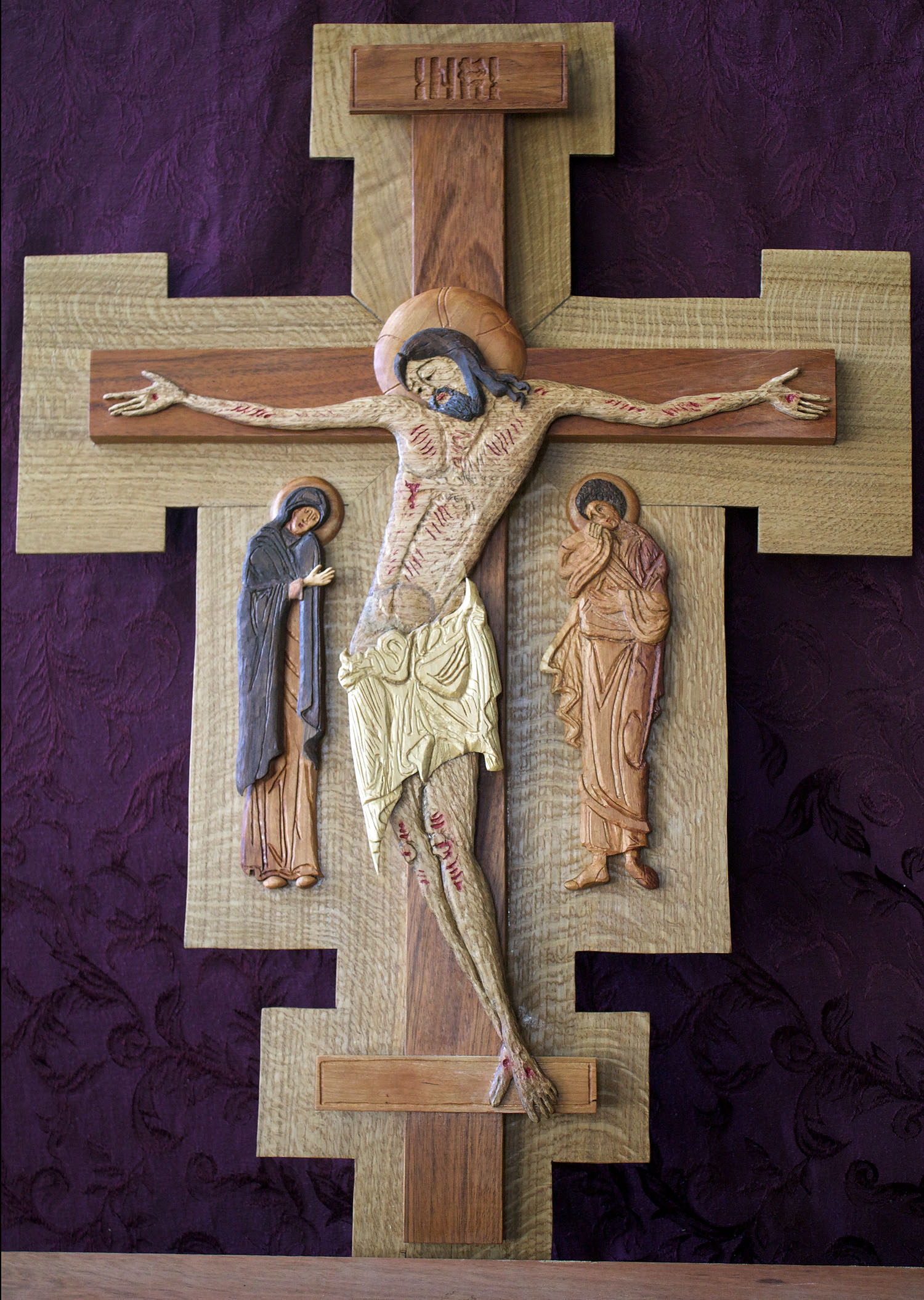
Judas commits suicide and John stands at the foot of the cross. 1500 x 2110 - 576K
 -
I can't think of a better time to have personal time with Jesus. When else are you going to have Him physically in you?
-
are there general principles that can assist in the selection of Offertory music?
As far as I can tell, the answer is "no." The chant in the Gradual seems almost never to have anything to do with offering, so there is no need to sing something like "Take Our Bread" or "Accept, Almighty Father." I would say that, if you are not using the official chant, it's a good time to have something sung (either by congregation of choir) that's is simply a good piece of music (a shocking notion, I know). -
are there general principles that can assist in the selection of Offertory music?
I'm not proposing these as principles exactly, but:
- We always do the Offertory proper first, and if there's time I add a hymn
- I would not sing something explicitly eucharistic during the Offertory, such as O Sacrum Convivium or Adoro Te Devote or Adoremus in Aeternum
- I tend to place music of a more rousing nature at the Offertory, and of a more peaceful nature after Communion
- I tend to prefer Marian hymns and motets at the Offertory, with the caveats that some seemingly 'Marian' texts are equally as or even more appropriate after Communion, and many hymns and motets about Our Lord are perfectly good at the Offertory spot
- If it's the feast of a saint and I have music about that saint I would most likely put that at the Offertory, e.g. Te Joseph Celebrent or Ave Mater Matris Dei (or if it's in the vernacular, as an entrance or exit hymn - I direct at a TLM)Thanked by 1ServiamScores -
I'm having trouble finding anything to support the idea of remaining standing after receiving Communion, or insisting on communal song throughout. It does note that singing the Communion Chant together expresses the "spiritual union of the communicants." But it also allows for silence after Communion, and does allow the choir alone to sing during Communion. Perhaps SponsaChristi can shed more light on this. I wonder if it was a more diocese-specific directive, or if there's a separate document/instruction beyond the GIRM that gave that direction?
Back when the new GIRM and corrected translation of the RM came out I remember seeing numerous Canadian Dioceses putting out documents saying such. It came to mind again recently when this short showed up on my YouTube page: https://youtube.com/shorts/OGrrzTSyIvM?si=gZ_AbatkCcnLC8zf
My own diocese still puts in Diocesan Mass worship aids instructions for the congregation to remain standing after receiving communion, “if [they] are able”. My conscience doesn’t allow me to remain standing after receiving Our Lord and just ignore that for the next 15 minutes or so until the host is completely broken down, I am, for all intents and purposes, a tabernacle with our Lord physical dwelling inside. I spend the time trying to commune with our Lord. Unfortunately, I get distracted easily by immodestly/sloppily dressed men and women walking past me, receiving irreverently, or people who don’t consume the host.I tend to place music of a more rousing nature at the Offertory
May I ask why? It is a time for everyone to internally re-orient themselves, internally make their own Mass offering, and dig through their purse for their money/envelope while the usher is sticking a basket in front of you waiting for your money.
I need all the help I can get to stay focused during the Offertory. They sang the actual full Latin Chant Offertory during the Offertory at an ordination Mass and for the first time I was actually able to re-orient myself and make my Mass offering and remain focused after getting so frustrated with the Protestant organist whose playing was so distracting (weird and dissonant modulations, harsh sounding registrations, loud at random and inappropriate times), even the bishop started looking annoyed at him and rolled his eyes a few times.
Thanked by 1a_f_hawkins -
I mostly agree with how Chant Supremacist would do things. That’s pretty sound, though I would put a hymn (polyphonic, harmonized, just chant) at communion in order to do it justice. I don’t have a real preference for Marian pieces in one spot or the other, but a polyphonic Marian antiphon line Palestrina’s Regina Caeli fit better at communion to me.
We’re returning to familiar favorites (and some of our bunch are discovering!!) the Palestrina Sicut Cervus and Byrd Ave Verum on Sat. If we prepared instead Victoria’s O Quam gloriosum I’d move Palestrina to communion, perhaps (or I wouldn’t care too much one way or the other).Thanked by 1Chant_Supremacist -
Back when the new GIRM and corrected translation of the RM came out I remember seeing numerous Canadian Dioceses putting out documents saying such.
I seem to remember that being the case as well. It's a Diocesan directive. not part of the GIRM. When we travel, we'll go to Mass wherever we are across Canada, and I swear every diocese does the stand/sit/kneel combo differently from the Preface until after Communion.Thanked by 1a_f_hawkins -
When in doubt, always look to the assigned proper, even if you're not using it. Most propers have a motet (or two, or three) set by famous composers. Is there a hymn that touches on the same scripture passage or has a similar emphasis (mercy, judgment, precepts of the Lord, etc.)? Hymnary.org is a great resource for searching for hymn texts based on scripture references. Aristotle Esguerra has his fabulous set of common meter texts where he's troped all the offertoriales into rhyming hymn texts which can be paired with any CM tune. I use these regularly if I don't have another specific hymn that I want to schedule for whatever reason.are there general principles that can assist in the selection of Offertory music?
As a secondary principle, if there's not a good hymn or motet for the specific proper, then something that references the Gospel which was just proclaimed is also very welcome. I regularly schedule offertory hymns (often by Watts or another Anglo poet) which are, again, poetic renderings of scripture. It can be very enriching to hear a gospel passage, and then sing about it a few minutes later which reinforces what was proclaimed, and then often adds a prayer component.
(I'll grant that this approach presupposes the option of using a worship aid. Mercifully, I have this flexibility. While it is a TON of work, it is also very rewarding.)Thanked by 1Chant_Supremacist -
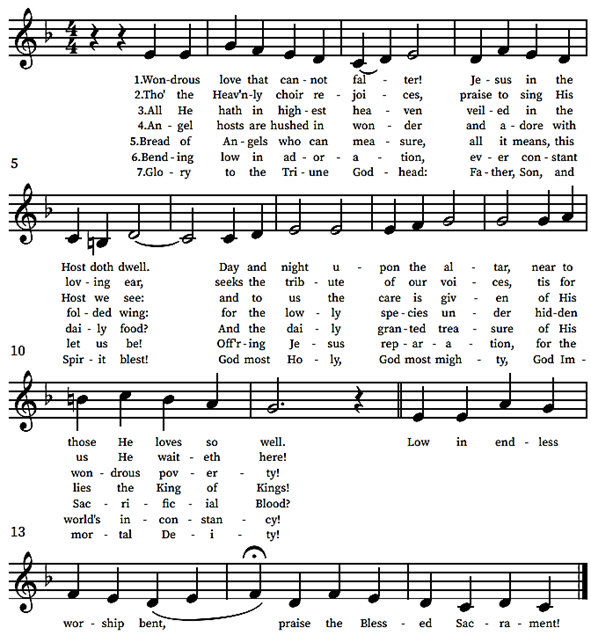
As for communion hymns, one text that I've absolutely fallen in love with is Wondrous Love That Cannot Falter. It is a difficult meter, so I've paired it with IRBY. This will be positively anathema to many, but it's one of the only tunes that most people will even remotely recognize, and since it is otherwise only sung once per year, it seemed fitting to breathe new life into the tune. You may take it or leave it, but our parish has grown to sing it well. At the bare minimum, perhaps the text will spur you on to better pairings. It's a text that is very much worth singing.
-
I would not worry about IRBY being paired with another text being a problem in American Catholic churches: Once In Royal David's City - while a fixture of English choral Christmas albums and a fixture in the broader Anglican Communion as a result - is, I think it's fair to say, not widely sung in American Catholic churches (the musicians are much more likely to know it than the PIPs, and musician enthusiasms are not relevant in this regard), and it's a seasonal text from the shortest liturgical season of the entire year.
Go for it. If anyone gives you shade over it and that person is not your pastor - ignore them.
It's nothing like setting a new text to STILLE NACHT.... -
@ServiamScores funny enough I did the same thing, I matched that text to a beloved Italian Hymn Melody.
 591 x 635 - 167K
 -
To date, it's really only one musician friend (who used to be an Anglican organ scholar) that's given me any grief over it, and even then, it was mostly in jest. He knows who he is, and he will read this. lol
Ironically, the other reason I picked this tune was because it was also a way to teach people the melody so that they would be ready when OIRDC rolled around on Christmas Eve. -
SS
That is a perfectly *EXCELLENT* reason and purpose to do this. (Loud applause.) I wish more people would consider this tactic for introducing tunes this way. -
@SponsaChristi
There is a beautiful selection of communion hymns over at The Devotional Hymns Project website: https://www.catholicdevotionalhymns.com/song-index/
Really no need to invent anything new, there is something for everyone on the website. You can also visit my website https://www.motherofmercycatholichymns.com/hymn-of-the-month/
I have written about a number of very good communion hymns.
About the only way I know to get away from OCP stuff is to try and convince your pastor that many of the hymns are not suited to the NO or TLM. They don't teach us about our Catholic faith nor do they remind us of our Catechism.
If you are using the Breaking Bread edition, I went through and picked about 90 or so hymns that are more inline with the musical traditions at my parish of St. Mary's in Akron, Ohio. I called it OCP Song List for St. Mary's. However, I was not succesful in getting our organist to use it. So, after 48 years in the choir, I deciced to step down. I just can't continue to sing some of the stuff that is being recommended by the OCP Liturgy guide and working with an organist who is not liturgically minded or willing to respect the musical traditions of the parish.
I attached the list for whatever good it may offer. It is in Alpha and Numeric order. -
I can’t remember where I read it but the Te Deum is highly recommended in some directive… I just can’t remember where.
I think you might be thinking of Te Laudamus, and I can't remember now where I saw it as a recommended Post Communion Canticle (also Benedictus and Magnificat).
Possibly in the 1967 missal where the English translation of the Canon first appeared.
https://gregorian-chant-hymns.com/hymns-2/te-laudamus.html -
A similar topic came up in September. Paul Ford wroteThe Graduale Simplex offers six post-communion songs of praise and thanksgiving. In addition to the long and short versions of the Te Deum, the Graduale Simplex restores the Te Decet Laus/To You Belongs Our Praise and the Te Laudamus Domine/We Give You Praise from the Ambrosian rite, one of my favorite pieces.
He included this attachment
https://forum.musicasacra.com/forum/uploads/FileUpload/09/e8ce3690578faa1b0028f436f28eb0.pdf
see also
https://gregobase.selapa.net/chant.php?id=4014





Welcome to the MusicaSacra Forum!
To participate in the discussions on Catholic church music, sign in or register as a forum member, The forum is a project of the Church Music Association of America.
Categories
- All Discussions21,839
- General Music Discussion8,545
- Job Openings292
- Management of Music Programs862
- Choral Matters539
- Church Documents and Rubrics540
- CMAA Notes307
- Events760
- For Newcomers: Read First26
- Sacred Polyphony567
- Hymnody898
- Gregorian Chant: General2,749
- ↳ Graduale Romanum and Liber Usualis372
- ↳ Graduale Simplex61
- ↳ Semiology65
- Vernacular Plainsong704
- Anglican Use and Anglican Chant73
- Organ, Other Instruments and Repertoire451
- New Composition/Works in Progress1,341
- Recordings238
- Music for Hispanic Ministry163
- Music Education: Children217
- Music Education: General223
- News Items247
- Positions Wanted3
- General Discussion: Catholicism742
- Amusements185
- General Discussion1,048
- Opinions119