
Gradual before/during Epistle
-
In the English translation of the "Rossini Propers" there is this strange instruction:At the ordinary High Mass (i.e. by one Priest) [the Gradual] is chanted immediately after the Oration (or Orations) preceding the Epistle.
I feel like I seen this elsewhere, in some choir handbook, and was wondering if anyone knows whether this was a usual practice. -
No doubt it was at least in some places… in the Anglosphere before Fortescue wrote ‘Ceremonies’ and dealt with the combination of sloppy translations and outright mistranslations. The preface is worth a read!
-
The quoted text does not mean that the Gradual was followed by the chanted Epistle, but rather, it supposes that the Epistle is read inaudibly, which would have been the usual practice in former decades and familiar to Rossini's readers. Predmore also mentions it. The inaudible epistle reading at a Sung Mass was still the norm in some places in recent years.
-
Now that I think about it, what I read elsewhere was actually about the practice you describe: the epistle read silently while the gradual was sung. This too strikes me as very odd.Thanked by 1Roborgelmeister
-
I think the entire practice of silent recitation of the Epistle and Gospel by the celebrant is absurd: it is a late insertion into the Western rites (foisted upon the Dominicans in the 16th century, for instance). The idea that the practice could have reached a point where the celebrant could have believed it appropriate to recite the epistle sotto voce in the absence of a subdeacon or lector shows such a distorted view of the liturgy that reform of one kind or another was inevitable.
For similar reasons, I get very uncomfortable when the possibility of using pre-1962 rubrics for Mass is mooted, along with reprints of earlier missals. A balanced critique of the reforms between 1900 and 1962 would be far more constructive. Thanks for lifting a corner on this interesting part of liturgical history, fcb and FSSPMusic! -
Further thought: might a history of the liturgy and its reform between 1900 and 1962 be served by a survey of specific abuses that Rome corrected during the period?Thanked by 1a_f_hawkins
-
I see that these guidelines also mention the practice in question:
I don't think the inaudible epistle should be considered an abuse, since there's ambiguity in the rubrics, which direct the priest to read the epistle at Low Mass aloud in an intelligible voice and also direct him to say quietly the words said aloud in Low Mass except the communion of the faithful and the final blessing.However, in the Missa Cantata, the Priest may choose to read the Epistle at the altar during which time the choir begins to sing the chants appointed.General Rubrics:
511. In a low Mass the following are said aloud:
... e) ... the epistle....
513. In a solemn Mass the celebrant:
... c) says aloud the formulas at the communion of the faithful and the words of the blessing at the end of the Mass;
... e) says quietly the other words which are said aloud in a low Mass....
514. In sung Masses, that is, those sung without sacred ministers, the celebrant must observe what has been said in the preceding section, and he must sing the parts proper to the sacred ministers. The epistle may be sung by a lector. If it is not sung by a lector, it will be satisfactory for the celebrant to read it without chant; the celebrant may, however, sing the epistle in the usual way.
Ritus servandus:
VI. 1. Having said the Orations, the Celebrant, with his hands placed on the book or on the Altar, so that the palms touch the book, or (if he prefers) holding the book, reads the Epistle in an intelligible voice....
8. In sung Masses the Epistle may be sung by a minister; otherwise, it suffices that it be read by the Celebrant, who however, may sing it in the usual manner.Thanked by 1tomjaw -
One of the things I think we forget is what role sound amplification plays in our liturgies today. If you are going to be in a vast church without amplification and you are speaking rather than singing, it’s going to be very difficult to be heard. So it makes sense to pray the canon sotto voce when one is facing away from the people and probably won’t be heard anyways.Thanked by 1tomjaw
-
Chanting the lections had a functional role in that regard.Thanked by 1tomjaw
-
I think the entire practice of silent recitation of the Epistle and Gospel by the celebrant is absurd: it is a late insertion into the Western rites (foisted upon the Dominicans in the 16th century, for instance). The idea that the practice could have reached a point where the celebrant could have believed it appropriate to recite the epistle sotto voce in the absence of a subdeacon or lector shows such a distorted view of the liturgy that reform of one kind or another was inevitable.
For similar reasons, I get very uncomfortable when the possibility of using pre-1962 rubrics for Mass is mooted, along with reprints of earlier missals. A balanced critique of the reforms between 1900 and 1962 would be far more constructive
The balanced critique of Holy Week was made in 2009 on NLM. People doubled down, and the libs also acted in bad faith by asking if people were interested in the old Holy Week and the pre-1911 psalter. And then other trads doubled down, not just in defending 1962 but with legal arguments that didn’t acknowledge the problems at all. Of course Scott Reid then went and got an indult for his monastery after having many a hissy fit over this.
You don’t have to like the silent recitation. I do. But you should celebrate the pre-Pius XII missal with integrity if you use it. We can discuss in 2125, maybe, if we should allow for the silent repetition of readings at the altar to be suppressed with those rubrics.
Anyway there are plenty of balanced criticisms. It’s just that the 1960 is that bad: Catholics go eleven or six years without celebrating one an Apostle on Sunday. Meanwhile the pre-55 had two in addition to the lone (double of the) first class feast this year. Before, there was Saint James in 2021, Saints Philip and James in 2022… and you get I Vespers of feasts moved to Monday (not done in 1960, but done semi-regularly for Saint
Matthias due to the gesimas, this year for Saint Andrew). But criticizing that in those terms (it’s pure facts, without editorial commentary after the colon) draws out the ire of certain people, either because they prefer 1960 or because they think that this isn’t the hill to die on (that it’s still 1975 and that the SSPX line on doctrine is the only one to take).
As to the point: I think they misinterpreted the euphemism for recto tono. There are all sorts of things where the meaning can’t possibly be read aloud but a verb that would not translate to sing or to chant is used.Thanked by 1tomjaw -
Matthew, could you expand a bit on your last point? Are you saying that those who recited the Epistle quietly during the gradual had misinterpreted the rubric?
-
Yes. I believe that is the case. I would have to read the Latin to confirm. But when you read about other things which are prayed sine cantu or recitatur or dicitur it can’t be taken to mean “read out loud or whispered”. The Christus factus est is a good example. It’s sung with the chant melody at Tenebrae. It is not sung with its full melody at the other hours. But it is obviously not read aloud.
I concede the ambiguity, because they go from low to sung Mass a bit haphazardly (all in trying to make sung Mass a distinct rubrical category) but I think that the point is that the celebrant may sing the epistle in all cases without the chant tone which is ordinarily required of the subdeacon (there are a few cases where he — customarily or otherwise — doesn’t use it but normally it’s expected to be used).
It could also be that I’m right about the meaning but they read the epistle anyway as if it were the priest duplicating it at the altar all while the gradual was sung. But I can’t see how liturgical abuse became so widespread. Even so, if I’m wrong, I believe that not waiting to finish the reading is an abuse.
Anyway Stercky (1935) does not mention the celebrant reading the epistle. (What occurs to me is that before the indult days, the missal was often moved at sung or solemn Masses before the silent gospel or, at sung Mass, the only one.)
O’Connell apparently takes the opposite position of mine for the 1962 (that is, the priest may read the epistle in a speaking voice) but the MC is to say “Deo gratias” only if the epistle was simply read, whereas the ICRSP priests had me recite that quietly in all cases including when the epistle was sung in any manner by the celebrant.Thanked by 1tomjaw -
Scribatur Em~o Patriarchae Lisbonensi ad mentem. Et mens est : Quod quum Missa cantetur sine Ministris et nullus sit Clericus inserviens qui superpelliceo indutus Epistolam decantet iuxta Rubricas, satius erit quod ipsa Epistola legatur sine cantu ab ipso Celebrante : nunquam vero in Ecclesiis Monialium decantetur ab una ex ipsis. (S.R.C. 3350, Apr. 23, 1875)Quod si non cantetur a lectore, satius erit quod legatur sine cantu ab ipso celebrante, qui tamen potest Epistolam more solito cantare. (514)
The ad libitum epistle tone is widely used but can't by any means be said to be "ordinarily required of the subdeacon." Recto tono (vox aequaliter) with interrogative inflections is the normal tone given in the liturgical books. Surely this is cantare, not legatur sine cantu?In Missis cantatis Epistola a ministrante cani potest; secus sufficit ut legatur a celebrante, qui tamen potest Epistolam more solito canere. (VI.8)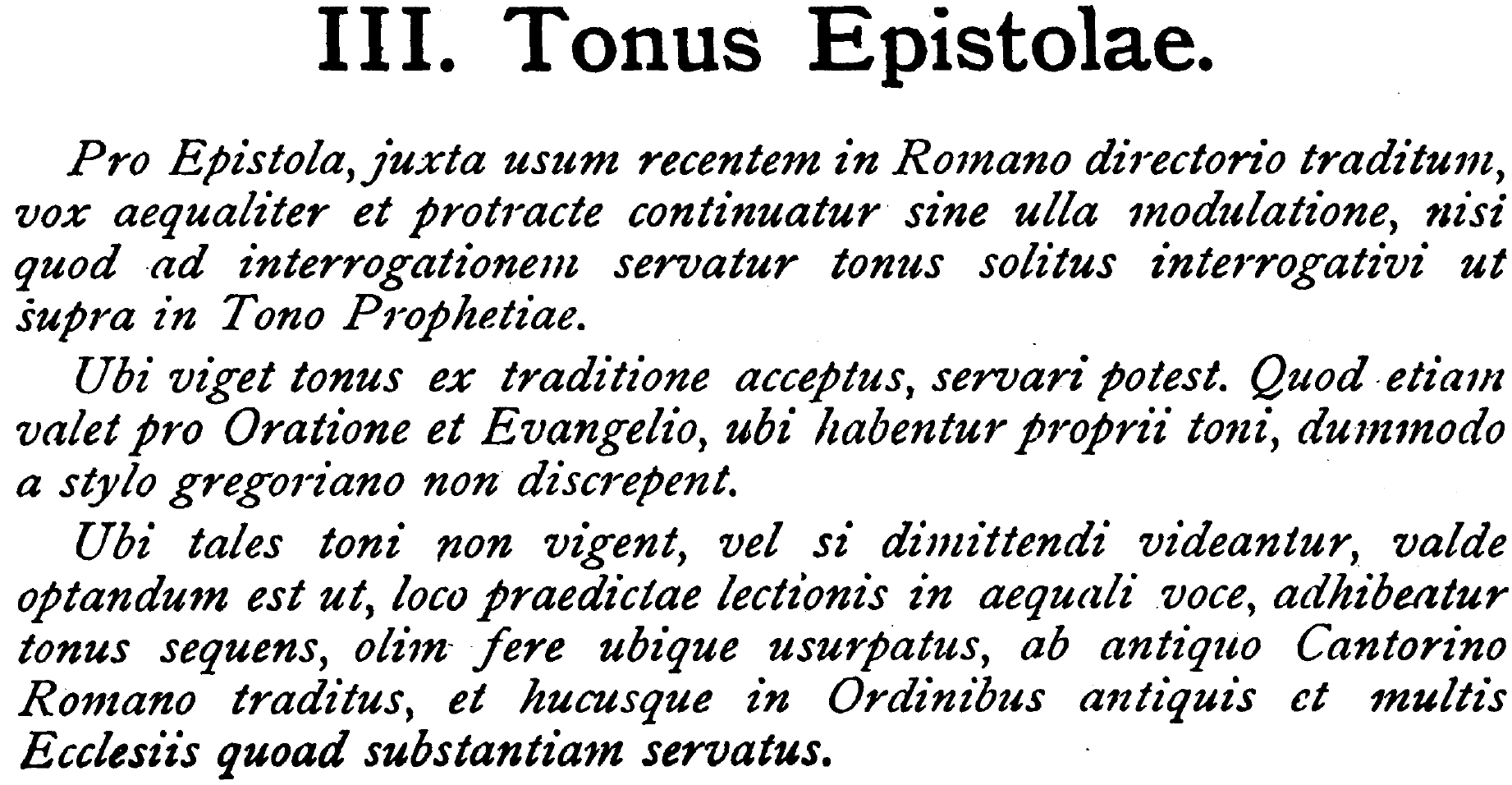 Thanked by 1tomjaw
 -
@FSSPMusic the problem is that there are places where it specifically says “in the epistle tone” and not just in contradistinction to the prophecy tone (on Good Friday this is the case: because the first reading is often sung recto tono since it’s assimilated to the Requiem rubrics).
And again: if it’s not in Stercky, I basically conclude that it doesn’t exist. But that said, fine, they seemingly mean no music whatsoever. It’s just that they say dicitur in other rubrics particularly in the Antiphonale which uh well they obviously don’t mean “speak”!Thanked by 1tomjaw

Welcome to the MusicaSacra Forum!
To participate in the discussions on Catholic church music, sign in or register as a forum member, The forum is a project of the Church Music Association of America.
Categories
- All Discussions21,810
- General Music Discussion8,534
- Job Openings290
- Management of Music Programs862
- Choral Matters539
- Church Documents and Rubrics540
- CMAA Notes307
- Events758
- For Newcomers: Read First26
- Sacred Polyphony566
- Hymnody896
- Gregorian Chant: General2,746
- ↳ Graduale Romanum and Liber Usualis372
- ↳ Graduale Simplex60
- ↳ Semiology65
- Vernacular Plainsong704
- Anglican Use and Anglican Chant72
- Organ, Other Instruments and Repertoire450
- New Composition/Works in Progress1,338
- Recordings238
- Music for Hispanic Ministry163
- Music Education: Children217
- Music Education: General222
- News Items246
- Positions Wanted3
- General Discussion: Catholicism742
- Amusements185
- General Discussion1,047
- Opinions119