
Publishers announced for new Breviary!
-
In case anyone missed this...
Word on Fire and Ascension Press have been officially selected to publish the new four-volume edition of The Liturgy of the Hours.
I must say, I had visions of several different firms getting "the call", but neither of these two were on my radar (although WOF's monthly paperback of the current edition probably should've been a tip-off!)
Deo gratias! The initial information is impressive, as well as the posted images!
Gaudete in Domino Semper!Thanked by 1Earl_Grey -
I am anticipating a difficult decision when it comes time to purchase the volumes.
-
where are the images? were there new updates on release?
-
The two sites:
https://www.liturgyofthehours.com/
https://ascensionpress.com/pages/liturgy-of-the-hoursThanked by 1monasteryliturgist -
Veni et noli tardare!!!! They look beautiful. I am especially ready to say goodbye to the 70s pink images forever.Thanked by 1ServiamScores
-
About time, it only took like 15 years, lolThanked by 1monasteryliturgist
-
I'm not aware of any plans to release a "singing edition". Something like the current Mundelein Psalter will become obsolete. And with all the translations copyrighted, there will be no legal way of pointing the psalms to sing vespers according to the new edition.
I'd be happy to work on such a project, but I don't know who to even speak with at the USCCB or if they are even interested in such a thing. Which is why those who wish to sing the office will have to use the traditional Latin texts.Thanked by 1LauraKaz -
@Earl_Grey In our Monastery we just mark our breviaries directly but of course that takes time and you have to make sure everyone does it right
-
Yes, but in a seminary or parish where vespers is only sung on occasion (Sundays, Feasts, etc.) a resource like the Mundelein Psalter was a great help.
Creating and printing a custom worship aid wouldn't be such a big deal if the texts were made available electronically, but it would also require permission to do it legally. One can subscribe to eBreviary and print the office legally, but one can't edit the PDF directly to point it for singing.
I know a vast majority of priests and religious will only ever read the breviary, but the Church should encourage the sung office by providing practical resources to make it happen.
Something like Source and Summit would be great for the Office with the ability to instantly render the text pointed for a variety of psalm tones. -
Remember (IIRC) when the 2011 Missal translation was published and the gospels couldn't be pointed in translation because the pointing wouldn't match the Latin typical edition? There seem to be (at least to me) layers to the - unnecessary - problems.Thanked by 1tomjaw
-
I guess my main issue with Mundelein is that they dont use the Gregorian tones.
-
There is a part of me that says « do it, and don’t tell anyone ». Another part is « well, maybe now is the time to ask Rome. » I normally don’t advocate for asking questions if the answer is uncertain, but I know at least one Catholic IP lawyer who could perhaps be coaxed, or could recommend confrères to be coaxed, into writing something on behalf of musicians such as ourselves, groups like the CMAA, in order to express to Rome that copyright protection is essential, active enforcement is essential, but that the current policies are prohibitive.
-
My understanding is that the Psalms and Canticles will have at least asterisks and daggers, so that will make them a bit easier to chant. I've also heard that there is discussion about having the final stressed syllable in each line marked, which would help with chanting. I think there might also be a set of tones included in an appendix, but I don't know what tones those might be.
-
I would bet that Source and Summit would like to provide Divine Office resources. Probably already working on it. And rest assured that USCCB will leverage it for financial gain, simony not withstanding.
-
The psalm divisions are still too long to use with Gregorian tones, or they’re way too short because English. The former is a choice!
-
We dont have any problems with applying the gregorian tones. If the line is too short we combine it with another line or take out the intonation note, which is what is done in Latin. In our monastery we underline the "accent" we establish so that it can be applied to any tone. Sometimes you might have to do something a little 'un-natural' but its better than destroying the tone in my opinion. Its the best way to do it if you dont have something printed.
examples:
O God you are my God for YOU I long
For you my soul is THIRSTing
Glory to the Father and TO the Son
and to the Holy SPIRit
as it was in the beginning IS now
and will be forever A-men
The Lord is my SHEPherd
there is nothing I shall want
My God my God why have you forSAKen me
you are far from my plea and the cry of MY distress
-
Sure but the division in the vernacular psalters is sort of bizarre for singing and maybe even recitation. This means that the tones can’t be applied consistently.
-
I definitely agree that the line division is not the best, especially those single lines connected to no stanza.
Im also really hoping they will fix the "to be full of love" line from the canticles which only appears in certain places and in other places does not appear.
-
I'm just pretty sure the new Psalter has dropped some of the sibilants from "So my soul sings psalms unceasingly." It is perhaps not a great thing when a psalm makes you chuckle, though "It is good to give thanks to the Lord" is only ever heard in John Paul II's accent in my home.
-
Count me disappointed that Catholic Book Publishing was not selected. Nothing against the others - but the dated artwork/clipart and some obstinate editorial decisions aside, I have generally found CBP books to be clear, readable, useable and more attentive to the finer points of book creation than many others - and at a very affordable price. Which is not surprising considering that they have been in the field for a while.
I remember when the missal came out and many US publishers jumped in with their offerings. Some had lovely artwork and typography - but were much heavier, prayers were harder to find or read, books didnt remain open flat, bindings fell apart after sustained use, ribbons and tabs kept coming off or were too small/awkwardly placed. Etc., etc., etc. I know many like myself who initially bought from others and then eventually gravitated back to the CBP editions.....
You can see the same difference btw, between vintage Latin altar missals and many modern reprints - the latter tend to be bulkier, heavier, and more susceptible to wear and tear than books that have survived for over half a century!
So here's hoping that WoF and Ascension do in fact produce a quality (and affordable!) product - not just in terms of visuals, but in terms of usability ...... As it is, they will have a hard time competing with the digital offerings. I'm surprised the USCCB hasn't jumped on that bandwagon faster. The vast majority of clergy I know use some kind of app for praying the Liturgy of the Hours - some even for the communal Office.
-
Oh I had the opposite reaction, I was praying that CBP would NOT be chosen. I always find that their products fall apart and look cheasy to my eye.Thanked by 1ServiamScores
-
PLTT:
Irony of ironies...
About twenty-four hours before the combined Word on Fire/Ascension Press notices dropped, I was drafting a letter to CBPC in which I, assuming they would be chosen for the project (either as one among many or exclusively), expressed my hope that the innumerable typos and rubrical errors which have dogged their current edition this past half-century would be attentively dealt with, and that the great aesthetic improvement they have effected in their newer editions of ritual books would carry over into the new breviary. Alas, said epistle has been rendered unnecessary.
I do wonder however about the one-volume diurnal ("Christian Prayer"). I assume such an item will be forthcoming as well and perhaps CBPC is one of the four(?) publishers rumored (I emphasize..."rumored" only!) to be in line to produce that item for those accustomed to using a one-volume version. Time will tell.
I am quite surprised that neither Magnificat nor Midwest Theologcal Forum was chosen.
I am also very curious, in light of the Holy See having finally completed the approved "supplement" as well as the full, proper two-year lectionary for the Office of Readings (which most other countries/languages already have!) if anyone in the Anglophonic world will be producing something similar to the magnificent new Argentine (Spanish) edition...which necessitates six volumes, instead of four (y'know...to "get all of it in"!)
Midwest Theological Forum currently produces an excellent Latin editio typica in six volumes. Perhaps something like that might be down the road from them...or maybe Magificat...or EWTN Publishing?
(Oh well, I can dream, can't I?)
Gaudete in Domino Semper! -
Yeah, but a lot of priests go with CBP because the books are reliable and familiar, even if ugly. One wonders if the companies themselves had a bad go of it, including financially, and didn't jump in.
But "media organizations" publishing the breviary…that's the semi-official framing, and good riddance. The mock-ups so far of the spine look terrible.
Also, if the typical edition itself only gives page numbers but not the incipit of a hymn, good riddance.
And this goes back to the destruction of Mame, Benziger, Desclée, Dessain, Pustet, etc.As it is, they will have a hard time competing with the digital offerings. I'm surprised the USCCB hasn't jumped on that bandwagon faster. The vast majority of clergy I know use some kind of app for praying the Liturgy of the Hours - some even for the communal Office.
Two problems: the clergy need to stop being so unedifying and lazy. Evergreen, but it's true, and while it's one thing to pray on one's phone in a dental waiting room when one wasn't expecting to wait forever, doing so in church or habitually is another matter.
There is for some reason, with the first edition, a problem of "page numbers" wherein people need to be told page numbers, not the parts from which something is taken: proper of the season, of the saints, common, the day of the week. But if you have different editions, or only Christian Prayer versus the four-volume set, you're going to be lost. And it's not just me, a layman, annoyed; there was a good discussion where an older priest (solidly middle-aged, been a priest a while) was complaining about how he hoped that "the page numbers would be the same, otherwise priest gatherings would be a problem" and a younger priest was like "no, you are not first-year seminarians in orientation week. Learn to set your breviary, in advance."
and the laity who prefer the new office, such as various third-order members, also have this problem. There's a whole ordo that refers to page numbers! What are we doing here?! (I understand that the layout is not friendly, and this goes back to "why did we reinvent the wheel" but still.)Thanked by 1monasteryliturgist -
Honest inquiry,
What about the spines look so horrendous?Thanked by 1RMSawicki -
What about the spines look so horrendous?
While "horrendous" seems a bit extreme, I'm not real keen on the Ascension logo. WoF, in the other hand, looks pretty good to me.
I too was a bit disappointed that Magnificat was not chosen. They are my go-to for ritual books.
FWIW, twenty year ago I sprang for the leather bound CPBC volumes and two decades later they're still in excellent shape, other than the printing being worn off the spine (for which my sweaty hands take full responsibility).Thanked by 1RMSawicki -
AnimaVocis--
I echo your query. What indeed?
The Word on Fire version almost looks like it is employing the Jesuit "IHS sunburst" motif on the spines, and the Ascension version has those endearing symbols of the liturgical seasons - "Stella Orientalis" for Advent/Christmas, Crown of Thorns for Lent/Easter, Sacred Heart for Ordinary Time 1-17 (wherein the Feast falls), and "Corona Christus Rex" for Ordinary Time 18-34 (wherein that Feast falls).
Personally...I like both designs.
Gaudete in Domino Semper! -
fcb --
What a coincidence- exactly twenty years ago I did the same thing and the condition of my set is just as you describe yours!
:-)
Gaudete in Domino Semper! -
I can't remember where I read this, but having the psalms broken into 4-6 lines stanzas (or sometimes more/less) was meant to offer a responsorial rendering where cantors would sing the verses and the congregation would sing the response after each stanza responsorially. However, when chanted (or read) antiphonally one should ideally alternate each verse of the psalm (ignoring the space breaks). Yet the common practice is to now read an entire 4-6 line stanza before alternating. Having the mediants marked with * should help, but it will be a hard habit to break.
Also, communities that regularly sing the office will come up with something that works well for them. The Mundelein Psalter is not a paradigm for singing the office, but it did make the task practical/possible for a group of non-singers who only sing the prayer occasionally.
I don't see the need to petition Rome for such an inquiry, but asking the USCCB makes sense. Do they really want to be inundated with permissions requests from those of us attempting to sing the office on a feast day? -
@Earl_Grey speaking from a monastery having to choose where to make a 3 liner and where to make a 2 liner in a community that chants is a constant source of contention. I was over joyed to see in one of the pictures that they are finally marking the flex +.
-
I used to own one of their prayer books that included prayers to the Egyptian god Ra, Buddha, Mohammed, Hindu prayers and more. “Prayers of the world”. I kid you not. It also had a nihil obstat and imprimatur, and that was the day that N.O.’s and Imprimaturs died for me. They are only as good as the people granting them, and no earnest Christian priest or bishop could grant an official approbation to pray Hindu prayers or prayers to Ra. It was absolute garbage and I burned that book, and resolved to never support their publishing house again.Count me disappointed that Catholic Book Publishing was not selected. Nothing against the others - but the dated artwork/clipart and some obstinate editorial decisions aside, I have generally found CBP books to be clear, readable, useable and more attentive to the finer points of book creation than many others - and at a very affordable price.Thanked by 1monasteryliturgist -
The font selections are terrible for the Ascension spine. Sans serif fonts belong nowhere near a breviary, and it's not 1940, we can drop slab serifs. Paper's not cheap, but it's not a rationed commodity. Classic humanist/roman serifs only.
Adding stuff is also just not necessary. You need the volume number or season name or something, that's it.
It is not that hard to make a breviary, insofar as it is trivial to make a pastiche of an older edition. And the spine already departs radically. They aren't in control of everything on the inside, sure, but the spine is apparently fair game…
as to the division 1) the original idea is dumb, dumb, dumb 2) the breviary and antiphonal did not always align historically, but at least you had 1 verse neatly divided, so the office could always be sung recto tono without too much trouble. -
Matthew,
That makes alot of sense, regardless of whether I agree or disagree.... Honestly, I didn't know that I should care that much - therefore I just never noticed. (Ha!)
That said, I am currently working on an all-in-one breviary for travel for my monastery (as an Oblate book/travel edition for the monks). As such, I'm using the St Michael Abbey diurnal as a baseline. Your comments are helpful.
As an aside, I definitely disagree with ascension's decision to place their logo on the spine. We don't need more advertisements this world... -
The reason you (a general you as much as a personal one) should care is that we should have beautiful things that are easy to read.
I think that there is a place for artistic innovation or creativity. (Without endorsing the publisher) Alcuin Reid’s bunch are publishing the monastic breviary. These typefaces to me are legible and have a lot of character. They’re trying to approach the aesthetic of a particular earlier edition of that breviary.
Slab serif fonts for body text are just too tiny and hard to make out with respect to letters and therefore words. It’s my one criticism of the Saint Andrews missal. They got easier to read and more typographically pleasing as the amount of content was reduced. The late 50s editions are my favorites. But I prefer the 1945 content.
Sans serifs are divorced from the print tradition and that of manuscripts and Roman stone carving such that they really have no place in the liturgical books whatsoever. It’s decisively modern, in a bad way. But you can do modern and interesting with legible serifs. -
An interesting follow-up here. The June-July 2025 issue of the official liturgical bulletin from the U.S. bishops conference includes the following text:
"Regarding the Liturgy of the Hours, Second Edition, the Committee reviewed proposals from four publishers and selected two of them to receive exclusive, five-year contracts to publish the four volumes of the breviary".
Now that it is publicly known that Word on Fire and Ascension were the two firms selected, I can't help but have a burning curiosity about the identity of the other two.
The same bulletin further states:
"Members also approved the details and timeline for the publication of major extracts of the Divine Office: after the bidding process, *four publishers* will receive exclusive, five-year contracts to produce single volumes that include Morning and Evening Prayer".
I'm guessing the two firms who lost out on the bid for the full breviary will likely be among this group of four who will handle the diurnal.
Maybe this means there is still a chance some nice, beautiful product from Magnificat will be in the offing? Or MTF/Scepter? Or Ignatius?
I thought WLP/J.S. Paluch produced a BEAUTIFUL option (Deluxe Edition) for the new altar Missal. I'd be quite confident they'd be able to turn out a lovely diurnal.
I am also hoping the Daughters of St. Paul will be able to offer an updated version of their very cost-effective previous option of a stand-alone volume for the Office of Readings coupled with their once highly-popular diurnal. They made a nice set in the past!
Oh well...time will tell.
"Lord open my lips, and my mouth will proclaim your praise"!
Gaudete in Domino Semper! -
Well now that all seminarians at least for the first round will get the WoF breviary, Ascension may well go belly-up or close to it.
-
Does anyone have any idea which one will look more traditional? Im not familiar with the books either one publishes- and Ive heard mixed opinions from different people. The pictures online dont give enough of a preview to really know what the inside looks like.
-
MatthewRoth
Funny you should mention that.
In 2013 WLP/J.S. Paluch did the same thing with their new altar missal, sending a copy to every newly-ordained priest in every U.S. diocese. It didn't seem to hurt missal sales for CBPC, Liturgical Press, LTP, Magnificat, etc. I suspect there will be room for everyone in this new venture.
Gaudete in Domino Semper! -
The problem is that the breviary is a different beast. You have one set. You’re not going to replace it. You don’t need it in different sizes. Pastors had control over the purchase.
There are also more seminarians than are eventually ordained priests due to attrition. There’s also the social contagion: people will be expected to have the WoF version.
And if they got in the game as late as 2013, of course WLP was already behind. But there were far too many publishers in 2011. I believe that some of these did really suffer and that CBPC is one of those that reliably gets new sales, despite the aesthetics. Anyway it’s not great that one publisher with a direct episcopal link is being favored. -
The US bishops' instincts when it comes to publishing ritual books seem over the years to be founded much more upon law and compliance (in this case, for example, getting something into the hands of individual clerics and religious so they can fulfill their canonical obligations) than upon evangelization and deeply empowering and encouraging euphony of language and beautiful corporate prayer and worship. Their instincts are like those of meat cutters, rather than of artistry (even a good butcher has artistry in his craft, but meat cutters not so much).
-
At this point, @monasteryliturgist , I don't want to place much trust in the promotional pics from either publisher.
The only thing that's really striking to me from the images is the difference in book size: Ascension's images suggest that they are planning to make the standard edition in the "pocket-sized" format (around 4.5" x 6.5") that we have been using for the past 50 years from the Vatican's publishing house and from Catholic Book here in the US. On the other hand, WoF appears to be designing with a larger format: maybe 5x8" or 6x9".
When various publishers made editions of the Roman Missal back in 2011, they were all required to preserve the page-numbering of the approved USCCB text. With the differing book formats that seem to be in the works for the LoTH, I can only wonder whether they will have different pagination, which would make common use of books from the two sources inconvenient.
Probably more images will come from the two companies as the months pass.Thanked by 1monasteryliturgist -
People should stop relying on pages other than the references in their own edition; that’s the only way to pray the preconciliar breviary with any ease, and yet every like-to-like edition (same rubrics, same format) has the same pagination.
-
@chonak thanks so much. Those are all really good points. I would hope that the page numbers would be all the same as that would cause a good deal of confusion when people pray in groups.
-
The Word on Fire images also stood out because they put an "IHS" symbol on the books, which happens to be the logo WoF uses for their existing LoTH publications.
The downside for me is that I associate that symbol with the Jesuits, so it's as though WoF were trying to positively discourage singing. :-)
-
oh goodness! ha maybe you should think of St Bernardine of Siena then :) !
“This Name must be carried in your heart, held on your lips, and sung with your voice.”
“Good Christians should accustom their tongues to holy words, to hymns, and to the singing of divine praises, for these drive away the enemy and lift the heart to God.” -
So...
Midwest Theological Forum is OFFICIALLY one of the publishers of the one-volume edition ("Major Extracts" - i.e. diurnal), with Liturgical Press, Magnificat, and our old friends Catholic Book Publishing Company allegedly rounding out the outfield.
Quite a healthy variety here. I am genuinely looking forward to seeing the variations among the forthcoming finished products.
Gaudete in Domino Semper! -
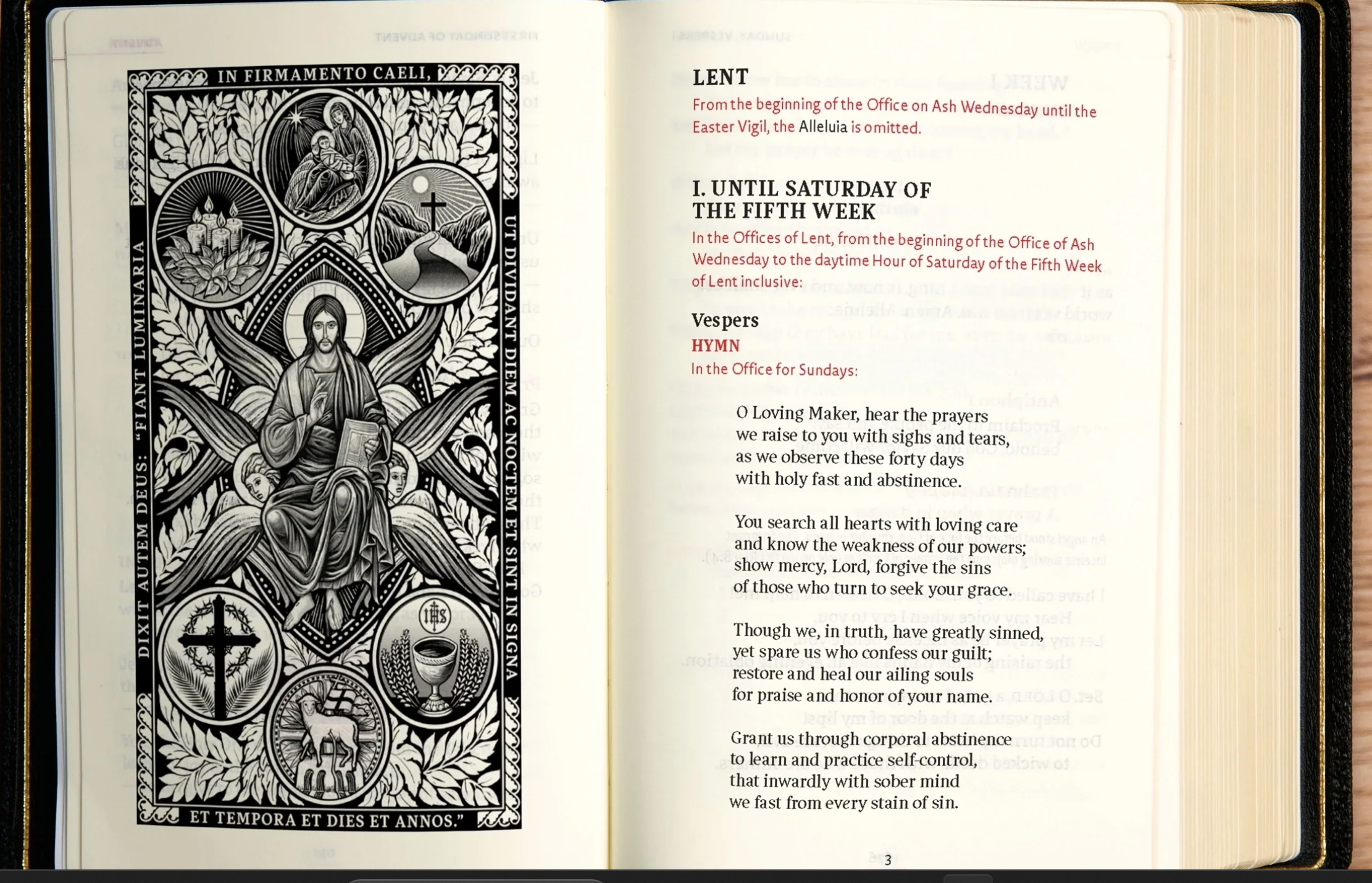
I saw that Ascension finally posted a picture on their Art Work for the New Breviary. I am a little disappointed. It looks very much like AI generated artwork to me. Obviously its a step up from the Pink 70s images but I was hoping they would be using Missal Art, I guess this is their version.
Hoping Word on Fire has better options. I have not seen any artwork from them yet.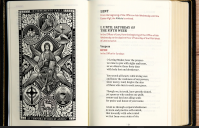 2222 x 1430 - 4M
 -
The art is by no means AI. While not old Missal Art (whether it should be or not is another story), it is being specially created for them.
https://ascensionpress.com/blogs/articles/beauty-that-evangelizes-meet-the-artist-of-the-new-liturgy-of-the-hours
It gives me senses of an Art Neuveau / woodcut style. -
yes I know its not AI but it looks alot like the AI Christian Art I have seen in recent years. I just dont like the style very much. It looks very cheesy to me... but thats just my style. I think particularly because I am an iconographer--the semi icon, semi wood cut, semi coloring book look is distasteful for me. But again just a personal opinion. Hoping that WOF does something a little more traditional looking- I want the art to help my prayer not disttract it.
-
Some "overly perfect" details in the image suggest that computer graphics were used in the design process.
In the upper half of the artwork, much of the leafy background looks identical from the left side to the right, which makes it appear as though one side was designed by hand, and the other side was made by just copying and flipping the image. That sort of perfect symmetry looks unnatural.
In contrast, the background in the lower half of the art shows more differences between the left and right sides.
Also, to me, the extensive use of gradient shading makes the image look like a product made with computer graphics tools.
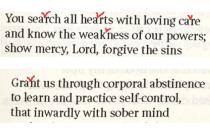
The choice of fonts doesn't look ideal either: in the sample shown, there are some problems associated with the character "a": the weak 'front' of the letter, and the seeming gaps that often appear after the letter: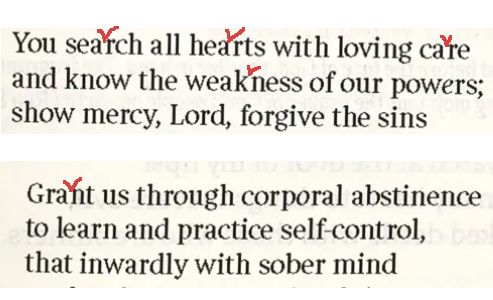
 493 x 300 - 49K


Welcome to the MusicaSacra Forum!
To participate in the discussions on Catholic church music, sign in or register as a forum member, The forum is a project of the Church Music Association of America.
Categories
- All Discussions21,849
- General Music Discussion8,551
- Job Openings293
- Management of Music Programs862
- Choral Matters539
- Church Documents and Rubrics540
- CMAA Notes307
- Events761
- For Newcomers: Read First26
- Sacred Polyphony567
- Hymnody898
- Gregorian Chant: General2,749
- ↳ Graduale Romanum and Liber Usualis372
- ↳ Graduale Simplex61
- ↳ Semiology65
- Vernacular Plainsong704
- Anglican Use and Anglican Chant73
- Organ, Other Instruments and Repertoire452
- New Composition/Works in Progress1,342
- Recordings238
- Music for Hispanic Ministry163
- Music Education: Children217
- Music Education: General223
- News Items247
- Positions Wanted3
- General Discussion: Catholicism742
- Amusements185
- General Discussion1,048
- Opinions119