
Has the Palmer-Burgess Plainchant Gradual been approved for use in the Ordinary Form?
-
Has the Palmer-Burgess Plainchant Gradual been approved for use in the Ordinary Form?
Does that even matter? -
No, but wait and see
Yes, for the gradual, alleluia, tract it does. The others are a little more iffy. -
Does that even matter?
I can't see how it would, given that it's permissible to jettison the propers entirely. Like Matthew said above, there's some debate about whether or not the P&B can licitly be used for the chants between readings. There are at least one or two discussions about this here on the forum. For the introit, offertory, and communion though, I don't see how it would in any way be illicit or poor form. -
Since the introit, offertory, and communion are not provided for in the NO, they may be sung from any source (such as Palmer-Burgess or Bruce Ford's 'American Gradual') as extra ornaments, such as is an offertory anthem, to the rite. Since, however, the lectionary's psalm and the alleluya, (which, after all, are 'proper' texts) are ritually prescribed, they may not be tinckered with for any reason....whether or not...
If a single book containing P-B or AG introit, offertory.and communion together with
the Lectionary's Responsorial Psalm and Alleluya and Verse were to be assembled
thus would we have a complete Gradual for the the NO, including tracts - We need only set to appropriate music for this 'unofficial Gradual'; But be careful in
composing music for the NO psalm and alleluia that they match in style
that of the Gregorian music found in the P-B or Ford's American Gradual.
-
As I've said elsewhere, I have a VERY DIFFICULT time believing that there is anything wrong with singing the PB, when other grossly inappropriate things are officially "approved" for use and published by the major three-letter houses. If those things are licit, I simply cannot abide the cognitive dissonance that literal vernacular adaptations of traditional plainchant are in any way illicit. And I don't even think you can haggle much over the translation either: if you can completely omit a prescribed text, then how is it somehow worse to do the prescribed text, even if it's not perfect or the current translation? It's still leagues better than not honoring the proper at all! (Pre-supposing the translation is broadly accurate.)
-
I read this as “Palmer bluegrass plain chant” and a new sound of chant entered my mind.I simply cannot abide the cognitive dissonance that literal vernacular adaptations of traditional plainchant are in any way illicit. And I don't even think you can haggle much over the translation either: if you can completely omit a prescribed text, then how is it somehow worse to do the prescribed text, even if it's not perfect or the current translation?
Our MD has been singing the spoken propers ad libitum instead of the propers from Gradual. Meanwhile I’m sitting in my pew reading the English translation of the Latin sung propers from the Gradual, which are often completely different (and also include the Offertory). I’ve been tempted to ask our pastor why we can’t just sing the Biblical translation from the Gregorian Missal and include the Offertory, but I don’t want to risk having them stop singing the propers altogether, especially now that I finally got the congregation standing for the Intoit. -
"I read this as “Palmer bluegrass plain chant” and a new sound of chant entered my mind."
I love that.
That said, cantillation as an idiom is capable of many moods. (As today is Yom Kippur, consider the cantillation of the Kol Nidre, which evolved in the late AD First Millennium, the same period as our Gregorian plainsong and chant were evolving.) I remember attending Mass at a largely historically African-American Catholic parish with a well-regarded music ministry whose longtime director developed psalm tones that evoked African-American cantillation styles without the vocal or solo dramatics or pyrotechnics of the showier side of Gospel music. Those tones were very effective at keeping the text in the foreground and the melody in the background, as it were. -
Liam, do you have access to those psalm tones?? I'm so curious!
-
introit, offertory, and communion are not provided for in the NO
In English do you mean? Solesmes republished the Graduale Romanum in 1974 for use in the OF of the Mass, and this contains the introit, offertory, and communion chants. It's basically identical to the 1961 GR.Thanked by 1ServiamScores -
Heath
No. I just was attending with a parishioner (who has since moved to another city) who is a close friend of mine. This was 20 years ago. -
But English translations of ¿nearly? all of the GR are available in DW:The Missal. Though that is Old Church English, not NABish or anything contemporary.not provided for in the NO -
True, all five propers are given for every mass in DW:The Missal. and they are required to be sung or recited at every mass in the Ordinariate....are available in...
This is, unless I am somehow mistaken, not the case in the NO which provides only for a responsorial psalm and the alleluia-verse. -
all five propers are ... required to be sung for every mass in the Ordinariate.
To be more exact, the general rule is that they will be said or sung "according to the solemnity of the celebration" (Rubrical Directory, 12), but it is expected they will be sung on "Sundays, Holy Days of obligation, Solemnities, and principal Feast Days" (11). -
Agreed, the NO Missal does not provide other sung propers, but GIRM contains the general rubrics and repeatedly refers to GR as the basic source for sung propers.... the NO which provides only for a responsorial psalm and the alleluia-verse.
For Communion the missal provides [a choice of] default antiphons to be read by the celebrant if there is no singing and no one else voices one. Omitting them completely is not permitted, but is widespread.
Similarly for the Entrance chant, except that the celebrant may "even adapt it as an introductory explanation".(!)
For the offertory GIRM again refers to GR, but does not require anything to be sung or a substitute to be spoken. -
This sounds delightful to me, but I do not know this particular document. Can anyone point me to it? (I assume DW = divine worship?). Not sure exactly what to search for here.ut English translations of ¿nearly? all of the GR are available in DW:The Missal. Though that is Old Church English, -
indeed it does. It makes very clear that the propers are still part of the NOM.but GIRM contains the general rubrics and repeatedly refers to GR as the basic source for sung propers.
As an aside, it's quite interesting to look at the "transitional" missal of 64(?) where all the propers and prayers are still in Latin, and merely the readings are in the vernacular. I think this really what the council actually intended, and I'd like to eventually learn more about the bait and switch which prevented us keeping that model. (Please don't get into all of that and derail this thread; I know the broad strokes and my reading list is quite long. I'm working on it. I just don't have all the fine details yet.)Thanked by 1irishtenor -
I understand the question, and it’s a mindset I once subscribed to, but no more.
If Matt Maher can be sung and nobody bats an eye; if “Big Red Love Ball” was ever sung and it was celebrated as a new springtime….
Then most definitely the serious and scholarly work of Palmer and Burgess can be sung, no questions asked. -
ServiamScores You can see a few pages here :- https://issuu.com/catholictruthsociety/docs/b._divine_worship_sunday_missal-peo?fr=sNmQyOTEyNjY2MAThanked by 1ServiamScores
-
Thanks AFH. I understand now. How lovely. I need to get my hands on one.
-
There isn’t a mandated English Language translation of the texts of the proper antiphons for the purposes of singing, so it’s reasonable to use one that’s recognised as faithful to the Latin, and ideally one that’s at least been approved by an Ordinary somewhere. The Divine Worship translations fall into that category: they are from an authorised form of the Roman Rite and are hallowed by practice. Indeed, in establishing the Ordinariates, Pope Benedict expressed the hope their texts would be "a precious gift ... a treasure to be shared" with the wider Church.
Interestingly, DW’s rubrics also allow for “musical settings of the Graduale which rely on a different translation of the same texts” (Rubrical Directory, 14). This allows for differences between the Palmer / Burgess translations and DW (these aren't substantial), and recognises the value of sensible flexibility when considering the singing of propers.
I’ve seen argument against wider use of P&B on the ground that we should take proper texts from a modern translation approved for liturgical use. That misses the point that while the Graduale’s texts are scriptural, they have developed in parallel with the scriptures, and are not always consistent with them. Which isn’t to say a fresh translation shouldn’t be based on the NAB or RSV-CE; rather, that we should recognise the particularity of the propers, which fall into a different category to the scriptural readings.
Thanked by 1ServiamScores -
So, looking into the DW Missal more, I am so very, very intrigued. (Personally, I LOVE old/high English; I call it "poor man's Latin".). More importantly, as a composer, my impetus is to either use Latin or this high english. So far, I'm not seeing a way to obtain a PDF of the full missal. The books are very prohibitively expensive; even hand missals are 200. Altar missals are double (no surprise). But I would gladly pay, say $100 for an authorized PDF version. If anyone can point me in the right direction, I'd be grateful. So far, my yahoogling only turn up various small pamphlets which are basically just the ordo missae, but don't have all the propers, and it is precisely these authorized translations of the propers that I'm interested in.
EDIT: I did find a website that has the hand missal at a more reasonable price. One website had 189 pounds... but another has it for 69, which is reasonable. Would still love a PDF though... I'm surprised that it is not available via Verbum. -
There is this one; it appears different; I'm not versed in this world yet. (Sorry to derail the thread) but it looks complete?
https://ourunifiedcatholic.org/wp-content/uploads/2018/06/book-of-divine-worship.pdf -
I was told that any of the Ordinariate books were NOT to be circulated in pdf form. And that was told to me by an Ordinariate priest. But there is a pdf that circulates among the clergy. Good luck. I have been trying for 2 years.
-
@Serviam, your link is to the Anglican Use missal, a fore-runner to the Ordinariates' DW, provided in the 1980s for North American Anglican groups who wished to convert. It has been superseded.
-
Like Kevin says, for whatever reason, the Ordinariate seems to be very protective of its texts. Very little is available online. I have the "study missal" but even that doesn't contain the readings. The lectionary is impossible to obtain in any form other than the liturgical book, as far as I'm aware. This makes setting the readings to chant for sung Mass a bit tricky.
-
See! This is why I'm glad I asked. These are uncharted waters for me, so I don't want to go awry. I'll just order the hand missal, then.@Serviam, your link is to the Anglican Use missal, a fore-runner to the Ordinariates' DW, provided in the 1980s for North American Anglican groups who wished to convert. It has been superseded. -
I would be astonished, somewhat at a distance, to hear of any priest anywhere willing to have Palmer-Burgess (or for that matter any other Ordinariate-) proper texts in place of the propers in the Novus missal.
As mentioned above, of course, I mean proper texts: collects, gradual psalm, alleluia or tract. -
I used to regularly chant from the PB at my last NO parish. I was pretty exclusively using it in the wake of the Rona when we couldn’t have choirs. Considering the fact that the GR propers are still an option for the NO, I don’t see why these would be an issue for any priest who is keen on propers in general.
-
You mean: you chanted the PB Gradual from a corresponding Sunday, in place of the Responsorial Psalm in the Novus lectionary?
-
Andrew, are you trying to claim here that the introit, offertory, and communion are not propers in the NO? Or are you specifically trying to deduce whether the PB translation of the gradual was sung in place of the responsorial psalm? (I've done PB for all of the above in the NO and not been tarred and feathered for it, for whatever that's worth).
-
For serviamscores's sake, most of the proper texts may be found in the Anglican Use Gradual 1st edition, pdf online. Other anthem-worthy anglocatholic collects and prayers may be found in the St Gregory Prayerbook, these would probably be much cheaper for you. The 2nd edition of the same gradual as well as the St Peter Gradual would also contain the fully corrected texts. There is a pdf of the St Peter gradual + occasional antiphons available from forum member Steve CollinsThanked by 1ServiamScores
-
I am very surprised that PB has been used in place of responsorial psalm anywhere. In my experience, which is not small, substituting the responsorial psalm is very unusual, and all the occasions I can remember were in a “popular” style rather than a traditional. “Shepherd Me, O God”, (Haugen) such as.
Trentonjconn, I'm referring to the evident distinction in the Novus rite between what is really proper to a particular Mass (the prayers and readings, including the responsorial psalm) and what is optionally replaced and usually is: the antiphons at the entrance, offertory, and communion. You'll have sung from PB the gradual from one of its Sundays in place of the proper responsorial psalm of a Sunday in the Novus calendar, have you? Hmm, did the celebrant recite the collect from the BDW for that Sunday as well? Probably not... but it would be just as improper.
-
The Responsorial Psalm is not the only option, Andrew - the Gradual from the Graduale Romanum (it is commonly sung in translation to a psalm-tone in Ordinariate celebrations) is equally licit, and is also "really proper" to a particular Mass. That said, a gradual is part of the Liturgy of the Word and as such is more of a direct scriptural reading than the Introit, Offertory and Communion antiphons; if it is to be sung in the vernacular a translation recognised for liturgical use by the particular Conference or equivalent ought to be employed (the Ordinariates' St. Peter Gradual sets the texts from Divine Worship, and the rubrics recognise the substantially identical P&B texts as licit).Thanked by 1ServiamScores
-
But Andrew has a point.
We have said, time and again, that currently in the USA (and elsewhere) the interlectionary chants cannot be sung in the vernacular, and using the P-B is not really kosher, for those chants at least (since you can sing virtually anything for the introit, the offertory, and the communion). Maybe it should be, but it isn’t.
He (of all people here) knows that the gradual is proper to the Mass; however, it’s not required and is not exactly preferred to the responsorial psalm, since it is not printed in the missal to be read in lieu of singing (or reading…) a psalm, even if it is listed first among the things to be sung after the (only or first) reading.
I also don’t think that being the sort of trad that I am is terribly inconsistent with this position but that’s sort of whatever if people think that going beyond the bounds of strict 1962 and either you had or you have sought out an insult for anything else is bad/wrong/immoral and illicit.
the NO does not need more free-for-all; I’d be happy to see a handful of vernacular graduals authorized if that’s what people really want (I would still take a psalm if I cannot have. the Latin gradual etc.) but you have so many options for most of the Mass propers, just one very specific restriction here, and it’s the sort of thing where you probably could get an indult… -
I have already agreed with the point about the P&B Gradual translation and the NO, Matthew. I have assumed that the use of the text from an an authorised Biblical translation would be appropriate. As for the responsorial psalm: I spent enough years at Diocesan masses to form the impression that many congregants would breath a sigh of relief not to have to actively participate in it.
-
yes. Again, this was in the months in the wake of the Rona. And it’s an option. We never stopped having masses and started live streaming immediately. No one could respond to a psalm anyway. It was very nice. And for a year or two after that, we did a gradual on high holy days.You mean: you chanted the PB Gradual from a corresponding Sunday, in place of the Responsorial Psalm in the Novus lectionary?Thanked by 1davido -
I have experienced a high number of liturgies in the last year and a half where people really seem like they don’t want to sing in spite of being offered very good music. I, too, have come to the conclusion that, for many people, it would be a relief if they were not expected to participate so much. It seems that many people are rediscovering the art of receptivity when it comes to attending a high liturgy (which, ironically, is still “active participation”.)I spent enough years at Diocesan masses to form the impression that many congregants would breath a sigh of relief not to have to actively participate in it. -
That would be a charitable gloss. Another factor could be that people are simply are used to consumption rather than that substantive receptivity. The external manifestations might resemble each other, but not the internal realities.
-
I think it's a deep-rooted cultural phenomenon, and not necessarily to be criticised. The liturgical movement ahistorically romanticised the idea and extent of lay activity in the liturgy, far beyond the deep-rooted experience of prayer in the presence of the sacrifice of the mass. It's a swing-of-the-pendulum thing.Thanked by 1davido
-
Ian I don’t see where in this thread you made such agreement, but OK.
I don’t advocate for the congregation singing more than the antiphon before and after the psalm; even that can be done by the entire choir (assuming that you have a choir), with the verses sung in alternation between halves or with cantors or similar. But I think that it’s more faithful to the NO to do that than a vernacular gradual; I also think that this sets us up ditching Latin entirely, which is an obvious mistake except to musicians apparently.
Liam also has a good point. I think that they overlap, but you have to push people to understand that they don’t need to consume all the time, that they need to receive, and that they don’t also need to « actively participate » in an external way the way that they have been taught. -
" . . . far beyond the deep-rooted experience of prayer in the presence of the sacrifice of the mass."
Which was not necessarily the most typical experience. The fact that congregational silence was customary during Low Mass does not mean that it was subjectively experienced by all or even the majority all of the time as a deep-rooted experience of prayer. Again, external manifestation and internal realities are different things that can overlap, but not necessarily.
That said, I fully acknowledge it was probably a much better environment for people on the autism and sensory sensitivity spectra (and also that contemplative and semi-contemplative religious life - i.e., not the Jesuits - probably attracted such people, reinforcing it). I have immediate family kin in these groups, and I consider myself to at least be adjacent to the sensory sensitivity spectrum (I am a synaesthete, and basically a lot of "incoming" (M*A*S*H metaphor) is a cumulative burden over the decades, as it were).Thanked by 1IanW -
Matthew:a gradual is part of the Liturgy of the Word and as such is more of a direct scriptural reading than the Introit, Offertory and Communion antiphons; if it is to be sung in the vernacular a translation recognised for liturgical use by the particular Conference or equivalent ought to be employed
Congregational singing of an antiphon before and after all the verses is an improvement on after every verse, but it still suffers from the problem of a different melody each week. That might be mitigated by consistent use of a particular psalm tone (which is how it's done for each of the propers in the St. Peter Gradual), but I'm not sure many catholic congregations would happily manage the pointing. As you say, you might leave it to the choir to sing the psalm antiphon, though I think that also begins to get away from the NO norm and the more you do so, the more you might as well go for the more traditional and entirely licit option of a sung gradual, with text from a liturgically approved translation.
As to the language: the Church has decided that the NO will normally be celebrated in the vernacular. Whatever's done elsewhere in the mass, that's particularly important for the proclamation of the scriptures.
A word of caution here: I do not speak as a cradle catholic, but as a convert who worshipped many years as a diocesan parishioner, before the Ordinariate was available to me. My views on these matters are coloured by long, often painful endurance of much catholic parish music, only ameliorated by visits to centres of excellence and occasional TLMs. The flatness of the translations didn't help. I speak therefore as a semi-outsider to the NO, albeit one who has found things done differently in a closely-related form of the rite, in ways I believe can be, in the words of Pope Bendict, "a treasure to be shared".
-
The trouble is less the approved translation and that for the NO it isn’t approved at all (yet, at least for the U.S.): in theory, this could be an approved option with that requirement, and you could find yourself without the episcopal conference (or in the U.S. a single bishop acting on its behalf) approving a text.
Yeah I just disagree. Latin matters. We are going to regret sooner rather than later the passage to an all-vernacular norm (the norm in reality, certainly never the norm on paper) and the attempts to get the toothpaste back in the tube. -
That said, I fully acknowledge [low Mass] was probably a much better environment for people on the autism and sensory sensitivity spectra
Not necessarily. I have ASD and ADHD. I am particularly sensitive to sounds and can feel them. The worst are high pitches, percussive and plucking sounds (ie: pianos, drums, acoustic guitars, and high pitched cantors), excessive reverb, vibrato, cacophony, electronics humming in the background, people breathing, etc. If it’s somewhat blended, it doesn’t feel as horrible. The flip side is, beautiful music feels even more beautiful than what others experience.
Low Mass and silence is horrible. I can literally hear every ambient sound in and outside of the church. Even ear plugs don’t help, because then all I can hear is my breathing and the kid(s) behind me kicking my pew. Now that it’s getting colder in the church, everything is so much louder because sound waves travel easier through cooler air.
All this being said, everyone is different. The gist seems to be though from what gets discussed on reddit is that pipe organ, chant, and traditional style worship is more neurodivergent friendly, particularly the priest offering Mass ad orientem to avoid eye contact and less cacophony. -
Sponsa -
I share your feelings - I too am very sensitive to environmental noise. We live in a gratuitously noisy world. Schopenhauer once wrote that intelligence decreases in inverse proportion to one's ability to withstand noise undisturbed. The sound waves of recorded noise are quite ugly, jagged, and highly irregular, whereas those of musical instruments are relatively beautiful and regularly patterned.
Now, off to savour the sweet sounds of Henry Purcell's chamber music!
(Or some Palmer-Burgess chant.) -
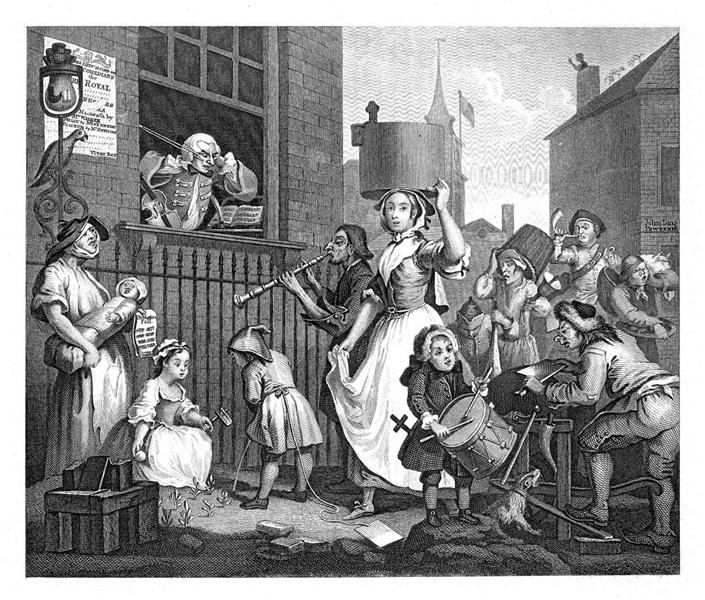
But even ancient Rome had laws against carts on the streets at night, it's the world not just 'modern man'.We live in a gratuitously noisy world. 705 x 600 - 120K


Welcome to the MusicaSacra Forum!
To participate in the discussions on Catholic church music, sign in or register as a forum member, The forum is a project of the Church Music Association of America.
Categories
- All Discussions21,844
- General Music Discussion8,548
- Job Openings292
- Management of Music Programs862
- Choral Matters539
- Church Documents and Rubrics540
- CMAA Notes307
- Events760
- For Newcomers: Read First26
- Sacred Polyphony567
- Hymnody898
- Gregorian Chant: General2,749
- ↳ Graduale Romanum and Liber Usualis372
- ↳ Graduale Simplex61
- ↳ Semiology65
- Vernacular Plainsong704
- Anglican Use and Anglican Chant73
- Organ, Other Instruments and Repertoire452
- New Composition/Works in Progress1,342
- Recordings238
- Music for Hispanic Ministry163
- Music Education: Children217
- Music Education: General223
- News Items247
- Positions Wanted3
- General Discussion: Catholicism742
- Amusements185
- General Discussion1,048
- Opinions119