
All Souls on a Sunday - Gloria and Credo
-
It's time for this discussion again. The 2nd of November falls on a Sunday this year - in the Ordinary Form, is there a Gloria or Credo?
I'm leaning towards no Gloria (as in Lent), but still Credo (since it's a Sunday, also as in Lent).
Any official word?
Also, inb4 the trads, I'm not interested in discussing the (de)merits of commemorating All Souls on a Sunday. Start another thread if you like.Thanked by 1PaxMelodious -
Peter Eliott is silent about the Gloria and Creed. Edward McNamara agrees that there is no Creed on Alls Souls if it falls on a Sunday:Effectively, this celebration is in a class of its own. It is not a feast as such, since it intercedes for, rather than celebrates, the faithful departed. The Mass has liturgical precedence over Sunday. All the same, whenever the commemoration falls on a Sunday, the Glory and Creed are omitted.
-
Edit: sorry, misunderstood the thread
-
I read somewhere (not sure where now) that there is no Gloria and no Creed. The ordo our parish has says no Gloria, but there is a Creed (if I didn't misread it). Now I need to double check on this.
-
What not just follow your rubrics?
This General Instruction has the Glory and the Creed on Sundays and Solemnities outside of Lent. The Missal has no exceptions for the Commemoration, and explicitly says that it should be used “even on Sunday”. So it's a Sunday. So do the red, and say the black: Glory and Creed. -
Except that this unique liturgical celebration *supersedes* that of the proper liturgical celebration of "a Sunday" so that even that from the GIRM is not a silver bullet (it doesn't even have a First Vespers like a regular Sunday or Solemnity). In liturgical terms, it's a strange beast to the Sunday/Solemnity cycle.
-
It does not have a first Vespers because it isn't a Solemnity, it's a ” Commemoration” -- and it concurs with a Solemnity that has is own proper Vespers. It's still a Sunday, like the rubric says.Thanked by 1MatthewRoth
-
Yeah, it's like how a feast in the TLM that uses the common preface for want of its own takes the Trinity preface when it is celebrated on a Sunday. or it gets a Credo because it doesn't have one (this happens basically never post-1960, unless it's a I class feast in a proper calendar, and therefore may be celebrated on Sunday as the feast itself, not just as an external solemnity, but it happens often enough: Saint Lawrence, Saint Anne…Saint Joachim were he not to have one because of the octave, the Nativity John the Baptist on Sundays or during an octave of the Lord).
this is obviously a flaw, and the right thing is the old practice and to move All Souls to Monday. But it is not so for now in the NO.Thanked by 1tomjaw -
If your diocese publishes an Ordo, check there.
Jesuit Ordo for USA and Canada :The Commemoration of All the Faithful Departed (All Souls)
Mass 1, 2 or 3 of All Souls; 3 readings from [668] or the Common of the Dead [1011ff]; (Creed on Sundays;) Preface for the Dead I - V
Priests may celebrate three Masses; second is offered for all faithful departed, third for intentions of the Pope.
Hours of the occurring Sunday (instead of the Hours of the Dead); Te Deum
Week 3 of the Psalter.
Standard Time returns today (turn clocks BACK one hour).
Our bishops made a different choice :All Saints
Holyday of Obligation
In England and Wales when the celebration falls on either a Saturday or a Monday it is transferred to the Sunday.
Replaces 31st Sunday in Ordinary Time when it falls on a Sunday.In England and Wales when All Saints (1 November) falls on a Saturday and is transferred to the Sunday the Commemoration of all the Faithful Departed is transferred to Monday 3 November. -
-
This is what we did last time that I attended All Souls on Sunday in the NO.
@a_f_hawkins but the ordines do not agree. Some have the Gloria and Creed, others just the Creed, and others neither. (I think that the middle position is what should be done, but the former is what the rubrics say to do, and the last is so unthinkable on a Sunday that if we concldue that it's correct, we should move All Souls.)Thanked by 1tomjaw -
FWIW, it seems the Vatican omits both, but in Italy otherwise the Credo is retained. I can see the reasons for both approaches; retaining the Gloria would be the least convincing case. It's one of those things where the order of precedence in its particulars is not necessarily clearly engaged in more general and therefore more automated/routinized (in practice) principles of setting the ordines. This issue arises every 11-6-5-6 years (except when the 28 year cycle includes a centenary year not divisible by 400), but it reminds me of the annual confusion over the renewal of baptismal promises vs Credo on Easter Sunday, where automated/routinized practice encounters a particular, as it were.
-
In the UK, or at least England and Wales, there is an indult to offer a Requiem Mass annually on the second Sunday in November. You can search Remembrance Sunday Mass on YouTube and find a number of examples, but I don't see much consistency regarding the inclusion of Gloria and Credo. @a_f_hawkins might be able to tell us more about this. Is the Remembrance Sunday Requiem required or optional? When November 2 is a Sunday, November 9 is also a Sunday, which happens to be a feast day that takes precedence over the Sunday Mass. To answer the question asked, and as others have said: follow your diocesan ordo.
As an aside, I've always been a little surprised how few priests and parishes here in the US offer a Requiem Mass on Memorial Day in May (which is always a Monday). I'm not a fan of mixing patriotic commemorations into the liturgy, but on a holiday commemorating the dead, it seems very fitting to do so. -
@FSSPmusic
The Remembrance Sunday Mass... From the LMS 1962 Ordo, "In England & Wales today is Remembrance Sunday. One Requiem Mass may be celebrated for those who died in the two World Wars. This should be Mass on the anniversary." This Mass is said without Gloria as it is a Requiem, but it is also said without a Creed...
N.B. Permission for this arrangement was for 5 years, no one has ever found a renewal of the permission. Our Diocesan Ordo (NO Mass), allows 1 Requiem Mass but does not mention about the Gloria and Creed.Thanked by 1FSSPmusic -
@Liam, do you have a source for this? I haven't been able to track down anything from 2014 or 2008 online.FWIW, it seems the Vatican omits both -
I guess this is how a rite evolves. Rubrics, after all, are historically originally descriptive rather than prescriptive. The liturgical practices of a cathedral or abbey or what have you, as governed by the Ordinary or Abbot, eventually emerge the “rules”. The Novus rite has only existed for what fifty or sixty years, and was conceived in an antinomian, or at least somewhat free, atmosphere.
So, exactly as @FSSPmusic says, surely the best thing to do is whatever the Bishop’s ordo says.
Here in Canada the Bishops’ (**) ordo notes that Sunday is Sunday, and a note of Resurrection (as for funeral Masses) is “strongly encouraged” -- and the Creed and Gloria are said.
(** genitive plural) -
At the risk of hijacking the thread: one would assume, this Sunday being a Missa pro defunctis, that the prohibition on solo organplaying from the Ceremonial of Bishops applies, no?
-
One would assume, and cf. Musicam sacram 66, but how bizarre to have a Sunday Mass in white vestments with Gloria and Alleluia with the absence of organ solos and altar flowers as signs of a penitential character. This is a fine example of a liturgical "reform" not well thought through.
-
Here in the Netherlands, the ordo of the Conference of Bishops indicates that there is no Gloria and no Credo on November 2, even if it falls on a Sunday. The preferred color is purple.Thanked by 1MatthewRoth
-
GerardH
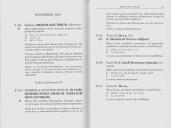
From the Vatican Ordo in 2014 (the last time this happened) - the way you can tell is the omission of mention of the Gloria and Credo in the case of All Souls and the contrasting inclusion of the Gloria and Credo on the previous day's solemnity:
 1600 x 1199 - 268K
 -
. It's one of those things where the order of precedence in its particulars is not necessarily clearly engaged in more general
To that point @Liam there are some specific issues with Saturday Vespers and evening Masses that the table of precedence has wrong but the CDW never published the corrections except in Notitiae, which hardly anyone reads.
Re: the Dutch custom, although I still want to move All Souls, it’s always funny when Americans discover that Europeans, even libs, wear violet for funerals.
@FSSPmusic, we used to do that but then Memorial Day fell on Pentecost Monday, and it’s frankly a busy time for us: Rogation Monday, Corpus Christi, Ascension…those are more important if I have to cut one.Thanked by 1Liam -
The Gloria is omitted as it is never sung when the liturgical color is/can be violet. The Creed is said because it is a Sunday.
-
That’s logical enough, but the rubrics should, you know, say that. They don’t. I don’t see why Masses for the dead should retain the Alleluia, which is not necessarily a problem with respect to the color, if violet is worn, since it’s said in Advent (but not on weekdays!) and on the Rogation days (albeit in a special form pre-1962) but it becomes more so once we admit black (and it’s licit to wear black all over the world…) and therefore remind ourselves that no, this really is a prayer for the dead.
Also @Andrew_Malton:It does not have a first Vespers because it isn't a Solemnity, it's a ” Commemoration” -- and it concurs with a Solemnity that has is own proper Vespers.
Prior to 1911, and through the Divino Afflatu period until 1961, the office of the dead only had Vespers, Matins, and Lauds, said in the same way for All Souls, funerals, and the appointed days after death or burial, plus anniversaries. On other days, only one nocturne needed to be said attached to the main office, the antiphons were not said in full before the psalms, and an extra psalm was said at the end of the office a bit like the repeated Miserere of the Lauds of the Triduum.
After 1911, Pius X added new readings for Nov 2’s Matins (it’s a disaster) and there is now a complete office from Vespers of the dead through None, replacing the office of the octave from Compline. What it never had, until 1960, was evening Vespers of the dead to conclude the day’s cursus: it mimicked feasts (every feast except on rare occasions where a feast reduced to a commemoration wasn’t part of I Vespers of a major feast). This is why the office of the dead is the way it is in the Liber, which is to say that it’s all over the place if all you ever do is the Subvenite then the Mass and absolution. On Nov 1, Vespers of All Saints is sung, then that of the dead, and then Compline follows accordingly (of Sunday with the solemn tone of the hymn pre-1911, the new form of Nov 2 for anyone doing Divino Afflatu). That is done on Nov 2 with Sunday’s Vespers in cases like this year’s.
Naturally this continued into the Novus Ordo, and since you don’t move All Souls, you have a bonkers problem on Nov 1 and 2, where the office may be said only publicly, but priests have to pray the day’s office only. Bizarre. So long as you do the canonical office and then add that of the dead to it, there’s nothing wrong with praying the office of the dead on a Sunday (the Requiem, with its ceremonies, is another matter). -
So, I contacted the USCCB Divine Worship Committee and they said the Gloria is omitted but the Creed is said.
-
My Ordinariate ordo (Chair of St. Peter) says no Gloria, yes Credo.
-
I managed to check our Ordo, which says both Gloria and Creed are said, but I've known the Ordo to be very wrong before. Might see if we can contact the diocesan liturgy office.
-
@GerardH See my comment above- USCCB liturgy office said yes creed no gloria.
-
@monasteryliturgist I'm not in the USA
-
And you are where?
-
Not in the UK or Canada either :p
-
@GerardH ah! Too bad! Well you are always welcome!
-
@FSSPMusic: in my, English, diocesan ordo for Remembrance Sunday the requiem Mass is always given as optional, and it’s directed to be with Creed, no Gloria (in the NO).Thanked by 1tomjaw




Welcome to the MusicaSacra Forum!
To participate in the discussions on Catholic church music, sign in or register as a forum member, The forum is a project of the Church Music Association of America.
Categories
- All Discussions21,810
- General Music Discussion8,534
- Job Openings290
- Management of Music Programs862
- Choral Matters539
- Church Documents and Rubrics540
- CMAA Notes307
- Events758
- For Newcomers: Read First26
- Sacred Polyphony566
- Hymnody896
- Gregorian Chant: General2,746
- ↳ Graduale Romanum and Liber Usualis372
- ↳ Graduale Simplex60
- ↳ Semiology65
- Vernacular Plainsong704
- Anglican Use and Anglican Chant72
- Organ, Other Instruments and Repertoire450
- New Composition/Works in Progress1,338
- Recordings238
- Music for Hispanic Ministry163
- Music Education: Children217
- Music Education: General222
- News Items246
- Positions Wanted3
- General Discussion: Catholicism742
- Amusements185
- General Discussion1,047
- Opinions119