
Antiphonale Romanum (2009) question
-
For the Gospel Canticle "Salus et gloria" at second vespers of Sunday, the new Antiphonale provides the following direction at p. 457:Tempore per annum, canticum Novi Testamenti canitur modo responsoriali, cum Alleluia.
Aliis temporibus, canticum Novi Testamenti canitur modo troparii, cum Alleluia et antiphona.
This would seem to be further explained at p. 10:Antiphona ad canticum dicitur modo troparii ante et post canticum
My question: what is meant by "in the manner of a trope"? I know what a trope is, but I find this direction strange. Is it just that during ordinary time, there is no antiphon before and after the canticle, but in other seasons there is an antiphon? But then why not just say that? Is the canticle supposed to be interpolated somehow into the antiphon? If anyone has any insight into this, I would very much appreciate it! -
In the Ordo Cantus Officii (p. 54, no. 97) this was expressed as follows: In omnibus temporibus, praeterquam in Quadragesima, canticum Salus et Gloria cantatur more responsoriali cum Alleluia.
In the new Antiphonale Romanum, during Advent, Christmas and Easter Season, an antiphon has been added to this canticle, which is sung before and after the canticle. Now, with the antiphon added, it is called modo troparii instead of modo responsoriali, but the canticle itself is still sung responsorialy with Alleluia. Note, however, that on page 457 the canticle is sung modo troparii, whereas on page 10 and 30 it is said that the antiphon is sung modo troparii. Strange indeed.Thanked by 1igneus -
I would interpret both indications as meaning that, rather than
||: first half of verse, Alleluia, second half of verse, Alleluia :|| Gloria Patri, Alleluia, Sicut erat, Alleluia
as is the case during Ordinary Time, during Advent, Christmas Season and Lent, the Salus et gloria is sung thus:
Antiphon ||: first half of verse, Alleluia, second half of verse, Alleluia :|| Gloria Patri, Alleluia, Sicut erat, Alleluia, Antiphon -
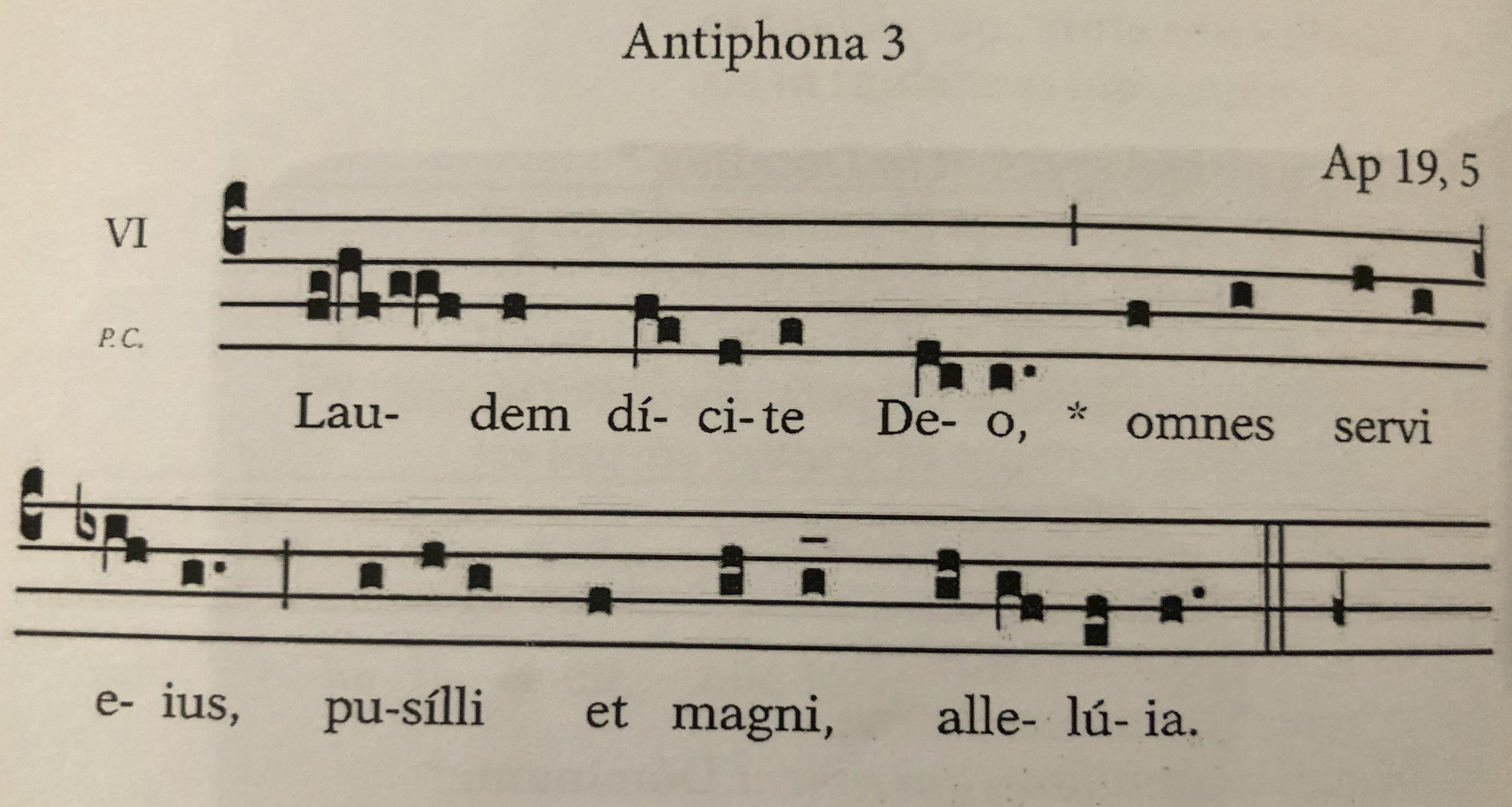
I attended Sunday vespers in St. Peter's basilica during the Jubilee of Youth, and I was surprised to find out that the canticle Salus et gloria during Ordinary Time was actually sung with an antiphone, "Laudem dicite Deo", with exactly the same text as the antiphone in the Liturgy of the Hours for week II and IV. I am attaching a picture of it.
Would there be anyone residing in Rome who could take a photo of the antiphone for week I and III as well, "Regnavit Dominus Deus noster omnipotens, alleluia" so that I can include that in my vespers booklets in Latin and Swedish? I have not been able to find such an antiphone on either GregoBase or Antiphonale Synopticum (and not the "Laudem dicite Deo" used in St. Peter's basilica either).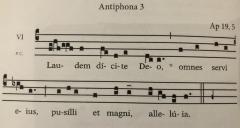 3719 x 1985 - 1MThanked by 1igneus
 -
This must be a neo-gregorian composition then. It’s not mentioned in the 2015 Ordo Cantus Officii, nor does it appear in any recent chant book.
-
Pablo Colino: Liber Vesperalis, p. 84
The book is in modern notation. While the melody is the same, this square notation rendering makes changes to some rhythmic details.
(I won't provide a picture of the requested other antiphon, as it's copyrighted stuff and my conscience doesn't evaluate this particular theft of intellectual property as justified.)
A related thread may be of interest. -
(... and Colino's neo-gregorian antiphons mostly aren't worth stealing anyway.)
-
I won't provide a picture of the requested other antiphon, as it's copyrighted stuff and my conscience doesn't evaluate this particular theft of intellectual property as justified.)
FWIW: In North America (and possibly other countries) there are fair use copyright laws that allow people to copy and small portions of copyrighted material.
-
FWIW: In North America (and possibly other countries) there are fair use copyright laws that allow people to copy and small portions of copyrighted material.
In Germany (and other countries) citations are allowed for the sake of discussing the cited content. This is necessary to allow for controversial discussions: If a citation would require permission, it would only be given for laudatory contexts and critics would be made impossible. In the US, citing for the sake of criticism or commenting is explicitly listed in §107 as an example of fair use. -
I'm based in Czech Republic and the law here is particularly strict with regard to copying music notation. There are fair use clauses, but music notation is explicitly excluded.
I may be missing something, but AFAIK I am not allowed to copy a notated portion of a book's content and share or publish it online. And I don't see a reason to consider the prohibition unjust in this particular case and ignore it. -
This isn’t theft of IP and if you can’t contribute the photo then it’s not a worthy contribution to this forum. Like, it’s just slander at that point. (If you had left it at the copyright, I think that I’d still be mad, but you go on to criticize it, so let us decide for ourselves.)
-
Liber Vesperalis by Pablo Colino seems to be out of stock. If there is any possibility to buy it, either first or second hand, I would be very happy to do so. Otherwise, I would also be very happy if someone could provide me with just this single antiphone (it seems to me that the comments by SponsaChristi and Xopheros above regarding the copyright issue are correct).
-
And no university libraries in North America seem to have it, according to WorldCat.
-
Not the kind of book I would expect to find in university libraries. It's a cheap publication (poor binding, paper, very basic typesetting) without scholarly ambitions: the preface cites four modern-era chant editions as its sources, but it really has a single main source, Liber usualis; second most used is Liber hymnarius with three hymn tones reproduced.
A practical solution of liturgical needs at St. Peter's - and not much more than that. -
-
The site with Vespers chants used in the Prague cathedral was defunct for a long time, but it seems to be restored now. The antiphons with literal texts from Liturgia horarum are available in archived Sunday Vespers from before the adoption of the Antiphonale Romanum II from Solesmes (blue letters here).
I'm not sure who their author is. I thought everything not available in Liber usualis (and possibly some other commonly available chant books) was local production, mainly by the gentleman who for a long time was responsible both for typesetting the booklets and directing the Latin Vespers choir, but upon request some unidentified book, obtained in the eighties(?) by one of local canons in the Monserrat(?) abbey was vaguely mentioned as source of the common repertory.




Welcome to the MusicaSacra Forum!
To participate in the discussions on Catholic church music, sign in or register as a forum member, The forum is a project of the Church Music Association of America.
Categories
- All Discussions21,826
- General Music Discussion8,540
- Job Openings291
- Management of Music Programs862
- Choral Matters539
- Church Documents and Rubrics540
- CMAA Notes307
- Events758
- For Newcomers: Read First26
- Sacred Polyphony566
- Hymnody897
- Gregorian Chant: General2,749
- ↳ Graduale Romanum and Liber Usualis372
- ↳ Graduale Simplex61
- ↳ Semiology65
- Vernacular Plainsong704
- Anglican Use and Anglican Chant73
- Organ, Other Instruments and Repertoire451
- New Composition/Works in Progress1,339
- Recordings238
- Music for Hispanic Ministry163
- Music Education: Children217
- Music Education: General223
- News Items246
- Positions Wanted3
- General Discussion: Catholicism742
- Amusements185
- General Discussion1,048
- Opinions119