
Tone 3 pointing: Lauda anima mea
-
We're getting ready to sing Dufay's Office this Tuesday with the 'five laude' Psalms (a cursus I've only come across in 17c Venetian context before), but I'm a little unsure about pointing CXLV, Lauda anima mea. This Psalm does turn up in LU as part of the Office of the Dead, but I want a iii toni pointing, and hope someone can tell me whether I'm on the right track below; the la-do of the given differentia is presumably(?) a Cambrai dialect rather than a typo.
-
Tone III mediation is a two-accent cadence (with no preparatory syllables). Notin vita mea
butin vita mea
In verses where the clivis slides down to the unaccented additional syllable I find it very useful to have this indicated in the pointing, e.g. likein princípibus
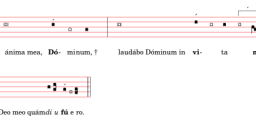
Unless there's an indication somewhere to do otherwise, I would understand the termination as a variant of Vatican edition tone III.a2, i.e. the a-c pes is not for the accent, but for the second preparatory syllable.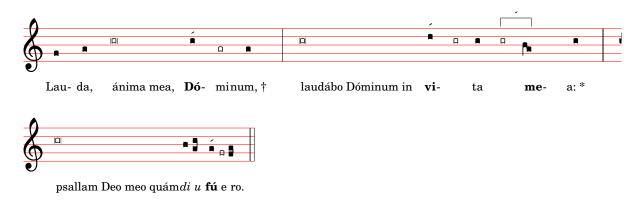
 634 x 213 - 17K
 -
What igneus said.
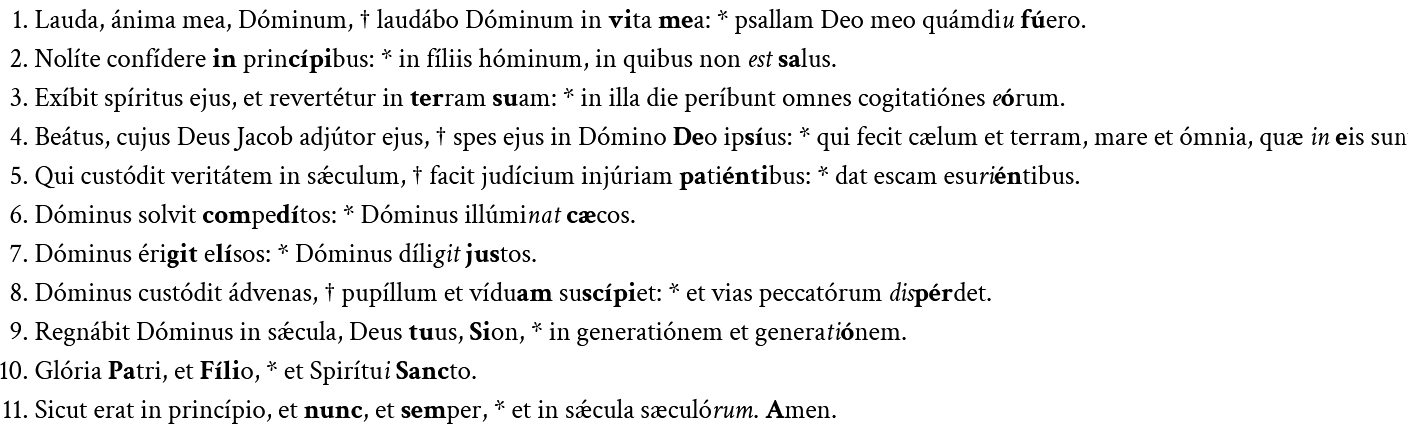
I was able to produce the attached results with Ben Bloomfield's Psalm Tone Tool - format verses as html for formatted text which you can copy and paste into your program (or change the .txt file attached to .html and open that in your browser to do the same).
@igneus, what program are you using to output chant notation on a modern staff?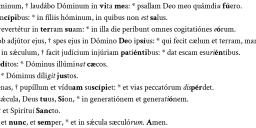 1408 x 429 - 114K
 3KThanked by 1Richard Mix
 -
There is a missing L in psallam.
The Sarum noted breviary produced by William Renwick also has a single punctum so the incipit is Sol-La-Do on three separate puncta and three syllables (or if you prefer, on two and two, since the third is the reciting tone), not a punctum on one syllable and a podatus on the next as in the Vatican edition. If you wish to stick to the first, and the dominant there is Do, I’d keep that, but if you go for the Vatican incipit (which I like because it’s distinct from tone 8 and therefore tone 2), you could also consider dropping the dominant to the original Ti. (I am being led to believe that by Dufay’s time the dominant had shifted.)
But that gets to your original question: the Vatican edition gives La-Ti for this podatus; as igneous notes, this is close to tone 3a2, which is very common on feasts. But I can’t assess if one or the other would be more correct for a performance of Dufay (and that depends on your goals, of course; I would probably just sing the familiar one and be done with it, but I also am prone to hesitating and wishing to follow the source).
And I also don’t understand your pointing, even aside from the problem of correctly aligning the podatus. I would certainly keep one major accent with two preparatory syllables, with the punctum cavum note sung on additional syllables per the Vatican edition for simplicity’s sake.Thanked by 1Richard Mix -
I hadn't occurred to me to try the Psalm Tone Tool, which seems very handy (though it gives only a single preparation for the termination?) Thanks all around, and if I've now got the hang of things, this is (abbreviated) version should work better:
-
Yes. Apart of one incorrect flex (should be ádvenas, not advenas) I don't see errors, only inconsistencies in marking up the "slide" of the clivis in mediation to the additional syllable (marked up in "principibus" vs. not marked up in "patientibus" and "suscipiet").Thanked by 1Richard Mix
-
The flex is always a bit counterintuitive since the dactyls are dominant-lower note-lower note.
-
I came to the right place then!


Welcome to the MusicaSacra Forum!
To participate in the discussions on Catholic church music, sign in or register as a forum member, The forum is a project of the Church Music Association of America.
Categories
- All Discussions21,810
- General Music Discussion8,534
- Job Openings290
- Management of Music Programs862
- Choral Matters539
- Church Documents and Rubrics540
- CMAA Notes307
- Events758
- For Newcomers: Read First26
- Sacred Polyphony566
- Hymnody896
- Gregorian Chant: General2,746
- ↳ Graduale Romanum and Liber Usualis372
- ↳ Graduale Simplex60
- ↳ Semiology65
- Vernacular Plainsong704
- Anglican Use and Anglican Chant72
- Organ, Other Instruments and Repertoire450
- New Composition/Works in Progress1,338
- Recordings238
- Music for Hispanic Ministry163
- Music Education: Children217
- Music Education: General222
- News Items246
- Positions Wanted3
- General Discussion: Catholicism742
- Amusements185
- General Discussion1,047
- Opinions119