
Origins of Oremus Pro Pontifice chant
-
I'm trying to figure out whatever I can about the origin of the Oremus Pro Pontifice chant. I haven't been able to find any manuscripts, although it seemed to be quite popular in the early 20th century chant books. Any leads as to who/when/where this piece was composed/arranged/found?
-
It’s from the Divine Office and goes back to the Medieval Latin Rite.Thanked by 1OMagnumMysterium
-
The text Oremus ... inimicorum eius is taken from preces feriales, but the custom of singing this particular versicle on its own to some sort of solemn musical setting doesn't seem to be much older than late 19th c.
As for the chant setting divulged in Solesmes chant books, I bet it was created in Solesmes as an answer to the various choral settings popular back then. -
My notes are that Variae Preces, 2nd edition (1889), p. 136 is the earliest I was able to find it.
Cantus Selecti has notes on the sources of many chants, and for this it says: "Textus psalmi 40, v. 1. Auctor melodiae est Dom Pothier O. S. B. († 1923)." -
Yes, it’s…a bit hard to be quite honest, and I prefer to read it in the vernacular or to sing the Tu es Petrus in Latin.
There are a few which don’t have an attribution (or otherwise I have to go check) and I wonder who it is if it wasn’t Dom Pothier.Thanked by 1OMagnumMysterium -
Thanks, all.
It's nice to know that our good old friend Dom Pothier cobbled this one together himself. Matthew, I certainly have mixed feelings about his setting as well. I actually like the melody, and don't find it too hard to sing; the beginning I find reminiscent of a fanfare, and the way it floats around between modes I do enjoy. The mode 8 intonation, cadence onto Re, shifting recitative throughout, cadance onto Mi and then final cadance onto Re again. But the problem I have is that it doesn't really follow the traditional logic of gregorian chant, as far as I can tell. What I mean is that the first millennia chants have a certain rationale which allows reconstruction, shows consistent structure, and has certain "rules" that each genre follows. This chant seems to be cobbled together free of much in the way of modal or rhythmic requirements. It seems entirely free rhythm in its compositional rational.
I've had a look at the choral settings at IMSLP, but none of them are what I'm looking for. If someone knows of a choral setting which could be easily learned by a congregation and sung robustly, please let me know. But almost all the choral settings I've seen so far are polyphony, not appropriate for a congregation. And I'm not a fan of the Schubert...
But digging a little deeper, I've found what appears to be an Ambrosian setting, in an appendix of the Ambrosian Vesperale. If anyone has more information on this setting, or has an idea what "centon" means, please share.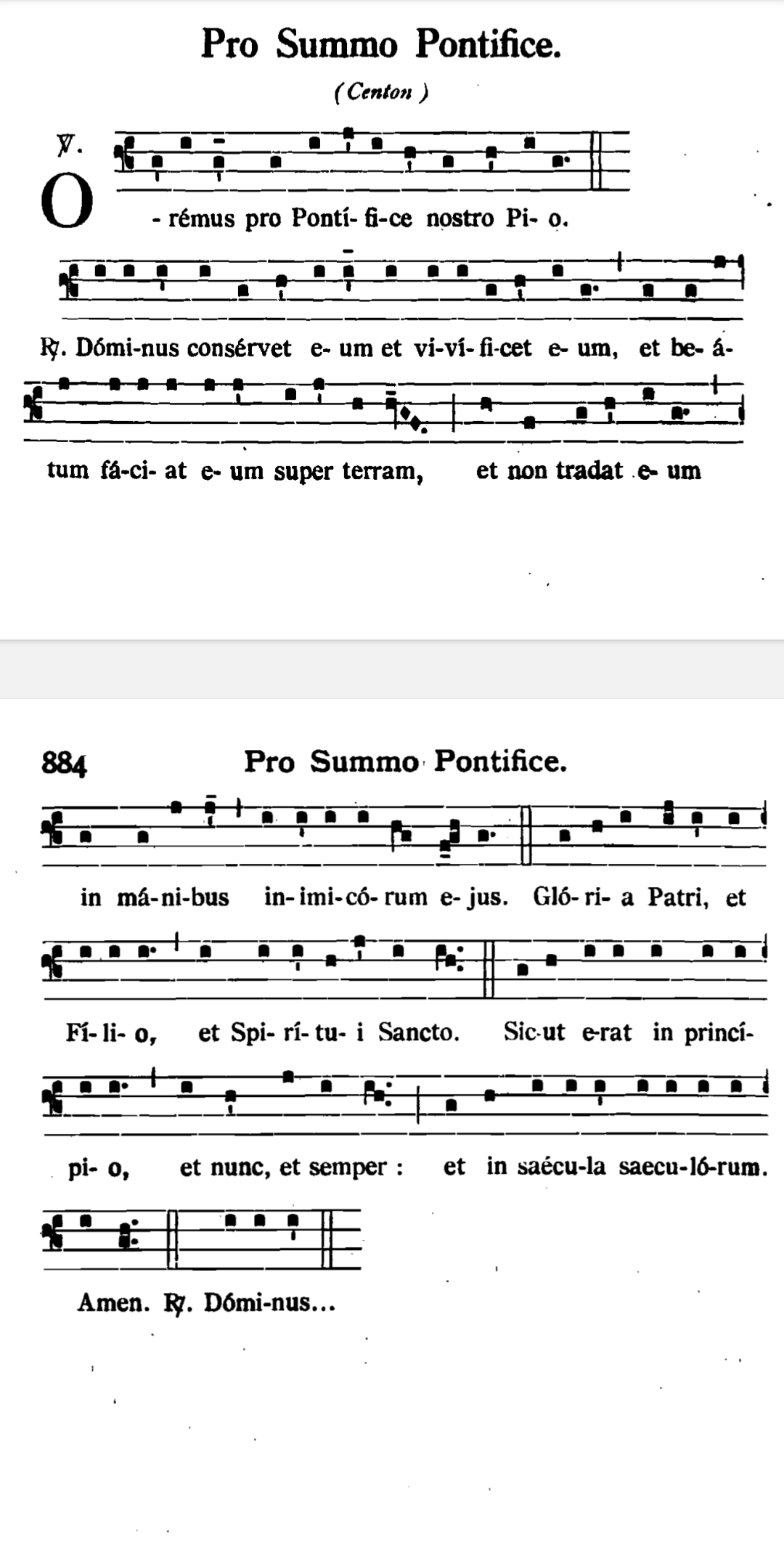
 1080 x 2160 - 304K
 -
“Centon/cento” means the music has been put together from other sources (something like the “soup” my mother would make in lean times, out of whatever leftovers were in the fridge). The term is frequently abused and liberally applied. Could be that this is an existing melody retexted, pieces of several tunes combined, a new composition inspired by something else, or a humble editor who had to compose this, but did not want to claim credit for himself.Thanked by 1OMagnumMysterium
-
There are a few which don’t have an attribution (or otherwise I have to go check) and I wonder who it is if it wasn’t Dom Pothier.
The familiar Cor Jesu sacratissimum is unattributed. So is the one that shares a melody with the Litany of the Sacred Heart. (That might postdate Pothier, actually.)
I don’t think that I found the sources to which Cantus Selecti refers for the familiar mode V Adoremus in aeternum; I know that I went looking, as I put the sources in our booklets (I think that disambiguating mode, melody, and source helps, even if only passively: like, a handful of people probably read it in our booklets, but it shows that we’re not just making it up, even if the choices are arbitrary).
I wonder where that version of the Liber got its melody for the alternate Adoremus. And then the ton royal for ps 116 (modified by Solesmes to be more Gregorian) isn’t given a source, but, like, it’s obviously the ton royal in mode 6.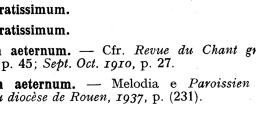 2289 x 508 - 280KThanked by 1OMagnumMysterium
 -
The text Oremus ... inimicorum eius is taken from preces feriales
Turns out I took for granted something I shouldn't have. The verse was only introduced in the preces feriales of the Roman Breviary as part of the breviary reforms of Pius X (cf. preces before the reform). Before it was included in preces of some local breviaries, but even there it seems to be rather an addition of the 19th c. than an ancient feature.


Welcome to the MusicaSacra Forum!
To participate in the discussions on Catholic church music, sign in or register as a forum member, The forum is a project of the Church Music Association of America.
Categories
- All Discussions21,849
- General Music Discussion8,551
- Job Openings293
- Management of Music Programs862
- Choral Matters539
- Church Documents and Rubrics540
- CMAA Notes307
- Events761
- For Newcomers: Read First26
- Sacred Polyphony567
- Hymnody898
- Gregorian Chant: General2,749
- ↳ Graduale Romanum and Liber Usualis372
- ↳ Graduale Simplex61
- ↳ Semiology65
- Vernacular Plainsong704
- Anglican Use and Anglican Chant73
- Organ, Other Instruments and Repertoire452
- New Composition/Works in Progress1,342
- Recordings238
- Music for Hispanic Ministry163
- Music Education: Children217
- Music Education: General223
- News Items247
- Positions Wanted3
- General Discussion: Catholicism742
- Amusements185
- General Discussion1,048
- Opinions119