
Proper Use of the Cope & Organist/Choir Vestments
-
Can lay people vest in a cope? For instance, a cantor? I have heard of some Parishes doing this, but have also heard "NOPE. The Cope belongs to the ordained." Any thoughts on this?
-
...why?
-
As in, why am I asking? More out of curiosity than anything.
-
As in, why would a cantor wear a cope? I'm as curious as you are.
-
Yeah, I'm not sure. But I think I remember reading something about the cantor wearing a cope for various proclamations. Specifically, the Announcement of the Moveable Feasts on Epiphany....?
-
Bp. Elliott's "Ceremonies of the Liturgical Year" specifies that a cantor or reader wears an alb or cassock and surplice for this ceremony; a deacon wears a white cope, unless he is already vested in a dalmatic.
(p. 43). -
In some Benedictine monasteries (I'm thinking of Saint Meinrad Archabbey), on solemnities (and maybe feasts) you'll see Vespers being led not by the one cantor assigned for the week but by a trio of cantors in copes, huddled around a central music stand and microphone between the two sides of the choir. The cantors wouldn't always be priests, and at Vespers no distinction is typically made between lay and ordained monks anyway (although Solemn Vespers may need a priest and two deacons to be the sacred ministers; not sure).
So I don't know if it comes from Benedictine tradition or not, but when I think of lay cantors in copes, I think of a solemn Vespers (I guess Lauds could be done similarly) on a holy day. I've also heard of a lay cantor chanting the Exsultet if no deacon or priest or bishop was capable, but I don't know the rules on that and haven't experienced it.
I don't think a cope is as reserved to clergy as a stole or chasuble or dalmatic would be.Thanked by 1TheUbiquitous -
In the Sarum Use alleluya was on great feasts chanted by choirboys (the number depending of the importance of the feast) vested in copes and singing from the rood loft. Obviously, we have lost all sense and sensibility in our advanced era.
(And, Sarum was not alone in such liturgical niceties.) It is the custom at Walsingham for the thuribler to wear a rochet, a practice borrowed from Sarum. Crucifers also wear tunicles in many Anglican churches, no doubt an old practice which was never thought disposable. High Anglican churches also put their acolytes in apparelled albs and amices, not the later day and not-very-traditional cassocks and surplices (or even worse, those funny so-called cottas [chopped-off surplices]) that scads of Catholics seem to think are very very traditional and ancient. They're Not. Albs Are. I think strongly that in this and other liturgical praxes, we should restore, and even innovate, some of the diocesan uses and customs that were for most of the Church's history a fact of life. How burdensome and boring it is when every jot and title has to be codified and concretised into law.Thanked by 1CHGiffen -
Excuse me while I go look up what a tunicle is! :-)
-
Excuse me while I go look up what a tunicle is!
That's the melody of a versicle.
-----
A Cope is just a Cape, which has been consecrated to liturgical use.
(And, of course, its usually a pretty particular style of cape.)
If it has been so consecrated, it should only be used for a legit liturgical reason. So the question isn't quite who can wear it, but when it is worn. The "when" limits the "who," but the "who" isn't primary: a Bishop doesn't wear a cope to go grocery shopping.
(You know- unless he's Episcopalian or something.)
Can a lay person wear a chasuble and stole? Sure: Any lay person who is qualified to consecrate bread and wine... oh, wait. There aren't any lay people like that.
Can a lay person wear a chasuble-shaped bath robe with a stole-shaped scarf? Sure. But it would be really weird if that lay person showed up to Mass dressed that way.
I saw a really neat video a while ago of some kind of Traddie fest or something (French, IIRC). The choir was mixed and "vested." But, since they were conservative traditionalists, the women did not wear cassock and surplice. Instead, the women wore an alb (I think), and a heavy cape in the same color/material as the men's cassocks (a sort of light Marian blue). It was a nice effect. One could refer to these as copes, if one was being weird.
If the curiosity stems from a personal desire to wear a cape (I'm not joking- I can totally understand this!) - there is precedent for wearing capes in choirs. They aren't copes- but they are pretty awesome. -
The use of copes by cantors on high feast days at Mass & Office is only licitly used in the EF (cf. Ceremonies of the Liturgical year; Fortesque, et. al), and is verboten in the OF (cf. Ceremonies of the Modern Roman Rite; Elliott). There are other elements which have been lost.
In the EF the choir and cantors (in choir dress, and cantors in copes) process with the clergy and sit in the stalls when going to sing the liturgy (unless they are already there from another function (e.g. Terce before High Mass). In the OF the choir and cantors (in choir dress, but withou copes) go to their places before liturgy begins.
There so many other little things that make a big difference that have been suppressed, that I wish would be brought back. Kissing items (cruets, biretta, etc.) that are handed back by the Priest/Deacon being one of them. It is a small thing, but it says "these items have been set aside for sacred use, they must be treated with care and respect." -
Adam, I know who you're talking about. Is it this pic?

-
I would be more interested in what liturgical norms Elliott is citing than in his book, which is not an official one.
-
That's the choir I was thinking of, yes.
-
That picture brings back many happy memories; thanks for posting.
It was taken on August 10, 2005 at Ottobeuren Basilica in Bavaria during a Pontifical High Mass (EF) celebrated by Bp. Fernando Arêas Rifan—the opening liturgy of the International Federation «Juventutem» WYD delegation. One of the men in the front row is now an FSSP priest.
Somewhat back to the topic at hand, I thought the capes for the ladies were fantastic (still do). The choir's dress code was all black (besides the blue cape for the women and the blue cassock for the men). -
In response to MJO's post, I believe the monks of St. Louis Abbey have apparelled albs for their sets of vestments for the EF. They are gorgeous, and the connection makes sense as that foundation is from Ampleforth.
-
Salieri confirmed my suspicions. I figured this stemmed from the EF when the cantor had a more prominent role. I was not, however, aware that it was not licit in the OF.
The curiosity stemmed from a personal desire only insofar as to more visually set liturgical rarities apart. I am currently looking into, as the organist, vesting in C&S for holy week and solemnities (probably funerals and weddings as well, since it provides a visual cue to behave appropriately for unchurched congregations), but I am the cantor fire Good Friday since we don't use the organ and thought the visual of the C&S with a red cope would really open the congregation's eyes. I must confess, I would probably feel a bit silly, but this congregation needs the extra visual simulation, I think. However, if it's not licit, there's no question!Thanked by 1TheUbiquitous -
I am the cantor fire Good Friday since we don't use the organ and thought the visual of the C&S with a red cope would really open the congregation's eyes.
At first I thought "fire" was a typo. Then I got to "red cope."
Hrmm...
Please do not do this.
Vest the choir in black cassocks, or don't. Don't you, on your own, vest separately from the choir.
And do not, under any circumstances, put on a red cope. You are neither a cardinal, nor Superman. -
Ask your pastor and do what he says. As far as any musician or minister is concerned, he is the lawful authority - plus, you have to live with him.
-
Hahaha fire definitely was a typo.
Aside from the laity issue, are copes not supposed to change color with the liturgical season? Is red reserved to Cardinals? Our priests wear a red cope for the first Gospel of Palm Sunday and also for Palm Sunday Vespers.
No worries! I won't be donning a cope any time soon.
There are a couple of threads on here about the organist vesting so I don't want to beat a dead horse or go too far off topic, but what is the reasoning behind the organist not vesting if the choir doesn't? Is it because it is all essentially the same Ministry and it would be akin to having some servers vest and others not on the altar? Because that does make sense.
On the other hand, perhaps the organist and cantor are two distinct liturgical roles (or are the only two present). Could those two then vest even if the choir doesn't?
I ask mainly because considering the direction like liturgy and music are taking, it feels a bit odd to me not to be vested. I very well concede to anyone else's knowledge on the matter, though, since it is still new to me. (Although, I was hoping to avoid starting a new discussion on this subject, hahaha.) -
Charles, you are correct. However, pastors are not always as aware of liturgical qualifications and requirements as we are. In fact, mine frequently defers to me for "what the documents say." I prefer to read up a bit before just taking a priest's word for it. :)Thanked by 1TheUbiquitous
-
bk-XXVII.
Red copes are not reserved for cardinals - don't get these confused with the red capes worn by cardinals as part of their habito piano ('street dress' i.e. cassock, fascia, etc.) when the cappa magna is not worn.
However, for the Goode Friday solemn afternoon Liturgy of the Passion, the colour for the liturgy until holy Communion was black, and from holy communion the color was violet; red for Goode Friday (in the Roman Rite) is a Novus Ordo thing (I think borrowed from a Mediaeval source? Sarum? York?). I'd have to consult Fortescue, but I'd surmise that since the ceremonial for Holy Friday (like the Requiem Mass) is pared down, I'd suspect that cantors would not have worn copes at all at the afternoon liturgy - certainly at the Office only choir dress was worn and No-one, neither clerk nor boy, wore copes. -
Choir dress does not change color with the season. If you are vested in choir, the traditional color is black. As discussed in another thread (probably the one about organists vesting) some specific places vest in another color for some site-specific reason (a dedication to the BVM, a cathedral, etc), but those are generally special cases.
The reason not to vest as an organist/cantor/director unless the whole choir is vesting has nothing to do with rules and everything to do with not making vestments about you, the wearer. If the whole choir vests- then the whole choir vests and there is nothing weird about it. If one person over (up) there vests, then its an affectation.
Liturgy is not theatre, and vestments are not costumes.
-
Liturgy is not theatre, and vestments are not costumes.
Though there are certain vestments that look more like costumes and churches that look more like theaters.Thanked by 1CHGiffen -
Back on a computer, so hopefully fewer typos will work their way in....bk-XXVII
I'm stealing this. Forever. FYI, the 27 happens to be my birthday (January 27).Red copes are not reserved for cardinals - don't get these confused with the red capes worn by cardinals as part of their habito piano ('street dress' i.e. cassock, fascia, etc.) when the cappa magna is not worn.
Okay, thanks. That's what I thought.Choir dress does not change color with the season. If you are vested in choir, the traditional color is black. As discussed in another thread (probably the one about organists vesting) some specific places vest in another color for some site-specific reason (a dedication to the BVM, a cathedral, etc), but those are generally special cases.
Right. My question about "red" pertained only to the cope which, thanks to the folks that have responded, I now understand is not part of choir dress, especially in the Norvus Ordo.The reason not to vest as an organist/cantor/director unless the whole choir is vesting has nothing to do with rules and everything to do with not making vestments about you, the wearer.
An excellent point. I can see how it might read to a congregation if no one else is vested. I hope you understand, though, that that isn't so much the place I was coming from. If I could, I certainly would want the entire choir to vest... but it gets costly. I suppose, too, that there are bigger issues within the liturgy that need to be worked out so we're not polishing the doorknobs while the church burns behind them. :) -
Re:Use of Copes on Good Friday. Both the Caeremoniale Parisiense and the Missale Sarum ask for copes to be used on Good Friday (in black [Popule meus] and red [Agios] for the Parisian Use [which uses black for the Celebrant] and in black for the "Agios" Cantors at the Impropreria for the Sarum Use [which uses red for the Celebrant and Ministers of the Altar]).Thanked by 1Salieri
-
Interesting! I love the color distinctions in the Improperia.
-
Every time I hear some new detail about the Sarum use, I think... now THAT was a Mass and a half, for real, yo.
-
Resurrecting for a tangent. I am beginning to talk to people about various music ministers vesting. How would you introduce this to a staff and congregation that has perhaps never seen it before?
-
Do you have an idea for what sort of attire you want to propose? Would it apply to all music ministers, or only those in the sanctuary? Would the same attire apply to men and women?
-
BK-XXVII,
(Benedict-Karl XXVIII?)
There's nothing inherently evil in the choir vesting, but you'll have quite a fight on your hands if parish staff and congregation are completely unfamiliar with it. I don't know your particular parish situation, but you want to avoid the appearance that the choir is trying to draw attention to itself: the purpose of the uniform cassock for a choir, in a litugical setting, is to remove distinction, not bestow it (unlike at an academic setting, where the hood is distinctive and intentionally so). If the purpose is to bring greater sense of discipline to the choir and reverence to the liturgy, dress simply. Otherwise, you're likely to set off a chain reaction of "me-too-ism", so everyone under the sun will suddenly need distinctive dress for Mass......
-
Black really? I know it is not supposed to be about theatre, and I don't want it to be about theatre. My choir is in the loft, so except for communion, no one sees us. But black is so dull and depressing. That blue was stunning. We wear gowns to look uniform and to draw attention away from those who insist on not dressing modestly (a problem).
-
Black has the advantage of neutrality, both religiously and visually: it's not associated with any season, and it won't especially clash with anyone's own color (hair/eye/complexion).
-
One of my choirs wears black academic robes, but that is because it is the college choir. At a few masses I have been to, we've had the men in cassock and surplice with the women wearing black academic robes. There are those who object to women wearing cassocks as it is traditionally considered clerical attire.
I believe that Acolytes may wear a tunicle, but it is a tradition which seems to have fallen out of use. There was a permanent deacon that I knew who only wore an alb - never even put on his stole let alone a dalmatic.Thanked by 1TheUbiquitous -
There are those who object to women wearing cassocks as it is traditionally considered clerical attire.
This deserves highlighting.Thanked by 1TheUbiquitous -
Academic robes is not a good solution to "women can't wear choir cassocks."
Academic robes are an evangelical Protestant thing. I can hardly believe any Catholic would think them appropriate for liturgy in any context. -
I've seen academic robes on non-evangelical Protestants: e.g., UCC ministers.
Anyway, the local Anglican-use congregation uses them for Evensong, but in the general Roman-rite context, I agree they're not used. -
I endorse black baccalaureate robes for a choir. There's no conflict with liturgical colors. There's no confusion with the clerical cassock. It covers a multitude of sins with its looseness. It shows the dignity of an educated laity. Like the puppeteers in Bunraku, the black robes hide the singers; unlike children, they are to be heard, not seen.Thanked by 1chonak
-
Chonak -
WHERE is this Anglican Use church that wears academic gowns for evensong? They must be reported immediately to our Vestment Police. This is unheard of!
Seriously: which Anglican Use church is near you? -
Thanks for the feedback.
I asked our pastor about women (and, specifically, girls) in cassocks and he didn't have a problem with it. As some of our female altar servers vest in cassock and surplice, I don't really see that as my issue to correct. I'm not the Director of Liturgy; however, I don't necessarily see it as ideal. I DO think that it would be a good stepping stone since the congregation is already accustomed to seeing the C&S.
This is where it gets a bit tricky. It would not be possible right now (financially or with regard to willingness) to have the choirs and cantors vest. So, (although I know there are many here who will disagree with me) I decided to start with myself so they can become used to the idea that ministers OTHER than Altar Servers can indeed vest in C&S. This, I'm hoping, will dampen the sensitivity to the vestments so that, eventually, we will be able to have the choir vest. (We'll probably start with the Children's Choir.)
I feel it important that choirs vest to reaffirm their identity as a group of people exercising a ministry... not simply performing. Whether they are in the loft or not I think is irrelevant.
So, going back to the fact that I am starting with me: this is why I want to educate the staff and congregation that it is an act of humility and, though it may not appear so, it is simple dress intended to remind the minister to be humble in their place as such.
This is also not going to be a weekly custom for now. Many of the Directors of Music in my area will vest for more solemn occasions which is what I plan to do. Sacramental/Ritual celebrations, Christmas, Triduum, etc.
Any other thoughts? -
All your ideas are spot on, faultless.
Godspeed in implementing them.
(Except that vesture is worn at all liturgy, not just on special occasions. Every single liturgy is a special occasion.) -
I would also say that while women in cassocks isn't your issue to correct, I also wouldn't spread the practice either by doing it in the chjoir as well. That could only make things worse if a future pastor ever tries to correct the practice.
-
I do agree with bkenney27. Back in my Anglican days, black cassock and surplice were standard for the organist and choir, women included--I was once asked to play a service as I walked into the church in a brown suit, and felt very undressed on the bench. In Gerre Hancock's time at St. Thomas's, NY, Fr. Andrew introduced red cassocks and long surplices for the choir. Here in western Mass there are no vested choirs and organists in the Catholic churches I know, and music is generally neglected. To my mind, vesting a choir implies that it's a real choir, and serious about its musical and liturgical business, but getting the congregation I sit in these days to understand that wouldn't be easy.
-
We aren't Anglicans. They "ordain" women too.
-
My suggestion would be for you to begin wearing C&S at every single Mass and liturgy and have your choir and cantors begin wearing all black at all times. Then raise funds for C&S for the gentlemen of the choir and male cantors. Then either leave it as is or add some plain blue choir robes for the women.Thanked by 1bkenney27
-
@Ben, the vesture used in Anglican liturgy has nothing to do with errors that have arisen since the 1960s. It's the same vesture prescribed for Catholic men's choirs in the sanctuary by Pope St. Pius X. They've kept their choirs in the sanctuary more than we have done.
@MJO: Occasionally Steve Cavanaugh of the Anglican-use community in Brookline, MA (St. Athanasius, Archdiocese of Boston) invites my old cathedral chant-group buddies for Evensong; he has mentioned that academic robes are welcome there.Thanked by 1CHGiffen -
I think Ben was specifically referring to the Anglican practice of C & S for choirs, women included.
-
Thanks, everyone!
The all black suggestion is an excellent, practical one. And I agree about the "every Mass" comment. We've got to ease them in. :)
I "debuted" the vestments at our monthly baptismal liturgy today and received very positive feedback. Not only that, I made a last minute decision to step away from the piano (I inherited this structure and music from past DMs...) and chant the alleluia and Litany. Suddenly, the silent congregation became a partially singing congregation! All around, a much better atmosphere.
I'll post what I plan to publish to the staff and congregation when I finish it. I'd appreciate input. -
Here's what the U.S. Bishops' document, Sing to the Lord: Music in Divine Worship says about choir vesture:
(33.) Choir and ensemble members may dress in albs or choir robes, but always in clean, presentable, and modest clothing. Cassock and surplice, being clerical attire, are not recommended as choir vesture. -
I dispute whether cassock and surplice are strictly clerical attire. Servers wear them all the time.Thanked by 1Adam Wood
-
Um, we know what albs are; but um, what is a 'choir robe'?
Curious, too, is that the alb, the attire of priests and properly dressed acolytes, is apparently considered non clerical, whilst c&s, which is choir habit, is implied to be strictly clerical. I would read the word 'recommended' as operational in this odd assertion. For Anglican Use Catholics, whose choirs wear choir habit, there exists no problem. -
Luckily, STTL has no intrinsic authority. Moving on...
I'm all for C&S for a choir, for the men. A men's schola that I'm in recently did so, and it looks pretty awesome. -
Luckily, STTL has no intrinsic authority.
Ben, I beg to differ. STTL was approved for publication by the full body of bishops at its November 2007 General Meeting. Yes, it was published as guidelines, and not liturgical law.
But in my estimation, any document approved by the full body of our bishops deserves serious consideration and respect, and does reflect an intrinsic authority of sorts, whether that document is about liturgical music, social justice issues, or other areas of concern.
The authority of Episcopal Conferences is something very real, as mentioned in documents of the Second Vatican Council.Thanked by 1TheUbiquitous -
Andrew: Aren't altar servers functionally acolytes?
-
Father, if they felt so strongly that it should be "important for our serious consideration and respect", then why was it not submitted to Rome, so that it could gain our respect as legitimate liturgical law?
Probably because they knew it'd be rejected, if you ask me. Try finding another plausible reason. That seems pretty obvious by the fact that it included things that were directly contrary to the Missal, so much that Rome even saw a need to change them. If they can't even sort out basic things like that (or, as was more likely, they could, and decided to disobediently put it in there anyways), then it deserves no respect from me.
I hate to be so cynical, but it's worked pretty well: they put together a document that couldn't pass as liturgical law, but still wanting it to be out there, they decide to publish it on their own. While it technically has no authority, many (most?) still treat it like it does, leaving it in a state of faux-law difficult to argue against, yet easy to spread.
This is kind of like the USCCB's page on the Holy Thursday Mandatum. It directly contradicts both the Missal's text AND the CDW's clarification of the question. Yet it remained online still, available by a quick search on the USCCB's site for either "foot washing" or "holy thursday". I won't even link to it. Just go to their site, and you can find it in 20 seconds. First thing that comes up.
Again, while this document has no authority on it's own, simply being published under the header of the USCCB gives it an air of authority, just like you say STTL should have authority. This is particularly disturbing, because again, it directly contradicts the rubrics of the missal, and in the case of the Holy Thursday mandatum page, it even admits that this is so ("While this variation may differ from the rubric of the Sacramentary which mentions only men...[feel free to do it anyway]"), EVEN AFTER being corrected by the CDW.
If they wanted the document to have authority and respect, they should have submitted it to the CDW. As it stands, they refused to do so, so it will have no such respect from me. -
If STTL ever holds authority, I'll take a job in Europe.
Thank you, Fr. Chepponis, for pointing that out, though. I have read and considered that statement; but I believe the statement is contradicted in any rubrics that speak to vesture. I don't have the Missal or other liturgical books in front of me, but am I correct in saying it actually calls for cassock and surplice when a cantor proclaims the Epiphany proclamation or the Exsultet? -
Regardless of STTL's "authority," I think it is well worth considering: It represents the thinking and interpretation of the relevant issues by the Bishops. Dismissing it out of hand seems as imprudent as following its counsel blindly. The thinking should at least be considered as part of the range of inputs one uses for figuring out what is the best approach in your particular situation.
That being said, I disagree with the thinking regarding C&S for choirs.
Also, I think trying to find documentary support for every single liturgical practice is a little...um.. what's word? ... something. It's definitely something.
Anyone know what the rules say about organ shoes? Paper color for printed programs? Whether pews should be cushioned or not?Thanked by 1Andrew Motyka -
Andrew: Aren't altar servers functionally acolytes?
They function as acolytes, but are notinstalledordained, and hence notministersclerics. My cantor might intone the Penitential Act in the absence of a deacon, but that doesn't mean he can wear a dalmatic. -
that doesn't mean he can wear a dalmatic.
Dang. I better call Almy and cancel my order... -
Andrew, you usually do a fine job responding to questions of a liturgical nature. I'm afraid I'd have to give you an "F" ("D" if I'm in a generous mood) for your last response!
Of course altar servers are liturgical ministers. However, most of them have not been "instituted" as acolytes. (Many parishes have commissioning or installation ceremonies for their altar servers, but this is not the Rite of Institution of Acolytes.)
And instituted acolytes are not clerics, either. Prior to 15 August 1972 a seminarian entered the clerical state (became a member of the clergy) with the liturgical rite of tonsure. But with his motu proprio Ministeriam Quaedam, Pope Paul IV suppressed tonsure, the four minor orders and the subdiaconate. The instituted ministries of reader and acolyte were established, but they were not "clerical" ministries. Henceforth, a man entered the clerical state through ordination to the order of deacons.
The vestment common to all liturgical ministers is the alb, and not the vestments placed over the alb (stole, dalmatic, chasuble) and worn by ordained ministers. A surplice/cotta is actually a mini-alb. -
Pardon my lack of precision. I wrote "ministers" when I meant "clerics" (and you are correct to observe that even instituted acolytes are not clerics).
My point is that even instituted acolytes wear cassock & surplice with regularity, and have not been contradicted by a bishops' instruction.The vestment common to all liturgical ministers is the alb, and not the vestments placed over the alb (stole, dalmatic, chasuble) and worn by ordained ministers. A surplice/cotta is actually a mini-alb.
Now we're getting somewhere! Why, then, should the choir (serving in liturgical ministry) be disallowed from wearing the mini-alb? -
Why, then, should the choir (serving in liturgical ministry) be disallowed from wearing the mini-alb?
Funny thing about the cassock and surplice/cotta. The cassock is a piece of clerical clothing, often described as "choir dress" but in previous centuries actually donned as the normal clothing - indoors or outdoors, in church/chapel or outside it - for all clerics. The surplice is a shortened alb; thus, it is a variation on a liturgical vestment. But this shortening of the alb took place well after all liturgical ministries had been assumed by tonsured clerics. So a cotta was always worn over a cassock, the cleric's normal outer garment. But it was an in-church, liturgical vestment; a cleric did not wear cassock and surplice to the town market, just the cassock (and any outerwear required for inclement weather).
When untonsured boys (non-clerics) substituted for tonsured acolytes (clerics) to serve Mass, the former adopted the vesture of the latter, even though the cassock was clerical dress. The same thing happened when lay choirs of men and boys substituted for scholae cantorum comprised of tonsured clerics.
So, historically, the practice of having the cassock worn only by clerics saw a rupture a few hundred years ago when lay men and boys began wearing it and the surplice for certain liturgical functions. I suppose one could argue for that rupture to be extended now to girls and women who serve at the altar or sing in the choir.
My preference is to see the cassock returned to an exclusive use by the clergy. I believe that's what STTL is recommending as well when it addresses the issue of choir dress. And yes, Andrew, as far as I know there's been no statement from the U.S. bishops or from the Apostolic See saying that instituted readers and acolytes should not wear the cassock and surplice when they are performing their liturgical ministry. Even so, I think it would be better if they wore an alb instead.
Thanked by 1ghmus7 -
There was some point in the past when cassocks became non-exclusive to clerics.
My question would then be... at what point prior to that did they become exclusive to clerics. -
I can be on board with that thinking, Father, for consistency's sake. After all, I also think it's weird for women to wear a cassock. It stems from the same place.
Either non clerics are allowed to wear the cassock, in which case the choir could, or only clerics should, in which case servers should not. We have it both ways now. -
Regarding Sing to the Lord:
The problem with dismissing it out of hand is that it is co-authored by a number of bishops and approved by a majority of bishops. Who are the Church (in the hierarchical sense)? Yes, I know someone will say "we are ALL the Church!" Well, yes ... but again, when we speak of who the legislators and interpreters and chief liturgists are, who IS the Church? The bishops!
It is not as though a group of academic liturgists wrote the document. Then you could say "Well, they can suppose what they want, but it's not backed up by the Roman Missal and they have no authority." This was written by a combination of real Church authorities.
It is walking a REAL fine line, in my opinion, to begin arguing about definitions of documents and canon law in terms of which item has more weight, etc. Those arguments seem, to me, more academic and more suited to a canon law class.
The bottom line is this: rest assured that if Rome had real problems with the contents of that document, it would be GONE. Especially under Pope Benedict, under whom it came out. If Pope Benedict had taken exception to it, you would not be hearing about Sing to the Lord anymore. And please don't say "Rome isn't aware of what it says." Sure they are. In fact, in one area in which Rome DID take exception, tropes for the Agnus Dei, they stepped in and said "fix that." And the USCCB did. -
I think the fact that Rome needed to "fix" something as simple as that speaks volumes to how liturgy has devolved under the direction of the USCCB in recent years. I read somewhere (probably here) that we are missing the ROMAN part of being Roman Catholic and I think the text of this document entirely demonstrates the fact that we are rapidly becoming AMERICAN Catholic and departing from the greater church. Are there a excellent parts of that document that I appreciate? Sure. Are there a number of others that I feel are completely in conflict with the universal church? Absolutely.
This attitude could be because of my experience with many Bishops that are absolutely clueless when it comes to liturgy. So much so that I feel the church might be better served with a group of liturgists and musicians from the CMAA rewriting (read: correcting) the document. My sense is that the American bishops are perhaps not the most qualified to be speaking about liturgy and music. I recognize this is an arrogant statement, but just because one is ordained does not mean they are the most qualified and educated in these subjects. Do they have the authority? Yes. I wonder, though, that if Rome "fixed" the tropes issue, how many other areas of the document were questioned but left alone as "passable" rather than ideal?
-
The bishops don't operate in a vacuum. When Sing to the Lord was in draft form, having been distributed to the bishops to look over, I was handed a copy by - someone - asking for my thoughts on it. This someone wanted my input, and probably the input of others as well, before they gave the bishop THEIR input, so that he could go back to vote on it.Thanked by 1bkenney27
-
That's good to know. Thanks. I admit I don't know much about process, but I do know I'm really not the biggest fan of the document. :)
-
It is not as though a group of academic liturgists wrote the document.
Just a nitpick: actually, it was. It was written by a commission, including Leo Nestor, Fr. Anthony Ruff, and a whole mixed bag of personalities (and frankly, it reads like it).
Now, it was approved by the bishops, and so carries due weight. We can't just disregard the document, but it is fine to recognize it as non-legislative as long as you are aware that are departing from it.It is walking a REAL fine line, in my opinion, to begin arguing about definitions of documents and canon law in terms of which item has more weight, etc.
I don't agree here. If a document such as STTL conflicted, directly or in emphasis, from an established liturgical norm that carried legislative weight, it's quite important indeed to recognize which is the leading document. This doesn't seem to be the case with STTL, but I can imagine a case where it might be. -
Bill Mahrt's review of STTL is on-line at http://musicasacra.com/commentaries/sttl/
-
Wow. Nail on the head. Only about halfway through reading, but already feel as if I could have written it myself!
-
I should have been more precise.
What I intended to convey was that it was not merely an academic treatise written by academics as such. It was, rather, written in the name of the bishops, and with their input, and then approved by them.Thanked by 1Andrew Motyka -
Black academic robes actually have their origins in clerical attire. In my own situation they are entirely appropriate as the choir is the choir of a Catholic College and we are all given our academic robe at our matriculation ceremony.
-
Ok, here's a question, if a choir of seminarians
Is singing in c&s, what would be appropriate for
A conductor to wear? An alb? -
If the director is also male, just wear a c&s. I sing in a completely non-clerical choir that uses them. There's nothing wrong with it. For men.Thanked by 1bkenney27
-
A hairshirt.

-
I think part of what makes a fancy cape a cope is the Christus vesica embroidered on the hood. This would be the mark of an ordained priest since vesicas (vesicae?) are not included on deacons' dalmatics. Capes and copes were probably more prevalent in the past, but an expensive vestment for only occasional use today.
-
There is no requirement for a cope to have a hood with an embroidered vesica. The Romans in fact don't usually do so, cf. the following image:
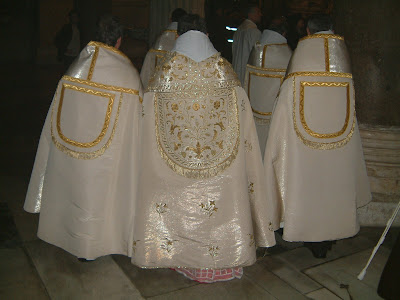
-
Regarding this comment (link):The reason not to vest as an organist/cantor/director unless the whole choir is vesting has nothing to do with rules and everything to do with not making vestments about you, the wearer. If the whole choir vests- then the whole choir vests and there is nothing weird about it. If one person over (up) there vests, then its an affectation.
I agree with this comment if the choir is visible. In that case, the contrast between the vested cantor and the unvested choir is odd.
If, however, the choir is in the loft and not visible to the congregation, I see no harm in having the cantor vest if he is singing something from a visible position, especially on a solemn occasion like the Good Friday intercessions or the Exultet.Thanked by 1bkenney27 -
I'm reviving this old post only to answer the original question: whether laymen may vest in a cope?
O'Connell ("The Celebration of Mass..."), speaking of the 1962 Mass, says that this is forbidden, citing a decree made in 1871 (S.R.C. 3248).
Regarding lay singers wearing cassock and surplice, Tra le Sollecitudini says that this is a fitting practice for men and boys.
So this is what applies to the EF, at least. I don't know the relevant rules for the OF, but this at least gives you the attitude in the past. -
Shawn, I think I must disagree with your statement.
First, looking at the original posts, in the EF it would not be cantors in cope. It would be Assistants in cope. So, for Vespers, the EF delineation would be (for the Office in choir), Sung Vespers vs. Solemn Vespers... where there may be 2, 4, or 6 Assistants in cope. This is in addition to the cantors. The Assistants take part of what the cantors do, but not all.
In Sung Vespers, the choir in the sanctuary sit facing the other side - Epistle side faces Gospel side and Gospel side faces Epistle side. The cantors, in cassock and surplice, are closest the communion rail on their respective sides.
In Solemn Vespers, the choir is as above. The cantors are as above. The Assistants (2, 4, or 6 depending on the solemnity) sit facing the altar on their respective sides, closest the communion rail. The primary Assistants do pre-intonations to the celebrant; the cantors do all the other pre-intonations as normal. Don't remember for certain, but I believe the primary Assistants also intone the Magnificat, while the cantors do the remaining intonations pertinent to their role.
Just as in the EF, it is permissible (not desirable) that a layman act as sub-deacon for a Solemn Mass, it is also permissible (not desirable) that laymen can act as Assistants in cope. The lay sub-deacon wears all of the sub-diaconate vestments with the exception of the maniple... this includes the amice, alb, and dalmatic.
Assistants in cope wear cassock, surplice, and cope, regardless of lay or cleric.
Fortescue recommends that lay assistants and lay sub-deacons be at least tonsured, but often, the situations where I've seen lay assistants or lay sub-deacons, this has not been the case.
The quote from the 1962 Fortescue (with revisions by O'Connell, pg 207, Vespers) is:
"On ordinary Sundays there should be two such assistants [in cope]... on greater feasts there may be four or six. Since they wear the cope, according to the general rule these assistants should be at least tonsured... in addition to the assistants in cope, there should be (on greater days) two cantors, in surplice." -
Incardination:
I can't comment on Vespers or on straw sub-deacons, but O'Connell--in speaking of laymen and boys singing at Mass--says "They may not wear copes (S.R.C. 3248 [4])." -
Copes have not always been the preserve of the clerical orders. In times past (in Sarum usage, for instance) four choir boys vested in copes intoned 'alleluia' from the rood loft. One might conjecture that this usage, which suggests a more liberal attitude in matters of vesture in times past, was not unique to Sarum.Thanked by 1tomjaw
-
Shawn, I think my real point was that your reference may either be superseded (1962 vs. the decree of the SRC in question from 1871) or is too specific to the more general question of whether - in some circumstance - laity may wear the cope... given that O'Connell was also involved in the publication of the 1962 Fortescue edition I mentioned.
-
I'm going to quietly hijack this thread just to ask @Incardination where might such rubrics for Vespers be found? I have been searching in vain for precedents to apply to the Ordinary Form (The GILH is largely unheplful in this regard).
-
@GerardH
From Fortescue, this is an old edition from 1917,
https://archive.org/details/ceremoniesofroma00fort/page/198 -
Unfortunately, I don't have a resource for the OF.
Fr. Adrian Fortescue was a renowned liturgist who wrote detailed books regarding rubrics which applied to the TLM and associated rites. Although he died in 1923, an updated version of his book - the Ceremonies of the Roman Rite Described was published periodically through at least the 1962 rubrics with updates from Canon J. B. O'Connell, another respected liturgist (died in 1977). -
Unfortunately, I don't have a resource for the OF.
In reality, nobody does. The closest you can get is Eliott's "Ceremonies of the Modern Roman Rite", but even with that a lot of the Office ceremonial, IIRC, is applied to the OF from the EF. Most places that I have heard of that do sung Vespers on a regular basis are either Benedictine monasteries, who follow the Rule and have their own liturgical books, or use EF Vespers, or an adaptation thereof for the Modern Calendar, and follow the EF rubrics (whether 1960 or earlier). -
>> n ordinary Sundays there should be two such assistants [in cope]... on greater feasts there may be four or six.
on a practical note, what parish has four to six copes on hand in the same color ?!
If the choir is not in the sanctuary, doesn't a cope seem (I'm sorry) affected, whether or not the rest of a mixed choir is wearing identical clothing of one kind or another including C&S?!
This is not a person assisting at the altar; it's a member of the choir.
Sorry, frankly as a PIP I would read that for many years someone has been longing to find some rationale to look like a cleric, has not found it, and is going ahead anywat.
Or maybe, as I say, I'm just reading it wrong. -
When Abp Lefebvre came through St. Mary's, Ks. in 1982, we had Pontifical Solemn Vespers with 6 Assistants in cope. All six were lay. In his same visit, for the Pontifical Mass (at the throne, no less), the 4 cappellani (all lay) were in cope (although that was perhaps an European affectation since the rubrics simply mention vimpae for the principal 2 cappellani, which they had in addition to the copes). In addition to the cappellani, the Assistant Priest was also in cope, so that was five all of one color - white / gold. For Vespers, it was seven - green. It isn't necessarily uncommon for parishes to have multiple sets of a given color (especially green), which allows ability to have Assistants in cope of the same color although not necessarily matching.
I don't know what you mean by "if the choir is not in the sanctuary". What I'm referencing presumes exactly that... the choir (i.e. the liturgical choir of all men), vested in cassock and surplice, on opposite sides of the sanctuary. Several times in the past several years at our principal parish we've had two Assistants in cope (both clerics) with the rest of the choir (10-14 men in cassock and surplice, both cleric and lay) in the sanctuary.
My experience, both with lay sub-deacon and lay Assistants in cope is that this isn't something typically advocated for by laity eager to play dress-up, but because of an earnest desire to have Solemn ceremonies (usually by the clergy) where it can be reasonably done. I haven't seen it that often (sub-deacon maybe 2x; lay Assistants in cope maybe 2x)... particularly as - more and more - we have clerics that can fill those roles.
The original question was (as I read it), whether such a thing was allowed. I think I was pretty clear that... it is permissible (not desirable)...
:)Thanked by 1StimsonInRehab -
>> I don't know what you mean by "if the choir is not in the sanctuary".
Well, I meant, you know, if the choir is not in the sanctuary. :)
Ours is not.
In monasteries, in seminaries, in times past, the Choir would be all male, maybe even all clerics or religious (not saying it would have to be, I do not know), but in the sanctuary.
In modern parlance however, and times being what they are (e.g., our little place has barely enough young men to serve at Mass, let alone sing in a boychoir), "choir" is often a mixed group of singers (e.g., the photo published earlier in this thread of a mixed group in blue garb).
Ours is a mixed group; we do not sing in the sanctuary or assist at the altar. Any of us. -
I checked the Ceremonial of Bishops to look for OF rubrics.
For the celebration of Vespers on major solemnities (note that proviso), the bishop is to wear amice, alb, cincture, pectoral cross, stole, and cope. Priests may wear a cope over a surplice or alb; deacons may wear either a cope or a dalmatic. [Sec. 192]. [For a simpler form of celebration on other occasions, the bishop may wear alb and stole and cope.]
Cantors are mentioned later, but no specification of their vesture is given. In a chapter on general norms, the alb is identified as the vestment common to ministers in general. It should be worn with a cincture, and with an amice if it is needed to cover the minister's secular clothing at the neck. Also, that section says that ministers may wear other lawfully approved vesture: thus there may be instructions elsewhere about what they are to wear in specific cases. -
Mme,
Do you regularly have sung vespers? If yes, is there a hebdom alone in the sanctuary? Do you have cantors? Are the cantors vested? If you don't have sufficient men (be they clerics or lay) to have SOMEONE other than the hebdom vested in the sanctuary, clearly you wouldn't have Assistants in cope.
In my experience, most EF parishes that have vespers (periodic or regular), typically have a group of men "in choir" (i.e. on either side in the sanctuary)... whether or not there are Assistants in cope. -
Incard - no, we don't have sung Vespers.


Welcome to the MusicaSacra Forum!
To participate in the discussions on Catholic church music, sign in or register as a forum member, The forum is a project of the Church Music Association of America.
Categories
- All Discussions21,515
- General Music Discussion8,410
- Job Openings244
- Management of Music Programs854
- Choral Matters536
- Church Documents and Rubrics533
- CMAA Notes306
- Events744
- For Newcomers: Read First26
- Sacred Polyphony560
- Hymnody886
- Gregorian Chant: General2,724
- ↳ Graduale Romanum and Liber Usualis372
- ↳ Graduale Simplex60
- ↳ Semiology65
- Vernacular Plainsong701
- Anglican Use and Anglican Chant69
- Organ, Other Instruments and Repertoire445
- New Composition/Works in Progress1,312
- Recordings237
- Music for Hispanic Ministry162
- Music Education: Children214
- Music Education: General222
- News Items245
- Positions Wanted3
- General Discussion: Catholicism741
- Amusements180
- General Discussion1,042
- Opinions119