
HYMN OF THE MONTH – December: Silent Night
-
The hymn Silent Night has become popular with Catholic Christmas music programs and Christmas concerts in many parishes. Many of you are unaware that there was once Catholic text for the hymn that is very different from what we sing today. In this month’s write-up, I shed some light on the Catholic version of Silent Night. Please take a moment to read about this beautiful Catholic hymn.
Please visit my website Mother of Mercy Catholic Hymns and click on HYMN OF THE MONTH.
Silent Night
-
Fascinating! I know The Huron Carol is another where the common English lyrics are completely unrelated to the original Wendant/Huron lyrics written by St Jean de Brébeuf and though there are more accurate English translations, they're almost never sung. I'm not surprised that there are many different translations here too. I've seen Silent Night sung in many different languages. I wonder what all the different translations amount too...
Will give the article a deep dive. -
Thanks for the very interesting translation survey. From the samples listed in your blog, it seems that most translators only translated stanzas 1,2 & 6 and omitted the other stanzas (as modern German hymn books doo, too). Did you also create a table, which translator translated which stanzas?
Concerning your question about a Latin version, Ingeborg Weber-Kellermann ("Das Buch der Weihnachtslieder", Schott, 1982) writes:The origin of this most famous German Christmas song is presumably a Latin text found on a loft of a rural church in the Bavarian Forest:
1. Alma nox, tacita nox / Omnium silet vox
Sola virgo nunc beatum / Ulnis fovet dulcem natum / Pax tibi puer, pax.
[and two further Latin stanzas]
Unfortunately, she does not give a source and not even the village where this church is or was, so this might just be another legend around the song. -
Cantique de Noël is another victim of an English-language "inspired by" versification.
Leave the English, take the French. Always.Thanked by 1CHGiffen -
Songs for weddings, also. I've seen so-called "translations" of Franck's Panis angelicus and Gounod's Ave Maria that are, in fact, totally different texts. My guess is, this was done to accommodate non-Catholics.Thanked by 1Abbysmum
-
Something I really liked about Don's article on Silent Night are the two illustrations of typical Catholic music programs (in this case for Christmas) that were used in the days prior to Vatican II. One of the illustrations is even from a Cathedral! Silent Night is included, needless to say, in both programs. However, hymns like Joy to the World, The First Nowell, and, of course, Away in a Manger are not included. They were deemed as too secular and were not included in any Catholic hymnals prior to 1965 or so.
The types of hymns included in both illustrations are very similar to what we used in my parish in the late 50s and early 60s; e.g., Jesus, Teach Me How to Pray; The Christ Child in the Sacred Host; Birthday of a King, etc. I think most English-speaking American parishes used hymns such as these. Turton's SS. Cordis Jesu, used at St. Mary's Church, in Erie, PA, is a splendid Mass that was also widely used year-round.
In the Massachusetts city in which I grew up, there were 27 Catholic churches in the early 60s (most of these were ethnic). About a week before Christmas, the city's chief newspaper would publish the Christmas music program of every church in the city--Catholic and Protestant. It was a couple of pages long! I think I'll go to the public library in that city and try to find some of these on microfilm for a pleasant history lesson. -
Away in The Manager was deemed to be too Lutheran, IIRC (though the attribution to Luther turned out to be spurious, but I recall my German-American father, who grew up in a German national parish in Bridgeport CT, had inherited the supposed attribution as an explanation of why it was never sung in his parish).
It Came Upon A Midnight Clear was deemed to be too Universalist.... -
I'm somewhat flabbergasted by there being a service that started at 4:30AM.Thanked by 1Don9of11
-
Liam, I, too, was taught the same as your father learned. We had a small booklet of Christmas Carols put out by the John Hancock Mutual Life Insurance Company that contained Away in a Manger. When I was in the fourth or fifth grade, the nun who was our music teacher (she was well into her 70s at the time), told us we would not be singing Away in a Manger. The reason?--it was composed by Martin Luther, who "caused a lot of problems for the church." And that was the end of it. Years later, I learned from another Sister who lived with her at our parish convent, that this nun was a convert, entered the Sisters of Mercy at age 17, and was disowned from her very affluent family for her conversion.
-
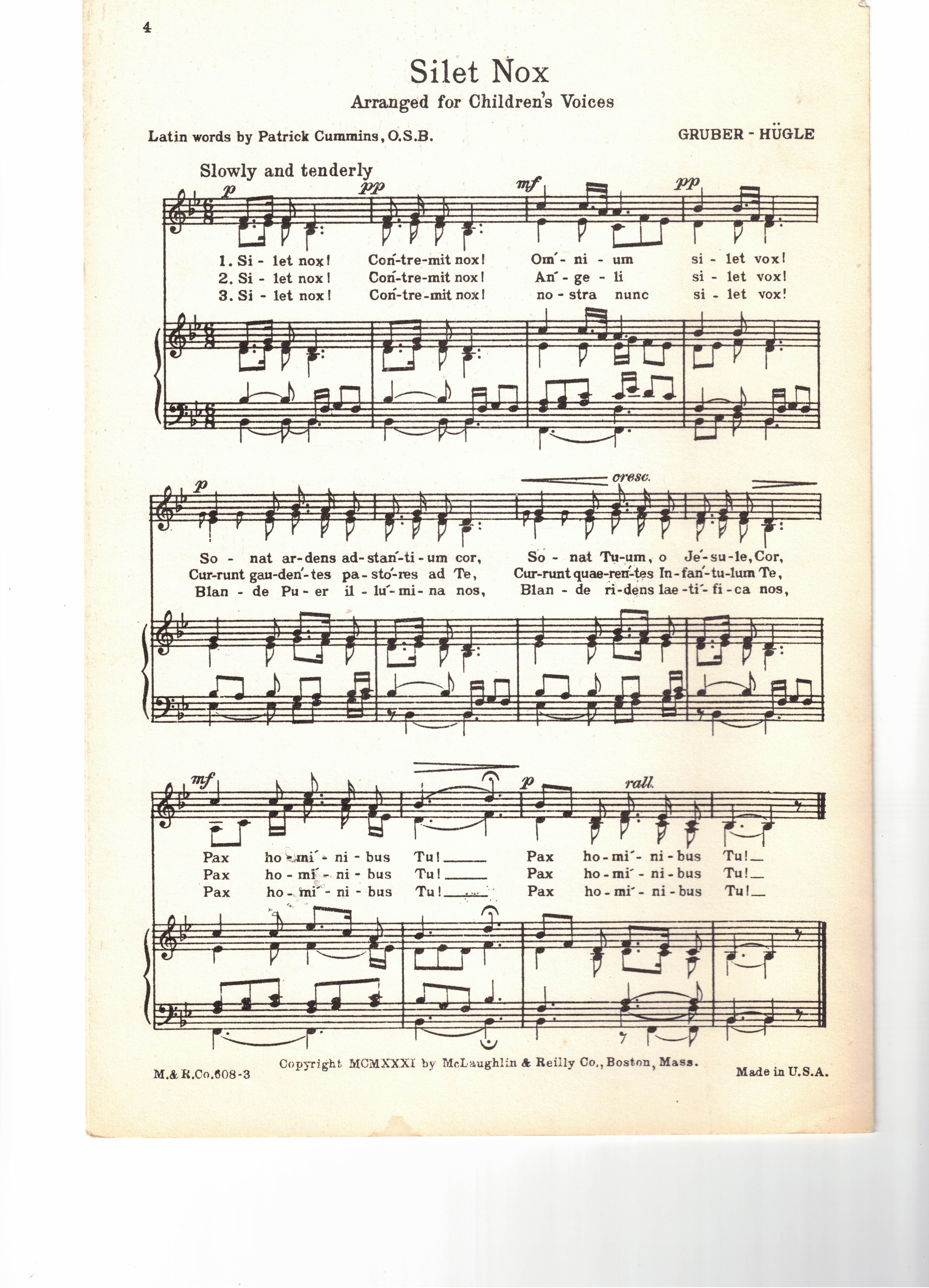
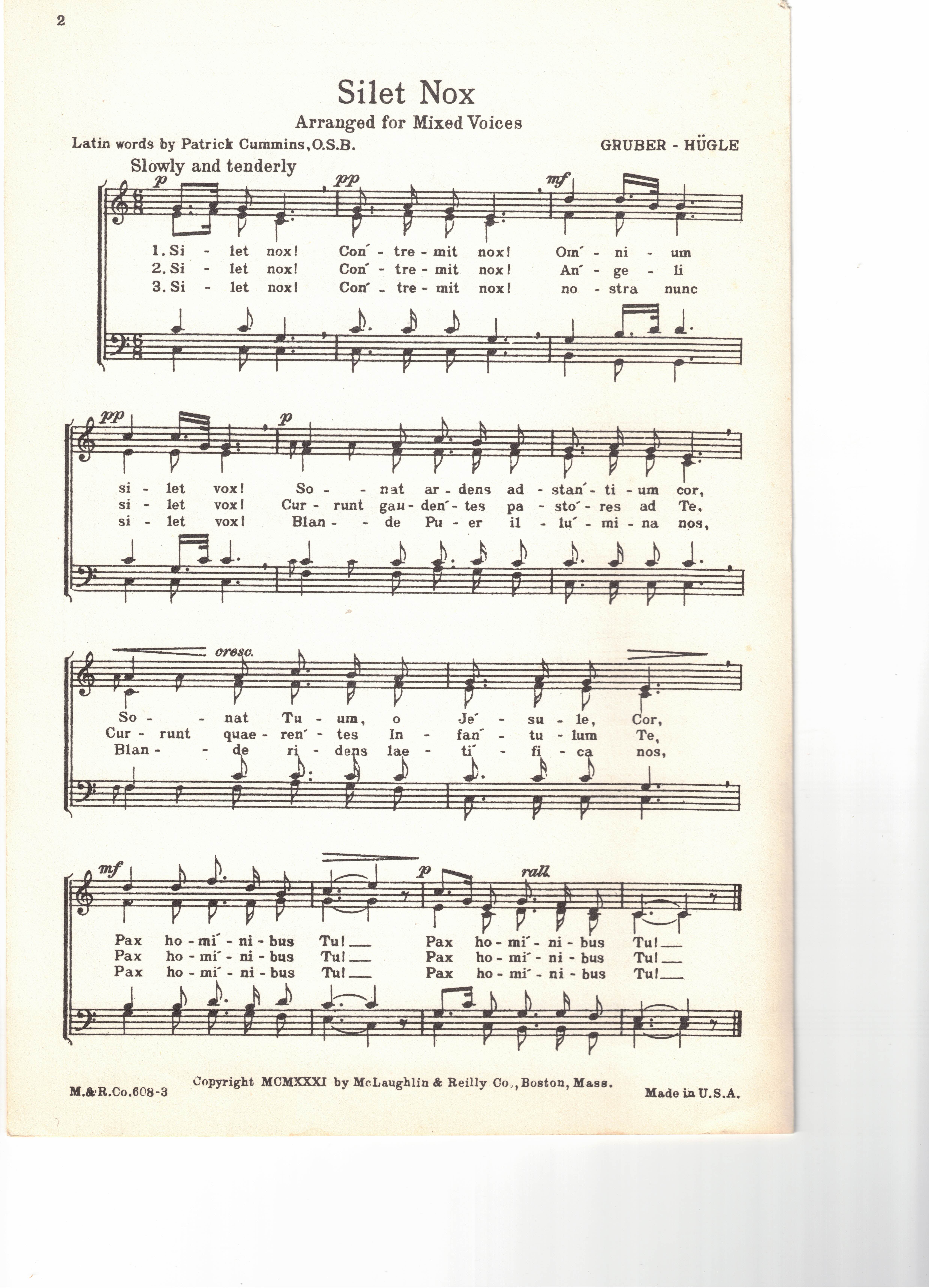
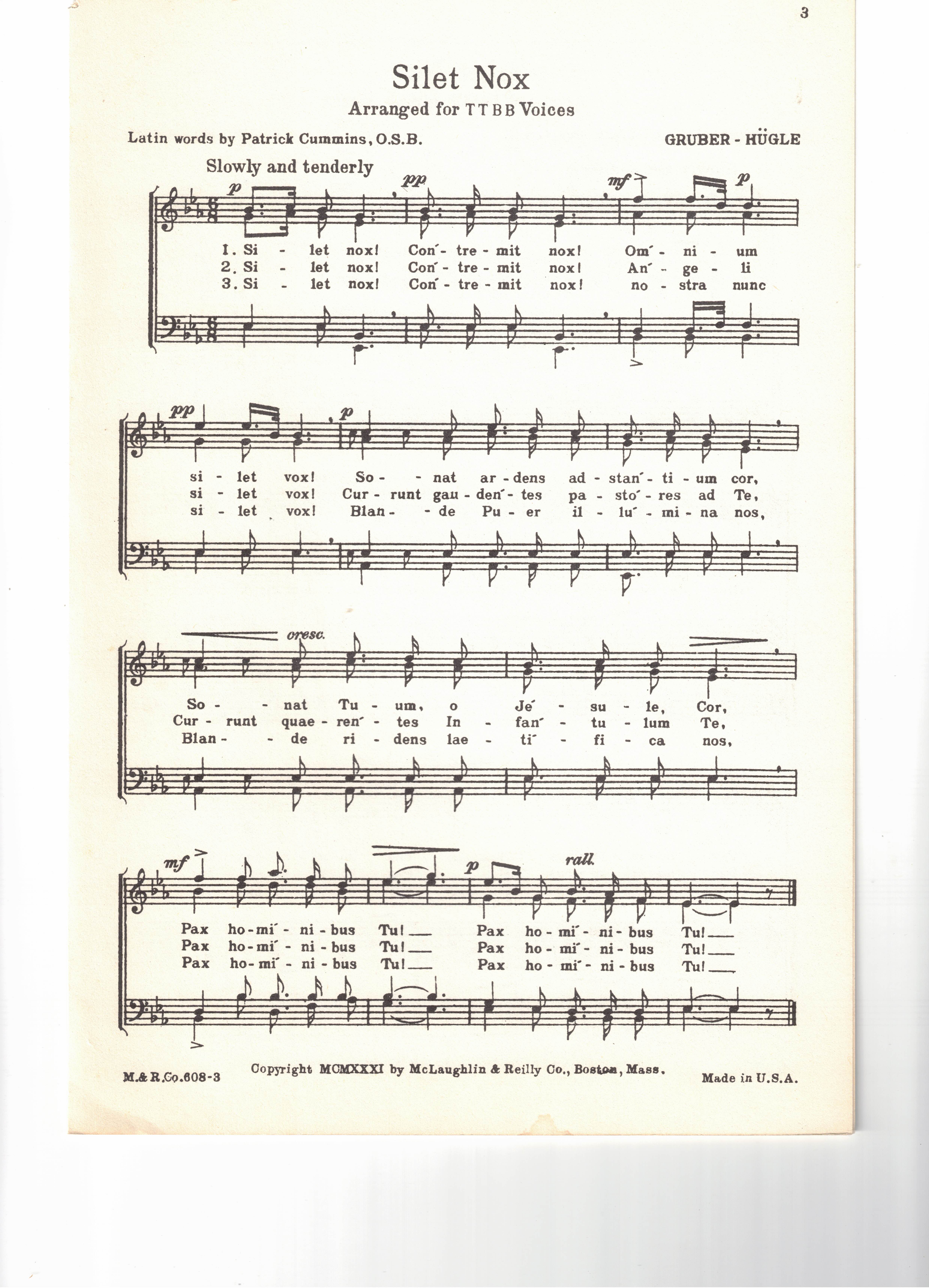
Here are three arrangements of Silent Night in Latin, Silet Nox, arranged by Gregory Hugle, OSB: Mixed, TT BB, Children's Voices.
 4958 x 6874 - 2M
 4958 x 6874 - 2M
 4958 x 6874 - 2M
 -
The First Nowell appears in the Westminster Hymnal (1940), attribution : Old English Traditional
-
@Liam we would not be singing Away in a Manger. The reason?--it was composed by Martin Luther
This is particularly ironic as neither the lyrics nor the melody are by Luther. What seems to have been merely a marketing gimmick to give a false "historic authenticity" to a new song turned out to have an anti-marketing effect in some circumstances ;-) -
also, early Masses outside of the usual times permitted by ecclesiastical law were somewhat more tolerated than late ones before the permission for evening Masses of the same day came under Pius XII. The rule was from dawn (or an hour before), to the end of the noon hour (whether civil or astronomical, whatever was more favorable), but for a good-enough reason (I can’t remember if it’s simply a just cause) you could certainly say private Masses earlier (private, in the sense of a priest’s daily Mass with a server) especially when otherwise a priest would be inconvenienced later in the day, and there is a fairly wide berth given for holy days of obligation including Sunday for morning Masses beginning before sunrise. The knock-on effect is that now we eliminated those and only have evening Masses, but afternoon-to-night and night-shift workers are either going to their shifts or are at their shifts. People who could conceivably attend an early morning Mass might not be able to attend such a Mass either (both on Saturday and Sunday: service-industry folks who do clopenings—closing one night to open the next—are not uncommon). Or if they can attend, they’re in miserable shape, more so than hauling it after a late Saturday night. And the other knock-on effect is the elimination of most evening devotions and of Vespers. :(
-
I would imagine that, during the World Wars, dispensations were readily granted where needed - and, once granted, not necessarily sunsetted, as it were.
-
I’d have to look up the evening Mass question (I believe that the permissions were for the 2nd war because the 1917 Code immediately revoked any previous permissions), but for fasting they removed indults including historical ones but Pius XII loosened the Eucharistic fast for the evening, cut out most vigils, and so on, and didn’t finish the job. So the 1965/6 documents did, then the 1983 Code finished the job. :(
-
@fcb here in Akron, when the rubber companies were in full swing, early AM masses were quite common to accommodate the different work shifts.
I followed up with the Cathedral archivist and was informed that during the 1930s a "Printers Mass" was held at 2am.According to the archivist, “the Cathedral had a 2 am "Printer's Mass" every Sunday for those who worked in the printing industry. There was, of course, no vigil Masses at that time and you had to get special permission from the Bishop to say Mass after 12 pm (and he almost never granted it) so early in the morning it was! It matched with the longer Eucharistic fast.”
She also sent me a page from the directory listing Mass times in Akron, Ohio in 1935. The earliest Mass time was 6am, which confirms some of the anecdotes by older brothers would tell me of serving for early Mass.
-
This is actually confusing insofar as maybe that was a problem with the public Mass schedule being approved by the bishop. That is still the case today. However, noon was defined in the most favorable way, and the prohibition was after the noon hour which went until just before 1, in whichever way you defined noon, and tbh this was just episcopal fiefdom run wild. The celebrant’s the one on the line for not following the canons, and he’s allowed to decide this for himself in private Masses. So long as the main (usually, ideally, sung/solemn Mass) was before noon, between 9:30 and 11, why fuss about a late Mass? (I find evening Mass more problematic.)



Welcome to the MusicaSacra Forum!
To participate in the discussions on Catholic church music, sign in or register as a forum member, The forum is a project of the Church Music Association of America.
Categories
- All Discussions21,853
- General Music Discussion8,552
- Job Openings293
- Management of Music Programs862
- Choral Matters539
- Church Documents and Rubrics540
- CMAA Notes307
- Events763
- For Newcomers: Read First26
- Sacred Polyphony567
- Hymnody898
- Gregorian Chant: General2,749
- ↳ Graduale Romanum and Liber Usualis372
- ↳ Graduale Simplex61
- ↳ Semiology65
- Vernacular Plainsong704
- Anglican Use and Anglican Chant73
- Organ, Other Instruments and Repertoire452
- New Composition/Works in Progress1,342
- Recordings238
- Music for Hispanic Ministry163
- Music Education: Children217
- Music Education: General223
- News Items247
- Positions Wanted3
- General Discussion: Catholicism742
- Amusements185
- General Discussion1,049
- Opinions119