
bad rhythm in a Solesmes edition
-
I admit it! There is what I would consider an unforgivable error in two places in the Solesmes edition of the preconciliar Roman office. One, which I didn't notice in the spring when we sang Vespers of Saint Mark, in the antiphon Sancti tui in the common of Apostles (and so on) in Paschal Time at “erunt” and then in the proper of France as published by Desclée in the Solesmes Liber antiphonarius of 1949 (okay, let's not exaggerate). in the antiphon at the Magnificat for I Vespers of Saint Clothilde, on the first syllable of "quia" they have inserted, for a reason that I don't quite understand, a punctum mora. In practice, there's no real difference between it and a bistropha if you don't repercuss, which probably explains the thinking. In the monastic version, these dots are often replaced by an episema or a bistropha. Sometimes the melody differs enough to change the rhythmic pattern of 1s, 2s, and 3s, sometimes it's just a different way of getting to that, as would be the case here if you insert a bistropha.
The dot coming on the first syllable after the half bar struck my attention, coming as it is right after the punctum mora before the bar.
The 1935 antiphonal for the abbey of Solesmes and its family (mostly the same as the 1934 antiphonal but with the propers integrated into the main body of the book, containing more than the appendix of the main monastic antiphonal) has different antiphons at both Vespers and Lauds so I can't compare them. One might wonder if they felt that this antiphon was deficient.
But I think that I am justified in changing this dot in both cases to a bistropha, since the monastic version does that for Sancti tui, and I also don't understand this: the word is naturally broken up by this. It breaks Solesmes' own rule in an obvious way. In the case of this more likely to be authentic antiphon from the common, I wonder why the Vatican Edition did this.
Now, of course, why stick to Solesmes and (for the most part) the 1912 melodies at all? Why not add more dots or change signs to the monastic ones when the melodies are the same or closely related? Because I don't have time, the expertise, or the desire to do something more (too) speculative nor to relearn everything; weak syllable-accent-weak syllable at the end of phrases really should have a dotted punctum on both of the last two notes, which the monastic version does. People often sing them long anyway. And then you're just stuck with bad things sometimes: the hymn for Vespers of February 11 is awful. There's no fixing that mess.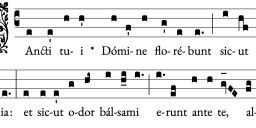 1758 x 622 - 126K
 -
It took me a while before I understood the actual problem you’re trying to explain. To sum up, it is about two antiphons, ‘Sancti tui…sicut lilium’ (CAO 4736) and ‘Tu honorificentia’ (neo-Gregorian?), and more specifically the rendering of ‘erunt’ and ‘quia’ respectively.
You are right that ‘erunt’ is misrepresented in the source you quote. The chant editions you refer to are now redundant, of course, although AM 632 doesn’t use a dot at ‘erunt’ but a bistropha.
With regard to ‘Sancti tui’, the manuscript (see Hartker II, 59) shows a virga strata. In the current chant editions this is rendered by a punctum and an oriscus (see Antiphonale Monasticum III, 361 and Antiphonæ et Responsoria VI, 51); Anton Stingl represents a virga strata usually by a virga with an added oriscus.
With regard to ‘Tu honorificentia’ it is difficult to judge if the notation could be improved, because I suspect it is a new, neo-Gregorian composition (but please correct me if I’m wrong about that). -
I am almost certain that the best we can do is a bistropha. I don’t know if it’s truly neo-Gregorian or an attempt to make something Gregorian of a later chant.
But see this is where I think that maybe Dom Pothier and the Vatican Commission had a point: the notation would be constantly changing and the melodies evolving. This is not good news for amateurs who are asked to sing even just Vespers of Sundays and feasts which is a conciliar directive no less.
And if it is going to change I’d prefer that it’d be some kind of virga since, well, that’s what it is.although AM 632 doesn’t use a dot at ‘erunt’ but a bistropha.
I said this.The chant editions you refer to are now redundant, of course,
Not in my world, not for many others, and not even for the late pope were they since I’m not even sure that the office existed for him as public prayer. He hardly mentioned it: not in TC, not in Desiderio Desideravi. I could do without the commentary framed this way.
And I have always appreciated that the English Benedictine custom is Latin Vespers from the AM1934 without even acknowledging the existence of the 2000s editions to make up for the new lectionary; the houses with Latin Vespers adopt an antiphon from elsewhere in the 1934 that sort of fits. And of course Fontgombault’s part of the Solesmes family uses 1934, the abbey of , Le Barroux and its daughter house now an abbey of its own all use them.Thanked by 1BGP

Welcome to the MusicaSacra Forum!
To participate in the discussions on Catholic church music, sign in or register as a forum member, The forum is a project of the Church Music Association of America.
Categories
- All Discussions21,844
- General Music Discussion8,548
- Job Openings292
- Management of Music Programs862
- Choral Matters539
- Church Documents and Rubrics540
- CMAA Notes307
- Events760
- For Newcomers: Read First26
- Sacred Polyphony567
- Hymnody898
- Gregorian Chant: General2,749
- ↳ Graduale Romanum and Liber Usualis372
- ↳ Graduale Simplex61
- ↳ Semiology65
- Vernacular Plainsong704
- Anglican Use and Anglican Chant73
- Organ, Other Instruments and Repertoire452
- New Composition/Works in Progress1,342
- Recordings238
- Music for Hispanic Ministry163
- Music Education: Children217
- Music Education: General223
- News Items247
- Positions Wanted3
- General Discussion: Catholicism742
- Amusements185
- General Discussion1,048
- Opinions119