
Amen Alleluia in Sequences
-
So there has been an internal controversy for a while...
In the Graduale Romanum none of the sequences include the Amen Alleluia, in the N.O. Missal they are included in the written text. I think if I recall correctly I have seen it in the L.U.
However, in formation, there was a professor we had from a pontifical university who was absolutely convinced that the Amen. Alleluia was modern and shouldnt be added.
So, two questions- 1. What are the actual rubrics? Since the Missal contains the Amen Alleluia but the Gradual (which is supposed to be the official go to) doesnt... what is supposed to be done? Or is it like the Antiphon issue, if you recite do what the missal says, if you chant, do what the Gradual says?
Second, when was the Amen Alleluia included? It seems to me its not just a Vatican 2 invention. Thoughts? -
Well Solesmes has it in the LU since at least 1896, but maybe that counts as 'modern' in the eyes of that academic.
-
thats precisely why I am confused about it.
-
The Sarum Sequentarium doesn't include Amen Alleluia. Neither is it included in my local lectionary - @monasteryliturgist I'm surprised to learn it is in your locale. I don't think the Latin lectionary does.
Adding Amen Alleluia does make some sense to me when the sequence is sung in the traditional place after the Alleluia. While the lectionary and missal both say it should be read before the Alleluia, the Ordo Cantus Missae 1987 specifies that it should come after the Alleluia in a sung Mass. However, it explicitly states the Sequence is sung without Amen (and presumably Alleluia).8. Sequentia, si casus fert, cantatur post ultimum Alleluia alternatim a cantoribus et a choro, vel a duabus partibus chori, omisso Amen in fine. Si non cantatur Alleluia cum suo versu, omittitur Sequentia. -
Interesting, we do have a very old lectionary that is sometimes not the same as the USCCB (in very slight ways) so that could be possibly why... but Im always suprised that in the MTF Hand missal which is normally considered the best NO daily missal, it still has Amen Alleluia there as well. But if the Ordo Cantus says no thats good enough for me.
-
Here you will see Fr. Weber included it https://media.musicasacra.com/weber/propers/Pentecost Sequence.pdf
and so does CCWatershed
https://archive.ccwatershed.org/media/pdfs/12/06/04/16-56-15_0.pdf
-
Well, Roman Missal 3 is later legislation than OCM, and could reasonably be interpreted to override the latter in case of conflict.Thanked by 1monasteryliturgist
-
Looking at my hand missals from 1925 and 2012, I see that both have the 'Amen, alleluia', in both Latin and parallel English. Perhaps the editors of texts have it in their sources, but the music editors have no ancient sources.
It is indeed in the 1570 Missale Romanum 'Amen. Alleluia' without notation. https://archive.org/details/bub_gb_adC-aRGza70C/page/n339/mode/2up
In Lippe's transcription of the 1474 earliest(?) printed 'Roman' Missal the sequences end with Amen but no Alleluia https://archive.org/details/missaleromanumm01churgoog/page/240/mode/2up -
So if that's true, why would Solesmes have changed the music notation? It would seem since they were the main ones with access to the manuscripts that they would have changed from early 1900s to late 1900s for a reason? Or they were just following the OCM?
-
I always assumed the omission was because the order of the sequence got swapped in the OF and it therefore didn't make sense to sing "amen, alleluia" and then launch into another alleluia.Thanked by 1monasteryliturgist
-
My 1852 altar Missale Romanum has the "Amen. Alleluia" listed for Victimae....
A quick search in cantus shows the following:
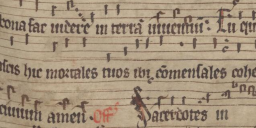
F-pn Latin 15182 (ca 14th cent. Manuscript) shows Victimae Paschali... ending with only an amen.
https://gallica.bnf.fr/ark:/12148/btv1b8447769r/f505.item
Nl-Uu Ms. 406 (ca 12th cent. Manuscript) shows Lauda sion... also ending with only an amen.
https://objects.library.uu.nl/reader/viewer.php?obj=1874-327915&pagenum=283&lan=enAdding Amen Alleluia does make some sense to me when the sequence is sung in the traditional place after the Alleluia. While the lectionary and missal both say it should be read before the Alleluia, the Ordo Cantus Missae 1987 specifies that it should come after the Alleluia in a sung Mass. However, it explicitly states the Sequence is sung without Amen (and presumably Alleluia).
This though....
Meanwhile, gregobase shows the 1908 vatican edition including it...
https://gregobase.selapa.net/chant.php?id=1718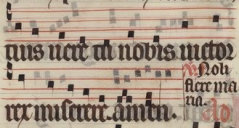 329 x 176 - 112K
 1032 x 317 - 498KThanked by 1monasteryliturgist
 -
Well, Roman Missal 3 is later legislation than OCM, and could reasonably be interpreted to override the latter in case of conflict.
@Liam I was going to push back on this, but I was surprised to find the rubrics about the sequence did change with the Third Edition. From romanrite.comThe 1975 GIRM 40 was not specific, but the Lectionary seems to have had the Sequence sung before the Alleluia. But the 2000 GIRM had it after the Alleluia. The 2002 GIRM returns it to before the Alleluia.
I still think an argument could be made the the OCM is the definitive rule book for sung Mass, but it would be a shaky one. -
I think that it is but not ending the sequence with Amen and Alleluia is bizarre, and they just did not think this through. The authors of the GIRM appear to have assumed that you will always use a lectionary verse…
-
From HYMNS OF THE ROMAN LITURGY BY THE REv. JOSEPH CONNELLY, M.A.Sequentia was the name given to the jubilus or musical prolongation of the last vowel of the word alleluia. The jubilus is divided into small sections, and to these parts separately as well as to the whole melody the name sequentia could be applied. The custom gradually came into being of adding words or a Prosa to the music of the jubilus. At first, perhaps in the eighth century, a text was added to some of the sections, the last vowel of such texts being, in some places, always the vowel a to which the next wordless section could be sung. Later on a text was added to the whole melody and so began what is now generally called a Sequence or, less generally, a Prose. Its full name would properly be Sequentia cum prosa.
Just as the sung liturgical texts of the Mass are mostly prose, not poetry, so the earliest Proses were, as their name indicates, unmetrical, their structure being dictated by the length and shape of the melody. The first use of such texts is connected with the name of Notker Balbulus, the Stammerer, who was born about 840 and died as a monk of St Gall in Switzerland in 912. But whether such a connection is rightly asserted and, if rightly, what compositions are to be ascribed to him, are matters of great dispute. As time went on, the words were not attached to an existing melody but words and music were composed together. This made for rhythmical structure in prose and, later still, in poetry until the Sequence reached its glory in the compositions of Adam of St Victor (c£ the introduction to Corpus Christi and the notes on its hymns), the Lauda Sion, 74, and the Dies irae, 154. The Victimae, which is in rhythmical prose, belongs to the transitional period of the history of the Sequence.
A Sequence is distinguished, musically, from the alleluia and the alleluia verse by being a syllabic chant, or practically syllabic; and from a hymn by having a new melody for different sections, for instance for each pair of verses or half-verses.
So our Sequence is replacing in most cases the final repeated Alleluia, it is logical that this lost word should be vocalised in some way. Whether this is said sotto voce by one member of the choir or sung by all the choir would depend on local custom.
We can see this with the Troped Kyrie, sometimes the Kyrie is said at the end of the Troped verse, or sometimes another voice sings the Kyrie etc.
The Amen has another purpose, when singing Antiphonally the choir as a whole are not singing the complete text, each side is singing half. The Amen makes up for this deficiency we all agree with all the text.
So before the great liturgical deformation of the last century, the choir books (ie Graduale Romanum 1924 edition) would have the Amen. / Alleluia. As for older / ancient manuscripts, they don't always have the complete texts and leave out sections that are obvious, such as the Amen and possibly the Alleluia.
So if the Sequence is sung Antiphonally it should have an Amen. and if it is sung in its proper place as the final jubilus of the proper Alleluia, we should sing Alleluia at the very end of the Sequence.

Welcome to the MusicaSacra Forum!
To participate in the discussions on Catholic church music, sign in or register as a forum member, The forum is a project of the Church Music Association of America.
Categories
- All Discussions21,809
- General Music Discussion8,535
- Job Openings289
- Management of Music Programs862
- Choral Matters539
- Church Documents and Rubrics540
- CMAA Notes307
- Events758
- For Newcomers: Read First26
- Sacred Polyphony566
- Hymnody896
- Gregorian Chant: General2,745
- ↳ Graduale Romanum and Liber Usualis372
- ↳ Graduale Simplex60
- ↳ Semiology65
- Vernacular Plainsong704
- Anglican Use and Anglican Chant72
- Organ, Other Instruments and Repertoire450
- New Composition/Works in Progress1,338
- Recordings238
- Music for Hispanic Ministry163
- Music Education: Children217
- Music Education: General222
- News Items246
- Positions Wanted3
- General Discussion: Catholicism742
- Amusements185
- General Discussion1,047
- Opinions119