
Liquescences
-
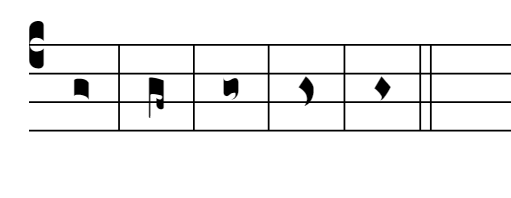
For quite some time now, the question of liquescence in Gregorian chant has been keeping me up at night.
I find myself opening Hartker's Nocturnale, seeing the liquescent neumes, and although I understand the general theory, I'm struggling to grasp their deeper meaning in performance and from a compositional point of view. I want to understand this topic not merely on a definitional level, but to try and 'get inside the mind' of the medieval scribe or composer. I'm trying to answer some fundamental questions for myself:
1) What is the practical, physical way to perform a liquescence? What does it actually sound like?
2) Why did a composer decide to use it at all?
3) If I were a medieval composer myself, in what musical and textual situations would I reach for a liquescent neume, and in which—despite a difficult consonant cluster—would I consciously avoid it in favour of, for instance, a stronger, clearer accent on separate notes?
In other words, I'm trying to grasp the logic and the 'soul' of liquescence. I would be grateful for any explanations, references to sources, or even your own personal performance experiences that could help me see these through the eyes of their creators.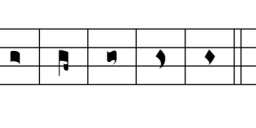 511 x 198 - 5K
 -
Liquescent notation is fundamentally a reminder of good diction. Close to the voiced consonant or auxiliary vowel for the little note (or half the unison note). When it affects the letter s, finish the syllable before the beat and be sure not to unvoice or otherwise alter the following consonant, e.g., Spiritus Domini has to come out as sdo, not sto, and diebus vitae has to be svi, not sfi. There is a tendency not to use liquescents when the following note is in unison, but there are many exceptions. If you're dealing with adiastematic neumes, it's important to understand the ambiguity of the notation, as each liquescent sign has two possible meanings: unison (also called augmentative), or either ascending or descending (also called diminutive). Your first two examples are both cephalici and notated exactly the same as each other in the adiastematic neumes.Thanked by 1cantor_pomeranis
-
I agree with FSSPmusic that liquescents are about diction. Two particular cases I have noticed: they make sure a double consonant is pronounced; they make sure a clear, Italianate vowel is pronounced instead of a French nasal vowel.
-
Remember that during the time liquescents were first being notated, the process of writing music was different than in modern times. Today, a composer thinks of what he wants the music to sound like, writes it down, and then gives it to the singer. In other words, the notation is prescriptive.
The scribes of Laon and St. Gall did not compose music this way, nor did singers read music as a set of performance indications. The musical notation is an attempt to write down sounds after they had already been sung. In other words, the notation is descriptive.
How is it that modern singers of opera, art song, and musical theater can sing in a way that the words can still be understood in spite of the lack of liquescent notation in modern music? Because they have been trained to have good diction. Likewise, if your schola has good diction they can 100% ignore liquescent neumes without doing any violence to the chant.
What does interrupt the chant line is the practice of replacing an entire sung pitch with a consonant, rather than simply voicing the consonant a little before the end of the note. The frequency with which various manuscripts disagree about liquescents does not suggest different performance practices. It suggests a consistent practice that is sometimes written explicitly and sometimes not.
The example I always give is a sign I once saw outside a tunnel: “Driving on sidewalk prohibited.” It would be a huge mistake for archeologists 1,000 from now to assume that meant everywhere else driving on the sidewalk was permitted! Likewise, the absence of a liquescent should not suggest poor diction any more than its presence should suggest an exaggerated stopping of vocal tone. -
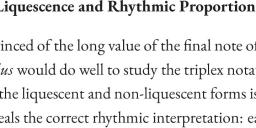
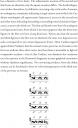
This thread from 12.5 years ago may also be of interest. I've written about the rhythmic implications of liquescent notes in the preface to my edition.
 1284 x 360 - 106K
 1292 x 2119 - 449K


Welcome to the MusicaSacra Forum!
To participate in the discussions on Catholic church music, sign in or register as a forum member, The forum is a project of the Church Music Association of America.
Categories
- All Discussions21,851
- General Music Discussion8,551
- Job Openings293
- Management of Music Programs862
- Choral Matters539
- Church Documents and Rubrics540
- CMAA Notes307
- Events762
- For Newcomers: Read First26
- Sacred Polyphony567
- Hymnody898
- Gregorian Chant: General2,749
- ↳ Graduale Romanum and Liber Usualis372
- ↳ Graduale Simplex61
- ↳ Semiology65
- Vernacular Plainsong704
- Anglican Use and Anglican Chant73
- Organ, Other Instruments and Repertoire452
- New Composition/Works in Progress1,342
- Recordings238
- Music for Hispanic Ministry163
- Music Education: Children217
- Music Education: General223
- News Items247
- Positions Wanted3
- General Discussion: Catholicism742
- Amusements185
- General Discussion1,049
- Opinions119