
Question on musica ficta in Victoria's 'Missa O magnum mysterium'
-
For some time I have been working on a transcription of Victoria's 1592 mass Missa O magnum mysterium. There are several parts in the mass that are clearly quoting from the original 1572 motet but are missing some accidentals.
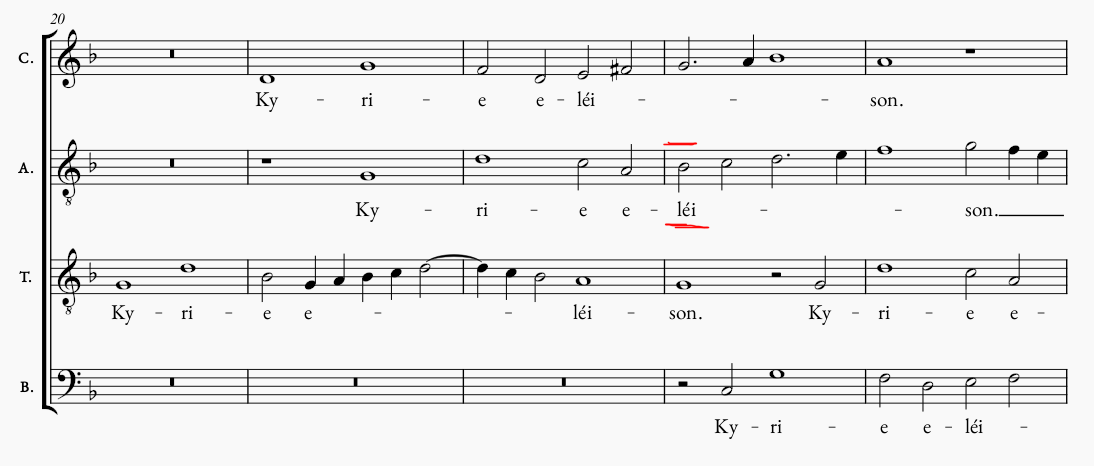
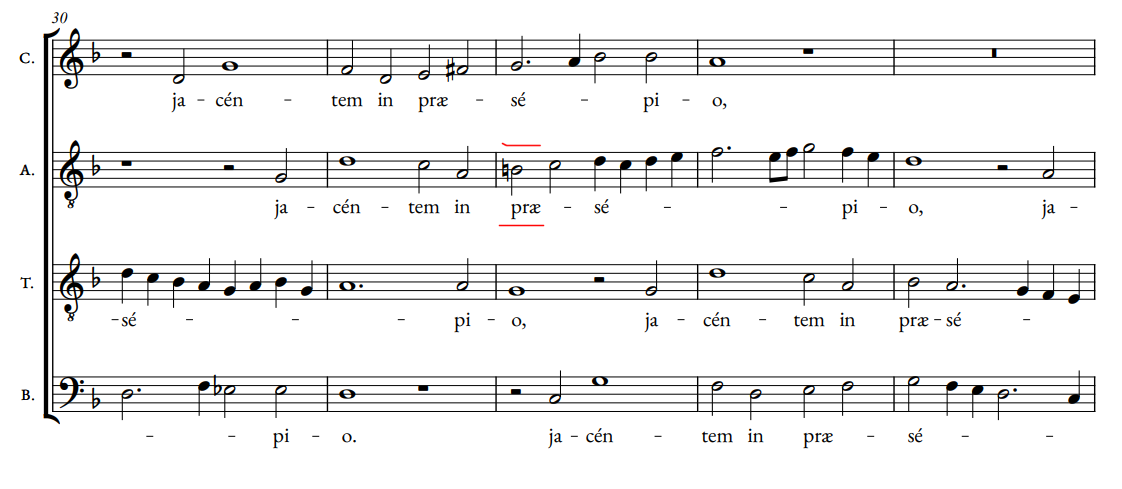
For example, Kyrie II is almost directly copied from the jacentem in praesepio segment of the motet, however the Alto has B-flat on measure 23 of the Kyrie (see 'A' attachment below) instead of B-natural as on measure 32 of the motet ('B' attachment).
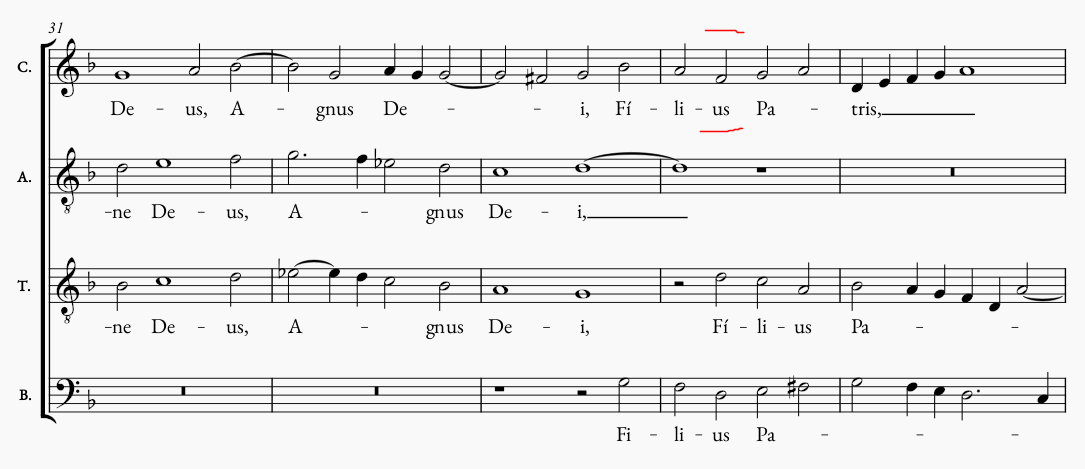
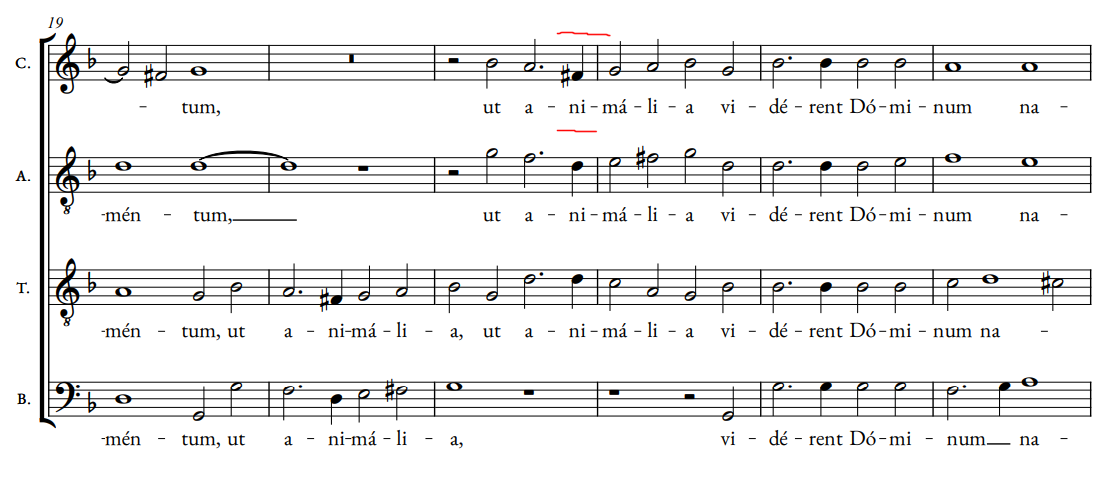
Another example is the Filius Patris segment of the Gloria, based on ut animalia from the motet. The Cantus has F-natural on measure 34 of the Gloria ('C' attachment) instead of F-sharp as on measure 21 of the motet ('D' attachment).
There are more examples like these elsewhere in the mass. I am wondering if it would be appropriate in these cases to add editorial accidentals so that these portions of the mass more closely match the source material?
I am a complete amateur at this so I would really appreciate some guidance on rules/conventions for ficta in cases like this. -
You could make a good case for matching the model motet, but I wouldn't bother in either of these cases, since someone just sight reading the Mass on its own would probably not inflect in those spots.
I would summarize the sixteenth-century conventions this way. You add ficta either for the sake of beauty or the sake of necessity. The sake of beauty means you add a sharp to make a cadence (that is, two voices converging at a phrase end in contrary motion to an octave or unison on D, G, or A, in which case you really ought to add C-sharp, F-sharp, or G-sharp to the voice going up. The sake of necessity means you add a flat to avoid a vertical diminished fifth or octave. This is usually B-flat under an F, or E-flat under a B-flat. It's sometimes a judgment call. This is also used for horizontal fourths and fifths, like a voice that leaps down a fifth from B-flat ought to go to E-flat. Lastly, there is the rule that you add a flat (sing fa) when you go only one note above a hexachord. Like if your melody peaks on B after staying below that for a while, it is conventional to add B-flat. The exception is Ave Maris Stella, where the B-natural is emblematic.
Anyway, in your transcription, you can add the ficta you like above, but I would say these are less clear cut than the ones according to the rules I listed. -
Thank you very much for the thorough response! If I might impose a couple more questions regarding adding ficta for the 'sake of beauty':
Here, in the Credo at the word baptisma, is a cadence on D, but sharpening the Cantus' C seems to create a tritone between itself and the G below. Multiple editions at CPDL apparently ignore this, but I assume in this case the C should be left natural?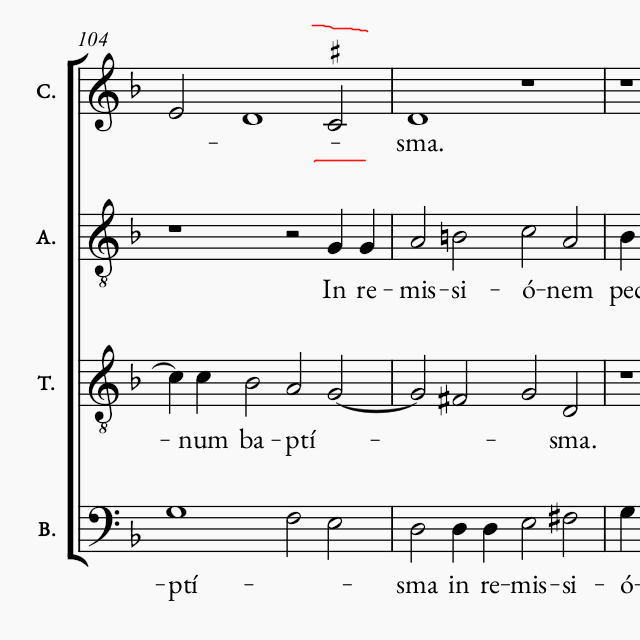
Another case is in the Benedictus, again multiple editions (but not all) seem to prefer flattening the Tenor's E, and I agree that it sounds better, but I don't see how the rules you listed justify it. You mentioned that sometimes it's just up to judgment. Is that so in cases like this one, simply up to the editor or performer, and that either a natural or flat doesn't matter?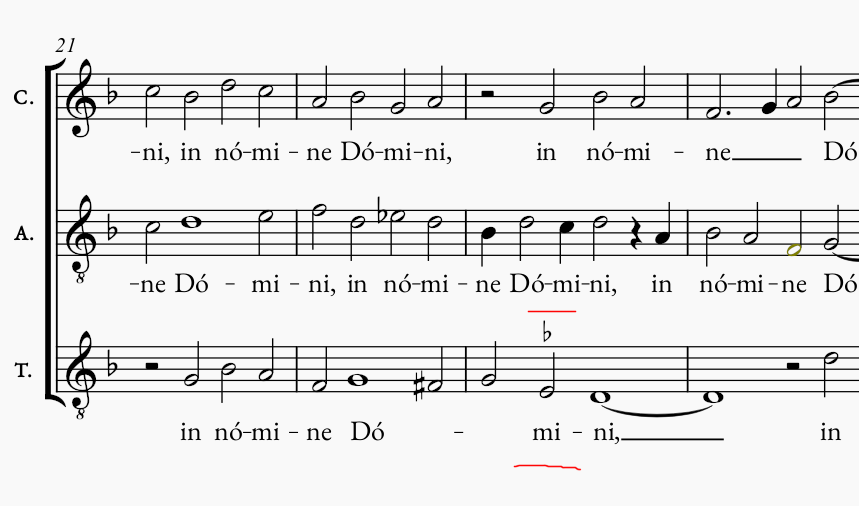
Thanks again! 859 x 506 - 45K
 640 x 640 - 42K
 -
Vertical tritones at cadence points (local "vii6"/whatever) happen all the time in Counterreformation music.
-
In your first case, C-sharp is definitely good. In the second one, the context is a lot of E-flats around it: several entrances in "in NO-mine," so an editor choosing to use E-flat is acknowledging that context and presuming that the Tenor's E here should be flat. If every E for about ten measures before has been flat, you can keep that going, in which case you don't need the C-sharp, since in a "Phrygian" cadence like this, the descending voice is moving by half step, same as a cadence on E, or on A with B-flats. Still the other option (E-natural with C-sharp) is not wrong. I would just pick one based on your ear and judgment. Notice the vertical tritone at the end of the movement. Totally normal as Jeffrey says.
-
It may be useful to bear in mind that counterpoint treats 4ths and 5ths as fundamentally different: c above g is a dissonance whether or not it's sharp.
-
Much thanks to all of you. This has been very helpful to learn these things I was ignorant ofThanked by 1tomjaw

Welcome to the MusicaSacra Forum!
To participate in the discussions on Catholic church music, sign in or register as a forum member, The forum is a project of the Church Music Association of America.
Categories
- All Discussions21,849
- General Music Discussion8,551
- Job Openings293
- Management of Music Programs862
- Choral Matters539
- Church Documents and Rubrics540
- CMAA Notes307
- Events761
- For Newcomers: Read First26
- Sacred Polyphony567
- Hymnody898
- Gregorian Chant: General2,749
- ↳ Graduale Romanum and Liber Usualis372
- ↳ Graduale Simplex61
- ↳ Semiology65
- Vernacular Plainsong704
- Anglican Use and Anglican Chant73
- Organ, Other Instruments and Repertoire452
- New Composition/Works in Progress1,342
- Recordings238
- Music for Hispanic Ministry163
- Music Education: Children217
- Music Education: General223
- News Items247
- Positions Wanted3
- General Discussion: Catholicism742
- Amusements185
- General Discussion1,048
- Opinions119