
Congaudent — how to read it?
-
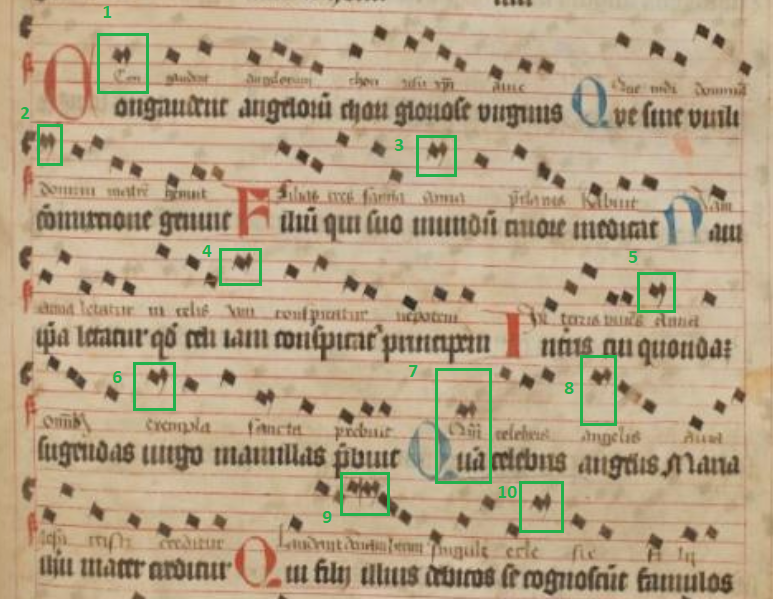
The attached image concerns the sequence for the Assumption of the BVM, "Congaudent," from the Tyniec Gradual (Poland). I have reviewed all other digitally available sources for this sequence, and in every case, the notation uses exclusively the punctum in the places where this manuscript has these interesting neumes.
So, how should these be interpreted in this case? A bistropha, liquescence? An uncinus?
I'm also not sure if they all mean exactly the same thing, which is why I have numbered the signs.
Please let me know how you would interpret these.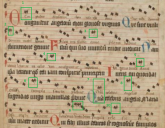 773 x 599 - 694K
 -
normally, at least in the solesmes interpretation you would count each of those as a separate note, not run together, but its a special technique that is neither choppy like sausage links (if that makes sense) nor one big elongation... I like to tell my sisters that its more like waves in an ocean, each distinct but fluid.
-
I dont know if this is helpful, I found this, this is a recording I made for one of our choir members last year to practice (really bad quality recording, and trying to keep monastic silence while doing so- so not the best vocals, but the idea is there). Its not a perfect rendering, but I think it might help get the idea of the double notes- this is the Introit for September 15th, it can be found here https://gregobase.selapa.net/chant.php?id=149
-
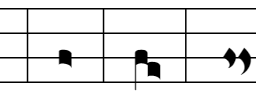
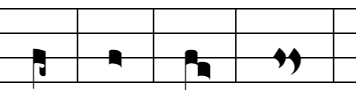
That's how a liquescence is written in the rhombic notation - by joining a strophicus to a punctum.
(No. 9 is not a special note shape, but a simple vertical line separating two neumes / syllables in a tight spacing situation: there's a simple punctum on fili<i>, a line separating it from the following syllable, and a liquescence on <i>llius.) -
Thank you so much for your reply. This raises just one more question for me: if I wanted to transcribe this into modern notation while maintaining the greatest possible fidelity, what would you suggest? The notation itself is one thing, but guidance on how to perform it faithfully is also crucial.
 356 x 107 - 3K
 -
When transcribing to square notation I would follow the majority of manuscripts and ignore the liquescences.
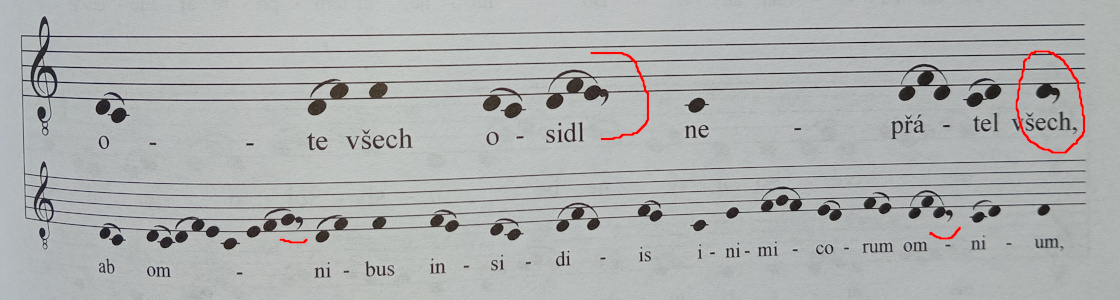
Idiomatic transcription of the liquescences to square notation would require sensible translation to various liquescent neumes, depending on context, which would introduce a level of nuance unknown to the source. (But it could be argued that any transcription from the rhombic to the square notation, excepting some purely syllabic pieces, inevitably introduces additional nuance.)
In modern notation transcriptions, if considered relevant for the audience, the liquescences are transcribed e.g. like this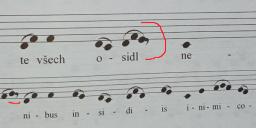 1120 x 300 - 127K
 -
When I studied in Italy, we learned that those little lines that look like liquescences are more about the ease of the pen, they were using a calligraphy pen and so many of those things dont necessarily mean anything but that it made it faster for them or easier for them to write... Im no expert, but that is what is being taught in Rome.
-
This is a particular notation type common in Bohemia and elsewhere in Central Europe. A punctum with an attached smaller note (strophicus) is generally accepted to be a liquescence. Yes, length (or absence) of the strophicus' "tail" shouldn't have any additional meaning.
There's a Czech monograph (with an extensive French summary) on the notation type:
HUTTER, Josef. Česká notace = Nota choralis = La notation tchéque. Praha 1930.
I'll see if I can find some freely accessible resource in English.Thanked by 1cantor_pomeranis -
@igneus that would be very interesting, please post if you can find it.




Welcome to the MusicaSacra Forum!
To participate in the discussions on Catholic church music, sign in or register as a forum member, The forum is a project of the Church Music Association of America.
Categories
- All Discussions21,851
- General Music Discussion8,551
- Job Openings293
- Management of Music Programs862
- Choral Matters539
- Church Documents and Rubrics540
- CMAA Notes307
- Events762
- For Newcomers: Read First26
- Sacred Polyphony567
- Hymnody898
- Gregorian Chant: General2,749
- ↳ Graduale Romanum and Liber Usualis372
- ↳ Graduale Simplex61
- ↳ Semiology65
- Vernacular Plainsong704
- Anglican Use and Anglican Chant73
- Organ, Other Instruments and Repertoire452
- New Composition/Works in Progress1,342
- Recordings238
- Music for Hispanic Ministry163
- Music Education: Children217
- Music Education: General223
- News Items247
- Positions Wanted3
- General Discussion: Catholicism742
- Amusements185
- General Discussion1,049
- Opinions119