
My thoughts on chant rhythm (and a few other things)
-
Matthew, very interesting comments as always. It seems to me that Denise Lebon and the circle around her must have something to do with this rather interesting style. It would be interesting to hear more of Schola Saint Grégoire's activities. There are pockets of that same tradition here in the states as well, as you and I have both witnessed.
I know for sure that there are a certain extra expressive neumes and other musical indications observed at Fontgombault and the daughter houses, and that these are reported to have come from Dom Gajard through oral tradition. I've never heard that this tradition has extended to the ordinary. -
@OMagnumMysterium
Regarding the quarter barline, you write:I have taken serious issue with this for a long time. This contradicts the principles of effective notation. If the quarter bar does nothing, it means nothing, and is useless.
This is an interesting point. One thing to consider is that unlike Guéranger and Pothier and most of the other people working on the chant restoration, Mocquereau was a trained musician. In modern music, a barline doesn't add time but functions precisely like the quarter barline as interpreted by Mocquereau. It divides the music into discrete sections of a certain length, without having any duration of its own. It is purely organizational. By giving this function to the quarter barline, and then giving the idea of two lengths of rest (single length, longer (or double length), Mocquereau is again rationalizing the system. Why should there be three distinct lengths of rest notated, in addition to the natural mora vocis that happens at the end of every word.
A second thing to consider is what Mocquereau actually says about this, which as usual with Pothier and Mocquereau comes with a rather lengthy paper trail stretching back to the middle ages. It's in the second volume of Le nombre (another reason to learn French!), and he talks about different lengths of time that one might accord to Guido's idea of three levels of mora vocis. Mocquereau basically says that the shortest level is a temporal parallel to the small intervals one experiences when tuning an instrument or when studying a temperament. That is, there might be some amount of time that is natural to take at the small point of division, but its so small that it's not worth notating. The same idea should apply by extension to the smallest barline, since it probably adds a minute amount of time not worth measuring or writing now.
In general, then, I would say that Mocquereau's interpretation makes the chant notation something more like modern notation: all lengths of notes are indicated by the notes themselves and their additions, but the barlines (particularly the quarter barline) go back to having the same primarily organization function they have in modern music. Since the barlines in their current usage in the liturgical books are a modern editorial innovation anyway, perhaps this was a reasonable solution. -
I also note that, and I feel bad for this, it is indeed sa-lú-tem but most people sing it d sá-lu-tem. This comes out in the Fontgombault recordings, so my own scores will get some kind of marking…
-
In this vast topic, a short but dense book published at Solesmes in 2022 may be of great help here. "Le Rythme du Chant Grégorien" by Dom Jacques-Marie Guilmard of Solesmes looks at the essential contributions of Dom Cardine in the practical "performance" of Gregorian Chant. It is founded on the notion of note value as suggested by the ancient adiastematic manuscripts. It is pretty good, but available only in French.
An issue that should be mentioned here is notation. Whereas these ancient manuscripts are concerned mainly with showing the rhythm of the chant, incorporating this into square notation is not that simple since the latter is mainly concerned with pitch. This is where I think a form of fluxus notation is of great practical help if one wishes to sing in a way that is more faithful to the rhythm indicated in these ancient manuscripts particularly St Gall, instead of having to read 2 music notations at the same time such as from the Graduale Triplex. -
Yes, I need to actually purchase Dom Guilmard's book. As an aside, I've heard really nice things about Dom Guilmard, so there you go.
I have a respect for all of these methods, in their own way: duplex or triplex editions, new editions (there are several semiological editions for example), making notes on the chant based on semiology or custom…Thanked by 1tomjaw -
I would be very interested to know if any of the better informed proponents of semiology have written down their ideas of what the different neumes and note values are. I've read most of Dom Cardine's book on semiology, and he talks about the nuems a lot, but I didn't get any clear understanding of the relations between different lengths.
Even if you are saying that there are a variety of different note lengths beyond simple longs and shorts, you have to at least be able to organize them and explain what they are. If you believe in "natural speech rhythm", you have to be able to explain what that means, and also explain the rhythm of neumes in melismas, since speech rhythm cannot apply to an extended melisma.
If semiologists can provide a clear explanation of exactly what each of the elements in the adiestematic manuscripts mean, then we can make a notation which reflects that. Otherwise, semiology is a theoretical science, not a practical science.Thanked by 1M. Jackson Osborn -
I second the recommendation of Dom Guilmard's little book! Matthew, perhaps I showed it to you in California last summer.
To your last question, OMM, there is a bit more really practical stuff from the "mainstream semiology" point of view in languages other than English. But no matter what, you have to be able to separate the paleography/semiology (just reading the signs on the page and gleaning information from them) from the performance practice being advocated. Cardine's book is foundational for the whole field but is probably too discursive to be a simple, practical guide. However, the various tables of neumes, if studied carefully, have an awful lot of explanatory heft. Even playing around with the nabc feature in Gregorio is really useful, especially in conjunction with the versions of Cardine's tables printed in the nabc reference document. Probably the best short book from a semiological point of view I can recommend is Rampi and De Lillo's Nella mente del notatore from 2019.
Actually I would also highly recommend the various mensuralist materials on Cantatorium on learning to read semiology as a matter of distinguishing relative note values. Semiologists and mensuralists generally agree on relative lengths implied by individual signs (i.e., they largely agree on the paleography), even if they are in complete disagreement about whether the resultant durational relationships between sounds are strictly proportional or not.
There are some complications inherent baked into a non-proportionalist semiological approach. You write "Even if you are saying that there are a variety of different note lengths beyond simple longs and shorts, you have to at least be able to organize them and explain what they are." Well, I'm not sure that any of them would consider it that kind of problem to address. In their view, the neumes we have sort of mediate between the sound of the speech as modulated through the melody, and the signs of the neumes variously diminish or augment the value, but they don't do so in nearly as regimented a way as the proportionalists.
As for the problem of applying "speech rhythm" to melismas, there is a forthcoming book (that I helped out with over the last 8 months by doing gabc engraving) that addresses that very question. I hope it will be interesting to all of you, even though the author is quite a bit more skeptical than any semiologist I've ever met about the supposed rhythmic meaning of the neume signs! -
Is it possible to have two lines of chant performed and notated in the various schools of thought so we can all hear the difference?
-
Yes, it would be possible. Although I don't have very good equipment for recording personally, but perhaps that's besides the point. Do you have a particular chant in mind?Thanked by 1francis
-
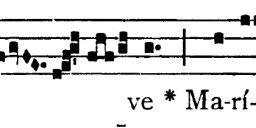
Patrick has done this before, and I'm sure he could share his very nice video again. It would be good to have a really short example, though, so I just recorded the first two words of the Ave Maria offertory mentioned above in this thread four ways. Attached are three scores (Vatican with no signs, Liber usualis, Graduale triplex). I recorded first the Vatican according to what I know of Pothier, then the Mocquereau method, then my sort of personal semiology, then proportionalist according to Patrick's method. The Mp3 is all four recordings (about twenty seconds each). For both the semiology and the mensuralist I just read from the triplex score.
I have argued elsewhere for pluralism, and what I mean is that I think actually being able to do this for any given chant would be extremely valuable for anyone who wants to understand the issues.
 Ave1.png1502 x 286 - 42K
 Ave3.png1082 x 210 - 28K
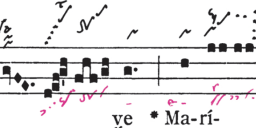 Ave2.png1668 x 366 - 301K
 ave_maria.mp32M
 -
Very beautiful. I liked the first one the best (aesthetically), although I would have wanted to emphasize the MMV a tad more. But they were all beautiful, and if I remember correctly, presenting all arguments (especially those you disagree with) in the best possible light is something Saint Thomas Aquinas says we should do.
It's a shame I only understand English, because if I could, I would definitely look into the books you've mentioned above, especially the one by Dom Pothier. Do you know of any resources in English which explain how natural speech rhythm works in singing? -
Dr. Weaver, you did show it to us! I've been thinking about it since. By the way, he is teaching a session on rhythm this summer at Solesmes, from the 21st to the 25th (the event is called the "Session de chant grégorien de Solesmes" and seems to be organized by the Association de Musicologie médiévale.
I can attest to this method; am I misremembering, or did Mocquereau or Pothier never sing the same chants one after the other? I can find some of their 1904 demonstrations in Rome (by searching "Dom Pothier Dom Mocquereau 1904" on Youtube), but there, they're singing a series of chants (and I note that there, e.g. in the Assumption introit, Dom Pothier's treatment of the note before quilisma is considerably weaker than what we expect even from Dom Pothier and not Mocquereau; in any case, it's a wonderful demonstration particularly of the Golden Rule in application, where the mora vocis is applied judiciously in between words and therefore at bar lines, but the word is never interrupted for a breath).
As a slight aside, there's a very interesting comment from Fr Z, who is apparently a Cardine disciple and like Mocquereau is a musician.
And as to the traditions, I'm now in the weeds within the traditions. Having thought about it some more, I would argue that recordings are limited but valuable. Even taking into account the technology and the ease of recording an album now, perhaps some of the singing is adjusted for that context, and the degree to which it was adjusted in the past is impossible to know, but I don't have a time machine to go back myself to 1904 or to 1930 (I believe that it's around this point that Solesmes starts issuing LPs under Dom Gajard) and so on. Listening to Mocquereau's "Saceredotes Dei" shows some of the nuance that I associate with Fontgombault, whereas Santo Domingo de Silos sings Gloria XI in a straight way that I consider very beautiful. It is a more literal reading of the neumes and of the signs. I need to get my hands on the CD from Triors which has Mass XI to compare.
OMM, it's good that Dr. Weaver is teaching a class on manuscripts. It's not so good that you'll have to wait to take the rhythm class, but if it comes up again with the CISM at the seminary in Menlo Park, California, do it. (Well, you would probably like the manuscript class too.)
Thanked by 1OMagnumMysterium -
Yes, the principle of charity, or as we might say now, steel-manning, is important, most especially when people get passionate about a disputed subject. What I was trying to do with the MMVs in number 1 was to treat them as a very slight amount of space, like the kind of gap you naturally put between small words when you speak. If you think of the melisma like a sentence, the neumes are the individual words, and the ones with space after them are like groups of words. Anyway, it's very easy to default into the MMVs just being double length. This is actually one of Patrick's strongest points of agreement with Jeff O.!
Anyway, I like all four approaches well enough. I think 3 is probably my favorite here, although I would do 2 with my schola, modified, perhaps, with a few of the niceties from 3.
For speech rhythm, Fr. Columba Kelly did translate the first volume of the big Agustoni & Göschl book into English, but it's expensive and hard to find. It may be possible to get through interlibrary loan. Anyway, speech rhythm as applied to music is notoriously difficult to put into words!Thanked by 1OMagnumMysterium -
A little bit more about "speech rhythm" in melismas. One thing that has occurred to a lot of writers since at least Dom Pothier is that the rhythmic organization of the melismas is probably a lot like the organization of the syllabic chants. There is some relationship between the neumes and the rhetoric of putting a sentence together. This is the same idea as in Notker's practice of turning melodies into texted sequences.
In the case of this first melisma with the MMVs, you might imagine each pitch getting a syllable, like in the attached file. Here I tried at least most of the time to follow Pothier/Mocquereau's principle of the tonic accent, although I didn't come up with anything particularly nice. So you sort of shape the words accordingly, and you space them out from each other and group them in a way that seems sensible. The last step would be to go back to the melisma, and sing it with basically the same shape, except instead of words you get individual neumes.
That's the idea, anyway. Notker's sequences are remarkable because he always observes word breaks between individual neume signs but still manages to come up with really intelligible poetry in process.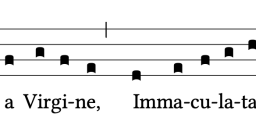 ave4.png1622 x 292 - 33KThanked by 1OMagnumMysterium
 -
A recording from 2022 is attached. Now I would interpret both of the notes marked with t and long-and-a-half (=dotted quarter). I previously treated the incipit in free rhythm, with the beat not established until gratia. It's not considerably different from the semiological interpretation Charles shared, is it? We use the restored melodic reading, which has sol instead of la at Ma-, and my tempo is slower. He holds the last note of A- a bit longer and doesn't hold the penultimate note of -ri-.
Here's the video of mine that Charles mentioned:
Ave Maria 20221214.mp3371K -
I took it upon myself to put Dr. Weaver's example above into a video for easy examination. Thank you Dr. Weaver for your time and effort. Let me know if this is correct.
http://www.myopus.com/preview/chantComparison.mp4
Personally I favor the first (vatican edition). It is stark and simple and would seem easiest for a schola (with minimal time) to remain together. -
Mr. Williams,
As you have often encouraged, I have been looking at the manuscripts myself this morning, and I am struck by the lack of uniformity between the oldest sources. I wanted to look at the Requiem Gradual, but I was having difficulty finding it in some of the manuscripts, so I used the Gradual Angelis Suis from the first Sunday of Lent for examination instead. Because there were so many images, I put them into a pdf.
One can certainly argue that my transcriptions are bad, and that's probably true, but what really strikes me is the lack of uniformity, comparing the various manuscripts to each other, and then to your edition. The earliest manuscripts don't give just one rhythmic (or melodic) tradition. So if in the ninth and tenth centuries the chant was sung with differing rhythms and pitches in different regions, who are we to say how it was sung in the fifth century, hundreds of years earlier?
I think your work has a lot of musical and historical value, but perhaps you are trying to recreate something which never existed when you speak of "The Authentic
Traditional Rhythm". As history has shown us, chant can shift from being rhythmically differentiated to equal, but it can also shift the other way, from being equal to being rhythmically differentiated. Angelis Suis Comparison.pdf684K -
OMM, thank you for posting this. I'm sure Patrick will have much to say, but I just want to make a few comments. For one thing, L has an entirely different melody, which is quite uncommon, but it makes the comparison a little less useful here. Second, all the the manuscripts after that actually have all the melisma on "su-" of "suis." The way they space this is that the melisma just goes up and to the right, while only the tractulus belongs on "-is." Also, I don't know how you are choosing your pitches, but it also makes it a little more difficult to compare. For this kind of work, I think I would prefer to take the pitches from the Vatican and see how the neumes fit.
But the most important thing, which I would encourage you to continue, is that you are onto a really great idea when you try to do the reverse transcription at the end, even though I think you don't do it in the way the manuscripts would suggest. I think this is probably an excellent way to make sure you understand semiology: if these certain notes were long, how would you transcribe it? There are lots of such exercises in that Rampi book I mentioned earlier. There's probably no better way to get a firm grasp on the SG and Laon neumes. I think you don't need nearly so many episemata in your SG, for instance. Anyway, keep at it!Thanked by 1OMagnumMysterium -
Yes. I tend to think there is no way to identify what “authentic” is or was or should now be. IMHO, All of the schools of thought tend toward favoring an artistic interpretation which in the end exhibit very slight nuances from one to the next.
-
Yes, Laon does give a completely different melody, and although I'm sure it's not an extremely common occurrence, I happened to stumble upon it accidentally rather than specifically seeking out such differences. So I think it demonstrates the lack of a single unified tradition.
Now I see what you mean about the tractulus on "-is". I was rather confused by that before. -
I don’t have time this evening to draw up a table of this passage, but I think you are overstating the lack of uniformity. I’m all for skepticism and looking at things from a different point of view, but I do think if you were to arrange and align these neumes over the melody of the Vat, you would find quite an impressive regularity in groupings, as well as a fair amount of agreement in which notes are longer or shorter, especially if you take into account the habits of each individual scribe, which would require a lot of study. I guess I’m suggesting that skepticism in approaching historical sources and theories is good, but don’t just dismiss all the research that scholars have done. This actually tends to support the idea of some kind of rhythmic tradition in the early sources.
In general, I’m as skeptical as you, but I do think it’s healthy to foster a thorough knowledge of what the signs are and what they likely mean.
If I remember, tomorrow I will draw up a bit of a table of this to show you what I mean.
-
The order of MSS listed is approximately chronological. Domine refugium (Pentecost XXI) would better serve your purposes, as Laon uses the same melody as St. Gall there. Note that my edition follows the melodic reading of the Graduale Novum, with occasional exceptions.
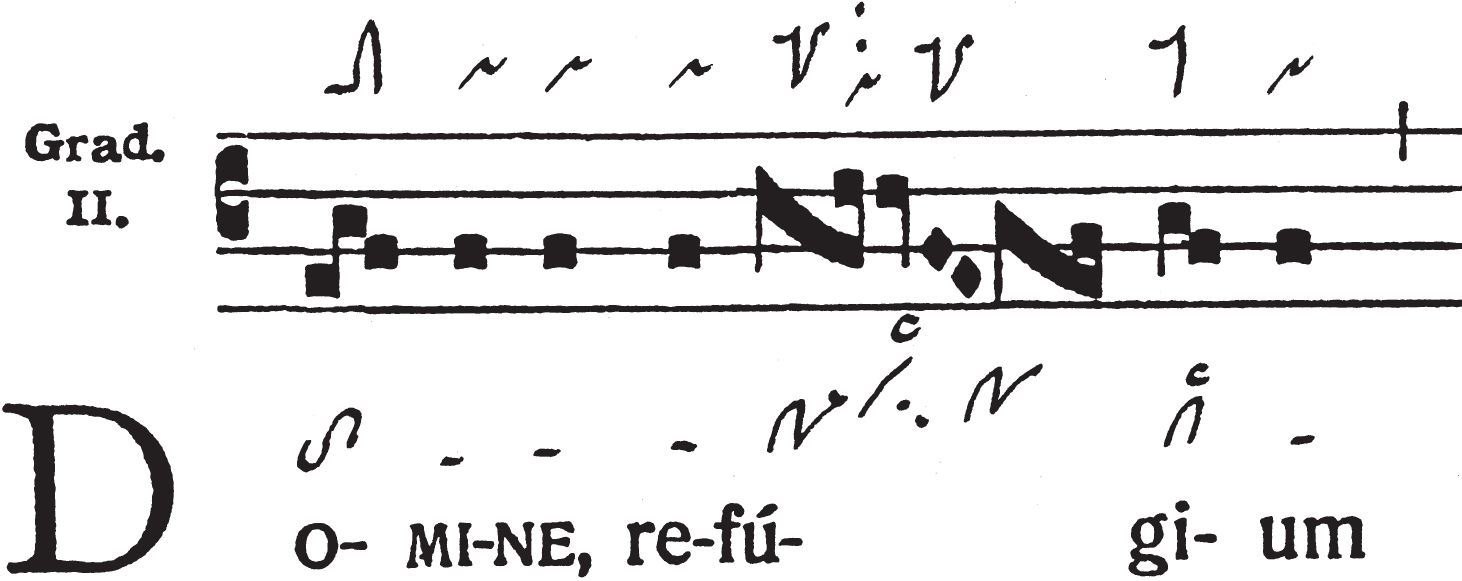
See that the Laon neumes agree with what you transcribed for Angelis suis, without the added t's and the substitution of the clivis at -gi-. Are you still struck by the lack of uniformity? In your transcription of E, you have added extra notes at the beginning of both su- and -is, where you wrote a torculus resupinus each time instead of a porrectus.
B adds an episema at the beginning of -is, where the others don't, but look how Domine refugium is written in the same source: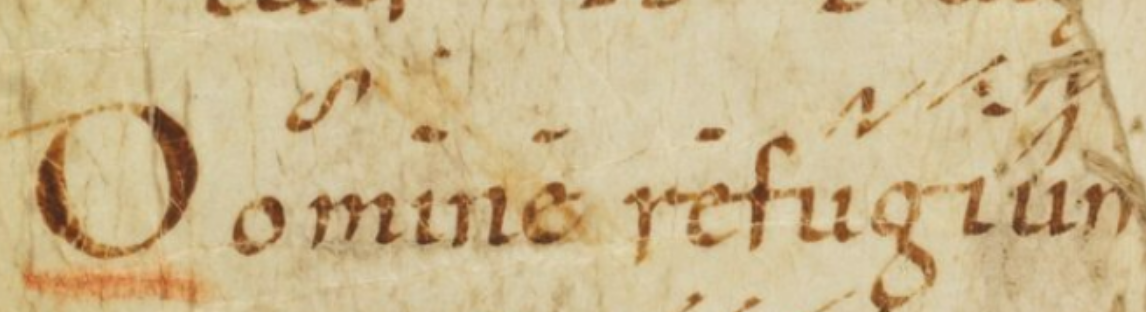
What's an editor to do? Well, pick one and and go with it! Charles touches on this in his latest CCW post. It's impossible to follow two contradictory readings simultaneously.
I would never venture a guess on how any chant was sung in the fifth century. We have no notated sources from that period, and I have repeatedly emphasized the importance of following the oldest extant sources. That is as close to the authentic traditional rhythm as we can get without more conjecture than I would be comfortable with. But they get us to something singable, and that's the important thing! I have no interest in creating something that never existed. We've had quite enough of that already with at least half a dozen different antimensuralist approaches from Solesmes and elsewhere in just over a century, and now apparently cycling back through them. I'm content with the oldest sources, although I will occasionally deviate from L, especially if Chartres and all of the SG MSS from the 9th–11th centuries give a different reading. Scribes make mistakes, and the scribe of Laon was no more infallible than any other.
Yes, let's hope and pray that chant will shift from being equal to being rhythmically differentiated!!! I'm glad you, too, think it can happen. -
For a very very small percentage of musicians devoted to sacred music this may be a wish that is possible. At the risk of sounding dismissive I will still put this forward. This effort at this particular point in time and in history seems to demand an exponential amount of energy displaced compared to the smaller benefit of it's summary result on both the liturgical milleu and the spiritual landscape of the church that is presently dissolving from within.Yes, let's hope and pray that chant will shift from being equal to being rhythmically differentiated!!!
Could it be invaluable work for a future moment? That is entirely possible. But us musicians in the trenches are just hoping and struggling to keep the dirt out of our firing mechanisms. In other words I don't believe one method over the other will alter the cause of the salvation of souls.
Perhaps a metaphor would be “shall we eat rotten moldy bread out of fine china or just a plain clay pot?” I have said it in the past and I will say it again: I may be completely wrong, but it seems to be along the lines of straining out a gnat and swallowing a camel. Am I the only one that thinks this? If so, I will try to revisit the entire matter again. -
I happen to believe the restoration of chant is worth an exponential amount of energy. It is strange to me that more church musicians don't see it as a priority, but I just have to accept that for what it is. "Not in bread alone doth man live, but in every word that proceedeth from the mouth of God." What is our chant but music—art—crafted from the word of God? Yes, it is rotten and moldy to the extent that its original rhythmic vitality has deteriorated, but I'm not really interested in the rotten moldy bread, whether served in the fine china of a leather-bound Graduale or the plain clay pot of a throwaway missalette. The manna has been well preserved in the oldest sources, and it remains there for our nourishment!
I'm very curious why you say the rhythmic restoration may be possible for "a very very small percentage of musicians." Do you sincerely think nuanced lengthenings (but only one of them in this example) and irregular groupings of two and three notes are easier to learn and sing well than straightforward quarter and eighth notes?
If so, why?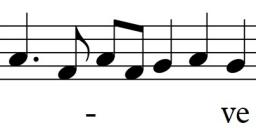 Ave example.jpg2187 x 202 - 70K
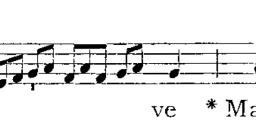 Ave solesmes.jpg2473 x 325 - 138KThanked by 1francis
 -
Recording of this Ave Maria offertory from my graduale. like the previous "Ascendit Deus" it contains extra verses. Note: some notes don't match the solesmes editions. pdf is an excerpt from my graduale AdvSun4Off.mp39M Ave Maria - Full Score.pdf39K
-
Ok, attached is a little table showing the four sources you cite of that melody, OMM. I didn't try to beautify the spacing or anything. While there are a couple of discrepancies in terms of which notes are longer etc., there is also quite a bit of agreement. This strikes me as completely normal and also to be expected. An editorial method like, say, just always choosing C when it's a solo chant and E for everything else is completely reasonable.
I don't think it's a good policy to just throw up your hands and say, there must be no rhythmic tradition here so I should do pure equalism. It's a choice, but I don't think it's the best choice. I feel strongly that scholarship, manuscript research, and looking at the sources is a very good thing for chant performers to study.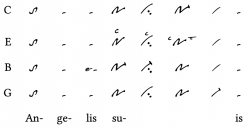 angelis-table.png902 x 462 - 39KThanked by 1OMagnumMysterium
 -
@francis
I take your point, but I wonder if the passion some of us feel about this question is not very much augmented rather than diminished in reaction to the problems in the Church. After all, Patrick and I, along with most of the commenters here, are also in the trenches in parishes.
For my part, chant played a big part in my coming back to the faith, and specifically this was the curious beauty and spirituality of the Mocquereau method. Later I studied the other approaches; I do still have a soft spot for the spiritual witness of the writers in the Solesmes orbit. Consider among these Simone Weil, from Gravity and Grace:The beautiful is the experimental proof that the incarnation is possible. Hence all art of the highest order is religious in essence. (That is what people have forgotten today.) A Gregorian melody is as powerful a witness as the death of a martyr.
What a strong idea that is, and what a responsibility for those of us who do it week in and week out! I think a lot of that special quality is not just the melody itself, but also the way the rhythm differs from so much of our mundane musical tasks. I have to do a million other things in my musical life, but there is something set apart about the chanting I do on Sunday mornings, which is as it should be, since I consider Gregorian chant to be a sacramental. That is, it is so special by its nature that it is worth all the fuss, probably way more fuss than any other kind of music would merit.
For this reason, I place a really high value on exploring the rhythmic question in both teaching and performance.
Teaching children by passing on this study of the chant is also passing on the patrimony of the Roman Church. I often find that kids respond well to the little bits of Solesmes/Mocquereau tradition that I pass down to them. I imagine that would be true if I were in a schola geared toward semiology or mensuralism too.
In performing, I think the rhythmic differentiation we make in our schola is extremely important for the beauty of the chant. First, it gives the singers more to think about, more to chew on spiritually; see Gajard's idea that the episema is an invitation to turn within and contemplate the indwelling guest, as I have written about elsewhere. Second, I think our chanting sounds more beautiful for the people in the pews, because we sing it with vitality and interest, drawn from the rhythmic approach. Equalism is fine, but it is also more possible in singing that way to sort of go on autopilot, or to think about the chanting as something to be got through (putting the plain in plainsong). I've been there before.
I'm not saying incorporating the rhythmic study of manuscripts is the only good way to sing chant, but I think it really can help the chant to do its jobs, which are primarily the glorification of God and secondarily the sanctification of the people.
Anyway, that's why I think it's worthy of our study and attention, regardless of which method you follow, even in the present ecclesial climate. -
I think if he had lived longer that he would probably have favored editions such as the semiologists now use.
From the CCW post. Yes. In fact, although it’s hard to attribute the source of these things without going into the archives, we see the Holy Week chants and particularly the Antiphonale Monasticum as departing from the Vatican edition’s frameworks.
Some have gone even further. Mocquereau would have liked, IMHO, what Le Barroux did when typesetting the chant for the patronal office, proper to their house.
Maybe we can say that there are too many episemata here, and it’s a pressus here, not an oriscus — my bad! — but IIRC you see this already in Le Nombre, and yet the official AM doesn’t have this until the 2000s.
Beyond the notation, some of the practical compromises in singing characteristic of Solesmes (the fusions at the pressus for example) can be done away with; I know people who teach and sing according to the Mocquereau system while repeating the note at the pressus! (I don’t always know how I feel about this, as a singer, but so long as it’s clear, I’m fine with it.) -
Yes, Francis, I agree with you, at least for the most part.
When I had talked about chant shifting from equal to rhythmically differentiated, I was talking about the transition from the late medieval chant to the chant used after the Council of Trent.
I suppose as long as one is trying to sing beautifully for God, the exact method doesn't really matter. Just make sure whatever you choose isn't going to cause unnecessary confusion and frustration for your singers. By which I mean, be consistent with your principles so your singers know what to expect.
I have a personal disdain of the Solesmes signs and editions, but it's probably unreasonable of me. I don't even have any control over the music we do at our parish, so I had better just stop spending so much time arguing on the internet, start deflating my pride, and focus on the things I do actually need to be working on in life now.
It's a free country, so Mr. Williams is certainly entitled to spend the "exponential amount of energy" on his new edition, and I pray God will bless his efforts. I still reject the idea of "The Authentic Traditional Rhythm", but I respect his work as being one side of the dice, and frequently consult his website for things such as offertory verses.
I am honored that such knowledgeable people have been willing to take me seriously enough to answer my questions and correct me.
To narrow down the example even further of the mode II graduale, I will offer the following point. It is clear that Mr. Williams (and I am assuming semiologists in general) believe the torculus on the first syllable of the chant is two shorts followed by one long note. There seems to be no indication that the last note is long. When I transcribed the proportional edition using a "T" and an episema, I was using forms found elsewhere in those notations (Laon and St. Gall). If the simple torculus is short-short-long, what are the ones marked with an episema or "T" at the end? -
@MatthewRoth Perhaps the clearest example of Mocquereau thinking this way is in the study on Alleluia Ostende, which appears in PM vol. 10. Attached is a snapshot of the beginning, with his presumably idealized notation.
 Mocquereau_ostende.png1838 x 1330 - 2M
 -
OMM, you write: "It is clear that Mr. Williams (and I am assuming semiologists in general) believe the torculus on the first syllable of the chant is two shorts followed by one long note."
I don't think that is the opinion of semiologists in general, but some of them consider the last note of a syllable in a longer group like this to regain its “full syllabic value.” You won’t find this rule in the Guilmard or Rampi books mentioned above. Patrick posted about this some in our discussion at CCW, where I believe he found it in some later Cardine editions.
I think there is probably some value in maintaining a distinction between the cursive torculus and the other forms you mention.Thanked by 1OMagnumMysterium -
The latest CCW Gregorian Rhythm Wars posts have included the opinions that if Mocquereau had lived longer, "he would probably have favored editions such as the semiologists now use" (CW) and that if Cardine were alive today, "I strongly suspect he’d abandon his 'authentic rhythm' theory" (JO). Now to round things out, we need contributors to step up and hypothesize that if they were still around, Murray would surely be a Mocquereauvian and Pothier would be a mensuralist!
The 1983 Liber hymnarius states that the last note of a neume regains the normal syllabic value, i.e., the same value denoted by the horizontal episema, neumatic break, or note before or after a quilisma. According to those rules, the last note of a torculus would be long except where followed by a unison note. I would have to go back and check Cardine's Gregorian Semiology, (I don't have it handy at the moment), but I think he interpreted an ascending neumatic break after a torculus as inexpressive, since the note before the break is lower than both neighboring notes. One of the semiologists here may know better. Laon's equivalent of St. Gall's pes subpunctis is written as torculus+punctum/-a. There, the puncta are considered part of the same neume. https://gregobase.selapa.net/sources/15/15.png
OMM, I recently addressed in another thread why the ordinary cursive torculus is normally short-short-long. To flesh out the evidence a bit more, let's consider the incipit of today's tract. The torculus at -la-, also considered as a scandicus flexus with neumatic break in Cardine's tables and elsewhere, shows no sign of lengthening on its final note, but does it need one to be interpreted as long? The "pure Vatican" equalist and "classic Solesmes" people would say yes. The Cardinian "semiologists" might interpret it as long anyway, in accordance with the 1983 Liber hymnarius rules for interpretation. Compare the tracts Attende caelum, De profundis, Qui regis, and Sicut cervus, where the liquescent form is used. That liquescent scandicus flexus, =tractulus+ancus, is either four notes, LssL, or five, Lssss. There is no argument to be made in favor of reading it as Lsss, yet that is the interpretation being given to the non-liquescent form—and they're all printed as non-liquescents in the Vatican and Solesmes editions. I did come across one instance where an episema was written in St. Gall 342, for the tract Laudate Dominum, but that's exceptional.
Although this is evidence, it is not proof per se. I think the centonization formulae must have been used with rhythmic consistency when the chant was memorized and preserved orally/aurally because it seems improbable that the cantors would have committed a single formula to memory with multiple rhythmic variations for different texts. I cannot prove this anymore than I can prove that there are no ternary rhythmic groupings. This is where common sense and musical intuition factor into the work. As you remind us, it's a free country (although we have international members of the forum!) and others are free to believe that centonization formulae were recalled and transmitted with different rhythmic nuances for each chant (see the uncannily similar quotes from Van Kampen and Olbash here, at the end of the paragraph titled "An Incredible Claim"), that a few ternary groupings were mixed into chants with an otherwise binary rhythm (the paragraph titled "Being Sensible" here), or that an agogic nuance was added to certain notes of office antiphons only at the beginning of a syllable sung to two notes (here). But proof is another matter ;)
Thanked by 1OMagnumMysterium -
This Troyes 522 is interesting. It's a Missal, not just a Graduale.
https://portail.mediatheque.grand-troyes.fr/iguana/www.main.cls?surl=search&p=*#recordId=2.2541 -
FSSPmusicI happen to believe the restoration of chant is worth an exponential amount of energy. It is strange to me that more church musicians don't see it as a priority, but I just have to accept that for what it is. "Not in bread alone doth man live, but in every word that proceedeth from the mouth of God." What is our chant but music—art—crafted from the word of God? Yes, it is rotten and moldy to the extent that its original rhythmic vitality has deteriorated, but I'm not really interested in the rotten moldy bread, whether served in the fine china of a leather-bound Graduale or the plain clay pot of a throwaway missalette. The manna has been well preserved in the oldest sources, and it remains there for our nourishment!
@FSSPmusic
Sorry for my poor analogy.
I think I must reiterate that the level of interest in how you approach chant is commendable and admirable. Do not get me wrong. I was speaking from a pragmatic point of view from one who is a organist, composer, choirmaster, arranger, performer, etc. What it comes down to is I don't have the time or energy to become this granular in the execution of the craft of the chant at this level.
Therefore I default to the more straightforward interpretation of the chant. Personally over the years I have less and less liked the Solemnes method. As I said above I like the beauty in simplicity of the Vatican edition without any markings.I'm very curious why you say the rhythmic restoration may be possible for "a very very small percentage of musicians." Do you sincerely think nuanced lengthenings and irregular groupings of two and three notes are easier to learn and sing well than straightforward quarter and eighth notes?
If so, why?
When one only has 20 minutes per set of Propers to rehearse, unless all the members of the schola are familiar with a particular school of thought, it becomes cumbersome to execute all the material without getting lost in the weeds. The schola I sing with now all practice the Solemnes method. I don't see them rethinking the note values, however, they are becoming less rigid in the 'all notes are the same value' approach, and are starting to think more musically.Charles_Weaver February 11 Thanks
Posts: 31
@francis
...but also the way the rhythm differs from so much of our mundane musical tasks.
Teaching children by passing on this study of the chant is also passing on the patrimony of the Roman Church. I often find that kids respond well to the little bits of Solesmes/Mocquereau tradition that I pass down to them. I imagine that would be true if I were in a schola geared toward semiology or mensuralism too.
I commend you on your efforts! Could you post some recordings of the children?Anyway, that's why I think it's worthy of our study and attention, regardless of which method you follow, even in the present ecclesial climate.
Yes, the difficulties of the moldy bread (which is really the contemporary music that has invaded the liturgy) take over the place of even doing any chant at all, so it becomes a struggle even to do the simplest forms.OMagnumMysterium February 11 Thanks
Posts: 153
Yes, Francis, I agree with you, at least for the most part.
I suppose as long as one is trying to sing beautifully for God, the exact method doesn't really matter. Just make sure whatever you choose isn't going to cause unnecessary confusion and frustration for your singers. By which I mean, be consistent with your principles so your singers know what to expect.
Yes... this is the position I have had to maintain for years with the various scholas under my direction.It's a free country, so Mr. Williams is certainly entitled to spend the "exponential amount of energy" on his new edition, and I pray God will bless his efforts. I still reject the idea of "The Authentic Traditional Rhythm", but I respect his work as being one side of the dice, and frequently consult his website for things such as offertory verses.
Yes. I totally agree. I laud those who can do this work of semiology and I admit it makes me a bit sad inside that I do not have the time or the platform to do so myself.
Thank you all for your expertise. -
This is a fascinating discussion. I have my own quite strong opinions on how Chant ought to be sung, but acknowledge that it is impossible to know exactly how chant would have been sung in earlier centuries, and therefore don't fault anyone else for holding an opinion different than mine. Mine stems mostly from what I grew up with and studied in college, sang for 2 years in a monastery, and have continued to stick with, but I also acknowledge that other "methods," if you can even call them a method, can also be beautiful.
On the one hand, there have always been local traditions, and variances from location to location in the liturgy, and I am sure this has always been reflected in the music from location to location or region to region as well. On the other hand, it's really unfortunate that chant performance in the liturgy is a somewhat divisive topic with many differing opinions. And the reason it is really unfortunate is that the liturgy itself has suffered very, very greatly in the past 60 years, with the advent of the Novus Ordo Missae and its countless options (most of them non-traditional options, but that's not my point here...) - the last thing we need in today's Church is yet another point of disagreement and seeming lack of unity. For decades now (particularly the decades leading to Vatican II) the liturgy has been subject to so much criticism and change supposedly based on early sources, and it seems that in many ways the same has happened with Gregorian chant.
My view on the liturgy is that we really just need to go back to the pre-Vatican II liturgy, and until we live in more sane times, we should just learn to love the liturgy as it developed until then. After the Church (and the world) comes more out of its current crisis, maybe then we'll be able to take a good, better, more honest look at "reforming" the liturgy (although I personally think there is little to no reforming necessary of a liturgy that has developed from Apostolic times into what it was before the reforms of the '60s). I tend to think the same about chant, but it's a little more difficult to pinpoint what "method" would be the most likely for the Church (Latin church at least) as a whole to agree upon and stick with until more sane times. -
@charlessa
That is very beautifully said and well put. I share the same sentiments. I think the whole world is going to go far beyond what I would term a rude awakening in the coming year -
According to Dom Jean Claire, who was at Cardine's bedside at the time of his death and and to whom Cardine dictated his "Final Testament," Cardine held that the difference between the value of a "long" note and a "regular" note was the difference between the time it takes to pronounce a syllable the consists of a vowel plus consonant and a syllable that consists of a vowel only. Claire urged that chant directors should recruit someone to record this difference and show singers how short it is. Cardine never approved of any recorded performance purpotedly based on his teachings.
Cardine recognized that incorporating all the nuances shown in the adiastematic mss. according to his interpretation was nigh unto impossible and discouraged the attempt except in ideal circumstances.
We need not agree with Cardine 's ideas about note values or anything else; but those who claim to perform "according to the teachings of Cardine" should either embrace his reported ideas or drop their claim.
In the Liber hymnarius Solesmes attempted to show all the nuances evident in the adiastematicmanuscripts. Choirs (monastic choirs, probably) complained that singers were doubling every note marked with an episema, with ludicrous results. So in subsequent recent books Solesmes stopped including the episemas.
My source for what I've written about Claire's statements is, Jean Claire, “Dom Eugene Cardine (1905-1988)" Revue gregorienne XVII (1989), 20. -
Although Anthony Ruff, no fan of Dom Mocquereau’s signs, has observed that Solesmes observes them in an oral tradition and the choirmaster of Saint-Benoît-du-Lac added them to the modern antiphonal by hand… and Solesmes then revised the preface to the Liber Hymnarius, but, some would argue, since they want to do away with the signs, they’ve taken away the clues.
In a comment, a reader mentions the Praglia antiphonal, which does make use of rhythmic signs. Interesting, and apparently there is a Benedictine monastery of nuns in Rome that uses this book, in addition to the monasteries that produced it. So there you are. -
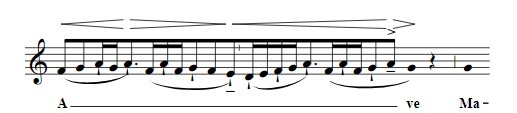
I would do the notation like this: in melismas - short in sixteenth notes, long in eighth notes; outside of melismas - stemless black note head for long/syllabic time and sixteenth note for short. Some "tenuto" indicating expressive slowing chosen by me as an expressive nuance, an accent notation ">" indicating on a note an important crescendo in intensity and "ictus" marks marking some important downbeats to maintain an interesting flow.
the notation could be interpreted in a nuanced semiological style by considering the distinctions between long and short as not strictly proportional and using "rubato". test notation.jpg517 x 113 - 17K
 -
The "quarter bar" and the ligatures maybe could be used to separate the neumatic elements of the long melisma instead of grouping section of phrases. Or the long melisma could be represented by a ligature and the beaming of the eighth and sixteenth notes would separate the neumatic elements.
Thanked by 1OMagnumMysterium -
Maybe in the future I could spent time writing in this syle of modern notation using the edition of Patrick as a guide to where is long, where is short, where is grace, etc.Thanked by 1OMagnumMysterium
-
I can easily add stropha, oriscus and quilisma

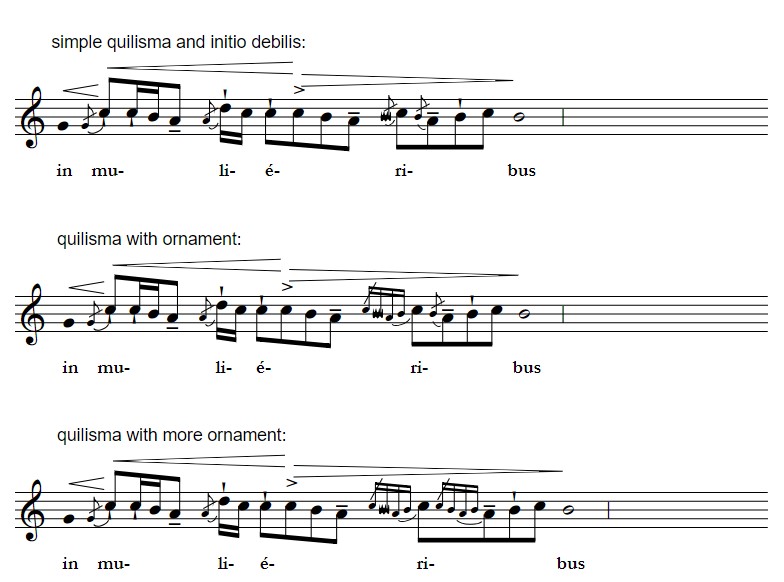
 test notation 1.jpg785 x 284 - 43K
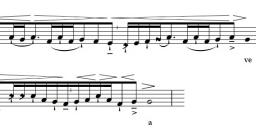
 test notation 2.jpg784 x 582 - 80K
 -
To Lincoln_Hein:
When I wrote something similar, people complained that it's too ornate and quoted "tra la sollicitudine" against me.
My version of Ave Maria is still on the first page of this thread -
Check out the pdf and tell what you think.
I could do something like this for the entire gradual.
teste ad te.pdf141K -
I think that sort of notation does a good job explaining proportional rhythm, at least visually and intellectually, but in practice I would have a very hard time singing from it, unless someone helped me learn it and I practiced more. I think that Mr. Williams' editions are easier for me to sing from, but this notation definitely has some interesting ideas as well.
I like how the three different colors are used, and I think if the neumes are included, it should be like this. I think the neumes would be beneficial in an earlier edition to teach people about where the proportional rhythm comes from and for people who read the neumes to compare for themselves, but in a final performing edition, they should be left out. Whatever notation is used should convey all the information of pitch and rhythm without having to include two other notations in the same score.
I would really like to see a notation which has the horizontal compactness of Mr. Williams' editions which comes from use of the podatus, but without using the episema for every single long note. If someone could design a notation, it could be made into a gregorio font in FontForge, and then it could be used with gabc.
I also think four staff lines are adequate and easier to read than five, and the traditional Do clef is preferable over the treble clef. -
OMagnumMysterium, given your preference for a traditional square-note notation that could express both pitch and rhythm, are you familiar with the Graduale Renovatum project?
www.GradualeRenovatum.com
Thanked by 1FSSPmusic -
I link to the Graduale Renovatum on my page and find it to be an interesting edition. The most frequent criticism of my editions is that they are too cluttered with episemata. In the Ad te introit, the Graduale Renovatum shows the same rhythm at (ne)que and (exspe)ctant, apparently short-long-long, which cannot be justified from the triplex edition. The rhythm at the end of -que is short according to Laon or long according to St. Gall 376; I see no justification in those two manuscripts for short-long-long. At -ctant, why not use the initio debilis figure to notate what Cardine calls the special torculus?
-
I am familiar with the Graduale Renovatum. It seems obvious to me though that the Graduale Renovatum does not show strict proportional rhythm. I suppose there are two questions here, that of what the "authentic" rhythm and melody is, and how it is most effectively notated. I'm really only considering the second question at the moment. Following the sort of pluralism which Dr. Weaver often advocates for, I would be interested to improve the notation of all schools of rhythm, just to be able to have an easier time of singing each of them if nothing else.
For proportional rhythm, I have not found any notation I have seen completely satisfying as being both elegant and effective. But I readily admit I may not be the best judge, both due to my perfectionism, and my bias towards the types of notation I am most used to and enjoy singing and looking at.
If you have a collection of recordings, Mr. Nickel, I would be interested to listen to some while following along with your editions to get a better idea of what you're really aiming at. Our schola director follows a roughly semiological approach while singing from the Liber (formerly he used the Triplex). It used to frustrate me, but I've gotten used to it over the years, and I've started to appreciate the expressiveness of certain parts of his method.Thanked by 1CHGiffen -
I second OMagnumMysterium's request for a few recordings of the Renovatum editions. I have followed the Renovatum project for a while now, and would love to hear Royce's own interpretations of it. Thanks!Thanked by 1CHGiffen
-
I don't mean to speak for Royce, but I'm pretty sure his edition is intended to convey mainstream semiology, such as Göschl's:
https://www.youtube.com/watch?v=mStjSU36Ceo
Welcome to the MusicaSacra Forum!
To participate in the discussions on Catholic church music, sign in or register as a forum member, The forum is a project of the Church Music Association of America.
Categories
- All Discussions21,096
- General Music Discussion8,211
- Job Openings197
- Management of Music Programs850
- Choral Matters532
- Church Documents and Rubrics524
- CMAA Notes301
- Events716
- For Newcomers: Read First26
- Sacred Polyphony546
- Hymnody872
- Gregorian Chant: General2,697
- ↳ Graduale Romanum and Liber Usualis368
- ↳ Graduale Simplex60
- ↳ Semiology63
- Vernacular Plainsong696
- Anglican Use and Anglican Chant68
- Organ, Other Instruments and Repertoire435
- New Composition/Works in Progress1,290
- Recordings230
- Music for Hispanic Ministry159
- Music Education: Children211
- Music Education: General222
- News Items245
- Positions Wanted2
- General Discussion: Catholicism739
- Amusements177
- General Discussion1,033
- Opinions117