
Kyrie when Penitential Rite is omitted?
-
Is the Kyrie part of the Penitential Rite, or on those occasions when the OF Missal says the Penitential Rite is omitted, can the Kyrie still be sung?
I encounter this problem mostly on Ash Wednesday and at Nuptial masses. Is there any definitive position on this topic? -
Someone else can cite the GIRM specifically, but the gist of your answer is:
-The Kyrie is a part of the Penitential Rite. If there's not Penitential Rite (now called Penitential Act), no Kyrie.
-At Nuptial Masses under RM3, there is no Penitential Act but the Gloria is said/sung.
-
I've actually found that the GIRM is quite clear that the Kyrie is after the penitential rite (which means it would NOT be part of the penitential rite).
It's not quite clear, but I'd argue that the kyrie should be done in cases when the penitential rite is omitted, since it was not included in the non-existent penitential rite. -
Though I agree with Ben, it's rather ambiguous, and I can see either course being justified as the correct one.
Here's an example from the Vigil of Pentecost:
"a) If First Vespers (Evening Prayer I) celebrated in choir or in common immediately precede Mass, the celebration may begin either from the introductory verse and the hymn (Veni, creator Spiritus) or else from the singing of the Entrance Antiphon with the procession and greeting of the Priest; in either case the Penitential Act is omitted (cf. General Instruction of the Liturgy of the Hours, nos. 94 and 96).
Then the Psalmody prescribed for Vespers follows, up to but not including the Short
Reading.
After the Psalmody, omitting the Penitential Act, and if appropriate, the Kyrie (Lord,
have mercy), the Priest says the prayer Grant, we pray, almighty God, that the splendor, as at the Vigil Mass."
The Kyrie is part of the Penitential Act, however, if option C (with the tropes) is used. -
Somebody get Pope Benedict to celebrate a Nuptial Mass and we'll take notes...
Or perhaps we should just look and see what he did last Ash Wednesday. -
I always thought the Kyrie was part of the Penitential Act and therefor would not be sung if the Penitential Act is omitted. That is how we do it at the seminary and the priests there are pretty savvy when it comes to the liturgy.
-
From the GIRM:
"The Penitential Act
51. After this, the Priest calls upon the whole community to take part in the Penitential Act, which, after a brief pause for silence, it does by means of a formula of general confession. The rite concludes with the Priest’s absolution, which, however, lacks the efficacy of the Sacrament of Penance.
From time to time on Sundays, especially in Easter Time, instead of the customary Penitential Act, the blessing and sprinkling of water may take place as a reminder of Baptism.
The Kyrie, Eleison
52. After the Penitential Act, the Kyrie, eleison (Lord, have mercy), is always begun, unless it has already been part of the Penitential Act. Since it is a chant by which the faithful acclaim the Lord and implore his mercy, it is usually executed by everyone, that is to say, with the people and the choir or cantor taking part in it."
Like I said, it seems either interpretation has merit, so without further clarification, go with what the Priest says, I guess. I know I've certainly done it both ways. -
What did the Pope do on Ash Wednesday, by the way?
-
Thanks for the "clarification" ClemensRomanus.
-
ClemensRomanus: there was no Kyrie at the Papal Mass for Ash Wednesday in 2012; the Collect immediately followed the Introit.
http://www.vatican.va/news_services/liturgy/libretti/2012/20120222.pdf
-
Thanks to all.
-
52. After the Penitential Act, the Kyrie, eleison (Lord, have mercy), is always begun, unless it has already been part of the Penitential Act. Since it is a chant by which the faithful acclaim the Lord and implore his mercy, it is usually executed by everyone, that is to say, with the people and the choir or cantor taking part in it."
Can somebody settle this once and for all?
It seems like this discussion has popped up again and again.
unless it has already been part of the Penitential Act
Is this not how the Kyrie can occur inside the Penitential Rite?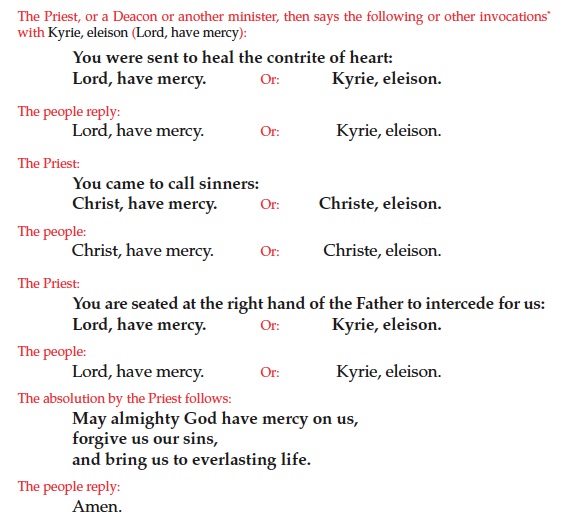
-
I have a rule I follow. Ask the pastor. If in doubt, ask the pastor again. JMO, my understanding is that the option you have posted is correct and allowed.
-
JMO and ClemensRomanus are correct. It is possible that the Kyrie (Lord, have mercy) is included in some forms (ie. those with troped Kyries), but not all forms, of the Penitential Rite. GIRM 52 covers the cases where the Kyrie has not been incorportated into the Penitential Rite.
If it ain't been sung already, then sing it!! -
Yes, Jeff, the kyrie with tropes can appear within the penitential act, but the standalone kyrie, without the tropes, is not part of the penitential act, the GIRM seems pretty clear.
-
But what's not clear is whether the occasional instructions to omit the penitential act was necessarily intended to be read restrictively to refer to only #6 in the Missal or more broadly to both ##6&7 in the Order of the Mass.
-
That's where the question lies.
-
Why is it not clear? Instructions to omit the Penitential Rite refer only to the Penitential Rite and not to the Kyrie (if not sung before). Sections 6 and 7 of the Missal are, respecitvely, the Penitential Rite and the Kyrie, and the omission instructions refer only to section 6, not to section 7. Good grief, what's the problem?Thanked by 1ServiamScores
-
CHG-
The problem is that it's the Novus Ordo. We all know that none of the rubrics are clear in the Novus Ordo. You can do whatever you want in the Novus Ordo- so many options, it's just too confusing. -
Actually, this one seems quite clear when read at face value. The real problem is that far too many priests, liturgists, and musicians think they can get away with anything, just to suit their fancy.
-
-
What does the Roman Missal have to say about this?
From the GIRM (emphasis mine):52. After the Penitential Act, the Kyrie, eleison (Lord, have mercy), is always begun, unless it has already been part of the Penitential Act. Since it is a chant by which the faithful acclaim the Lord and implore his mercy, it is usually executed by everyone, that is to say, with the people and the choir or cantor taking part in it.
From the Order of Mass (emphasis mine):7. The Kyrie, eleison (Lord, have mercy) invocations follow, unless they have just occurred in a formula of the Penitential Act.
Character or not, subtantively or not, it is abundantly clear and very specific from what is written in the Roman Missal that the "Kyrie eleison (Lord, have mercy) invocations" are not part of the Penitential Act (sorry for mislabelling it Rite instead of Act previously). Moreover, unless the Roman Missal explicitly says that both the Penitential Act and the Kyrie are to be omitted, as in the Vigil of Pentecost following First Vespers (Evening Prayer), then any instruction omitting just the Penitential Act cannot refer both to the Penitential Act and the Kyrie.
The Kyrie is not some tail that is pinned on the donkey, not some moustache that is painted on a poster, not frosting on a cake nor sprinkes on an ice-cream sundae, not some attire put on to dress up an occasion. No, the Kyrie was there before the Penitential Act was ever formulated and made a part of the Mass, and the author(s) of the Roman Missal have been very explicit in taking care not to make it seem as if the Penitential Act is some sort of "holy swiffer" that sweeps up the "holy dust" of the Kyrie and carries it away whenever the Penitential Act is omitted. End of metaphors.
To hem and haw about and excuse omitting – or, worse, to make it ones agenda to omit – the Kyrie whenever the Penitential Act is omitted is wrong, irrespective of whether it has been (and is being) done, illicitly or through misunderstanding.
-
Edited..
Perhaps my message was a bit testy :)
That being said... typically when the documents aren't clear (and they aren't in this case), I look at what Pope Benedict is doing and use that as my guide. This isn't World Youth Day in the 90s - Papal liturgies are well thought out and respect the Missal and GIRM. If the Papal MC thinks that the Kyrie is to be omitted on Ash Wednesday, I tend to follow his example. -
Let's not be testy, Matthew. The above are simply parsing what the documents actually say. The liturgy isn't necessarily normative only because the pope has celebrated it a certain way.
The GIRM, as well as the text of the Missal itself, sets the Kyrie apart from the Penitential Act (both are part of the Introductory Rites). GIRM 46 names it as a separate rite, and #52 is not only its own section, but specifically says that it comes "after the Penitential Act."
Something that comes after the Penitential Act is not the Penitential Act. -
Thank you all for clarifications regarding my initial answer to the OP. Here I was thinking I understood the liturgy....
-
That's quite true, Andrew. I recall reading that even after the 1955 Holy Week changes, Pope John XXIII still used aspects of the pre-1955 Good Friday liturgy, preferring to retrieve the Sactissimum himself rather than allow the deacon to retrieve it (I know it's not a perfect analogy by any means).
-
Thank you all for the help. I buy the argument that the Penitential Act and Kyrie are separate. But how can I convince my priest in 1 minute or less that I should sing the Kyrie at the wedding this Saturday?
He is very conservative and wants to do things by the book, but from his reading, "no Penitential Act" also means "no Kyrie." -
Maybe you can make a deal to do it his way for now, and for the next time check with the diocesan Office for Worship to get guidance.
-
I'd be willing to bet most Diocesan Offices of Worship will say not to do the Kyrie.Thanked by 1marajoy
-
Either way, it resolves the question; if they tell you to do the wrong thing, at least you have permission.
-
1. To definitively answer one of cantorconvert’s points – on Ash Wednesday, the Kyrie may be sung (as you have phrased it). It may also be omitted. No ambiguity in the Missal (preamble to Ash Wednesday.) Do it or don’t do it, it’s up to the priest, who is custodian of the liturgy in the parish. Perfectly licit either way. No sense arguing over it.
2. If Mass begins with the Rite of Blessing and Sprinkling of Holy Water (as it may on any Sunday,) there is no Kyrie. Period. Missal is clear (Appendix II.) No Kyrie, straight to the Gloria afterwards (in season.)
3. If part of Vespers is combined with Mass, replacing the Penitential Act, the General Instruction on the Liturgy of the Hours says that “at choice” the Kyrie is omitted (GILH n.94). Clear: do it or don’t do it; the priest, who is custodian of the liturgy in the parish, gets to decide. Perfectly licit either way. (How often are you going to do this anyway?)
4. For the Rite of Marriage, ... I think there is a revised edition in the works, and I would expected some clarification of this issue, so wait and see.
The wording of the rubrics in situ before the Kyrie in the Order of Mass is probably a little vague because it’s not really the best place to list all the specific circumstances at that point in the Missal.
I don’t get the grousing about choices in the Novus Ordo. There are a small, finite number of choices, allowing for legitimate variety; a much better way than having the “liturgy committee” come up with their own “creative” variations that are not legitimate. That’s really been the source of problems, not the use of legitimate and worthy ritual variety.
Thanked by 1ClemensRomanus -
And if you can't wait and see, then follow the Rite of Marriage rubric currently given:4. For the Rite of Marriage, ... I think there is a revised edition in the works, and I would expected some clarification of this issue, so wait and see.
And, because the Penitential Act does not include the Kyrie, the Kyrie is said. Of course "said" means "said or sung".The Penitential Act is omitted. The Gloria in excelsis (Glory to God in the highest) is said. -
On the other hand, The Kyrie follows the penitential act. Therefore, no penitential act, no Kyrie. (A hard act to follow, evidently.) Therein lies the problem – someone’s interpretation is required.
Claiming that the Kyrie is an independent ritual element, not dependent on what precedes it, is an interpretation which does not necessarily follow from the rubrics or any magisterial source. On the other hand, the rites themselves indicate that the Kyrie is related to whatever precedes it. Consider it a “penitential doxology”. Like the Gloria Patri, it is a ritual culmination and local climax of a liturgical element (in this case a corporate penitential act.) Like the Gloria Patri, it is also a prayer with its own internal logic. (One could pray the Gloria Patri on its own, though this does not occur in the liturgy. All analogies limp, but this is not intended to be a definitive analogy.)
The black-and-white conclusion that the Kyrie always stands on its own loses the nuances of its relation to what precedes it.
Final point: an interpretation of this nature is beyond the competence of an episcopal conference and requires clarification from the Congregation. Anyone want to send the letter? Until then, it is NOT a free-for-all. A temporary clarification must at least be requested from your local ordinary. This sort of thing should not vary from parish to parish.
-
Looking at the rubrics for the ritual Mass for the conferral of baptism apart from the Vigil, one reads "the Penitential Act, the Kyrie, and the Creed are omitted." Compare that with the ritual Mass for marriage, which says that the Penitential Act is omitted, and the Gloria is said. Both rubrics say to skip the Penitential Act. The first rubric explicitly says to skip the Kyrie, while the second does not. I think the simplest interpretation is best. The Kyrie is always said (or sung), unless included in the Penitential Rite, or explicitly excluded by special rubric.
-
Paul, I'm not sure if that follows logically. The GIRM presents the kyrie as quite separate from the penitential act. Indeed, it always follows the penitential act, but if the penitential act act is skipped, then one would just move on to the next part of the Mass, the kyrie.Thanked by 1E_A_Fulhorst
-
It is a good policy to follow what the priest wants, but there is another good policy: remind the priest what the rubrics require. There has been a lot of down-playing of the Ordinary of the Mass; very often the Kyrie or the Gloria or the Creed is omitted at a normal Sunday Mass, and often priests just think that this is how to do it; a polite reminder of the rubrics can serve a good purpose.
I believe, however, that the rubrics are contradictory. Several days show rubrics on the proper pages for the day that say after a special ritual action, the collect is then said, implying that both the penitential rite and the Kyrie are omitted. I would hold that at least rubrically the Kyrie is a separate item from the penitential act; in the GIRM they are both numbered separately, and thus the rubric saying that the Kyrie is always said should be taken seriously.
Moreover, in the context in which one is attempting to cultivate congregational singing of the Ordinary, what sense does it make to omit the Kyrie? -
There is a subtlety here that is being missed: the Kyrie has an identity of its own, but it is not independent of what has preceded it.
Ben claims, “The GIRM presents the Kyrie as quite separate from the Penitential Act.”
No, look at the whole picture: the Missal and GIRM present the Kyrie as an element which is incorporated into a Penitential Act, or follows a Penitential act, or is omitted entirely when the sprinkling rite is used; and in the funeral rites when the body is greeted at the door; and (likely) in the rite or marriage; and sometimes when the office is incorporated.
The rite of sprinkling is a guide: it “takes the place of the usual Penitential Act.” It does not include the Kyrie. This is perhaps the best ritual reference, because it is not drawn from another ceremony, but is part of the Mass itself.
The rites express our theology of worship. Whenever the Kyrie is used, there is some kind of related preparation. One does not just “up” and sing the Kyrie. One prepares by reflection (i.e. penitential act or the psalmody of the hours).
Likely this is why it does not say “The Kyrie is said;” rather, the Kyrie “follows”. It is interesting to note the use of this term elsewhere in the Missal, usually where a string of elements are grouped together.
Therefore, I am not convinced of your assertion that the Kyrie is said when the penitential act is omitted (unless specified otherwise). I think all the rites point to the contrary.
Per Dr. Mahrt’s comments, yes by all means remind priests of rubrics, but if you dealing in the realm of opinion as in this case, be sure to admit that. And by using the sprinkling rite, for example, what an excellent opportunity for all to sing the Vidi aquam or Asperges me!
HOWEVER, finally, I would not be surprised if the eventual revised rubrics for the Rite of Marriage says, “The Penitential Act is omitted, and, at choice, the Kyrie.” But until then, someone in authority needs to be consulted.
Thanked by 1hilluminar -
The thing that frustrates me most about this whole conversation is that the missal itself doesn't seem to take the rubrics seriously. Or at the least, it seems like something new that doesn't yet have the kinks ironed out - not exactly what you might expect from the book of ceremonies of a two thousand year old organization. Why should lay musicians even be having this conversation?
All other Vatican II discussion aside, the old missal was a systematic approach to how to celebrate mass. I long for that level of organization as I plan music and deal with brides-to-be. -
cantorconvert:
1. I am of the opinion that the Rubrics are clear in the current Missal (at least on this matter- but also on most others), as are other people. I find many of the above comments to be reading way too far into the instruction, trying to infer confusion where none exists.
2. The age of our venerable organization is likely to create more confusion, rather than give it time to settle down. In software we call this "cruft," and it is always in greater abundance on "legacy systems."
3. Have you had a great deal of experiencing planning weddings (and other liturgies) in accordance with the 1962 Missal? I don't know you at all, so I would not suggest that you don't have the credentials to call the older missal a "systematic approach to how to celebrate mass," and (in so doing) declare it to be drastically easier to understand and implement as compared to the current Missal. But at least some part of me thinks that perhaps if you did have such credentials, you wouldn't make such a statement.
If the rubrics for the 1962 Missal were so obvious and clear (as compared to the current), I should think that we would have no need for a specialist class of Latin-reading EF MCs. I would also expect there to be way fewer questions on this board and other places about how to do this or that thing in an EF liturgy.
4. English or Latin, clear or confusing- there is no rubricist in the world that can wield instruction manuals in a fight with a bride (and her mother) and hope for a victory based on the might of legislation. -
Adam, #4: Lol, too true.
-
Paul_D said:1. To definitively answer one of cantorconvert’s points – on Ash Wednesday, the Kyrie may be sung (as you have phrased it). It may also be omitted. No ambiguity in the Missal (preamble to Ash Wednesday.) Do it or don’t do it, it’s up to the priest, who is custodian of the liturgy in the parish. Perfectly licit either way. No sense arguing over it.
When you refer to the preamble to Ash Wednesday, which language are you citing?
By the way, thanks to everyone for this enlightening thread. This issue has perplexed me from time to time.Thanked by 1Paul_D -
WJA – good catch! I was reading the page before Ash Wednesday note 1 (how to cite?) But in my haste I failed to notice that I was reading the general procedure for a Lenten stational Mass with procession.
Therefore this does not help answer cantorconvert’s original question as I had proposed. I could go on, but I'm giving up at this point.
In light of all this, I laughed when I dug up my diocesan Ordo from the past Ash Wednesday. The first “pastoral note” for Ash Wednesday says,
“It is important to read the Roman Missal, beforehand.”
I wonder if they meant the whole thing?
-
I had beleived that the "Penitential Act" was either to recite the confiteor or the tropes used by the priest.
The "Penitential Rite" consists of of the examination of conscience, confiteor, absolution and kyrie. -
ZENIT's Fr. Edward McNamara weighs in here.
-
Judging by some of the logic expressed earlier in this post, if the Kyrie is not intrinsically part of the "Penitential Act" except when you do it with tropes (instead of the Confiteor) then in those cases when the Penitential Act is to be omitted, one must know which form of the Pentitential Act would have been done to decide on whether to omit the Kyrie.
This is ludicrous. I understand tradition, and see the point in the wording of the documents, but it seems effectively clear to me that the Kyrie (for better or worse) in the OF is now considered part of the Penitential Act. -
No need to get carried away now. To interpret "Kyrie, eleison (Lord, have mercy), is always begun, unless it has already been part of the Penitential Act" to mean that the Kyrie itself is not part of the Penitential Act is no more "ludicrous" than reading "the Alleluia or the Verse before the Gospel, if not sung, may be omitted" and wondering whether the Alleluia or Verse before the Gospel may be omitted if sung. These instructions are poorly and confusingly worded and need to be rewritten for the next edition of the Roman Missal, whenever that may be.Thanked by 1ClemensRomanus
-
...to mean that the Kyrie itself is not part of the Penitential Act is no more "ludicrous" than reading "the Alleluia or the Verse before the Gospel, if not sung, may be omitted" and wondering whether the Alleluia or Verse before the Gospel may be omitted if sung.
You make my point. -
Whatever. Both instructions are clear as mud.
-
Actually, in the rubric in the Order of Mass in the Missal is a shade clearer than that in the GIRM. It states, "The Kyrie, eleison (Lord, have mercy) invocations follow, unless they have just occurred in a formula of the Penitential Act." Calling them "Kyrie invocations" rather than "the Kyrie" seem to make it part of something greater.
-
I'm not sure what papal masses have done in the past on this issue, but the program for today's papal mass in the Vatican has no penitential rite as per the missal, and yet has the Kyrie printed. Would seem to indicate that the Kyrie is not part of the penitential rite.
Here's the link: http://www.vatican.va/news_services/liturgy/libretti/2013/20130202.pdf -
Then again, I'm not sure how seriously to take this program. I thought today was a Feast without Creed, yet they have the Credo printed in the program. Maybe Presentation of the Lord has a different status in Rome.
-
The Creed and Gloria are said on Feasts of the Lord. Presentation is a Feast of The Lord (which is also why it has precedence over Sundays of Ordinary Time; the propers for Mass this evening should still be of the Presentation).Thanked by 1CHGiffen
-
Liam,
The Missal says:
When this feast falls on a Sunday, the Creed is said.
Perhaps the particular calendar at the Vatican elevates the Feast to a Solemnity. -
Ah, but this Mass was offered on Saturday evening in Rome....Thanked by 1CHGiffen
-
Liam,
Your first sentence is still misleading: "The Creed and Gloria are said on Feasts of the Lord." Any Mass in the morning today for the Presentation should not have included the Creed.
I agree that vespers this evening should be for the Presentation. That's explicit in the calendar norms (#61). The norms are not explicit about the choice of Mass for this evening. And, if WLP's Word & Song is typical, American parishes will be using the Mass of the 4th Sunday per annum. -
Chris you are correct about what should have happened this morning.
WLP reflects continued misunderstanding due to years of USCCB error that was only corrected in 2010. The USCCB used to get this wrong for many years when preparing the US calendar (based on an overinterpretation of what the liturgical day is vs how the table of precedence governs the selection of propers), but finally got it right since 2010, a year when Christmas fell on a Saturday, and the USCCB finally fixed its long-standing erroneous instructions about the the propers of that Saturday evening: the corrected answer is that Saturday evening is still Christmas, and the propers are of Christmas, not of the Holy Family. (Now, it's unusual for parishes to have Masses on Christmas evening - it's the one Saturday evening every 5-6-11 yrs where there tends to be no Mass. But, if you can find a Mass on that evening, it fulfills your preceptual obligation for Sunday Mass (if you've gone to Mass for Christmas earlier in the same day or on the Eve) even though the propers are for Christmas.) The same reasoning applies to today. -
Is it possible that the Creed was added per GIRM #68: "It may be said also at particular celebrations of a more solemn character"?
-
I think this discussion is happening in several threads, but the Creed was probably said in Rome because it was liturgically Sunday. Although the Mass of the Feast of the Presentation normally doesn't have a Creed in the OF, because it was celebrated at the time when the observance of the Lord's Day has begun (in current understanding) the Sunday rules apply, which include the saying/singing of the Creed, the Prayer of the Faithful, and the requirement of a homily.
-
I'm with Chonak. You can't really say that they were wrong to say the creed, with GIRM no. 68 in force.
-
Paul D wrote: One does not just “up” and sing the Kyrie.
From the demise of the Deprecatio Gelasii (an intercessory litany that followed the introit and replaced the old biddings and collects at the end of the LIturgy of the Word), shortly before the reign of Gregory the Great, until the 20th century post-Conciliar reform, Roman rite worshippers did just that.
Some liturgists, pointing out that the Kyrie was introduced to the Roman Mass as a response to a litany, think that in its vestigial form the Kyrie is pointless. But Jungmann tells us the "Kyrie eleison" was used in the secular sphere as an acclamationfor the emperor before it was used in Christian rites as a litany response. For about 1300 years the Kyrie was the "opening acclamation" of the Roman Mass, sung right after the introit.
"Kyrie eleison" does not necessarily have a penitential connotation. It is used constantly in the Byzantine rite as a litany response and is so used in some of the model intercessions included in the modern Roman Missal. "For...let us pray to the Lord. R. Lord have mercy."
The rubrics of the current Roman Missal do not imply to me that the Kyrie is dependent upon the penitential act. But my interpretation is irrelevant. -
Ooh, ooh, can we revisit this? I'm making worship aids for Ash Wednesday and I really want to get this right this year.
(A wise man would have submitted a question to someone at the USCCB last year. I am not that man.)
I'm on board with what Bruce Ford says above, with one question. Does said Kyrie occur right after the Introit, or is there a Sign of the Cross first?Thanked by 1BruceL -
.
-
Introit, Sign of the Cross, Greeting, Kyrie, Collect
-
"Kyrie eleison" does not necessarily have a penitential connotation.
I have heard it compared more than a few times to the Southern/African-American exclamation of the same literal meaning:
"Lawd ha' mussy!"
My grandmother (po' white folk) uses this exclamation. I have never heard her say it in a "penitential" context. -
Claiming that the Kyrie is an independent ritual element, not dependent on what precedes it, is an interpretation which does not necessarily follow from the rubrics or any magisterial source.
Paul, the 'source' of that division is very clear if one is familiar with the EF. The 'penitential rite' there is the prayers at the foot of the altar, which include the confiteor by the priest and the people (represented by the altar boys OR said aloud in the later 'participatory Mass' format.
The Kyrie was then always said (with few exceptions) after the Introit was read by the priest.
So, although one can argue that the EF is not "magisterial", it is logical to look at the precedent as a guide.Thanked by 1Adam Wood -
Hello, all. I recently was provided with the following information about this topic from the United States Conference of Catholic Bishops Secretariat of Divine Worship:The Secretariat of Divine Worship holds that, in general, when the rubrics of the Missal state that the Penitential Act is omitted this includes the omission of the Kyrie. The clearest indication of this is found in the Rite for the Blessing and Sprinkling of Water (found in Appendix II), where the Kyrie is clearly omitted. The examples of Ash Wednesday and Passion (Palm) Sunday do not apply because the Kyrie is employed (optionally) because of the solemn procession from another station to the church of celebration. The example of the Mass For the Conferral of Baptism names both the Penitential Act and the Kyrie for omission because normally one would have the possibility of including a Kyrie following a solemn procession (the baptismal rites begin at the doors of the church followed by a solemn procession into the church and later a solemn procession to the baptismal font). In this case, however, when a litany of the saints will be sung (as well as a prayer of exorcism offered), the possibility of the Kyrie is omitted altogether. It follows, then, that when the rubrics for the Mass For the Celebration of Marriage state that the Penitential Act is omitted, this includes the omission of the Kyrie (especially when no rubric similar to that for Ash Wednesday or Passion (Palm) Sunday is added giving the option of the Kyrie). While this omission strikes us as a bit awkward--at least in our normal experience--the second edition of the Order of Celebrating Marriage does include two sample introductions prior to the singing of the Gloria. These ease the transition from the procession and welcome of the couple. Adding a simple phrase such as, "And so let us sing our joy in the Gloria" or something similar could be added at the end of the prescribed introduction to introduce the Gloria itself.Thanked by 1Paul_D
-
I don't agree with the USCCB on this one.When the missal says on many occasions that the penitential act and kyrie are ommited, then says on other occasions that the penitential act is ommited, that is a clear message the two are separate, and one is not dependent on the other.
-
Perhaps it's just me, but it seems that the plain language, based on the GIRM, is that the Kyrie is not a part of the penitential rite. If it were, then any and all references to it would be embodied within that paragraph wherein the rubrics for the penitential rite are explained. As it stands, the Kyrie is described in full detail as a separate and discrete liturgical event.
I'm not convinced that simply because one of the options for the penitential rite includes a conflation of the Kyrie ipso facto the Kyrie is a part of the penitential rite. It would be an application of post hoc ergo propter hoc.
The USCCB's recent statement notwithstanding, the only clarification that will hold credibility with me is one from the CDW of the Holy See.
And in the spirit of full disclosure, the Kyrie was omitted at our Ash Wednesday Masses, per the priests, including at the EF Masses.
NOTE: In reviewing various sources for the EF, it is interesting to note that there is no mention of omitting the Kyrie. Only the Gloria is mentioned specifically as being omitted, together with any occurrence of the word "Alleluia." While not conclusive, it's certainly informative. -
Hmmm... Well, now I'm more confused. Where exactly is the solemn procession, then, in the Extended Vigil of Pentecost? I don't recall a Litany of the Saints there either.
-
Ben Yanke, when you include the Rite for Blessing and Sprinkling of Water during Mass, do you sing a Kyrie following the Rite? Nowhere in the rubrics of Appendix II does it say that the Kyrie is omitted. It only says the Gloria is sung following the Rite "when it is prescribed". According to your interpretation that the Kyrie is separate from the Penitential Act and therefore not omitted unless explicitly stated, the Gloria would be prescribed only after the Kyrie is sung after the Rite for Blessing and Sprinkling of Water. I don't know about you, but I wouldn't sing a Kyrie at that time. As the USCCB said, the clearest indication of the intent of the phrase "the Penitential Act is omitted" comes from Appendix II of the Roman Missal, and the Kyrie is allowed as an option during Ash Wednesday Mass (notice rubric 1 in the Roman Missal on the page right before the page with the proper for the Ash Wednesday Mass) and other times when Mass begins with the conclusion of a solemn procession. That's why its omission is not explicitly stated in the Ash Wednesday proper--because there are certain rare situations that allow it as an option. A parish Mass that begins with the Introit and a simple or no procession is not one of them.
David Andrew, Papal Mass liturgical practice coincides fully with the USCCB's statement, so I won't be waiting for any sort of confirmation from the Congregation for Divine Worship. I believe any continued confusion lies in the fact that each Mass is imbued with its own character and rituals, and the rubrics for it must be read in light of these, including all available liturgical options and all subtleties and nuances inherent to them.
ClemensRomanus, the Penitential Act is omitted and the Kyrie is optional during the Extended Vigil Mass of Pentecost when First Vespers (Evening Prayer I) is joined to the Mass because the General Instruction of the Liturgy of the Hours provides for the option in GILH 94 and 96. Otherwise, the Penitential Act and Kyrie are included as usual.94. When morning prayer, celebrated in choir or in common, comes immediately before Mass, the whole celebration may begin either with the introductory verse and hymn of morning prayer, especially on weekdays, or with the entrance song, procession, and celebrant's greeting, especially on Sundays and holydays; one of the introductory rites is thus omitted.
The psalmody of morning prayer follows as usual, up to, but excluding, the reading. After the psalmody the penitential rite is omitted and, as circumstances suggest, the Kyrie; the Gloria then follows, if required by the rubrics, and the celebrant says the opening prayer of the Mass. The liturgy of the word follows as usual...
96. Evening prayer, celebrated immediately before Mass, is joined to it in the same way as morning prayer. Evening prayer I of solemnities, Sundays, or feasts of the Lord falling on Sundays may not be celebrated until after Mass of the preceding day or Saturday.Thanked by 1chonak -
the clearest indication of the intent of the phrase "the Penitential Act is omitted" comes from Appendix II
Seems like an out-of-the-way place for the clearest indication.
I would think that the text of the Missal itself is the clearest indicator.ClemensRomanus, the Penitential Act is omitted and the Kyrie is optional during the Extended Vigil Mass of Pentecost when First Vespers (Evening Prayer I) is joined to the Mass because the General Instruction of the Liturgy of the Hours provides for the option in GILH 94 and 96. Otherwise, the Penitential Act and Kyrie are included as usual.
So they are two different things. -
Part of this is confusion that the Kyrie (without tropes) is a penitential litany. Invoking God's mercy is not *necessarily* penitential in quality, but can ALSO betoken a request for a blessing - it's in this usage that the same words would be used in Byzantine-style general intercessions.
-
Adam Wood, I didn't say they are not two different things, nor did the USCCB. The USCCB provided guidance on how to interpret the phrase "the Penitential Act is omitted" in the propers for various Masses, and why the Kyrie is not always specifically mentioned; nothing more. And since you seem to be supporting Ben Yanke's position that specific mention is needed, I will also ask you, do you sing the Kyrie following the Rite for the Blessing and Sprinkling of Water and before the Gloria? If not, why not?
-
SWM,
It should be noted that in the Appendix in which the Sprinkling Rite is included, there is no mention of the omission of the Kyrie.
However, the text does specifically indicate that the Collect is said immediately after the priest has returned to his chair. This is at least an implicit omission of the Kyrie. The other sections have no such implicit omission.
I would trust the USCCB's interpretation (with reservation) only because I have no better interpretation. I still don't think it's a very good explanation, though.Thanked by 1BruceL -
Andrew,
I see no mention of the Collect in Appendix II. Please cite your source. And you have restated what I said above, that the Kyrie is not at all mentioned in Appendix II. Therefore, for the one who requires specific textual reference to omission of the Kyrie, it follows that such a one would sing the Kyrie immediately after the Blessing and Sprinkling of Water and before the Gloria. And I would not do such a thing. That is what I have already stated. -
SWM,
Given what it says in the missal, I would omit the kyrie when the sprinkling rite is done (in normal circumstances). But not because I'm inconsistent or believe the kyrie is at all linked to the penitential act, because if you read the GIRM and Missal honestly, it's not. I would omit it because that's what the rite says. In simple terms, the rite says:
At the time of the penitential act, go to the water blessing instead.
[Sprinkling rite]
After the sprinkling rite, go to the gloria.
So while it doesn't say anything about omitting it, simply following the instructions literally results in it. It says to "skip forward" to the gloria, so naturally, the kyrie is omitted, because it is before the gloria.
That's not at all the same thing as when it say "omit the penitential act." The penitential act and Kyrie are not linked!
Why is this so complicated... I think the USCCB's interpretation still doesn't make sense.
Everywhere else assumes the kyrie is separate from the penitential act. This isn't complicated.
GIRM 258: "Then the penitential act takes place, and, in accordance with the rubrics, the Kyrie and Gloria are said." (They are separate)
Missal pg. 447: "After the Psalmody, omitting the penitential act, and if appropriate, the Kyrie..." (again, they are separate.)
Missal pg. 520: "The Kyrie invocations follow, unless they have just occurred in a formula of the penitential act." (ie, when a kyrie is used without tropes it is outside of the penitential act)
Thanked by 1CHGiffen -
SWM,
Apologies; I was going from memory, but when reading the text I stand by my position. Right after the antiphons during the Sprinkling:
When he returns to his chair and the singing is over, the Priest stands facing the people and, with hands joined, says: [absolution, not the Collect as I mentioned above]
Then when it is prescribed, the hymn Gloria in excelsis is sung or said.
Again, there is no explicit omission of the Kyrie, but there is and explicit direction to do something else right after the sprinkling.Thanked by 1Ben -
The USCCB explanation makes perfect sense to me, and is a good model of how we answer questions when the rubrics in a particular place are vague: by examining more explicit instructions in all forms of the rite, which shows the expectations of the general rubric.
I don’t see how we can insist that the rubrics as given in the Missal make the Kyrie an element which is always said unless explicitly omitted -- that is an interpretation which now appears to be incorrect given the study of all related situations. We don’t just “move on to the next part of the Mass” when that “part” is clearly dependent on what has happened before it. The rubrics for the Kyrie indicate that its use depends on what precedes it. They are two related elements within that part of the Mass, i.e. the Opening Rites.
The Penitential Act and Kyrie are two different elements, but they are related. The Kyrie follows the Penitential Act. No Penitential Act, no Kyrie. Makes perfect sense to me.
Thanked by 1SWM -
So a penitential act bombinating in a vacuum _can_ devour a subsequent kyrie.Thanked by 1CHGiffen
-
So a penitential act bombinating in a vacuum _can_ devour a subsequent kyrie.
Bombinating? I'm intrigued, Andrew. -
The Penitential Act and Kyrie are two different elements, but they are related. The Kyrie follows the Penitential Act. No Penitential Act, no Kyrie. Makes perfect sense to me.
Unless proceeded by a solemn procession (but not Palm Sunday or Baptismal Masses) or on Pentecost Vigil, in which case the Kyrie MAY be proclaimed, even though the Penitential Act is omitted. It's about as clear as mud. I certainly accept the USCCB's decision, but I can't say I'm satisfied with the explanation. -
The obvious answer is to stop celebrating the Ordinary Form.
;-0 -
The Penitential Act and Kyrie are two different elements, but they are related. The Kyrie follows the Penitential Act. No Penitential Act, no Kyrie. Makes perfect sense to me.
If that's the case, then why would the missal say to omit both in some places, and to only omit the Penitential Act in other places?Thanked by 1Adam Wood -
Ben Yanke, you're right, it's not complicated. So according to your requirement that the Kyrie must be specifically mentioned in order to admit it, you are in fact being inconsistent when you do not play a Kyrie after the Rite of Blessing and Sprinkling of Water. You conveniently omitted the phrase "when it is prescribed" from your simplified version of the rubric for how the Gloria follows the Rite of Blessing and Sprinkling of Water. The Gloria is prescribed after the Kyrie on days in which a Gloria is permitted according to GIRM. Since there is no omission of the Kyrie, the Kyrie, too, is prescribed, by your logic of literal interpretation of the rubrics and the GIRM. I'm not stating this because I actually believe the Kyrie should follow the Rite of Blessing and Sprinkling of Water, but because I believe it is, at this point, flawed and a waste of all of our time to continue this debate.
You'll notice that I did not post anything in this discussion thread until the information from the Secretariat of Divine Worship was provided. I found the thread a few days ago even though it has been open for over a year because I had the same questions as the rest of you. The questions and concerns that were discussed and debated before my first post are all valid. The post of the information from the Secretariat is meant to advise all of us of how we should be celebrating the Roman Rite liturgy in the United States in whatever capacity we are meant to serve it. I'm guessing that most of us are organists and directors of music or involved in liturgical music in some way based on the nature of this website and the organization that maintains it. Now we have heard from the Secretariat of Divine Worship of the Bishops Conference that has jurisdiction in the United States, which is where, I'm guessing, most of us carry out our liturgical duties. Therefore, whether or not some of us disagree with the Secretariat's interpretation of the rubrics, far be it for any of us to individually claim that we somehow possess a knowledge of the liturgy and the meaning of the rubrics in the Roman Missal superior to that of the Committee on Divine Worship of the United States Conference of Catholic Bishops, which is charged with the care of the liturgy in the United States, and perhaps to act on that knowledge in a way that conflicts with the wishes of our Bishops. I know I'm not willing to do that, because I'm not a liturgical protestant. Anyone is free to continue the debate, but no amount of debate and disagreement with the advisement is going to change my mind or practice. The Secretariat of Divine Worship has spoken. I will be carrying out the wishes of the Secretariat to the best of my ability in the parishes in which I am charged with directing liturgical music. -
This thread is a good example of at least two things:
1. Most people would make really terrible computer programmers.
2. There is no such thing as common sense. -
If that's the case, then why would the missal say to omit both in some places, and to only omit the Penitential Act in other places?
Because the committee that devised the rubrics for the Missal was not composed of geniuses who crossed every t, dotted every i, and anticipated every possible interpretation and misinterpretation. If that were the case, perhaps you could tell me when to blow out the candles on the Feast of the Presentation of the Lord. It’s March 12, and mine is still burning, because I am waiting for the explicit instruction to extinguish the candle.
With the many different things that replace the opening of Mass in the various rites and occasions, I can understand that the general rubrics for Mass do not attempt to cover all circumstances, and are worded only generally.
-
By the way - if any of you think the Roman Missal is ambiguous, you should try planning a service using the 1978 Book of Common Prayer.
"When observed, the ceremony of the washing of feet appropriately
follows the Gospel and homily.'
No further instruction on what this ceremony is or how it might be 'observed.' You literally just have to know already what to do (or make it up). -
You literally just have to know already what to do (or make it up).
There is some speculation (whether or not it is accurate, I don't know), that this is one reason why the Words of Institution are missing from Addai and Mari.Thanked by 1Paul_D -
So according to your requirement that the Kyrie must be specifically mentioned in order to admit it, you are in fact being inconsistent when you do not play a Kyrie after the Rite of Blessing and Sprinkling of Water.
That is NOT what I said. I said that the kyrie is not part of the penetential rite. Albet, the sprinkling site is unclear. But what it does say is to skip to a point in the Mass which is PAST the kyrie, so it is implicitly omitted. Just as saying "after the sign of the cross,skip to the communion rite" does not mention the kyrie, but it's obviously omitted, in the same way that it skips the creed and the gospel, without mentioning them either.
But still, when the missal says "the penetential act is ommited" does not mean the kyrie is omitted, unless the kyrie is omitted for some other reason, including 1) being also mentioned ad omitted, or 2) being implicitly skipped past by other rubrics.Thanked by 1Adam Wood -
I think Ben Yanke would make an excellent computer programmer. Also, if Common Sense were a thing, he would have it.
-
As Adam suggests, Ben, I think you are approaching the Missal rubrics as if they were written by a computer programmer. I'm sure the writers put simplicity (and perhaps even elegance) before strict logic. I can just hear someone on the committee saying, "Oh well, they'll figure it out."
And the candle still burns ...Thanked by 1SWM -
As Adam suggests, Ben, I think you are approaching the Missal rubrics as if they were written by a computer programmer.
That is not what I was suggesting. -
Paul, if by that you mean that you would approach it with a simple logic, that's exaclty what I'm advocating. Other than one respsonse from the USCCB (which carries no official weight anyways), there has been no official ruling on the matter, which means you should simply approach it with a simple sense of logic. That's all I did. If the CDW says otherwise, I'll listen. But until then, though it is unclear, I hold that the kyrie follows the penitential act (as the missal says) and that it is not a part of it.
-
If the pastor says to sing the Kyrie, sing it. If he says to not sing it, don't.
-
I'm with CharlesW. When in doubt, punt.
-
The USCCB Committee on Divine Worship Newsletter has a pretty big entry about this topic in this month's edition. Their conclusion:The following principles may be gleaned from this brief survey of the Penitential Act and Kyrie:
- Normally, when something additional takes place at the beginning of the Mass, then the Penitential Act is omitted, including the Kyrie, unless the rubrics provide otherwise;
- the Kyrie may be used without the Penitential Act in some circumstances, such as the conclusion of a solemn procession (normally only when a Kyrie was not included in the processional chant itself);
- Psalmody in the Mass may be concluded by a Kyrie; and
- when the Rite for the Blessing and Sprinkling of Water is used in place of the Penitential Act at the beginning of Mass, the Kyrie is always omitted.
This seems like the closest we're going to get to a "definitive ruling" on the issue, I would say. -
Psalmody in the Mass may be concluded by a Kyrie
OK, this is a total puzzle to me. Does the rest of the Newsletter give some explanation? Is this referring to when the psalmody of the Office replaces the entrance rite of the Mass?Thanked by 1Andrew Motyka -
Is this referring to when the psalmody of the Office replaces the entrance rite of the Mass?
Yes. There is a pretty lengthy discussion of the whole topic in the Newsletter, including when Mass is preceded by the Office. That's exactly what this is in reference to. -
Ok, thanks. That makes sense.
-
The newsletter with the full discussion is up: http://www.usccb.org/about/divine-worship/newsletter/upload/newsletter-2014-02-and-03.pdf
As much as I would like the Kyrie to be said at every Mass (unless already included in another part), except in uncommon circumstances most of us will rarely, if ever, encounter, it seems the rubrics envision that when the Penitential Act is omitted, the Kyrie is also.Thanked by 1Chris Hebard -
I have to disagree with the USCCB on this one. For one, the USCCB is not authoritative on this matter (the CoDW is). And, for two, the Holy Father himself at papal Masses **with the Sprinkling Rite includes the Kyrie**.
Here's evidence: http://www.vatican.va/news_services/liturgy/libretti/2015/20150405-libretto-pasqua.pdf
Another reference, when the Rite of Marriage was celebrated with the Holy Father: http://www.vatican.va/news_services/liturgy/libretti/2014/20140914-libretto-esaltazione-cr_matrimoni.pdf
Hard to argue with that.
The author of this USCCB Newsletter article is trying to extrapolate "rules" based on other rites, and his "system" gets really complicated. I had even emailed a reply to the USCCB in response to that article, but alas, I've never gotten a reply.
The only reason why this seems to be confusing to people is because the third option of the Penitential Act "combines" the Kyrie with the Penitential Act, but even then, the rubrics are clear that a) the Kyrie is said unless it's already occurred (or if the rubrics say that it's not said or is optional), and b) the Kyrie is a separate component of the Introductory Rites. The Missal (and the other liturgical books) over and over and over again refer to the Penitential Act and the Kyrie as separate things, both in the description of the rite and in terms of of what is omitted.
We see time and again, these three "exception" scenarios:
-Penitential Act is omitted, Kyrie is also omitted
-Penitential Act is omitted, Kyrie is optional
-Penitential Act is omitted, no mention of the Kyrie one way or the other
We do NOT see, however, not once to my memory, a scenario where the text says "The Penitential Act is omitted. The Kyrie is said." Never once! We have EVERY other scenario accounted for in the rubrics! How is this not plain as day?
I think the other part if the issue is that the third option has become so widely used that people, in their minds, equate the Penitential Act and the Kyrie. I never ever hear Form B used, and I've only ever heard Form A at traditional parishes. Otherwise, I can always plan on Form C. -
After the introduction of the ordinary form in 1970, Form B was preferred by the Consociation Internationalis Musicae Sacrae and by the Church Music Association of America for Masses sung in Latin. My choir uses it except during the Easter Season, when the aspersion replaces the penitential rite.
Concerning the Credo, the GIRM specifies that it is sung on Sundays and Solemnities, but it specifies that "it may be said also at particular celebrations of a more solemn character." (¶68)
Concerning the Kyrie, it says "After the Penitential Act, the Kyrie eleison . . . is always begun, unless it has already been part of the Penitential Act [i.e., Form C]." (¶52) I would contend that "always" represents a certain inconsistency in the rubrics for those days on which the penitential rite is omitted and the rubrics of the day say that the collect is then said, omitting the Kyrie. -
In working with elementary school choirs singing at school masses and with confirmation classes practicing the confirmation mass music I am able to get enthusiastic responses when I ask for cantors to lead the Kyrie. It is much easier to do than the responsorial psalm. This has meant we have to forgo using penitential form C and in choosing between A or B, I go with B as being easier and quicker for school kids to manage. Fortunately the cards that appeared in the pews three years ago with the new translation were being picked up and looked at and that made it easy for the whole congregation to learn form B existed and how it went. The cards wore out and have been removed but we continue to cycle between all three forms Sunday by Sunday. It used to be the habit to sing the Kyrie only in the seasons when Gloria was not being sung but the changes three years ago made it possible for me to introduce the habit of singing both. Making sure my amateur cantors know which setting we're doing and when it happens and what they have to do to lead it is a feature of every pre-mass warm-up now and requires constant attention.
-
the Holy Father himself at papal Masses **with the Sprinkling Rite includes the Kyrie**.... Hard to argue with that.
It's pretty easy to argue with. Regardless of whether the Kyrie is omitted in other situations, it's always omitted when there's a Sprinkling Rite (see Missal Appendix II). -
The Holy Father also washes the feet of Muslim women - in violation of the clearly stated directives the rest of us are required to follow: viri selecti can't be understood to include Muslim women, if we're going by the actual words of the directive. If the words of the directive are meaningless .... then standing on the text is untenable.
-
It's pretty clear if you read the missal:
- The kyrie is something that occurs after the penitential act, though it is sometimes not done.
- The sprinkling rite skips forward directly to the gloria (skipping both Penitential act & kyrie).
Not sure what is so confusing about this.Thanked by 1eft94530 -
though it is sometimes not done.
For example, if it has already occurred.
Also --- and this applies to (most?) things in the Missal --- if you sing it, you can not also omit it. (Avicenna was very clear on this point.) -
I recently came across the following in Jungmann's Mass of the Roman Rite and thought of this topic here:
"In line with this was the practice which lasted far into the Middle Ages-as late as the twelfth century-of omitting the Kyrie at Mass on days when the collecta with its protracted litany preceded the statio. The same thing happened at the major ordinations, since the litany followed. Even at present the litany (with its Kyrie) which is said on Holy Saturday counts for the Kyrie of the Mass."
So it was traditionally omitted when it was said elsewhere. The instruction to omit the Kyrie if it's already said in the Penitential Rite may not have been a pragmatic instruction invented for the OF but the traditional rubric. -
No, the two are distinct, because it is ommitted even when the Kyrie is not included in the precedig rite, even if this kind of thing is what inspired this reform in the decree Inter oecumenici.
There is no Introit on Holy Saturday, and in the pre-1955 liturgy there is a proper Kyrie, inasmuch as the ministers recite it. I recall the choir sings it in full, and Reid does not say how to sing it, only saying that the Litany is not finished before the ministers go to the altar. Omitting the preparatory prayers was a 1955 change that influenced Palm Sunday, Ash Wednesday, and Candlemas as well, and trads tend to dislike it. That is more likely the source of omitting the penitential act and Kyrie.


Welcome to the MusicaSacra Forum!
To participate in the discussions on Catholic church music, sign in or register as a forum member, The forum is a project of the Church Music Association of America.
Categories
- All Discussions21,583
- General Music Discussion8,438
- Job Openings252
- Management of Music Programs855
- Choral Matters537
- Church Documents and Rubrics535
- CMAA Notes307
- Events750
- For Newcomers: Read First26
- Sacred Polyphony563
- Hymnody887
- Gregorian Chant: General2,733
- ↳ Graduale Romanum and Liber Usualis372
- ↳ Graduale Simplex60
- ↳ Semiology65
- Vernacular Plainsong702
- Anglican Use and Anglican Chant70
- Organ, Other Instruments and Repertoire446
- New Composition/Works in Progress1,317
- Recordings237
- Music for Hispanic Ministry162
- Music Education: Children214
- Music Education: General222
- News Items245
- Positions Wanted3
- General Discussion: Catholicism741
- Amusements180
- General Discussion1,042
- Opinions119