
What is all the fuss about?
-
Weaknesses of JvB's interpretationI also saw in a French forum a Gregorian scholar saying that Van Biezen's researches answer all the objections that Cardine raised in relation to Vollaerts' mensuralism
I hope I wasn't the one that said that! On the whole yes, but not case by case. A few of Cardine's minute nitpicks (excluding his ad hominem) concerned cases that Van Biezen's interpretation only allows options for. One has to derive the solutions after the rhythmic interpretation, using formulaic analysis, and that is not always easy to do.Compare the three for each source to get an idea of the inconsistency of the scribes.
Kenneth Levy has a theory (Gregorian Chant and the Carolingians, 1998) that the neumatic discrepancies --- which, notice, are mostly rhythmic and syntactic, hardly ever affecting the shape of the melodic contour --- are due to typical Early Medieval human error combined with deliberate dialectic derivations into more rhythmically/syntactically precise neum forms from what was earlier a less rhythmically/syntactically precise massively distributed archetype that Charlemagne produced around the 790s or 8-naughts, itself based on one or more 'prototypes' of Paleo-Frankish notation from the decades before. The discrepancies in many cases would indicate details that were not there in the archetype.
Emma Hornby at Bristol, who discovered the formulaic comosition rules of the Tracts, put out a counterargument to Levy's theory some years back, that I have yet to read. Still, Levy's data is pretty thoroughly convincing to anyone who recognizes the sheer impossibility of the observed melodic consistency in the 10th-century neum manuscripts without an 8th-century ancestral source. -
The mods are gonna kill me for not shutting up....
Other InterpretationsWhere do the recorded offerings of speculative interpretations by Marcel Perez stand in your estimation?
Outstanding for inspiration, unreliable for accuracy. Ensemble Organum captures the right spirit of Christian monody far better than almost every non-Orthodox choir out there, by bringing back the masculinity to Latin chant, though at times it forfeits the round clearness of the vocal style in favor of non-Western vocal styles.
Peres's rhythmic interpretations are almost nothing but speculative. He sort of admitted it in the album booklet on his famous Old Roman chant album in the 1980s, but many of his later albums in the 2000s and 2010s try to skirt admitting that his interpretation, while growing and shifting, is rhythmically about as inauthentic as Cardine's. "Da Pacem" on the Knights Templar album is the closest thing on YouTube that you'll hear from Ensemble Organum to a true mensurated Gregorian Antiphon, and it's still quite a ways from accuracy.
Lucca Ricossa's interpretation in his YouTube videos is based partly on Jan Van Biezen, partly on his own winging it, but his singing lacks rhythmic tightness, meaning half the time you can't even hear the rhythm.I have read some criticism of his use of oblique organum/ison/drone, which apparently isn't documented before the 14th century.
If you're right (I seem to recall reading it was the 15th), that is the Byzantine ison. But oblique organum dates back to the post-Carolingian/Ottonian period, and drones are said to be the norm in Hildegard's music. I can't say much more on details (haven't studied it thoroughly), but both of those facts would prove there is precedent to sing ison on Gregorian chant, since it is just a variant of the same technique as both droning and oblique organum.
Historically speaking, however, Late Roman ("Old Roman") chant has mode-shifts more often than any ison cantor would be comfortable with, so it's unlikely ison was sung in 11th-century Rome as Ensemble Organum presents it.
Not that it's a bad thing to do so. I am all in favor of ison in Gregorian chant, but developing a consistent ison theory that will fit all the modes, genres, and chant styles of Gregorian chant, as well as both the Roman and Gallican idioms found in it, is quite challenging.Blackley was one of the last to publish on mensuralism.
R John Blackley's e-book makes the egregious mistake of interpreting Vollaerts as a nigh-end-all method rather than an incomplete body of evidence. It would be a grave mistake to do the same with Jan van Biezen or with any other chant scholar really.
-
Last post.
What comes next after Jan van Biezen's interpretationThere may be a kernel of truth in what he and others have proposed, but it would seem that we can never know with any certitude how the very earliest cantors performed their chant ... not to mention something so basic as how they 'felt' their chant, influenced immeasurably how the chant was performed.
Keyword: It would seem.
This is extremely new research, but the psycho-cognitive framework of musical motion, that moved the Roman cantor in improvising by heart and composing from only a text, is derivable from the structural skeleton of the melody.
It can be parsed by comparing the standard ("Gregorian") and Late Roman ("Old Roman") versions of the Graduals, Tracts, Responsories, and (to a lesser degree) Mass Antiphons (Introits/Communions). I believe 100% that the 'feeling' component of the oral tradition responsible for both Gregorian and Late Roman chant is completely reconstructable by tapping into this framework.
Jan van Biezen's interpretation, while not perfect, basically sheds light on the ground layer of that cognitive framework, namely the feeling of the rhythmic pulse. There are three other layers on top of that to discover before the code is cracked, which concern motivical mechanics, formulaic development, and compositional planing.
If we can crack the code of that framework, we hypothetically have a means of subjecting own hearts to the 'organic' aspect of the first-millennium Roman orality, thus enabling us effectively to resurrect the more important half of the oral tradition, which is its vitality, i.e., the ability to learn and sing 50 to 100 hours of Gregorian chant material by heart, even without paper.
The whole field of Latin chant studies will have to undergo two breakthroughs in progress before they reach this point. First, the musicologists would have to abandon semiology and revisit the neums, using JvB as their starting point, and synthesizing it with the stellar analytical techniques they've developed since the 1980s in their examinations of Latin orality. They would then look past the rhythmically interpreted neums to the true melos, catalogging and explicating the patterns of errors, and reverse-engineering the correct motives behind them, and how they evolved. Finally, they would have the means of scoping the motivic, formulaic, and compositional rationale of each melos, thus 'completing' Gregorian chant, and leaving it to the next 100 years of scholars to reexamine every open problem in light of what was found.
The lessons learned from such a massive, probably half-century-long project would revolutionize the whole field of ecclesiastical, even to the point of deciphering the Mozarabic chant, and resolving the problems of Znamenny rhythm.
Our musicians are parched thirsty for this splendor, but unfortunately musicological progress seem to be stagnating, and the musicologists haven't exactly synthesized their methods. Theories come and go, even the most profound ones, and they pay homage by devoting books to each other, but no one is bold enough to carry any particular proposal to its extreme logical conclusion. By and large, they opt instead for incremental progress, posting articles on Academia.edu and other places whenever they have a thought, but then leaving the topic alone after that.
I may post some conversation starters on this subject over on Musicologie Medievale to get them thinking, and see where it goes.
Anyway, I admit this subject is entirely too complicated to wax on eloquently about in a forum like this.
But, oh, the results! One of these years, we will look back and never again want to bother with unmensurated chant. If we take the science that far, we will glance back at what we have labeled "plainchant" for almost 800 years now, and be utterly baffled at how much sublimity it was missing in hindsight, when we finally restore it.
Jan van Biezen is only the beginning, folks. Don't treat it as perfect. Perfect is yet to come. -
@Coemgen An online edition of the Sunday Mass Propers in Gregorian notation according to the interpretation of the late JvB appears to be a mere seven weeks from completion:
https://www.cantatorium.com/proper
I'm sure the editor would appreciate hearing from you! -
madorganist, I looked through some of the examples of the cantatorium link you shared. I have to say, as someone who is unfamiliar with this method, I shudder to think of having to sing from those scores. They are so cluttered with markings one might as well try and sing from the triplex.
-
.
-
@Andrew_Malton
1. https://www.youtube.com/playlist?list=PLhIyPvt-f6OH-NrVt_emQXAowbu7yL3E0
and 2. https://www.youtube.com/playlist?list=OLAK5uy_mHA26lIJukaxbCVs18qScVffrac_vyu_8
are ensemble recordings. 3. https://www.youtube.com/user/CantorRomanus/videos Ricossa's are one man singing into a digital recording device, as are 4. https://www.youtube.com/channel/UCM1uEmpb9_JgPJhOPqDwctw/videos. I believe most of the double-long ("4") values are purely editorial. The Cantatorium site has Van Biezen's examples in Gregorian notation: https://www.cantatorium.com/vanbiezen, and you can compare his modern notation transcription in the Dutch article: http://www.janvanbiezen.nl/gregoriaans.pdf -
Serviam,
Try reading from black-and-white photocopies of the Triplex! -
Honestly, with gregobase, there's really little need (apart from highly-skilled singing directly from the triplex) for terrible copies anymore. It's so easy to print off pristine PDFs these days. I guess a lot of directors just don't know about gregobase.
-
and yet......
-
In the youtube there is singing examples of the The Cantatorium site (https://www.cantatorium.com/) with proportional values. https://youtu.be/2HMVpGR2ISI
https://youtu.be/7BZJ4zzJplk
Thanked by 1FSSPmusic -
Serviam, the vowel alignment is sometimes less than ideal, and you really do need to know how to work Gregorio and LaTeX (even just to clean up the scores) in order to integrate them into a book(-let) even if you do the rest in your program of choice, like InDesign. You can add nabc to add the Saint-Gall neumes, so you don't even need the GT if you're that invested, but I think that the flaws of Gregorio/LaTeX are real and shouldn't be discounted; plus they have not yet been able to code for multiple lines of lyrics, which means you need a book for litanies (the hack on the site is really advanced and complicated, at best). Now, I guess that fits into the "little need" category, but still, and it requires a real knowledge of the rubrics to sing from the PDFs if you don't also transcribe the rubrics; it's helpful to have them for the bigger ceremonies which, alas, are also the ones for which I don't want the Liber Usualis to be my main book in hand…
I'd also say that I'm really opposed to anything less permanent than stapling (like binders) so you've got to be committed to proofreading and to at least stapling what you copy, if not paying for spiral-bound books. It looks tacky. -
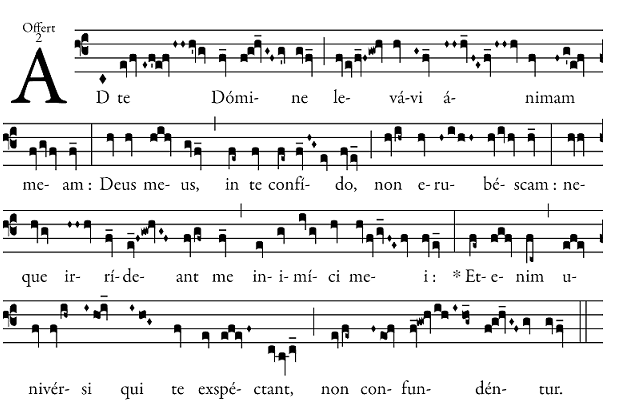
This is how I would make notation - virga always longa : quaver (~90-100bpm) - square punctum always breve: semiquaver ; diamond punctum, stropha (here with diamond punctum), liquescences, initio debilis (here with diamond punctum), upper auxiliary note on oriscus (here with diamond punctum), lower auxiliary note on quilisma (here with diamond punctum) and quilisma itself, always "grace notes before the beat": stealing time from previous note; some virgas with horizontal episema - nuance or duplex longa : from at least dotted quaver to crotchet duration. All grace notes always with legatissimo glissando/portamento (in strophas repercussive sound with "h" or Coup de glotte or some kind of tremolo trilo in the same melodic height) :
 Thanked by 1FSSPmusic
 -
There's an error in the "qui" in the image before.
 teste ad te levavi 2.png617 x 415 - 53KThanked by 1FSSPmusic
 -
In facebook I posted a video with myself trying to sing my transcription. https://www.facebook.com/lincoln.haashein/posts/pfbid08inATY1jucLpGaCpWc8jGAfULBToRsh9o9ywwpjkrgRZV4xZVHnfw1n3emAjqnurl
 teste ad te domine.pdf393KThanked by 1FSSPmusic
 -
Thank you for sharing these! I'll make two corrections to my edition: long at the sixth note of te, and shorts for the fourth and fifth notes of animam. L adds a t at the first spot, and the neumatic break may be significant there in E and the other St. Gall MSS, which could have written torculus+tristropha instead. I'm not sure about the initio debilis there, however. It avoids syncopation, but none of the MSS I checked use a special form at the beginning of the neume, nor do any omit the first note. Similarly at the last syllable of animam. At the second spot I mentioned, Ang writes an ordinary porrectus after the tristropha. Mp doesn't write an inverse quilisma there, as it does elsewhere in this chant (Domine, confido, irrideant, confundentur). I have reservations about the upper auxiliary at the last syllable of levavi. I would expect to find an episema or another long mark on the second note one MS or another if that were intended.
-
Actually, I need to give some more consideration to the first spot. A similar figure, DcdcdffFDfeC, occurs three times in the verses. I'm wondering if the fifth note should be long and the first 1.5.
-
In levavi I chose the clivis "initio debilis" as a tool to sing better the consonant "v" as a liquescence between the two vowels "a" and "i" and as a tool do make a cadence on the "d" of vi with a longer than longa. This makes more easy to sing the strophas that goes after (the "d" as "hinge" simultaneously ending the anterior melodic arc and as a source for the posterior arc) and in a choir with respiratory problems (or singing in slow and more solemn musical tempo) this would allow an emergerncial quick breath, and also highlights the tonic on "vá" and the entire word as a melodic arc. But it is a bit arbitrary.
-
In the case of initio debilis in the "cdcd" (te) neume and in the "decd" (mam), I saw the offertory verses and unless the three breves are sung as a tuplet I can't see how mantain the longa in the fourth note (episema in G376 in both "te" and "mam", "t" in laon and E in the first; in the verses of st. gall - at least according the offertoriale of Anton Stingl on gregor und taube - there is an episema in Deus, and in quoniam; in tota and the two similar four notes neums in "invocavi te" there is inconsistence and no episema - but here in "invocavi te" Laon puts "t").Thanked by 1FSSPmusic
-
The only more scientifical argument I could put to the "initio debilis" clivis on "vi" would be a treatment of srophas similar to quilismas stretching the note before the ornament, but this would require research in all chants of the repertoire and in medieval treatises seeing if the note before the strophas would be better rendered if lengthened.
-
It's a somewhat difficult case.

1 is literal, but retains syncopation. 2 ignores the long mark at the end of the torculus resupinus and disregards the neumatic break as insignificant/unexpressive. 3 interprets the first note of the torculus resupinus as initio debilis, without solid evidence from the MSS. 4. exceeds the 2:1 proportion, possibly supported by some of the MSS, but not others.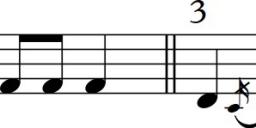 Ad te levavi example.jpg2125 x 149 - 65KThanked by 1Lincoln_Hein
 -
In the musical execution 3 and 4 tend to be very similar if the tempo (bpm) is relatively slow (it's common to extend the previous note d before the grace in 3, and in 4 to make a tethic accent on the middle d after c)
-
The option 2 puts tethic accent on "c" which is strange.
Welcome to the MusicaSacra Forum!
To participate in the discussions on Catholic church music, sign in or register as a forum member, The forum is a project of the Church Music Association of America.
Categories
- All Discussions21,096
- General Music Discussion8,211
- Job Openings197
- Management of Music Programs850
- Choral Matters532
- Church Documents and Rubrics524
- CMAA Notes301
- Events716
- For Newcomers: Read First26
- Sacred Polyphony546
- Hymnody872
- Gregorian Chant: General2,697
- ↳ Graduale Romanum and Liber Usualis368
- ↳ Graduale Simplex60
- ↳ Semiology63
- Vernacular Plainsong696
- Anglican Use and Anglican Chant68
- Organ, Other Instruments and Repertoire435
- New Composition/Works in Progress1,290
- Recordings230
- Music for Hispanic Ministry159
- Music Education: Children211
- Music Education: General222
- News Items245
- Positions Wanted2
- General Discussion: Catholicism739
- Amusements177
- General Discussion1,033
- Opinions117