
What is all the fuss about?
-
Thanks, that helps, sort of! Not sure that I see the connection withJan van Biezen's rhythmic discoveries now make Gregorian chant amazingly easy to singThanked by 1Andrew_Malton
-
With the steady tactus, it certainly doesn't require a conductor. You could put it in front of anyone who reads music and knows how to pronounce Latin and get respectable results.
-
So, does the written evidence for mensural rhythm, in the period when this music was sung this way, also provide evidence of the steady tactus? Or perhaps that's read into this music from Arabic or Byzantine performance practice?
(I am only an egg, I know nothing.) -
There have been others, particularly in the XIXth and early XXth centuries who proposed similar mensural methods for chant. There is very little difference, ultimately, between them. What is it that sets van Biezen's work apart? There may be a kernel of truth in what he and others have proposed, but it would seem that we can never know with any certitude how the very earliest cantors performed their chant (though we shouldn't stop studying how they might have done so). There must have been something of an improvisatorial and decorative element, a personal touch, in their performances, as there remains in middle eastern and Byzantine chant to this day. Eastern and Orthodox chant has never developed the pristine vocal tone that we Westerners cultivate today, nor the exactitude about pitch and 'note values', nor has the presence or absence of 'scooping' (which seems sloppy to me, but by some might be regarded as 'decorative' elements) bothered them at all. It remains that the languages and how they were spoken and sung with great familiarity, which will remain for ever a mystery to us, not to mention something so basic as how they 'felt' their chant, influenced immeasurably how the chant was performed. We can never know that, and trying to 'translate' such traditions into convenient modern sensitivities, note values, and grace notes can be but grasping at straws. One might add that there are today similar metrical renderings of Orthodox chant which have but the most tenuous likeness to how the Orthodox perform their chant. It may be that putting chant into a strict metricality could well result in a paint by number version of chant relative to how freely and familiarly it was sung by those who lived it.
This is not, of course, at all to denigrate Mad's or van Biezen's very impressive scholarship. We are definitely better off with it than without it, for it is genuine and well researched food for thought. It may be relevant to reflect that until very late in the classical era Latin was delivered with long and short syllables and had no 'accents' in the modern sense. This, no doubt, would have influenced early chant and would perhaps be relevant to Mad's theories. -
The latter. One of the earlier mensuralists surely would have noted it if the former were the case. Blackley writes of the "ordinarily binary nature" of chant but, following Vollaerts and Murray, admits short-long and long-short-long exceptions. (See https://www.scholaantiqua.net/pdfs/RhythmBeforeMid-Twelfth.pdf.)So, does the written evidence for mensural rhythm, in the period when this music was sung this way, also provide evidence of the steady tactus? Or perhaps that's read into this music from Arabic or Byzantine performance practice?
I would say it's his interpretation of ornamental notes. The summary in English (http://www.janvanbiezen.nl/gregorian.html) presents the substance of his theories.There is very little difference, ultimately, between them. What is it that sets van Biezen's work apart?
Is Van Biezen wrong when he claims that most semiology is about nuances and "nuances of nuances" rather than fundamentally long and short values? Since Cardine, musicologists for the most part seem to be unimpressed with mensuralism. In the other forum referred to above, it was mentioned that before Van Biezen, Blackley was one of the last to publish on mensuralism, but he self-published instead of submitting his work to peer-reviewed journals. That doesn't mean his research is invalid, but he limited his audience, and he's been mostly quiet for some years. Ricossa has put lots of mensuralist recordings on YouTube, but they're mostly of himself, made with a personal electronic device, with artificial reverb. Blackley's recordings from more than 30 years ago are still probably the best available in mensuralist style. To get an idea of how his interpretation differs from Van Biezen's, let's look at Blackley's edition of the Pentecost introit: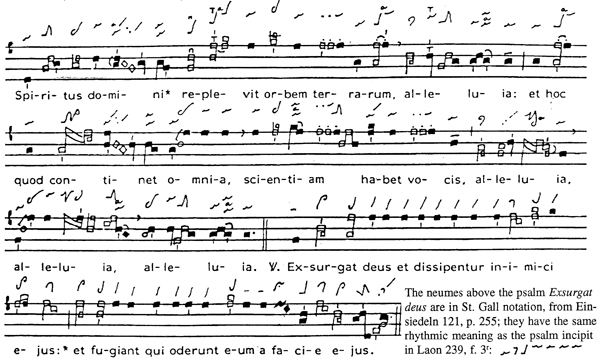
https://www.scholaantiqua.net/rjohnblackley.htm
And the Laon gradual itself: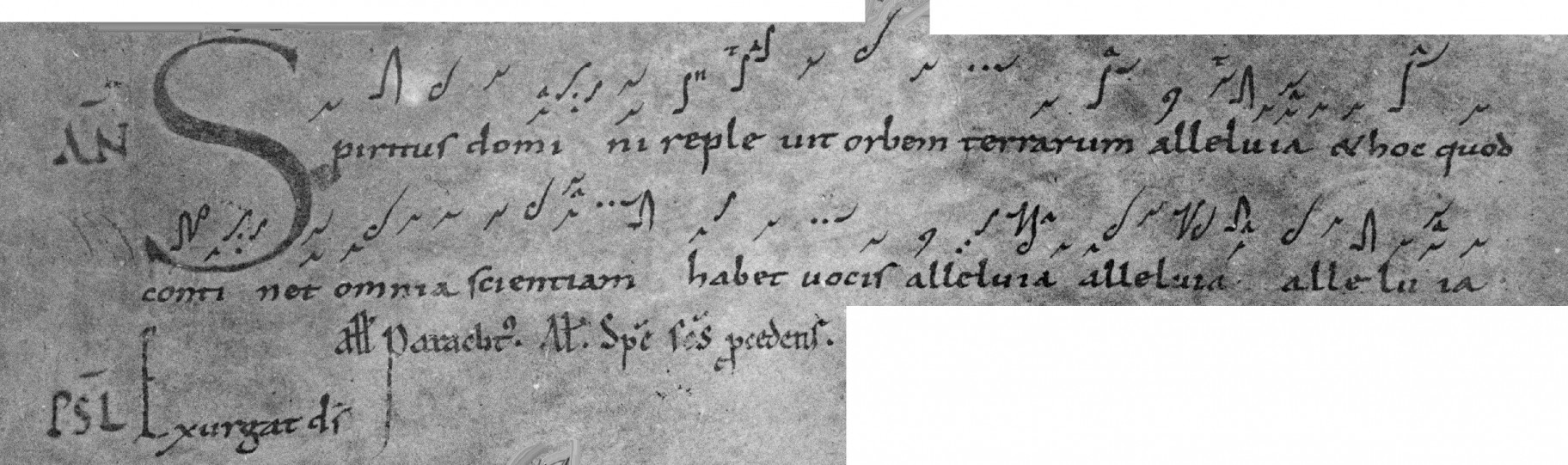
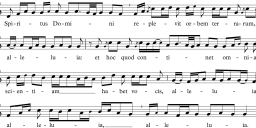
Already at the second word, we encounter a discrepancy in the hand-copied neumes. Although the a is written, there is no indication that the virga is different from the others, but in fact it's clearly elongated and nearly twice the size of the others in the source. This is exactly the same melodic figure as at facta in the Easter introit, which Van Biezen would interpret as a dotted note followed by a before-the-beat mordent. The same thing happens at continet. (The Graduale Novum is also imprecise about the long form the the Messine virga; compare for yourself.) Otherwise, the neumes appear to be accurate. I'm only concerned here about rhythm, not melody. What else would Van Biezen do differently? Look at the end of terrarum and the word hoc. Blackley seems to interpret the a as applying to the tractulus, which is already long. Others would write short-long-long, but Van Biezen would surely give an initio debilis interpretation to both. We should note that many semiologists would join him for terrarum, which has only a bivirga in E. Back up to replevit. At the second syllable, E gives a long virga+pes instead of double pes. The letters in L might suggest a pes initio debilis (long upper note) followed by a normal pes (long lower note in relation to the previous pes), and no comparison with E or other manuscripts would be needed to arrive at that conclusion. Van Biezen would give an initio debilis again at continet, probably also at the -lu of alleluia right after vocis, and possibly in the next alleluia as well. Could that explain E's use of c as the beginning of those neumes? Blackley misinterprets the epiphonus at omnia and the last two alleluias as short-long. L has another figure for that. The epiphonus is either a single long or two shorts, as he correctly interprets it at the end of Spiritus, at orbem, and at scientiam. (The liquescent s at the end of Spiritus is another can of worms. Does it suggest a voiced [z] sound? Space between the s and d? A "shadow vowel"? Or merely that the s sound has to finish before the beat?) At any rate, this chant is much more straightforward than the Easter introit.
It was not my intention to relate much (if anything) in the way of my own theories, only my understanding of what Jan van Biezen has published. -
madorganist - Thank you very much. A deep analysis of an example is just what my mind needs to appreciate a theory (or theorem, I am a mathematician not a musician).
-
I particularly liked the recording on youtube by Ricossa. Your example of Blackley's Pentecost introit is quite interesting, but for me a challenge to interpret. Where do the recorded offerings of speculative interpretations by Marcel Perez stand in your estimation?
-
Although I don't know him personally, Ricossa sparked my interest in mensuralism. I read commentary from him on some recordings wherein he posed a great question: How would a tenth-century scribe notate this performance? Since then, it's become obvious to me that many semiological interpretations fall short of making a clear distinction between the short (cursive) and long (non-cursive) values. Fr. Kelly (may he rest in peace!) is an excellent example. The scribe would have notated almost everything short. Same for "old Solesmes." I read with great interest Dirk van Kampen's article, but I ultimately found his position unconvincing. There are too many systems of neumes that write the normal syllabic value with a long note for us to assume it's normally short, and there are enough examples of the diminished value on a single-note neume (with agreement among various manuscripts) to say with certainly that long and short signs aren't used interchangeably.
Pérès focuses mainly on pre-Gregorian Latin chant. I find his recordings interesting but am not familiar enough with the repertory or notation to say anything valuable. I have read some criticism of his use of oblique organum/ison/drone, which apparently isn't documented before the 14th century. Vellard has also put out some very interesting recordings, but there's an awful lot in his interpretation that goes well beyond what's actually notated. -
Every time I see this thread title, I just hum "What is all the fuss about?" to the tune of "Where have all the flowers gone."
It's getting annoying.
Edit: the humming, I mean, and the earworm, not the thread. -
Relative to all this is a fascinating book by Peter Jeffery (Univ of Chicago Press), entitled Re-Envisioning Past Musical Cultures: Ethnomusicology in the Study of Gregorian Chant. There is much information and convincing arguments here which would be of interest to all who are students of early chant.
-
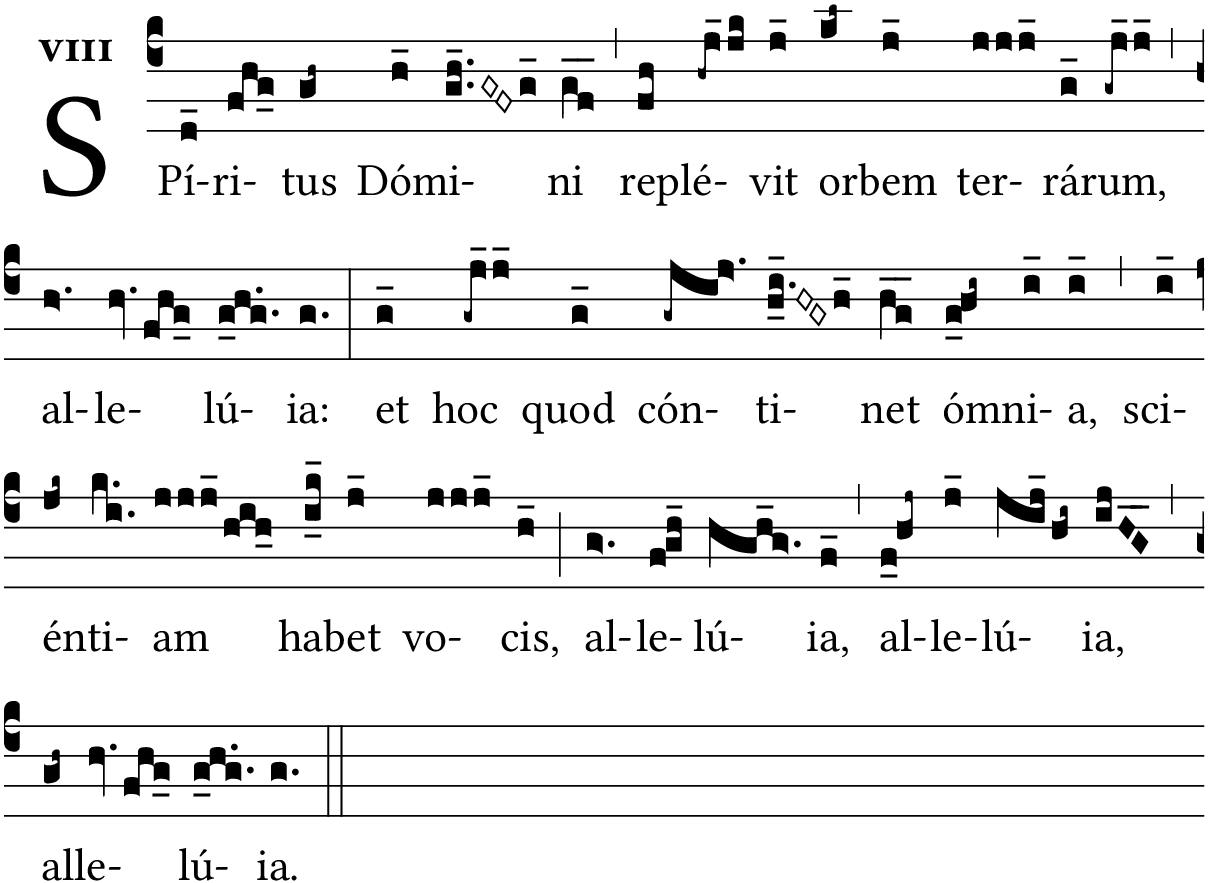
I corrected my previous post where I had written omnia instead of continet. I also failed to note the a at the alleluia after vocis. For clarity, here's a rhythmic edition based on the Graduale Novum:
And the same in modern notation:
I did these quickly and may have made errors. There are several discrepancies between L and E:
replevit (already noted above) - virga+pes instead of double pes
terrarum - liquescent at end of first syllable, bivirga instead of pes+tractulus
continet - first note is long in E
scientiam - last three notes are long in E
 Spiritus GN.png1208 x 883 - 31K
 Spiritus MN.png2233 x 1052 - 154K
 -
To Adam Wood:
there is such a thing as "Muslim Chant"?? I thought music was forbidden in the islamic service. -
A good question, Greg - I didn't know of any prohibition of music at Muslim worship. It would definitely seem, though, that the persons who call to prayer from minarets are speaking in a sort of cantilation, if not outright chant.Thanked by 1ServiamScores
-
There are many rich traditions of Muslim devotional and liturgical singing, particularly the recitation of the Koran. Misunderstandings simply depend on how one defines 'music'. Haven't most of us at one or another time heard from a chant-phobic backbeat-loving priest some variation of "There should't be any singing without music"?
-
I have an aunt who married into a muslim family years ago. I was at her house once and remarked at a beautiful manuscript of my uncle's on the wall. She told me that it was the "muslim equivalent of the 'Our Father' and its very beautiful when they sing it". I agree with MJO: calls to prayer are chanting, at least as far as I'm concerned. It is definitely different, but in a weird way, I suspect it is closer—at least in some respects—to what chant likely sounded like a thousand years ago. It's more related to other varieties of eastern music and likely derived from similar provenance to our own chant.Thanked by 1M. Jackson Osborn
-
I've found a streaming EF daily mass at the Church of St. Mary on Broadway in Providence, RI. The female cantor there has a beautiful voice and a compelling, original way of singing the chant from the Liber. I imagine not all who read this and listen will agree, but, well, I like it, and I guess that is as rational a criterion as any! I invite you to listen for yourselves. She only sings on Sundays and perhaps solemnities. I do not know her name and have not asked, which is logical in these difficult days.
https://youtu.be/Y1ylBa-FvoA
at time index 56:41, for one example. I believe it is the Offertory for the 14th Sunday after Pentecost. Would like to know what others think.
It seems from the quality of the sound that the schola is most likely in a loft at the rear of the church. There is only one camera.
Kevin -
Thanks for drawing our attention to this. She does have a beautiful voice and is singing the Offertory Immittet Angelus in the new Solesmes style. She does it very well.Thanked by 1CHGiffen
-
I find her chanting quite lovely.
-
Dr Ford, what are the aspects of her singing which make it right to say "new Solesmes style"?Thanked by 1CharlesW
-
It's alive!
Beautifully done! -
I missed the party! Shame on me for checking in once a year or so. I had no clue anyone was bothering to explore this topic so deeply. Thank you, madorganist, for stirring up a subject close to my heart!
There is WAY TOO MUCH to say on the subject of Jan Van Biezen's work. For future readers, I will post my responses to the posts from August 2020.
Please pardon the sequential posts I am about to make. I can't recall Musica Sacra's policy. -
About JvB's InterpretationJan van Biezen's rhythmic discoveries now make Gregorian chant amazingly easy to sing
I think I wrote that. Indeed it is amazingly easi-er to sing in many cases, as you fellows discovered in the fantastic examples you had posted. But it is far from a comprehensive interpretation.
Jan van Biezen's theory is not a methodology. While it can be put to use in scholas for many cases, do not be surprised if the Van Biezen interpretation breaks down, especially in bi- and tristrophic passages. (There is a solution to that, but it requires reworking the pitches, and I have not seen scholarship publish in English yet on how to do that properly.)"There is very little difference, ultimately, between them. What is it that sets van Biezen's work apart?" I would say it's his interpretation of ornamental notes.
More than that. In my opinion, his contribution is the intuitive analytical framework in which he starts, ever so briefly, to look past the neums to the underlying melos that the cantor intended. He never spells it out, but it's visible between the lines in his conclusions. I spoke with him in an email chain for several years before his death in 2021, and he clearly saw more than he wrote about.
The reason I hail it so highly is the 50-year roadblock in modern scholarship since Cardine (and before really). Chant scholars have to recognize that the prototypal neums are not prescriptive of how the chant should sound, but rather descriptive of how the cantor improvised the melody by heart from his experience of the oral tradition. Yes, it's not that simple, but it would force a breakthrough in chant studies if they would stop treating the neums as sacrosanct.there's no good way to notate those in square notes
Actually, we can capture the bulk of the Roman chant idiom, rhythmically read, with nothing more than solid and hollow square notes (for longs and shorts), diminutive notes (for neighboring and passing grace notes), and vertical lines (to tie notes together over a syllable). All other superfluous and decorative symbols can be trashed: virga tails, porrecti, quilismas, diamonds, pedes (plural of pes). I may post here one of these days with a sample or two of just how clear this hypothetical notational system can be.The liquescent s at the end of Spiritus is another can of worms. Does it suggest a voiced [z] sound? Space between the s and d? A "shadow vowel"? Or merely that the s sound has to finish before the beat?
Of your four options, the last three are legit. Try singing Spiritus Domini at 90 beats per minute, and sing "-tus" as just the G, not the pes with A, and pronounce the "s" in "-tus D-" about two thirds to three quarters the way through, and put an ever so slight ghost note between the "-s" and "D-", and you'll get a sense of liquescence after hard consonants.
Liquescence is really not a big deal. You have to feel Latin rhythm right. Very few professional choirs do, because they enunciate Italianate Latin like an incantation rather than a spoken language. In any case, under JvB's interpretation, it's irrelevant how you do the liquescence, because the rhythm is the same, and nobody will notice the resulting heterophony you just did by ignoring it.The most helpful site for comparative analysis is omnigreg.at.
Very cool! I myself have been waiting for a Responsoriale Synopticum to appear on Regensberg's website alongside their Graduale and Antiphonale. Some day ... Some year ... -
Weaknesses of JvB's interpretationI also saw in a French forum a Gregorian scholar saying that Van Biezen's researches answer all the objections that Cardine raised in relation to Vollaerts' mensuralism
I hope I wasn't the one that said that! On the whole yes, but not case by case. A few of Cardine's minute nitpicks (excluding his ad hominem) concerned cases that Van Biezen's interpretation only allows options for. One has to derive the solutions after the rhythmic interpretation, using formulaic analysis, and that is not always easy to do.Compare the three for each source to get an idea of the inconsistency of the scribes.
Kenneth Levy has a theory (Gregorian Chant and the Carolingians, 1998) that the neumatic discrepancies --- which, notice, are mostly rhythmic and syntactic, hardly ever affecting the shape of the melodic contour --- are due to typical Early Medieval human error combined with deliberate dialectic derivations into more rhythmically/syntactically precise neum forms from what was earlier a less rhythmically/syntactically precise massively distributed archetype that Charlemagne produced around the 790s or 8-naughts, itself based on one or more 'prototypes' of Paleo-Frankish notation from the decades before. The discrepancies in many cases would indicate details that were not there in the archetype.
Emma Hornby at Bristol, who discovered the formulaic comosition rules of the Tracts, put out a counterargument to Levy's theory some years back, that I have yet to read. Still, Levy's data is pretty thoroughly convincing to anyone who recognizes the sheer impossibility of the observed melodic consistency in the 10th-century neum manuscripts without an 8th-century ancestral source. -
The mods are gonna kill me for not shutting up....
Other InterpretationsWhere do the recorded offerings of speculative interpretations by Marcel Perez stand in your estimation?
Outstanding for inspiration, unreliable for accuracy. Ensemble Organum captures the right spirit of Christian monody far better than almost every non-Orthodox choir out there, by bringing back the masculinity to Latin chant, though at times it forfeits the round clearness of the vocal style in favor of non-Western vocal styles.
Peres's rhythmic interpretations are almost nothing but speculative. He sort of admitted it in the album booklet on his famous Old Roman chant album in the 1980s, but many of his later albums in the 2000s and 2010s try to skirt admitting that his interpretation, while growing and shifting, is rhythmically about as inauthentic as Cardine's. "Da Pacem" on the Knights Templar album is the closest thing on YouTube that you'll hear from Ensemble Organum to a true mensurated Gregorian Antiphon, and it's still quite a ways from accuracy.
Lucca Ricossa's interpretation in his YouTube videos is based partly on Jan Van Biezen, partly on his own winging it, but his singing lacks rhythmic tightness, meaning half the time you can't even hear the rhythm.I have read some criticism of his use of oblique organum/ison/drone, which apparently isn't documented before the 14th century.
If you're right (I seem to recall reading it was the 15th), that is the Byzantine ison. But oblique organum dates back to the post-Carolingian/Ottonian period, and drones are said to be the norm in Hildegard's music. I can't say much more on details (haven't studied it thoroughly), but both of those facts would prove there is precedent to sing ison on Gregorian chant, since it is just a variant of the same technique as both droning and oblique organum.
Historically speaking, however, Late Roman ("Old Roman") chant has mode-shifts more often than any ison cantor would be comfortable with, so it's unlikely ison was sung in 11th-century Rome as Ensemble Organum presents it.
Not that it's a bad thing to do so. I am all in favor of ison in Gregorian chant, but developing a consistent ison theory that will fit all the modes, genres, and chant styles of Gregorian chant, as well as both the Roman and Gallican idioms found in it, is quite challenging.Blackley was one of the last to publish on mensuralism.
R John Blackley's e-book makes the egregious mistake of interpreting Vollaerts as a nigh-end-all method rather than an incomplete body of evidence. It would be a grave mistake to do the same with Jan van Biezen or with any other chant scholar really.
-
Last post.
What comes next after Jan van Biezen's interpretationThere may be a kernel of truth in what he and others have proposed, but it would seem that we can never know with any certitude how the very earliest cantors performed their chant ... not to mention something so basic as how they 'felt' their chant, influenced immeasurably how the chant was performed.
Keyword: It would seem.
This is extremely new research, but the psycho-cognitive framework of musical motion, that moved the Roman cantor in improvising by heart and composing from only a text, is derivable from the structural skeleton of the melody.
It can be parsed by comparing the standard ("Gregorian") and Late Roman ("Old Roman") versions of the Graduals, Tracts, Responsories, and (to a lesser degree) Mass Antiphons (Introits/Communions). I believe 100% that the 'feeling' component of the oral tradition responsible for both Gregorian and Late Roman chant is completely reconstructable by tapping into this framework.
Jan van Biezen's interpretation, while not perfect, basically sheds light on the ground layer of that cognitive framework, namely the feeling of the rhythmic pulse. There are three other layers on top of that to discover before the code is cracked, which concern motivical mechanics, formulaic development, and compositional planing.
If we can crack the code of that framework, we hypothetically have a means of subjecting own hearts to the 'organic' aspect of the first-millennium Roman orality, thus enabling us effectively to resurrect the more important half of the oral tradition, which is its vitality, i.e., the ability to learn and sing 50 to 100 hours of Gregorian chant material by heart, even without paper.
The whole field of Latin chant studies will have to undergo two breakthroughs in progress before they reach this point. First, the musicologists would have to abandon semiology and revisit the neums, using JvB as their starting point, and synthesizing it with the stellar analytical techniques they've developed since the 1980s in their examinations of Latin orality. They would then look past the rhythmically interpreted neums to the true melos, catalogging and explicating the patterns of errors, and reverse-engineering the correct motives behind them, and how they evolved. Finally, they would have the means of scoping the motivic, formulaic, and compositional rationale of each melos, thus 'completing' Gregorian chant, and leaving it to the next 100 years of scholars to reexamine every open problem in light of what was found.
The lessons learned from such a massive, probably half-century-long project would revolutionize the whole field of ecclesiastical, even to the point of deciphering the Mozarabic chant, and resolving the problems of Znamenny rhythm.
Our musicians are parched thirsty for this splendor, but unfortunately musicological progress seem to be stagnating, and the musicologists haven't exactly synthesized their methods. Theories come and go, even the most profound ones, and they pay homage by devoting books to each other, but no one is bold enough to carry any particular proposal to its extreme logical conclusion. By and large, they opt instead for incremental progress, posting articles on Academia.edu and other places whenever they have a thought, but then leaving the topic alone after that.
I may post some conversation starters on this subject over on Musicologie Medievale to get them thinking, and see where it goes.
Anyway, I admit this subject is entirely too complicated to wax on eloquently about in a forum like this.
But, oh, the results! One of these years, we will look back and never again want to bother with unmensurated chant. If we take the science that far, we will glance back at what we have labeled "plainchant" for almost 800 years now, and be utterly baffled at how much sublimity it was missing in hindsight, when we finally restore it.
Jan van Biezen is only the beginning, folks. Don't treat it as perfect. Perfect is yet to come. -
@Coemgen An online edition of the Sunday Mass Propers in Gregorian notation according to the interpretation of the late JvB appears to be a mere seven weeks from completion:
https://www.cantatorium.com/proper
I'm sure the editor would appreciate hearing from you! -
madorganist, I looked through some of the examples of the cantatorium link you shared. I have to say, as someone who is unfamiliar with this method, I shudder to think of having to sing from those scores. They are so cluttered with markings one might as well try and sing from the triplex.
-
.
-
@Andrew_Malton
1. https://www.youtube.com/playlist?list=PLhIyPvt-f6OH-NrVt_emQXAowbu7yL3E0
and 2. https://www.youtube.com/playlist?list=OLAK5uy_mHA26lIJukaxbCVs18qScVffrac_vyu_8
are ensemble recordings. 3. https://www.youtube.com/user/CantorRomanus/videos Ricossa's are one man singing into a digital recording device, as are 4. https://www.youtube.com/channel/UCM1uEmpb9_JgPJhOPqDwctw/videos. I believe most of the double-long ("4") values are purely editorial. The Cantatorium site has Van Biezen's examples in Gregorian notation: https://www.cantatorium.com/vanbiezen, and you can compare his modern notation transcription in the Dutch article: http://www.janvanbiezen.nl/gregoriaans.pdf -
Serviam,
Try reading from black-and-white photocopies of the Triplex! -
Honestly, with gregobase, there's really little need (apart from highly-skilled singing directly from the triplex) for terrible copies anymore. It's so easy to print off pristine PDFs these days. I guess a lot of directors just don't know about gregobase.
-
and yet......
-
In the youtube there is singing examples of the The Cantatorium site (https://www.cantatorium.com/) with proportional values. https://youtu.be/2HMVpGR2ISI
https://youtu.be/7BZJ4zzJplk
Thanked by 1FSSPmusic -
Serviam, the vowel alignment is sometimes less than ideal, and you really do need to know how to work Gregorio and LaTeX (even just to clean up the scores) in order to integrate them into a book(-let) even if you do the rest in your program of choice, like InDesign. You can add nabc to add the Saint-Gall neumes, so you don't even need the GT if you're that invested, but I think that the flaws of Gregorio/LaTeX are real and shouldn't be discounted; plus they have not yet been able to code for multiple lines of lyrics, which means you need a book for litanies (the hack on the site is really advanced and complicated, at best). Now, I guess that fits into the "little need" category, but still, and it requires a real knowledge of the rubrics to sing from the PDFs if you don't also transcribe the rubrics; it's helpful to have them for the bigger ceremonies which, alas, are also the ones for which I don't want the Liber Usualis to be my main book in hand…
I'd also say that I'm really opposed to anything less permanent than stapling (like binders) so you've got to be committed to proofreading and to at least stapling what you copy, if not paying for spiral-bound books. It looks tacky. -
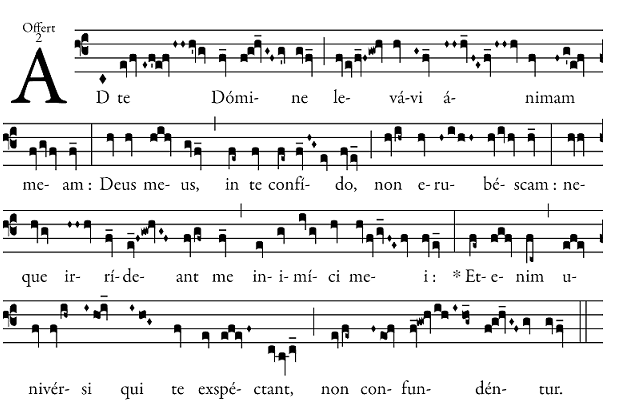
This is how I would make notation - virga always longa : quaver (~90-100bpm) - square punctum always breve: semiquaver ; diamond punctum, stropha (here with diamond punctum), liquescences, initio debilis (here with diamond punctum), upper auxiliary note on oriscus (here with diamond punctum), lower auxiliary note on quilisma (here with diamond punctum) and quilisma itself, always "grace notes before the beat": stealing time from previous note; some virgas with horizontal episema - nuance or duplex longa : from at least dotted quaver to crotchet duration. All grace notes always with legatissimo glissando/portamento (in strophas repercussive sound with "h" or Coup de glotte or some kind of tremolo trilo in the same melodic height) :
 Thanked by 1FSSPmusic
 -
There's an error in the "qui" in the image before.
 teste ad te levavi 2.png617 x 415 - 53KThanked by 1FSSPmusic
 -
In facebook I posted a video with myself trying to sing my transcription. https://www.facebook.com/lincoln.haashein/posts/pfbid08inATY1jucLpGaCpWc8jGAfULBToRsh9o9ywwpjkrgRZV4xZVHnfw1n3emAjqnurl
 teste ad te domine.pdf393KThanked by 1FSSPmusic
 -
Thank you for sharing these! I'll make two corrections to my edition: long at the sixth note of te, and shorts for the fourth and fifth notes of animam. L adds a t at the first spot, and the neumatic break may be significant there in E and the other St. Gall MSS, which could have written torculus+tristropha instead. I'm not sure about the initio debilis there, however. It avoids syncopation, but none of the MSS I checked use a special form at the beginning of the neume, nor do any omit the first note. Similarly at the last syllable of animam. At the second spot I mentioned, Ang writes an ordinary porrectus after the tristropha. Mp doesn't write an inverse quilisma there, as it does elsewhere in this chant (Domine, confido, irrideant, confundentur). I have reservations about the upper auxiliary at the last syllable of levavi. I would expect to find an episema or another long mark on the second note one MS or another if that were intended.
-
Actually, I need to give some more consideration to the first spot. A similar figure, DcdcdffFDfeC, occurs three times in the verses. I'm wondering if the fifth note should be long and the first 1.5.
-
In levavi I chose the clivis "initio debilis" as a tool to sing better the consonant "v" as a liquescence between the two vowels "a" and "i" and as a tool do make a cadence on the "d" of vi with a longer than longa. This makes more easy to sing the strophas that goes after (the "d" as "hinge" simultaneously ending the anterior melodic arc and as a source for the posterior arc) and in a choir with respiratory problems (or singing in slow and more solemn musical tempo) this would allow an emergerncial quick breath, and also highlights the tonic on "vá" and the entire word as a melodic arc. But it is a bit arbitrary.
-
In the case of initio debilis in the "cdcd" (te) neume and in the "decd" (mam), I saw the offertory verses and unless the three breves are sung as a tuplet I can't see how mantain the longa in the fourth note (episema in G376 in both "te" and "mam", "t" in laon and E in the first; in the verses of st. gall - at least according the offertoriale of Anton Stingl on gregor und taube - there is an episema in Deus, and in quoniam; in tota and the two similar four notes neums in "invocavi te" there is inconsistence and no episema - but here in "invocavi te" Laon puts "t").Thanked by 1FSSPmusic
-
The only more scientifical argument I could put to the "initio debilis" clivis on "vi" would be a treatment of srophas similar to quilismas stretching the note before the ornament, but this would require research in all chants of the repertoire and in medieval treatises seeing if the note before the strophas would be better rendered if lengthened.
-
It's a somewhat difficult case.

1 is literal, but retains syncopation. 2 ignores the long mark at the end of the torculus resupinus and disregards the neumatic break as insignificant/unexpressive. 3 interprets the first note of the torculus resupinus as initio debilis, without solid evidence from the MSS. 4. exceeds the 2:1 proportion, possibly supported by some of the MSS, but not others.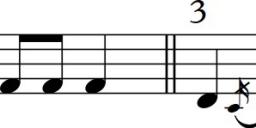 Ad te levavi example.jpg2125 x 149 - 65KThanked by 1Lincoln_Hein
 -
In the musical execution 3 and 4 tend to be very similar if the tempo (bpm) is relatively slow (it's common to extend the previous note d before the grace in 3, and in 4 to make a tethic accent on the middle d after c)
-
The option 2 puts tethic accent on "c" which is strange.


Welcome to the MusicaSacra Forum!
To participate in the discussions on Catholic church music, sign in or register as a forum member, The forum is a project of the Church Music Association of America.
Categories
- All Discussions21,107
- General Music Discussion8,218
- Job Openings197
- Management of Music Programs850
- Choral Matters533
- Church Documents and Rubrics524
- CMAA Notes302
- Events716
- For Newcomers: Read First26
- Sacred Polyphony546
- Hymnody872
- Gregorian Chant: General2,697
- ↳ Graduale Romanum and Liber Usualis368
- ↳ Graduale Simplex60
- ↳ Semiology63
- Vernacular Plainsong696
- Anglican Use and Anglican Chant68
- Organ, Other Instruments and Repertoire435
- New Composition/Works in Progress1,291
- Recordings231
- Music for Hispanic Ministry159
- Music Education: Children211
- Music Education: General222
- News Items245
- Positions Wanted2
- General Discussion: Catholicism739
- Amusements177
- General Discussion1,033
- Opinions117