
Liquescent Neumes
-
I have always wondered what to do whenever there is a liquescent nueme on a t or d vowel. I know that it is "Hosa-n-na filio David" and "Allelu-j-a", but I have always been stumped whenever it is "et Deus" and the "et" has a liquescent on it. I currently have found 3 options, let me know if one is right or if it is something else completely:
1. Don't do anything and just sing it as a normal note. (what I hear most commonly)
2. Sing the consonant with a glottal stop and a clearly aspirated 't' like "ɛʔtʰ ˈde.ʊs" . (What I do)
3. Have a ghost vowel like "et-ə" or "et-ɛ". (done by this guy: https://www.youtube.com/watch?v=yt9PKLNllMA&t=559s)
Let me know what is "correct," though I know there might be a ton of nuance for this. -
I do try to pay attention to double consonants like in Hosanna, but you can really overdo it, not only such that it might not be the most pleasing consonant but that it cuts off airflow to the detriment of the phrase; the same is true with -ll like in the Easter introit's Alleluias, and we don't do anything special for the vowel (so we never do five syllables IOW).
I really think that just pronouncing the consonant is important. What happens to the sound is a bit dependent on language, but it tends to disappear in American English, never mind get transformed…
Oh, Bruno de Labriolle…sigh. I really don't think that he musters sufficient evidence for his practice. however in "et Deus" I am pretty sure that it's /ə/ inserted between two consonants because that happens in French: "Arc de Triomphe" can be realized as /aʁ.kə.d(ə).tʁi.jɔ̃f/ (on second thought the second schwa would be deleted by speakers that add the first due to the rule of three consonants but oh well)
I would not suggest that people copy it. -
If you listen to his whole rendition he adds the "ghost vowel" in several places, the "et" being the only indicated liquescent among them.
I suspect this is partly a French singing practice/habit. Here he applies it in ways that afaik French people usually wouldn't when singing in French ("super-ə"), but I'd suggest this practice is, among Francophones, just in the water.
I notice he also - and not only in this recording - merely gestures ornamentally at some neumes without clearly landing on them, and occasionally outright skips complexes according to some logic of his own. Not all that troublesome, but it doesn't scream "I'm paying close and scholarly attention to the notation."
This style actually strives to not fixate on the notation, so I'd further suggest that, whether or not anyone wants to copy or be inspired by it, it's the wrong place to look for "strict" and "accurate" interpretations of neumes, because he simply doesn't care much about all that, at least not in the more usual way. It's beautiful music though.
On the larger question, with a liquescent on "et" I wouldn't do anything in particular. With liquescents on voiced consonants, in contrast, I tend to give fairly generous space, strength and expression to the consonant. I'm pro-consonant in general: they launch and land the vowel sounds and have a lot of character in their own right. I don't think of them as second-class citizens of the sound world, and I don't personally go in for really light and delicate treatment of them especially in chant.Thanked by 1ian_udell -
Some peoples’ “scholarship” is “I just do whatever I think sounds good” rather than singing based on hard evidence of a treatise or manuscript.Thanked by 1MatthewRoth
-
This might deserve its own thread, but I do not think that the approach by the "École Grégorien" can be nonchalantly dismissed. Obviously it is heavily inspired by Ensemble organum (Marcel Pérès), which is based an a lot of research. Apart from the much more solemn tempi, the most obvious difference is in the realm of oral tradition that was never written down: portamento and ornamentation. Portamento (gliding into a tone from below) was so ubiquituous until the first half of the twentieth century that it was not even mentioned back then. It is only noticable retrospectively, because it makes old recordings so much different from modern recordings. Somehow it came out of fashion and is today considered bad teste (I must admit, though, that I like it when applied as an ornament to stress certain notes and I feel that we are today deprived of an important means of musical expression): Even Marcel Pérès stops short from it.Thanked by 1Chant_Supremacist
-
I don't think it should be dismissed either, if only because it's good music. Personally I would shy away from speculatively attributing historical accuracy to that style, because even its own proponents don't really do that. Sure, a complex argument can be made that this is a better model than Solesmes of how it may have sounded in some times and places. But I think they'd prefer to argue on different grounds, e.g.: what exactly is so bad about doing what you think sounds good if your output is extremely well-executed and reasonably faithful-to-the-source liturgical chant?Thanked by 1Xopheros
-
In his chant method (1919) Dom Lucien David, an advocate of the Pothier approach (Old Solesmes) favors the shadow vowel (option 3). I think this practice could help with the projection of the words in a very resonant acoustic.
-
I like Bruno de Labriolle's singing very much, and I have always enjoyed listening to his group. The thing I am most skeptical of (as a practical matter for parish musicians, say) is the tempo, which just feels too slow most of the time.
One nice aspect of a lot of the other ways of chanting is that the tempo is not wildly different from the pace of speech. That is, the pace of the notes as they go is somehow analogous to the pace of the syllables of recited Latin. This is the foundation of Pothier, Cardine, Mocquereau etc. to varying degrees. -
"Stop-stop" liquescences (t–d, b–d, etc.) and portamentos are neither confined to French nor to Gregorian chant. They are used also in folk songs for articulation or expressive purposes, also in some forms of vernacular psalmody-like chant. That such liquescences find their way into the chant manuscripts may just mean that they were sung that way. In some late-medieval manuscripts there are even liquescences on consonants followed by a vowel, e.g. bonum est in the offertory of Septuagesima. Of course, copyist's mistakes cannot be excluded.
-
I have my thoughts on Bruno de Labriolle but the m followed by vowel is obviously a case of nasalization that they recognized (it is an early phenomenon) that can’t be allowed to totally lose the consonant as it would be in say French.
Nevertheless I think that we can safely say that liquescents are for pronunciation. Anything else starts to veer dangerously into vibes. -
For people of both proponents (more consonant sound/ghost vowel), how would one sing the "exercebor" of the communio "Confundantur superbi" (p. 529 GR 1974)?
On one hand you can only do so much for flipped r to make it sound. On the other hand, adding a ghost vowel sounds awkward and limits the comprehension of the word (exer-e-cebor).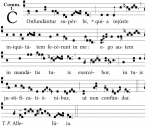 530 x 458 - 35K
 -
My general rule with choirs it to try to roll the r for half the length of the note. It usually works out okay to my ear.Thanked by 1ian_udell
Welcome to the MusicaSacra Forum!
To participate in the discussions on Catholic church music, sign in or register as a forum member, The forum is a project of the Church Music Association of America.
Categories
- All Discussions21,830
- General Music Discussion8,542
- Job Openings292
- Management of Music Programs862
- Choral Matters539
- Church Documents and Rubrics540
- CMAA Notes307
- Events758
- For Newcomers: Read First26
- Sacred Polyphony566
- Hymnody897
- Gregorian Chant: General2,749
- ↳ Graduale Romanum and Liber Usualis372
- ↳ Graduale Simplex61
- ↳ Semiology65
- Vernacular Plainsong704
- Anglican Use and Anglican Chant73
- Organ, Other Instruments and Repertoire451
- New Composition/Works in Progress1,340
- Recordings238
- Music for Hispanic Ministry163
- Music Education: Children217
- Music Education: General223
- News Items246
- Positions Wanted3
- General Discussion: Catholicism742
- Amusements185
- General Discussion1,048
- Opinions119