
Adding musica ficta (Lassus Magnificat Margot labourez les vignes)
-
We are adapting what we presently do for Vespers ad hoc and extending it to fixed dates on the choir year: major feasts of Our Lord and Our Lady (with some exceptions) will have the choir. So I am looking both for relatively easy Magnificats and to stretch us (and have something for future years).
This one from the 1619 collection of 100 Magnificats caught my eye for Christ the King; as it is, the CPDL edition needs chant verses.
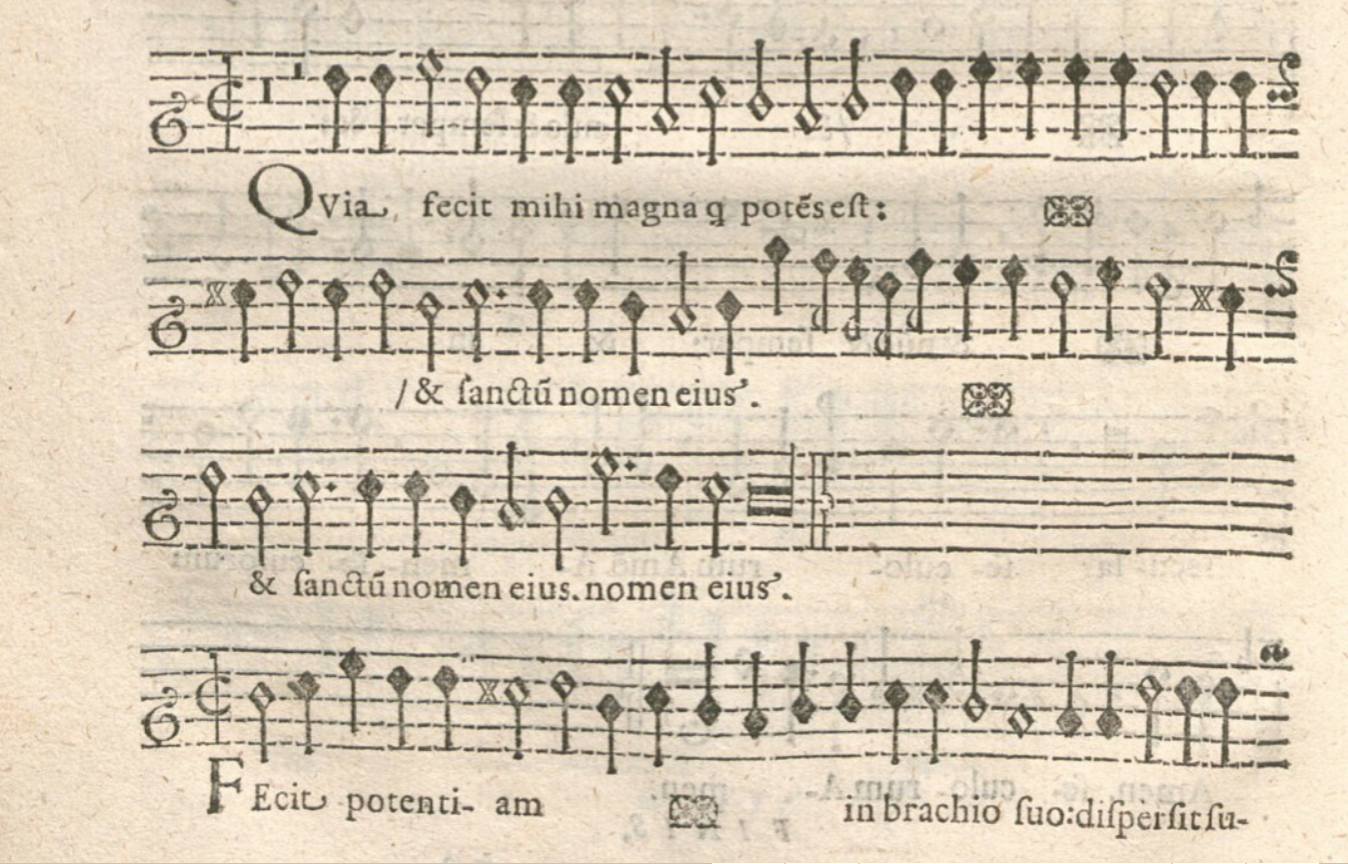
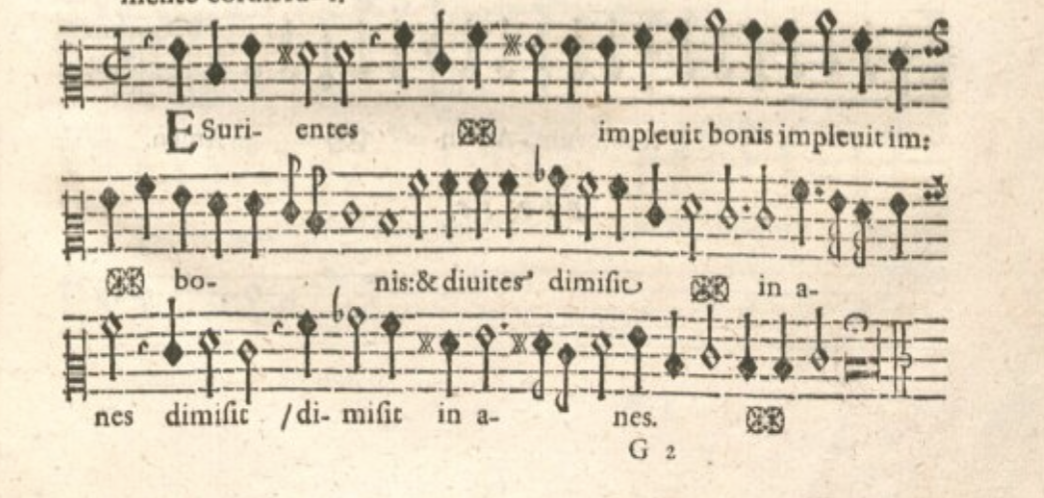
But I have a question about the placement of ficta: The Lassus family (either Orlando himself or his son) sometimes explicitly notates them again when returning to the note right away (this was not followed by the CPDL editor…), sometimes he doesn't. I know the general idea wherein musica ficta are sung for the sake of beauty and for the sake of necessity; I am, however, not very sure that I could judge adding them when not in the source (I tend to leave editorial ficta alone); the question is are we to understand the note as being raised again? My confusion stems from the variation: since this is a 1619 edition of work from 30 years before, one wonders why some are notated again, others are not; a very enterprising choir director (not for a church even!) has some very good ideas about presenting Renaissance music (I prefer original note values, but that's OK, I can't have it all), and one of those is explicitly notating every change since the rule about accidentals per measure can't apply when you don't have bars!
Also, I can only presume that the symbol means "repeat" because the existing edition in front of me took that approach, but it would not have occurred to me that this is intended instead of ij. I've included some images of the source which is available here; since the parts in isolation are somewhat useless, the Magnificat starts on p. 56, 320, 588, and 818 (one digital page count, with the 4 part books).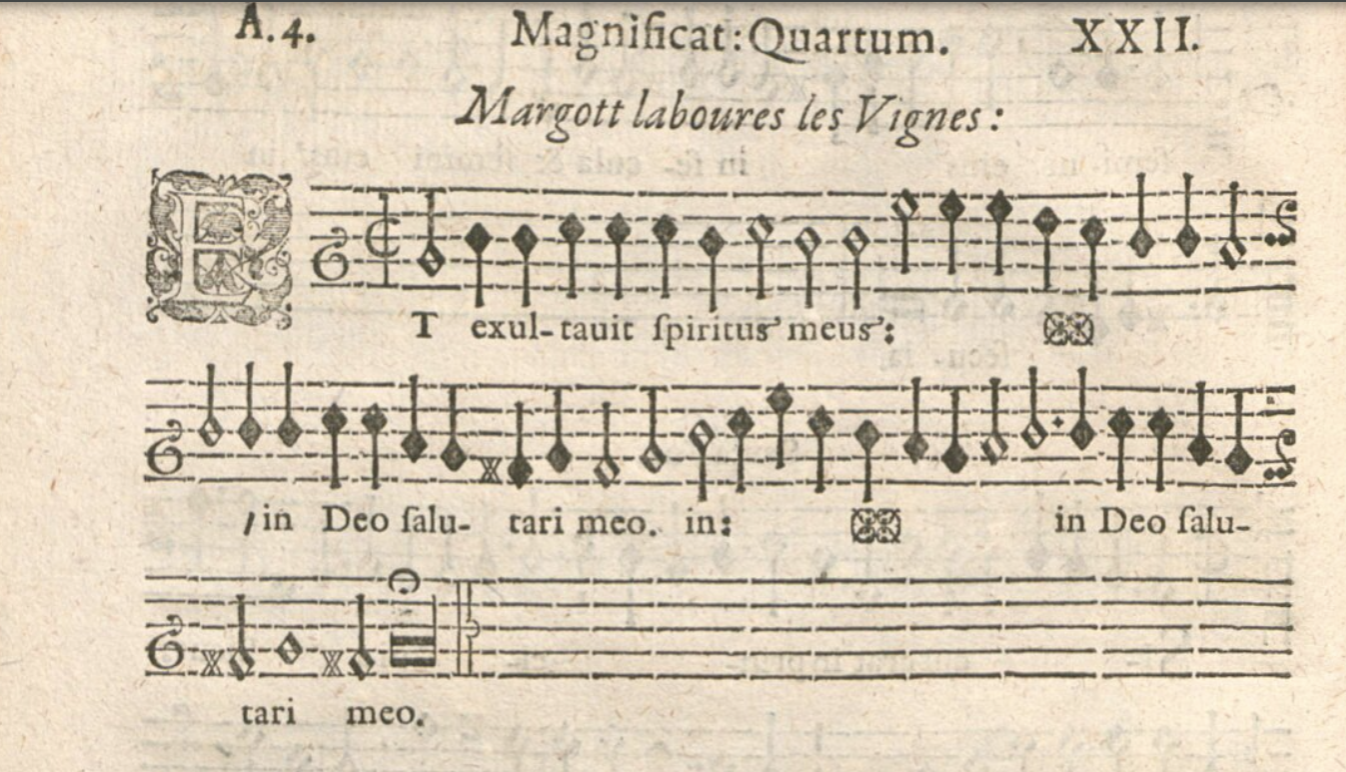
 1346 x 772 - 2M
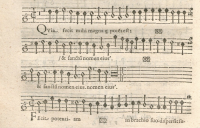 1348 x 864 - 2M
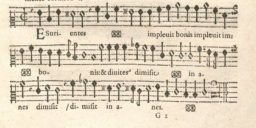 1044 x 498 - 818K
 -
Matthew, I think your ficta question has to be answered on a case-by-case basis. It's hard to make any hard and fast rule, especially not without just singing through the whole book. For instance, looking at this in isolation, in Et exultavit, I would the f-sharp in the second line to apply to the minim as well, since it is a phrase ending (you can practically predict what the other three voices are singing). In Quia fecit, second line, I would first assume that the cc-sharp applies to both semiminims but not to the minim on "sanctum." Then I would adjust accordingly if, after entering all the parts, my first guess seems wrong. In Esurientes, this is all spelled out more explicitly. The lack of perfect consistency is just part of the package.
Yes, I would agree that those must be text-repetition signs. The text setting is very syllabic, so it would be really strange to have these trailing melismas.
So many aspects of mensural notation are sui generis and unique to each publication. I do think a certain amount of editorial ficta notating is useful for singers, unless you have a group well versed in the rules. My parish schola can often adjust on the fly in an edition lacking cadential-beauty ficta, sometimes with a signal from me. On the other hand, marking it makes a good result more likely! -
It's hard to make any hard and fast rule, especially not without just singing through the whole book
That's what I was wondering, and it's helpful to know that entering it and changing the part is also just something that we can do.The lack of perfect consistency is just part of the package.
it's a fun little challenge, although I think that if I was doing this from scratch and not working from existing editions, I'd bump my head against something; realizing that the longa (with or without the fermata) may need to be turned into a semibreve tied to the final explicit note
To your point about editorial ficta: this edition has them in only one spot, which is what I'd call sparing. (Not to beat up on the editor: I find his editions useful and well-made overall).
By the way, if anyone has a decent reading list on performance practice (mensuration, ficta, and diminutions all being things that caught my attention when watching Early Music Sources again), I'll take suggestions… -
Thanks to an Urtext clause in German copyright law, IMSLP has the edition of the Neue Reihe sämptlicher Werke, with alternatim chants. It tacitly re-expresses the "exaltavit" sharp, either in deference to the chanson model or maybe another source (the preface & critical commentary being copyright).
-
There’s always so much out there. Thanks!

Welcome to the MusicaSacra Forum!
To participate in the discussions on Catholic church music, sign in or register as a forum member, The forum is a project of the Church Music Association of America.
Categories
- All Discussions21,848
- General Music Discussion8,550
- Job Openings293
- Management of Music Programs862
- Choral Matters539
- Church Documents and Rubrics540
- CMAA Notes307
- Events761
- For Newcomers: Read First26
- Sacred Polyphony567
- Hymnody898
- Gregorian Chant: General2,749
- ↳ Graduale Romanum and Liber Usualis372
- ↳ Graduale Simplex61
- ↳ Semiology65
- Vernacular Plainsong704
- Anglican Use and Anglican Chant73
- Organ, Other Instruments and Repertoire452
- New Composition/Works in Progress1,342
- Recordings238
- Music for Hispanic Ministry163
- Music Education: Children217
- Music Education: General223
- News Items247
- Positions Wanted3
- General Discussion: Catholicism742
- Amusements185
- General Discussion1,048
- Opinions119